"Love follows knowledge."
"Beauty above all beauty!"
– St. Catherine of Siena

Showing posts with label Trinity. Show all posts

Sunday, June 15, 2025

Sunday Meditation: The Mystery of God’s Being

We closed the Easter season with the coming of the Holy Spirit on Pentecost Sunday, and we return to Ordinary Time with the Solemnity of the Most Holy Trinity.  How fitting.  We have known the Father; we have met the Son; we have received the Holy Spirit.  Now we put them all together to understand—or at least intuit—the mystery of God’s being.  For the reading in Year C, we hear Jesus words at the Farewell Discourse from the Gospel of John on how the Holy Spirit will lead the apostles.


Jesus said to his disciples:

"I have much more to tell you, but you cannot bear it now.

But when he comes, the Spirit of truth,

he will guide you to all truth.

He will not speak on his own,

but he will speak what he hears,

and will declare to you the things that are coming.

He will glorify me,

because he will take from what is mine and declare it to you.

Everything that the Father has is mine;

for this reason I told you that he will take from what is mine

and declare it to you."

   ~Jn 16:12-15


Instead of a homily today to explain the Trinity, I want to present an episode (“The Persons of the Trinity”) from Aquinas 101, the Dominican Friar set of lectures on the Catholic faith as explained by St. Thomas Aquinas.  Here Fr. Dominic Legge O.P. explains the Trinity as the “mystery of God in Himself.”


Contemplating the Trinity, as Fr. Dominic explains quoting St. Thomas, “elevates our spirits so that our minds get some glimpse of the highest truth.”  So I hope you sit back with the Trinity today and absorb the concept with joy.


For the pastoral homily, I return to Fr. Peter Hahn.


Fr. Hahn quotes Pope Francis: “The word mercy reveals the very mystery of the most Holy Trinity.  Seeing the Father who only wants to forgive his wayward children, the Son in the His ultimate and supreme act of His love on the cross which offers to us the forgiveness of our sins, and the Holy Spirit dwelling in the heart of every person looks sincerely into the eyes of his brothers and sisters on their shared path of life.”


Sunday Meditation: “When he comes, the Spirit of truth, he will guide you to all truth.”


How about this Catholic classic for today’s hymn, which I bet you sung at Mass today, “Holy, Holy, Holy.”


Holy, holy, holy! Lord God Almighty!

Early in the morning our song shall rise to thee.

Holy, holy, holy! merciful and mighty!

God in three Persons, blessed Trinity!


Have a blessed Sunday with the Trinity and Happy Father’s Day.


Sunday, May 26, 2024

Sunday Meditation: The Solemnity of the Most Holy Trinity

The Easter season has ended and we are back into Ordinary Time.  [As an aside, Ordinary Time does not mean it is ordinary, but that it is numbered, as in ordinal numbers.  There is an ordinal number associated with each week.]  Technically I think we are in the eighth week of Ordinary Time, but the week after Pentecost is fixed for the Solemnity of the Most Holy Trinity.  The Gospel reading is quite short.  It’s the first mentioning of the Trinity in scripture.


The eleven disciples went to Galilee,

to the mountain to which Jesus had ordered them.

When they all saw him, they worshiped, but they doubted.

Then Jesus approached and said to them,

"All power in heaven and on earth has been given to me.

Go, therefore, and make disciples of all nations,

baptizing them in the name of the Father,

and of the Son, and of the Holy Spirit,

teaching them to observe all that I have commanded you.

And behold, I am with you always, until the end of the age."

~Mt 28:16-20

This is the homily I think most priests fear, trying to explain the Trinity.  It has been aid that if a priest speaks for more than ten minutes on the Trinity, he will slip unknowingly into heresy.  After scanning a dozen homilies and explanations of the Trinity, I’m not sure which one I should embed.  Let’s go with Bishop Barron.


Confused?  Perhaps Jeff Cavins makes it cleaner.


How about a third.  This is even simpler, from John Michael Talbot.


Sunday Meditation: “In the name of the Father, and of the Son, and of the Holy Spirit.”


Let’s not worried about understanding the Trinity.  Let’s just embrace Him.


Sunday, February 25, 2024

Sunday Meditation: Onto the Mountaintop with the Prophets

Last week Jesus took us into the desert with the wild beasts, but today on the Second Sunday of Lent in Year B, Jesus goes from the desert to the top of a mountain, and instead of communing with wild beasts Jesus communes with two prophets from the Old Testament.


Jesus took Peter, James, and John

and led them up a high mountain apart by themselves.

And he was transfigured before them,

and his clothes became dazzling white,

such as no fuller on earth could bleach them.

Then Elijah appeared to them along with Moses,

and they were conversing with Jesus.

Then Peter said to Jesus in reply,

"Rabbi, it is good that we are here!

Let us make three tents:

one for you, one for Moses, and one for Elijah."

He hardly knew what to say, they were so terrified.

Then a cloud came, casting a shadow over them;

from the cloud came a voice,

"This is my beloved Son. Listen to him."

Suddenly, looking around, they no longer saw anyone

but Jesus alone with them.


As they were coming down from the mountain,

he charged them not to relate what they had seen to anyone,

except when the Son of Man had risen from the dead.

So they kept the matter to themselves,

questioning what rising from the dead meant.

~Mk 9:2-1

This week I’m going to provide two sermons (I can’t say homilies since neither are priests) on this passage since both are short and to the point.  First will be Jeff Cavins, who has I think the better exegesis.


Jeff rightly points out how the almost sacrifice of Isaac and then replaced by the sacrifice of the lamb projects to the future sacrifice of Christ, the Lamb of God, on still another mountain, Calvary.  The Feast of Booths that he speaks of is called Sukkot, and if you live in a religiously Jewish neighborhood as I do, you will see the booths built for the week long feast in everyone’s backyards or decks.

I know people get hung up on how God could request Abraham the sacrifice of his child, but there is still another way to look at this from what I’ll call the more “Jewish” perspective.  Abraham here at this point is not Jewish; he is a Chaldean, a Semitic people of the region, and like most (if not all) Semitic people of the time practiced child sacrifice.  The most famous perhaps are the Carthaginians of the Punic people who sacrificed infants to the deity Baal.  By leading Abraham to the point of sacrificing his child—and notice Abraham goes along with it as a perfectly normal request—and then stopping it, God stops the practice of child sacrifice in the Jewish people.  Perhaps here with the ending of the child sacrifice, Abraham has now changed from a Chaldean to a Jew.  So do not think of God as a monster here.  There were both contemporaneous and archetypical reasons for God’s request with the intention of ending the horrific practice.  I didn’t mean to dwell so much on the first reading, but I think that needed to be said.

The second sermon will be from John Michael Talbot who I think better captures the spirituality of the passage.    


JMT points out the community that forms between Jesus and the three disciples and the two prophets, and that is very insightful and an element of the transfiguration that I never thought about.  I don’t think JMT goes far enough though.  Notice that there are two trinities on the mountain, trinity with a small “t” but perhaps pointing to the Trinity with a capital “T.”  Jesus, Moses, and Elijah form one trinity, and Peter, James, and John form a second trinity.  And both “trinity” and “Trinity” is a community. 

Could the Trinity be there in the passage as well?  Jesus, God the Father in the voice, and the Holy Spirit as the Glory Cloud?  Possible, but I am not quite that knowledgeable to say definitively.  Perhaps that could be our Sunday meditation.


Meditation: “Then a cloud came, casting a shadow over them; from the cloud came a voice, "This is my beloved Son. Listen to him.”


How can we have a sermon from John Michael Talbot and not play one of his beautiful hymns?  I can’t.  What song would be fitting for the Transfiguration?  How about, “Let Us Kneel Down.”


Sunday, June 4, 2023

Sunday Meditation: The Solemnity of the Most Holy Trinity

Following Pentecost of last Sunday, today begins a series of three feasts that reveal the nature of God.  First up, today, reveals the inscrutable nature of the Trinity.  Of course all three readings are required to get a full picture of the Trinity, but the Gospel reading focuses on the Son.


God so loved the world that he gave his only Son,

so that everyone who believes in him might not perish

but might have eternal life.

For God did not send his Son into the world to condemn the world,

but that the world might be saved through him.

Whoever believes in him will not be condemned,

but whoever does not believe has already been condemned,

because he has not believed in the name of the only Son of God.                Jn 3:16-18


Watch this from a group called The Mark 10 Mission on the Gospel passage.  I just came across them for the first time, and I’m impressed.  In just twelve minutes they read the Gospel, explain it most joyously, pray on it, and then sing a hymn. 


Wasn’t that wonderful!  Obviously they are British Catholics.  Here is their website.  https://www.themark10mission.co.uk/ It appears to be associated with the Franciscans with a mission to explain the faith to children.  But it has some good stuff for us older children!


Thursday, January 19, 2023

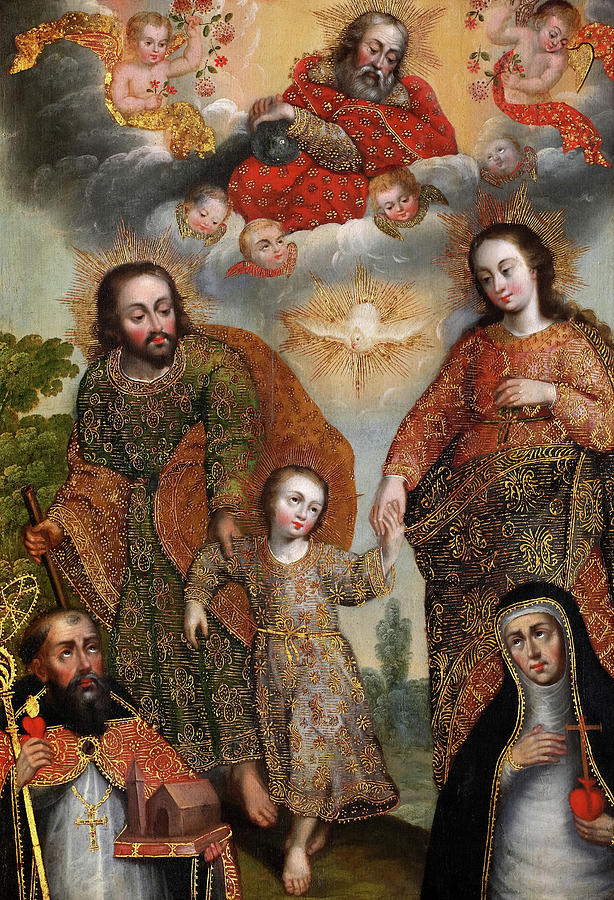
Art: Double Trinity with Saint Augustine and Saint Catherine of Siena

This painting was highlighted in last month’s Magnificat (Dec 2022) magazine with an analysis by Fr. Gabriel Torretta, O.P. 


I was really smitten with this work.  The artist is anonymous but from Peru and from the Cusco School   The painting, Double Trinity with Saint Augustine and Saint Catherine of Siena, is dated between 1700 and 1730.  I was surprised when I looked up Peruvian Baroque art to find just how rich and superb it is, but this painting may be the crowning achievement.  The Wikipedia entry on the Cusco School explained its origins:


The tradition originated after the 1534 Spanish conquest of the Peru,[1] and it is considered the first artistic center that systematically taught European artistic techniques in the Americas. The Spanish contribution, and in general European, to the Cusco School of painting, is given from very early time, when the construction of the Cathedral of Cusco begins. However, it is the arrival of the Italian painter Bernardo Bitti in 1583, that marks a beginning of the development of Cuzqueño art. The Jesuit introduced in Cusco one of the fashionable currents in Europe of the time, Mannerism, whose main characteristics were the treatment of figures in a somewhat elongated way, with the light focused on them.


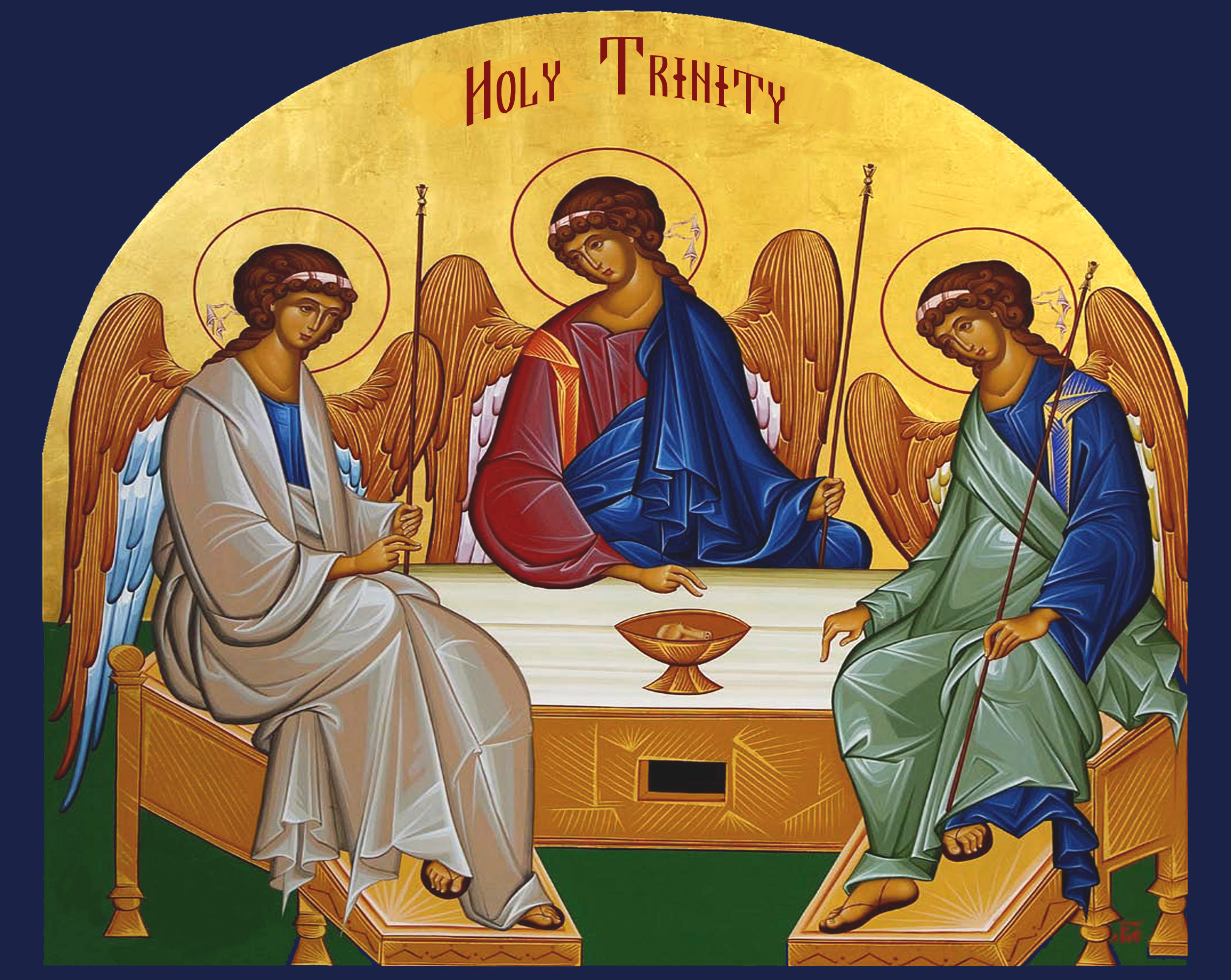
A Trinity in art is of course when an artist renders the Holy Trinity of God the Father, Jesus Christ, and the Holy Spirit.  A Double Trinity is when you couple the Holy Trinity with the trinity of Jesus, Mary, and Joseph—the Holy Family.  That is what you have here.  The scene is supposed to allude to the finding of the boy Jesus at the Temple after being lost (Luke 2:41-52), and the Google Arts and Culture entry mentions how His parents hold him tightly from the experience.


The coordination of the clothing pattern and colors of the holy family is striking.  The patterns are very similar but each individually unique.  The two parents seem to have the same shade while that of Jesus’s is lighter—perhaps suggesting youth—but if my eyes are seeing correctly the shade and pattern of Jesus matches that of God the Father’s sleeve.  The similar colors create a diamond shape between the holy family and God the Father with the Holy Spirit binding them in the center.


Interestingly here the Holy Trinity is rendered vertically with God the Father looking down and Jesus looking up. The holy family, on the other hand, is aligned horizontally with their eyes looking down at Jesus.  The vertical and horizontal lines notably form a cross with all eyes turned to Jesus. 


The artist also includes St. Augustine of Hippo and St. Catherine of Siena in the foreground, on the extreme sides of the canvas.  Fr. Gabriel rightly points out that this makes the painting a Triple Trinity since Jesus and the two saints form a third triangle.  Why St. Augustine and St. Catherine of Siena?  Google Arts and Culture suggests that it may have been the personal preference of the whoever commissioned the painting, and that may be.  But there may be an additional element which may more thought to the painting.    


Both St. Augustine and St. Catherine are holding hearts.  Now it is no coincidence that these two saints would hold hearts as part of their iconography.  St. Augustine famously said in his Confessions, “My heart is restless O Lord, until it rests on thee.”  One of St. Catherine of Siena’s most famous mystical experiences was when she lay in a coma and had her heart taken out by Jesus (mystically of course) and replaced with Christ’s heart.  So heart becomes a thematic element of the composition, and with that in mind we can see that not only are everyone’s eyes turned toward Jesus but so is everyone’s heart: God the Father through the Holy Spirit, and the two earthly parents having just found their lost child.  When we gaze at a beloved, it is through eyes but those eyes are linked to our hearts.


This painting is a magnificent achievement, worthy of any Italian Renaissance artist.  Who knew that such art was being created in seventeenth and eighteenth century Peru?

Sunday, June 12, 2022

Sunday Meditation: When the Lord Established the Heavens

Today’s most interesting reading I find is the first reading.


 Thus says the wisdom of God:
            "The LORD possessed me, the beginning of his ways,
                        the forerunner of his prodigies of long ago;
            from of old I was poured forth,
                        at the first, before the earth.
            When there were no depths I was brought forth,
                    when there were no fountains or springs of water;
            before the mountains were settled into place,
                        Thus says the wisdom of God:
            "The LORD possessed me, the beginning of his ways,
                        the forerunner of his prodigies of long ago;
            from of old I was poured forth,
                        at the first, before the earth.
            When there were no depths I was brought forth,
                    when there were no fountains or springs of water;
            before the mountains were settled into place,
                        before the hills, I was brought forth;
            while as yet the earth and fields were not made,
                        nor the first clods of the world.

            "When the Lord established the heavens I was there,
          when he marked out the vault over the face of the deep;
            when he made firm the skies above,
                        when he fixed fast the foundations of the earth;
            when he set for the sea its limit,
            so that the waters should not transgress his command;
            then was I beside him as his craftsman,
                        and I was his delight day by day,
            playing before him all the while,
                        playing on the surface of his earth;
                        and I found delight in the human race."      

-Prv 8:22:31

So the passage is spoken from a first person perspective.  Who is this person speaking?


Happy Solemnity of the Most Holy Trinity!

Friday, June 19, 2020

Faith Filled Friday: Understanding The Trinity by St. Hildegard of Bingen


I was just reading the Mass readings from Trinity Sunday last week in the devotional monthly magazine, Magnificat. The meditation was particularly penetrating, taken from the writings of St. Hildegard of Bingen.

The creator and Lord of all so loved his people that for their salvation he sent his Son, the Prince and Savior of the faithful, who washed and dried our wounds.  And he exuded the sweetest balm, from which flow all good things for salvation...For the Father is the Father, the Son is the Son, and the Holy Spirit is the Holy Spirit, and these three Persons are indivisible in the Unity of the Divinity...

As the flame of a fire has three qualities, so there is one God in three Persons.  How? A flame is made up of brilliant light and red power and fiery heat.  It has a brilliant light that it may shine, and red power that it may endure, and fiery heat that it may burn.  Therefore, by the brilliant light understand the Father, who with paternal love opens his brightness to his faithful; and by the red power, which is the flame that it may be strong, understand the Son, who took on body born from a Virgin, in which his divine wonders were shown; and by the fiery heat understand the Holy Spirit, who burns ardently in the minds of the faithful....Therefore as these three qualities are found in one flame, so three Persons must be understood in the Unity of the Divinity.

And as three causes for the production of words are seen, so the Trinity in the Unity of the Divinity is to be inferred.  How?  In a word there is sound, meaning, and breath.  It has sound that it may be heard, meaning that it may be understood, and breath that it may be pronounced.  In the sound, then, observe the Father, who manifests all things with ineffable power, in the meaning; the Son, who was miraculously; and in the breath, the Holy Spirit, who sweetly burns in them....Therefore, in these three Persons recognize you God, who created you in the power of his divinity and redeemed you.
--St. Hildegard of Bigen, from Scivias, translated by Mother Columba Hart and Jane Bishop [taken from Magnificat magazine, June 2020, p. 106-107]


I have said that truly understanding the Trinity is nearly impossible, probably the hardest thing in Christianity to conceptualize and accept. St. Hildegard’s explanation is possibly the best I have ever heard.


Thursday, August 8, 2019

Comments to Dante’s Paradiso, Cantos XXXI thru XXXIII, Part 3

Indeed, vision and eyes are of the utmost importance in the last canto leading to the theophany.  Actually eyes and vision have been a motif in the entire Commedia.  But here in the last canto the motif seems to reach a crescendo.  Almost every other tercet has a reference to vision or sight or eyes.  If Christ, and more generally God, is light, then how could sight not be a significant means of comprehending divinity?  It is the Holy Mother’s eyes who looks on Dante with love and then turns her eyes toward God.  Dante is allowed to withstand the intense brightness through her sight.  It’s almost as if he merges his sight with hers (43-57).

Finally the theophoric vision is the climax of the entire journey.  Dante (the character) is allowed to see what no mortal has ever been allowed to see—the vision of the Trinity.  Here’s how he describes the moment before he witnesses the theophany.

I believe, from the keenness of the living ray
that I endured, I would have been undone
had I withdrawn my eyes from it.

And I remember that, on this account,
I grew more bold and thus sustained my gaze
until I reached the Goodness that is infinite.

O plenitude of grace, by which I could presume
to fix my eyes upon eternal Light
until my sight was spent on it!  (XXXIII. 76-84)


As he witnesses the fullness of God, he is granted one more grace, that for a brief instant, for a fleeting moment, he is given comprehension of the entire order of all things.

In its depth I saw contained,
by love into a single volume bound,
the pages scattered through the universe:

substances, accidents, and the interplay between them,
as though they were conflated in such ways
that what I tell is but a simple light.

I believe I understood the universal form
of this dense knot because I feel my joy expand,
rejoicing as I speak of it.  (85-93)

And what is this vision of God?  Several cantos prior, Dante’s first vision of God was a point of light.  But now that his sight has been enlarged and strengthened, he can now see that point of light is a full circle.  Indeed, it is three circles, one for each person of the Trinity, each overlaying on top of each other, each a different color.

In the deep, transparent essence of the lofty Light
there appeared to me three circles
having three colors but the same extent,

and each one seemed reflected by the other
as rainbow is by rainbow, while the third one seemed fire,
equally breathed forth by one and by the other.  (115-120)

This is the Father and the Son, and that which proceeds from the two, the Holy Spirit.  And as he held his gaze he sees a face within the circles.

That circling which, thus conceived,
appeared in you as light's reflection,
once my eyes had gazed on it a while, seemed,

within itself and in its very color,
to be painted with our likeness,
so that my sight was all absorbed in it.  (127-132)

“An image painted with our likeness.”  Is that the face of God or the face of Christ, or is that the same thing?  It is our likeness, we made in the image of God. 

Overwhelmed, perhaps even disoriented, Dante in an instant finds himself back home trying to understand what has happened to him and understand “the Love that moves the sun and all the other stars” (145).

And so ends the greatest work of literature ever written.


###

Some concluding statements.  I began reading Paradiso believing it was the weakest of the three canticas of Inferno, Pugatorio, and Paradiso.  Such a notion was implanted from what I can only say are biased academics.  Paradiso does not have the fanciful torments of Inferno.  It does not have the bodily tensions of Purgatorio.  But Paradiso is special.  Perhaps it is the most theological of the three canticas—and that is why I think that academic biased developed.  But the theology is dramatized in imagery, proposed in beautiful similes and metaphors, all leading to that vision of God as the Trinity.  Paradiso is the most beautiful of the three canticas.  The sublimity of the imagery is unsurpassed.  One can be horrified at the imagery of Inferno, and feel empathy at the imagery of Purgatorio.  But one longs to embrace the imagery of Pardiso.  Indeed, one longs to participate in the imagery of Paradiso. 

In the very first canto of Paradiso, Beatrice in response to a question as to why all things move upward provides an answer which I think is the central thesis of not just Paradiso but of the entire Devine Comedy.

'All things created have an order
in themselves, and this begets the form
that lets the universe resemble God.

'Here the higher creatures see the imprint
of the eternal Worth, the end
for which that pattern was itself set forth.

'In that order, all natures have their bent
according to their different destinies,
whether nearer to their source or farther from it.

'They move, therefore, toward different harbors
upon the vastness of the sea of being,
each imbued with instinct that impels it on its course.  (Par.I.103-114)

That the universe has an order, that things created have an order, all of which resembles God, who has created all forms out of reason and love, is at the heart of this epic.  The entire Commedia is shaped to reflect God’s order.  The order in Inferno, as it winds its way down to the bottom pit of hell, reflects God’s ordering of justice.  The penitential climb up the mountain in Purgatorio reflects the order to retrain the soul to what you were made to be.  The order of Paradiso, with its impelling motion toward the city of God, reflects the order of God’s love as He draws us into His bosom as a parent draws their child.  No other epic has such a complete vision of humanity in its relationship to his universe, and, indeed, to his creator.


Which is the greatest of the three canticas?  You can’t think of it that way.  Each fulfills the other two.  They complement each other as a trinity for a unified vision.  So which of the three canticas do I prefer?  Whichever I have read last, which at the moment is Paradiso.

Robert and Jean Hollander

The great translators, Robert and Jean Hollander.