
This painting was highlighted in last month’s Magnificat (Dec 2022) magazine with an analysis by Fr. Gabriel Torretta, O.P.
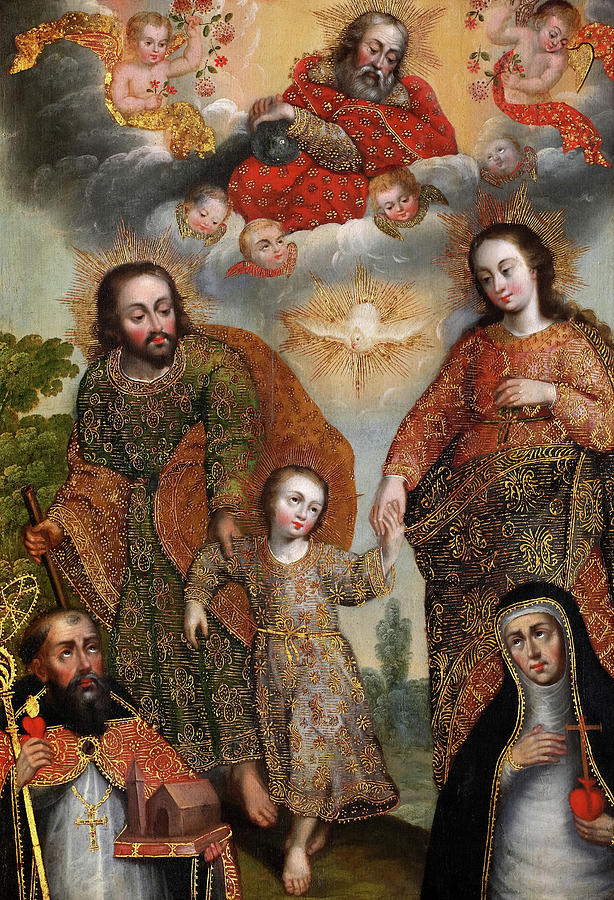
I was really smitten with this work. The artist is anonymous but from Peru and from the Cusco School The painting, Double Trinity with Saint Augustine and Saint Catherine of Siena, is dated between 1700 and 1730. I was surprised when I looked up Peruvian Baroque art to find just how rich and superb it is, but this painting may be the crowning achievement. The Wikipedia entry on the Cusco School explained its origins:
The tradition originated after the 1534 Spanish conquest of the Peru,[1] and it is considered the first artistic center that systematically taught European artistic techniques in the Americas. The Spanish contribution, and in general European, to the Cusco School of painting, is given from very early time, when the construction of the Cathedral of Cusco begins. However, it is the arrival of the Italian painter Bernardo Bitti in 1583, that marks a beginning of the development of Cuzqueño art. The Jesuit introduced in Cusco one of the fashionable currents in Europe of the time, Mannerism, whose main characteristics were the treatment of figures in a somewhat elongated way, with the light focused on them.
A Trinity in art is of course when an artist renders the Holy Trinity of God the Father, Jesus Christ, and the Holy Spirit. A Double Trinity is when you couple the Holy Trinity with the trinity of Jesus, Mary, and Joseph—the Holy Family. That is what you have here. The scene is supposed to allude to the finding of the boy Jesus at the Temple after being lost (Luke 2:41-52), and the Google Arts and Culture entry mentions how His parents hold him tightly from the experience.
The coordination of the clothing pattern and colors of the holy family is striking. The patterns are very similar but each individually unique. The two parents seem to have the same shade while that of Jesus’s is lighter—perhaps suggesting youth—but if my eyes are seeing correctly the shade and pattern of Jesus matches that of God the Father’s sleeve. The similar colors create a diamond shape between the holy family and God the Father with the Holy Spirit binding them in the center.
Interestingly here the Holy Trinity is rendered vertically with God the Father looking down and Jesus looking up. The holy family, on the other hand, is aligned horizontally with their eyes looking down at Jesus. The vertical and horizontal lines notably form a cross with all eyes turned to Jesus.
The artist also includes St. Augustine of Hippo and St. Catherine of Siena in the foreground, on the extreme sides of the canvas. Fr. Gabriel rightly points out that this makes the painting a Triple Trinity since Jesus and the two saints form a third triangle. Why St. Augustine and St. Catherine of Siena? Google Arts and Culture suggests that it may have been the personal preference of the whoever commissioned the painting, and that may be. But there may be an additional element which may more thought to the painting.
Both St. Augustine and St. Catherine are holding hearts. Now it is no coincidence that these two saints would hold hearts as part of their iconography. St. Augustine famously said in his Confessions, “My heart is restless O Lord, until it rests on thee.” One of St. Catherine of Siena’s most famous mystical experiences was when she lay in a coma and had her heart taken out by Jesus (mystically of course) and replaced with Christ’s heart. So heart becomes a thematic element of the composition, and with that in mind we can see that not only are everyone’s eyes turned toward Jesus but so is everyone’s heart: God the Father through the Holy Spirit, and the two earthly parents having just found their lost child. When we gaze at a beloved, it is through eyes but those eyes are linked to our hearts.
This painting is a magnificent achievement, worthy of any Italian Renaissance artist. Who knew that such art was being created in seventeenth and eighteenth century Peru?
