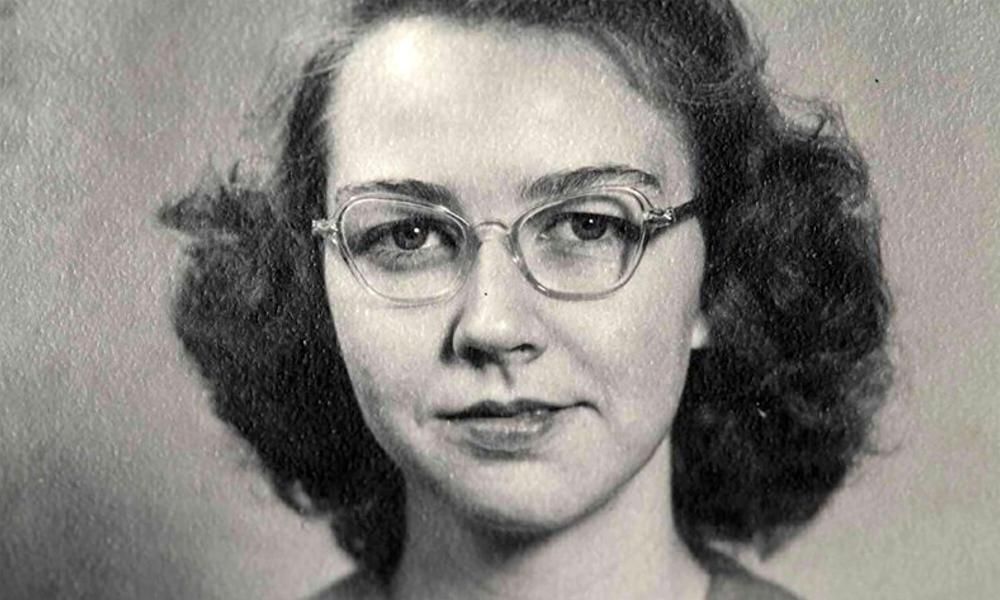
March
25th was not only the Feast Day of the Annunciation, but also the
anniversary of the birth of Flannery O’Connor.And this year, 2025, marked the 100th anniversary.In another post I’m going to provide my
analysis of a short story of hers I recently read, “The Displaced Person,” a
story you may not have ever heard except if you’re a big devotee of her
work.Before I get to that, I’m going to
do a commemoration of her life.She
remains a model for me as a Catholic writer.
The
Smithsonian Magazine has a beautiful tribute to her life and
work, with lots of pictures and a couple of embedded videos.In her short life of thirty-nine years she
produced 31 short stories, two published novels, another novel that was
unfinished but posthumously published, letters, journals, essays, and other
writings.Apparently she sat down to
write every day which is what a good writer needs to do.She has been quite influential.From the Smithsonian article titled, “Flannery O’Connor Wanted to Shake Her Readers Awake. Her Family Wanted Her to Write theNext ‘Gone With the Wind’” by Ellen Wexler:
To
be frank, I only know her work from her short stories, of which I have read
about ten.I’ve posted detailed analysis
of two of her short stories here on Ashes From Burnt Roses, “A Good Man
is Hard to Find” in three posts, (Part 1, Part 2, Part 3)and “Greenleaf” in two posts (Part 1, Part 2). Feel
free to peruse the posts.
There
are some interesting insights in Ellen Wexler’s piece.She really condenses O’Connor’s vision of
fiction into this quote she takes from an O’Connor essay.
“People are always
complaining that the modern novelist has no hope and that the picture he paints
of the world is unbearable,” she wrote in an essay titled “The Nature and Aim of Fiction.” “The only answer to
this is that people without hope do not write novels. … I’m always highly
irritated by people who imply that writing fiction is an escape from reality.
It is a plunge into reality and it’s very shocking to the system.”
That essay, “The Nature and Aim of Fiction” is an
important read for writers, and more on that later.Wexler continues on O’Connor’s philosophy of
great fiction.
She relished in the unusual and
the mysterious, arguing that the ability to understand good fiction belonged
only to the “kind of mind that is willing to have its sense of mystery deepened
by contact with reality, and its sense of reality deepened by contact with
mystery.”
Mystery deepened by reality, reality deepened by
mystery.That’s almost like looking into
a mirror and the mirror looking into another mirror.As a writer, O’Connor believed fiction should
be brutally honest and avoid sentimentality.
“Flannery saw in Catholicism and
in her Southern culture a strong inclination to avoid honesty,” says Bruce
Gentry, editor of the Flannery O’Connor Review at Georgia College & State
University. “Her own unflinching honesty was a reaction against the extremities
of Catholic piety and Southern niceness. She might not have gone so far with
her honesty if she weren’t inclined to fix the groups she belonged to.”
Wexler concludes O’Connor’s vision of fiction with an
understanding that the work needs to reach a moment of redemption.
O’Connor believed that redemption often came “at
considerable cost,” an idea that’s “implicit in the Christian view of the
world.” As such, her characters can’t reach their moments of reckoning on their
own. Instead, they need a push. They need to be shaken awake. O’Connor’s job
was to do the shaking.
O’Connor would wind up falling ill with Lupus, the genetic
disease that killed her father, and thus ending her promising life in the
literary centers of the country.She was
forced to move down to her mother’s house in Milledgeville, Georgia, where she
would write her best work, all the while suffering from the debilitating
disease.Lupus would ultimately kill her
too at the age of 39.Wexler’s
well-written article takes you through her life, her approach to writing, and through
some of her work.
This is a great little TED-ED short video summing up why you should read Flannery O'Connor.
###
In her essay, “The Nature and Aim of Fiction,” O’Connor
highlights the various elements of what she conceptualizes as the art of
fiction. I’m not going to go through everything she says, but one of the most important
elements is the ability of the writer to create an experience through the story
and one does that by use of the five senses.She gives an example from Gustave Flaubert’s novel, Madam Bovary.
All the sentences in Madame
Bo"Vary could be examined with wonder, but there is one in particular that
always stops me in admiration. Flaubert has just shown us Emma at the piano
with Charles watching her. He says, "She struck the notes with aplomb and ran
from top to bottom of the keyboard without a break. Thus shaken up, the old
instrument, whose strings buzzed, could be heard at the other end of the
village when the window was open, and often the bailiff's clerk, passing along
the highroad, bareheaded and in list slippers, stopped to listen, his sheet of
paper in his hand."
Why is this sentence so arresting?O’Connor finds it amazing that the piano
sound buzzes in the room while a clerk at the other end of town in his “list
slippers” hears it.A detail of sound,
one of the five senses, in one room that we cannot visually see but can see
pressing of the keys, incorporating both the auditory and visual senses,
travels across town to a clerk that we can also visually see, across some
distance of space hearing the auditory sound.In addition, we don’t actually hear the piano, since it’s only an
allusion with words on a page, but we imagine the sound as readers in our
minds.She sums this up with, “It's
always necessary to remember that the fiction writer is much less immediately
concerned with grand ideas and bristling emotions than he is with putting list
slippers on clerks.”
It is this accumulation of detail—details selected for
purpose—that creates the story.She will
go on to tell what kind of vision of details the story writer needs to
have.I don’t have the time and space
for this but let me jump to her conclusion when it comes to details.
People have a habit of saying,
"What is the theme of your story?" and they expect you to give them a
statement: "The theme of my story is the economic pressure of the machine
on the middle class"—or some such absurdity. And when they've got a
statement like that, they go off happy and feel it is no longer necessary to
read the story.
Some people have the notion that
you read the story and then climb out of it into the meaning, but for the fiction
writer himself the wholes tory is the meaning, because it is an experience, not
an abstraction.
That is speaking of story by what it is not, but O’Connor
feels that is the best way for a teacher to pass on the craft of
storytelling.She does finally explain
that the art of any medium has been explained by St. Thomas Aquinas.
St. Thomas called art
"reason in making." This is a very cold and very beautiful
definition, and if it is unpopular today, this is because reason has lost
ground among us. As grace and nature have been separated, so imagination and
reason have been separated, and this always means an end to art. The artist
uses his reason to discover an answering reason in everything he sees. For him,
to be reasonable is to find, in the object, in the situation, in the sequence,
the spirit which makes it itself. This is not an easy or simple thing to do. It
is to intrude upon the timeless, and that is only done by the violence of a
single- minded respect for the truth.
It seems to suggest that the artist is trying to apply
reason to human characters and situation to find what is truth in them and
their fate.It is not thematic but
experiential.I will show how she does
this in my upcoming analysis of her short story, “The Displaced Person.”
###
And so, after one hundred years of her birth, let us not
saddened by her early death and the huge loss to literature, but let us be
thankful for what she gave us in her short life, a wealth of fiction of the
highest art.
This is in Part 2 but I'll post it here
since it's relevant to this discussion. When the Abbot and Kinsella are
discussing the dangers of the TV documentary, this exchange ensued:
”A
program in the wrong hands, about this subject, could be made to look like the
first stirrings of a Catholic counterrevolution.”
“Ah,
now begging your pardon, Father Kinsella, I find that very far-fetched.”
“Far-fetched?
To the enemies of the church, won’t it seem that you have acted in direct
contradiction to the counsels of Vatican IV?”
Notice Kinsella fears the “Catholic
counterrevolution” and characterizes those that would seize on the issue as
“enemies of the church.” So the enemies of the church are the
counterrevolutionaries, which are people inside the church! And the monks, such
as Fr. Manus and Matthew and the Irish on the mainland, could easily be the
formation of the counterrevolution. Then how despicable is the Abbot’s
mollifying of the monks at the end where he undermines any coalescence of a
counterrevolution? Of course, I’m using the word “despicable” because it’s from
my point of view, but frankly I have no idea where Brian Moore falls on this
because he’s made such amess of the inherent logic of the novel.
By the way, it shows the counterrevolution
is the natural opposition to a dystopian situation. It's just that Moore never
follows through on it.
Irene Replied:
Manny wrote: "This is in Part 2 but
I'll post it here since it's relevant to this discussion. When the Abbot and
Kinsella are discussing the dangers of the TV documentary, this exchange
ensued:
A program in the..."
I read that exchange a bit differently. I saw the "enemies of the
Church" as outside the Church structure. They are those who would only
learn of the tension between the traditional rituals and the revised rituals by
a secular TV show. They would seize on that and use it against the Church.
Presumably, those in Church leadership would not need a TV show in the secular
world to learn of this debate. In fact, they already know that is why Fr.
Kinsella is there. The abbot rejects that perception. He does not accept the
claim that what is happening would be seized on as counter revolutionary by the
"enemies of the Church" My reading is that he does not see the
actions of the monastery as counter revolutionary. Are the monks mounting a
counter revolution or are they simply ministering to the people who come to the
monastery seeking spirituality? Are they trying to reform the Church or are
they responding to the immediate ministerial needs before them? Yes, they are
keeping the Latin Mass and oricular confession alive. But I did not see any
evidence that they are trying to reverse Vatican IV on a more grand scale.
Certainly, the monks' safe guarding of the tradition could have a revolutionary
impact over time. By keeping something alive, they may be planting the seeds of
a revolution. But, I don't see any indication that the abbot or the monks are
intentionally mounting a revolution to roll back the changes of Vatican IV in
the universal Church.
My Reply to Irene:
Irene wrote: "I read that exchange a
bit differently. I saw the "enemies of the Church" as outside the
Church structure. "
That's possible, but the antecedent of "enemies of the church" seems
like it's referring back to "counterrevolutionaries." Perhaps in
casual conversation it might be construed as that, but any counterrevolutionary
would certainly qualify as an enemy of the church, especially in this
militaristic context of this new church. On balance I think you're right. There
are no current counterrevolutionaries.
But who are these enemies of the church? They could easily be within the church
as without. Everything the forces that Kinsella has been working against seems
like he's addressing issues within the church.
Irene Replied:
Who are the "enemies of the
Church"? They are not specifically named. But they could be any force that
wants to see its demise. Of course, one could argue that the very changes that
the institution is implementing to make the Church more palitable, less offensive,
less prone to attack by "enemies" are the very forces that is
destroying it. But, as I read that exchange, I thought that Moore was alluding
to Church schism and the way secular and outside voices exploited any sign of
disunity in the church to discredit the entire Church. Certainly in the early
70s, there was a great deal of public division among Catholics as the
liturgical changes of Vatican II were implemented. And the secular
prognostigators were forecasting a schism that would end the Catholic Church in
a way that the Protestant Reformation did not do. Of course, those predictions
were not true. Outsiders could not understand that descent has always existed
in the Church as it does in any passionate family. But like any family, we also
don't want our family fights to become the next headline either. I don't see
any specific group or action being named as "counter revolutionary"
in that exchange. Rather I see the fear that "enemies of the Church"
will regard the perceived tension as an act of counter revolution.I don't see
Kinsella calling the monks "counter revolutionaries" but cautioning
that the enemies may perceive their celebration of the Latin mass as counter
revolutionary. Schism has been a major cause of concern from the 1st Letter to
the Corinthians to the present. The unity of the Body of Christ has always been
a primary goal. Maybe this is part of the tension that Moore wants the reader
to consider, sins against the unity of the Body of Christ vs sins against
orthodoxy.
My Reply to Irene:
Irene wrote: "Who are the
"enemies of the Church"? They are not specifically named. But they
could be any force that wants to see its demise. Of course, one could argue
that the very changes that the institution is implementing to make the Church
more palitable, less offensive, less prone to attack by "enemies" are
the very forces that is destroying it. But, as I read that exchange, I thought
that Moore was alluding to Church schism and the way secular and outside voices
exploited any sign of disunity in the church to discredit the entire
Church."
I guess it's vague enough for "the enemies" to be either or both,
within and without. Everything is so vague in this novel that one can create
any line of thought he wishes.
Yes, Irene, his Lourdes experience is at
the heart of his "null." Like everything else in this novel, and
including your observation of Hartman, it is woefully underdeveloped. Moore
spends pages and pages on the helicopter ride, the boat ride that never
happened, the blackberry jam, and a whole lot of meaningless details and he
doesn't develop what should be key elements to the novel.
For instance, is Hartman part of the
forces of the dystopia or the resistance? And don't say neither, because then
it won't fit.
Irene Replied to My Comment:
I don't read this as a dystopian battle
between the evil institutional Church and the good traditionalist monks. So, I
can't answer that question because it does not fit into the way I read this
story. Too bad Moore is dead and we can't hear his intent.
My Reply to Irene:
Irene wrote: "I don't read this as a
dystopian battle between the evil institutional Church and the good
traditionalist monks. So, I can't answer that question because it does not fit
into the way I read this st..."
Well, I guess I can read the Divine Comedy as some sort of Buddhist adventure
story but I would be wrong. There is no way to read this novel where the future
Catholic world envisions this:
- Priest’s collar and black shirt replaced by military style uniform.
- No praying of the rosary.
- No private confessions, but a group act of contrition.
- No Latin Mass but vernacular.
- Facing the congregation rather than God.
- No Pope but a “Father General”? Is that correct or is Father General head of
the Albanisean Order?
- No Rome as center of the Church but Amsterdam being the place of the World
Ecumen Council.
- The “interpenetration” between Christianity and Buddhism.
- No traditional church hierarchy but military ranks.
- No transubstantiation but symbolic act.
- Church service similar to a “bingo game.”
- No religious grace before meals but an ecumenical grace.
- No sign of the cross.
- Lourdes is no longer in operation. One would assume all miracle visitation
sites are closed.
- No distinction between mortal and venial sins.
- No prayers.
- Christianity without God or faith.
- Clerical dress for priests is optional.
- The sacrifice of the Mass is not a miracle but merely a ritual.
and not see it as a dystopian world, especially given the military allusion
that suggest a jackbooted attempt to enforcement if the Abbot chose the other
way. That Christianity can only survive if it gets rid of God is clearly an
Orwellian doublespeak.
The problem is not your reading, the problem is Moore. He set up incompatible
lines of thought, completely under developed everything, and published it.
Anyone can read all sorts of things in this. You are ignoring the parts of the
book that doesn't fit your reading while grasping onto the parts that do.
Joseph Commented:
I have to side with Irene on this one.
Dystopian novels have the society at large as the bad guy and its systems. What
Moore gives us is kind of a microcosm of what we now call the Liturgy Wars and
I think his aim is more to point out the condition of the Church in 1972. It so
happens that many of those elements are still current, and thus this novel does
present a parable about how we live the Faith when what we have known for
centuries upon centuries changes. I find the final scene with the monks
gathered in the chapel praying the Our Father to be indicative of how many
responded to the changes of the early 70s and how many still have to respond
when they cannot find a parish to their personal liking in terms of liturgy or
preaching. The conflict is certainly between Faith and non-Faith and it reaches
into the institutional Church, but that is a conflict which is fought every day
in the hearts of millions of believers around the world and I think that's what
the novel, in the end, is getting at.
My Reply to Joseph:
No, no, no.On a dystopia there is absolutely no
question.Definition from Wikipedia:
A
dystopia (from Ancient Greek δυσ- "bad, hard" and τόπος "place";
alternatively cacotopia or simply anti-utopia) is a fictional community or
society that is undesirable or frightening…Dystopias are often characterized by
rampant fear or distress, tyrannical governments, environmental disaster, or
other characteristics associated with a cataclysmic decline in society.
And further down:
Dystopias
typically reflect contemporary sociopolitical realities and extrapolate
worst-case scenarios as warnings for necessary social change or caution.
Dystopian fictions invariably reflect the concerns and fears of their creators'
contemporaneous culture.
The Catholic Church is acting as a dystopian
society and Moore has extrapolated the worst fears that came out of the Vatican
II changes.
This has all the earmarks of a
dystopia.It is set in the future,
Vatican IV.If it’s not a dystopia, why
does he set it in the future?Why is all
of Catholicism changed so dramatically already?No debate, no transition.And
from every character outside the governing structure, we see no one who wants
it.But more importantly, why are all
the changes so distasteful?Every single
one is put in a bad light.Every beloved
tradition is extirpated.There is no
moral equivalence.All the sympathy in
the novel are against the governing church.Look at all the folk (akin to the hobbits of Lord of the Rings) who go to the traditional Mass offered by the monks.Where is there one good word for the Church
and for Kinsella and what he represents?Show me.Show me one good word,
one positive detail for the governing church.For crying out loud, Kinsella wears a military uniform instead of
priestly garb.Look at the treatment
Kinsella gets by the good earthy folk in Ireland.He’s made out into an elitist.He’s contrasted with Padraig who treats him
to this.
The
boatman abruptly let go of the bollard and took up his oars. Kinsella,
irritated, reached down and caught hold of the curragh’s stern.
“Let
go of that.” “I tell you, I am Father Kinsella. The abbot is expecting me.”
Padraig,
the boatman, let go of one oar, seized up a steel rowlock from beneath it and,
swift as a biting dog, struck the knuckles that held the curragh’s stern. With
a gasp of pain, Kinsella drew his hand back. The rowlock snapped into its hole,
the oar in it, and, with two swift strokes, the boatman swung the curragh out
of reach.
That rap on the knuckles is exactly the
respect he is paid by the good general folk.That rap represents the attitude you’re supposed to have toward
Kinsella.
There is no moral equivalence presented
anywhere.No such detail or
characterization occurs to characterize the monks or the general Irish folk who
go to the old Mass and want the traditions.None that I find.Whatever
conclusion you want to draw about the Abbot or the ending, it has to be within
the context of a dystopia.On that there
is no ambiguity.On that it is clear.
I’ll say it again here because I don’t
want it forgotten: Show me one good detail, one positive word for the governing
church anywhere in the novel?Show me.
Joseph Replied:
I don't think there is one. But, by the
same token, I don't think there is one for the monks on Muck either. They're
not presented as the heroic stalwarts of say, Fr. Percy from Lord of the World,
more like a curiosity or a museum piece, and the people they serve are shown
more as backwards yokels than principled resistors. The Abbot says it himself
in Part 2, "We tried the new way, people didn't like it, so we went
back." That's not really something done because they saw the shortcomings
of the Vatican IV liturgy, although they did do that, but more like, "We
need to find a way to reach these people who have left," and that's the
solution they came up with. I find this to be more of a satire than a dystopia,
really. Moore has kind of caricatured the two camps in the liturgy wars and
presented us with the outlines of the continuing back and forth rather than
with a solution. I think he's trying to point out the short comings of the
demystification while at the same time noting that just because someone is
traditional, it doesn't mean that they have deep faith behind that either.
My Reply to Joseph:
Joseph Said: I don't think there is one. But, by the same token, I don't think there
is one for the monks on Muck either. They're not presented as the heroic
stalwarts of say, Fr. Percy from Lord of the World, more like a curiosity or a
museum piece
I would have to disagree.I think Frs. Matthew and Manus are presented
as heroic.Brian Moore’s
characterization is definitely two dimensional, but I don’t think he has the
skill to pull off what Hugh Benson did with Lord
of the World.First, everything in
Moore’s novel is woefully underdeveloped.Just look at how much space Fr. Percy is given in Lord of the World.And
Benson was a better novelist.
Joseph Said:and the
people they serve are shown more as backwards yokels than principled resistors.
I can see how you might see that, but I
think you’re missing how the Irish see their identity, especially in
literature.The Irish see the peasantry
as deeply part of their identity.Think
of the John Wayne in his movie The Quiet
Man.Think of the appearance of Our
Lady of Knock and the peasants she appeared to.William Butler Yeats glorified the peasantry in his poetry.Read over this article from Irish Studies,
“Identity and the Literary Revival.”I’ll
quote two key paragraphs.
Both
Yeats’s Cathleen Ni Houlihan and Sean O’Casey’s The Plough and The Stars open
with domestic scenes which hint at both plays’ agenda.Co-founder of the Gaelic League and president
National Literary Society Douglas Hyde initiated the ‘stranger in the country
kitchen’ motif with his play The Twisting of the Rope in 1901.[1]This motif uses the “cottage on stage” as a
“temple of Irish domesticity, the sacred origin, the mystery of mysteries –
within it the Irish are themselves.”[2]In contrast to the tradition of melodrama, Literary Revival plays sought
to present the ‘real’ Irish as opposed to demeaning stereotypes.They succeeded, however, only in constructing
an undifferentiated peasantry.Despite
the diversity in portrayals, all these authors contributed to the process of
“turning the peasants into a single figure of literary art…the ‘aestheticizing’
of the Irish country people.”[3]One
generalization has been replaced by another.
Yeats
and Lady Gregory use the peasantry to define the true spirit of the
nation.When called by Cathleen, a
thinly veiled representation of the nation, Ireland’s young men put aside
selfish temporal interests to fight and die for her.The volk are united by a spiritual connection
which drives them to self-sacrifice.This mythologizing of the peasantry reflected Yeats’s own struggle to
develop a uniquely Irish literary style: “What distinguished Irish from English
writers was a complex national identity, and in searching for that identity
Irish writers turned, as if naturally, to the people they imagined to be most
distinctively and authentically Irish: the peasants.”[4]This Anglo-Irish Ascendancy depiction of the
peasantry as a primitive, spiritual people blankets over social, economic, and
religious differences.It also expresses
many of his individual beliefs.The
peasants counter urban bourgeois commercialism.Yet Yeats was not alone in using the peasantry as a vehicle for his own
ideology: “To speak about the peasant was always to speak about something
beyond actual rural life.”[5]
In addition, Moore has the monks perform
the Mass outdoors using a large rock as an altar.That’s right out of Irish folklore where when
the British tried to shut down Catholicism and the priests moved the Mass outdoors
using boulders as altars for secret Masses.In fact if I remember correctly there was a priest who was shot dead performing
such an outdoor Mass and as I think legend goes was shot dead the very moment
he held the host up to God.And the
passion for the Mass as dramatized in the novel echoes the Irish identity as
the people who saved civilization in the Dark Ages through Catholicism.In fact the name Padraig, is the Gaelic
version of Patrick.It’s where they get
the diminutive “Paddy” from.Paddy is not
actually from Patrick.Moore uses the
most Irish version of the most Irish identity name.Something else I just thought of, Kinsella is
coming to Ireland to tell them how to worship much like the British came to
Ireland to do the same. And he brings a similar threat of force.Moore is wrapping the peasants in Irish motherhood,
apple pie, and the national anthem.No I
don’t think you’re supposed to see them as yokels but as the good Irish devout
who are going to save civilization again.
Joseph Said: I find this to be more of a satire than a dystopia, really. Moore has
kind of caricatured the two camps in the liturgy wars and presented us with the
outlines of the continuing back and forth rather than with a solution. I think
he's trying to point out the short comings of the demystification while at the
same time noting that just because someone is traditional, it doesn't mean that
they have deep faith behind that either.
Yes, but I think that speaks to his
skill.All the characters are two
dimensional, the situation is underdeveloped, and the logic of the novel is
ambiguous at best and incoherent at worst.
Let me take a crack at what I think Moore
meant by this novel, and mind you that this is partially speculation because of
the flaws I just mentioned.
That there is a dystopia that has imposed
this heresy upon the Catholic world is unquestionable.That there is a resistance in the Irish
people I think is pretty certain as well.Everything follows from those assumptions.The questions that follow are (1) why does
the Abbot capitulate, and (2) what does Moore wish to imply by the prayer
ending?
Why does the Abbot capitulate?(1) He has a personal interest in not rocking
the boat.He wants to be buried with the
other Abbots and that will consummate his career in the history of the Abbey.(2) He doesn’t really believe, so it doesn’t
really matter to him, and so given the choice between fighting the Church or
fighting his monks, he sees the monks as the ones he can mollify.Plus he has authority over them.He’s pusillanimous, and that’s his least
resistance.(3) He sees fighting the
Church as a losing effort, and so doesn’t see its practicality.
What does Moore wish to imply by the
prayer ending?Here is where it gets
speculative.Here are three
possibilities.
(1) If Moore is attempting to bring the
theme of atheism to the fore, then he is ending with an appeasement to the “Christianity
without God.”The prayer becomes a
kneeling before the “null” that the Abbot sees, and the monks become appeased
and are mollified, and it’s all meaningless anyway because there is no God and
it doesn’t really matter and the novel is so titled “Catholics” from an
outsider perspective because this is all Catholic hooey anyway.That would be the cynical possibility.
(2) Prayer will be the reinforcement that
will either strengthen the monks to persevere in the face of what could be a
long term persecution or a petition to God to change the state of the Church,
much like after the destruction of the first temple and through faith and prayer
the second temple was eventually built, and so will Catholicism.It could be seen as the start of
re-civilizing the world again, and in this case re-civilizing the Church
herself.That would be the idealistic
possibility.
(3) It could be a way to purely mollify
the monks and get over the hump.That
would be the utilitarian possibility.
There are other possibilities too, none of
which are satisfactory.You can read
whatever you so wish into the ending, and that’s a pretty crappy way to end a
novel.This indeterminate ending stems
directly from the novel’s moral ambiguity.
This novel is junk. It's sensationalism.
It has more holes than a sieve. It was put together because its original
premise (a Catholic dystopia of a secularized and militarized church)
titillates. Brian Moore puts forth two incompatible lines of thought: an
immoral dystopia and a central figure who has no belief when he is presented as
the center of the resistance, and then the author leaves the ending in a sort
of undetermined state, probably because the author himself is an atheist. Once
the author has established the dystopia, the story line cannot tolerate moral
ambiguity, and yet we are left with moral ambiguity. In addition, the novel is
woefully underdeveloped, the characters are not much more than cartoon figures,
the author violates a basic story-telling craft, such as holding back the
critical detail of the central character’s personality until two thirds of the
novel, and the novel then ends in a whimper. Bottom line: Don’t bother.
Fr.
Kinsella wakes up the following morning and is met with Fr. Manus instead of
the Abbot, is asked if he would like to celebrate Mass, which he declines, and
then is brought to breakfast.The Abbot
finally meets him after breakfast and is told Kinsella will be leaving shortly
with the helicopter.Kinsella finally
asks the Abbot what his decision will be, continue to rebel against the Vatican
authority or comply with the new ecumenical rules.The Abbot tells him he will comply and
deflect the TV news.At the helicopter
landing, monks have congregated to swarm Kinsella over what they see as heresy,
but the Abbot mollifies them enough for Kinsella to get on board and take off.
Part
Four
The
Abbot knows he will now have to face his monks.They press him for what came out of the discussions with Kinsella, and
he reveals the monastery will now comply with the new rules.The monks are now angered, especially Fr.
Matthew.The Abbot enjoins them to pray,
and kneels and starts the Our Father.The monks kneel behind him and the novel ends with all of them reciting
the Our Father.
###
Some
major questions here.
(1)
Why does Moore avoid the coming together of the two sides of the conflict?Why does he have the monk’s advocacy of the
traditional rules not engage the Kinsella, the advocacy of the new rules, come
to a head?He has avoided this the
entire novel and here in Part Three the two sides are perfectly aligned for a
conflict, and he makes sure it gets avoided.Why?
(2)
Is the Abbot sincere in his praying at the end?Here he is in a tight spot where his leadership is at stake, and he then
resorts to what could be an appeasing move.When he was alone in Part Two in the church, he decidedly didn’t
pray.Here when it serves his interest,
he does.Is he sincere?
(3)
Why does Brian Moore call the novel “Catholics?”The perspective is from one who is not a
Catholic.It’s as if I were to write a
novel about Islam and call it “Muslims.”The perspective is from the outside and not the inside.What is he trying to say?Is he condemning the whole religion?
###
If
there is any theme to be drawn from this novel, it lies in these passage from
Part IV.First, Fr. Matthew accosting
the Abbot.
“And I will not be put
off like that,” Father Matthew shouted. “I will not be ordered to believe
something that I do not believe.”
“No one can order
belief,” the abbot said. “It is a gift from God.” But even as he said this,
said the only truth left to him, he saw in these faces that he was failing,
that he was losing them, that he must do something he had never done, give
something he had never given in these, his years as their abbot. What had kept
him in fear since Lourdes, must now be faced. What he feared most to do must be
done. And if, in doing it, I enter null and never return, amen. My time has
come.
“No
one can order belief,” that is a true enough statement.But what is he getting at?Is the true presence a matter of belief or a
true reality?I seem to take that as a
statement of relativism.What is this
entering into the “null?”I think Moore
is suggesting that the Abbot is facing the nothing of the supernatural, its
non-existence. Of course, coming this
doesn’t mean Moore doesn’t believe in the supernatural, just that the Abbot is
facing his non-belief.Then we come to
this.
Stood, holding the door
for them, as they moved past him, his eyes on their faces, these faces he knew
better than his own, seeing every shade of wavering, from confusion, to doubt,
to anger at him, to fear, to Father Donald’s dangerous tears and Brother
Kevin’s hysterics, tight on snaffle, a horse ready to bolt. He entered behind
them and shut the door. Moved past them in the aisle, going up into the great
vault of the nave, moving in that silence, in the gray light of this place
where he had spent the longest years of his life, this place where his body
would lie, this place he feared most. He entered the chancel. He faced the
altar.
“A miracle,” he told
them, “is when God is there in the tabernacle.”
“But you said the
opposite, you said that the sacrifice of the Mass is just ritual, that bread
and wine remain bread and wine, that there are no miracles!”
So
the Abbot moves to the place he fears most, the place where his body will be
eventually interred.What specifically
is his fear here?His fear here could be
either facing God’s judgement or facing the nothing that is from an atheist’s
perspective.So when he says he is
entering the “null” above, is he saying he is facing God’s judgement or the
nothing of death from an atheist’s perspective?
And
then we get the final part of the scene.
Matthew, thundering:
righteous, wronged. The abbot, his back to all of them, heard their stiff
intake of breath, the fear of their lives at these words, said in this place.
He stared at the golden door of the tabernacle. His fear came. “Prayer is the
only miracle,” he said. “We pray. If our words become prayer, God will come.”
Slowly, with the painful
stiffness of age, he went down heavily on one knee, then on both. Knelt in the
center of the aisle, facing the altar, the soles of his heavy farm boots
showing from the hem of his robe. He trembled. He shut his eyes. “Let us pray.”
He bent his head. “Our
Father, who art in heaven,” he said. His trembling increased. He entered null.
He would never come back. In null.
“His
fear came?”Which fear is this, because
I think it’s not clear, the fear of God in the tabernacle or the fear of losing
the leadership of the monks?One can’t
help thinking that his words at that moment is Brian Moore’s central theme:
“Prayer is the only miracle,” he said. “We pray. If our words become prayer,
God will come.”
So
if that is the case, Moore is a relativist, and the Mass is just a ritual.That I think is the central theme of the
novel.That would explain why he names
the novel “Catholics,” because his perspective is not within Catholicism but
outside of it.
Frankly,
this novel is such a mess I can’t draw any conclusion with any certainty.In the end, Kinsella and the dystopian forces
are right?You got me.
###
This
is in Part 2 but I'll post it here since it's relevant to this discussion.When the Abbot and Kinsella are discussing
the dangers of the TV documentary, this exchange ensued:
A program in the wrong
hands, about this subject, could be made to look like the first stirrings of a
Catholic counterrevolution.”
“Ah, now begging your
pardon, Father Kinsella, I find that very far-fetched.”
“Far-fetched? To the
enemies of the church, won’t it seem that you have acted in direct
contradiction to the counsels of Vatican IV?”
Notice
Kinsella fears the “Catholic counterrevolution” and characterizes those that
would seize on the issue as “enemies of the church.”So the enemies of the church are the
counterrevolutionaries, which are people inside the church!And the monks, such as Fr. Manus and Matthew
and the Irish on the mainland, could easily be the formation of the
counterrevolution.Then how despicable
is the Abbot’s mollifying of the monks at the end where he undermines any coalescence
of a counterrevolution?Of course, I’m
using the word “despicable” because it’s from my point of view, but frankly I
have no idea where Brian Moore falls on this because he’s made such amess of
the inherent logic of the novel.
By
the way, it shows the counterrevolution is the natural opposition to a
dystopian situation.It's just that
Moore never follows through on it.
###
I
have to say I giggled out loud when I read this.That is Kinsella speaking first in dialogue
with the Abbot.
“Are you asking me what
do I believe?”
“Yes, if you wish. There
is a book by a Frenchman called Francis Jeanson, have ever you heard of it? An
Unbeliever’s Faith, it is called.”
“I have not read it.” “It
is interesting. He believes there can be a future for Christianity, provided it
gets rid of God. Your friend, Father Hartmann, has mentioned Jeanson in his own
writings. The idea is, a Christianity that keeps God can no longer stand up to
Marxism. You have not heard of the book?”
Christianity
can only survive if it gets rid of God…hahaha.Was that meant to be funny?Is
Moore satirizing here or is he serious?
###
I
skimmed through the book to make a list of all the “Vatican IV” changes to
Catholicism.It’s pretty interesting and
funny.
-Priest’s
collar and black shirt replaced by military style uniform.
-No
praying of the rosary.
-No
private confessions, but a group act of contrition.
-No
Latin Mass but vernacular.
-Facing
the congregation rather than God.
-No
Pope but a “Father General”?Is that
correct or is Father General head of the Albanisean Order?
-No
Rome as center of the Church but Amsterdam being the place of the World Ecumen
Council.
-The
“interpenetration” between Christianity and Buddhism.
-No
traditional church hierarchy but military ranks.
-No
transubstantiation but symbolic act.
-Church
service similar to a “bingo game.”
-No
religious grace before meals but an ecumenical grace.
-No
sign of the cross.
-Lourdes
is no longer in operation.One would
assume all miracle visitation sites are closed.
-No
distinction between mortal and venial sins.
-No
prayers.
-Christianity
without God or faith.
-Clerical
dress for priests is optional.
-The
sacrifice of the Mass is not a miracle but merely a ritual.
I probably missed others.It’s fun in a dystopian novel to see what the
details of the dystopia amount to.
###
Kerstin comment:
I expected more fireworks. I expected a
more detailed discussion with a lot of back and forth regarding the merits of Tradition
and the Latin Mass that goes back to Gregory the Great (if I remember
correctly). I expected a deeper delving into the spiritual needs of the people
and how the Latin Mass serves these needs on a deep level. Instead what we get
is an Abbot who falls like a house built of straw at the slightest puff from
Kinsella. Kinsella wasn't really needed to be there in person at all to bring
about the desired change for the Vatican, a stern letter of 'cease and desist'
would have sufficed.
This to me is what made this novel so
dissatisfying. Why bother? In Lord of the
World we have a group of priests whose faith is never in question, who are
steadfast to the bitter end. Here the end feels like a whimper.
My Reply to Irene:
Irene wrote: "Fr. Matthew defied the
abbot's orders and organized a vigil as part protest, part hope that God would
somehow make things work out the way he and the other monks desired. "
I didn't read your whole comment, I'll do so later, but I did see that which I
quoted. No, I don't think anyone has an obligation to obey clear heresy. See
St. Athanasius and his struggles against 4th century heresy from his bishops.
If the Pope tomorrow declared the Eucharist to be only a symbol, I would
imagine you would defy it? I would hope. I would.
This is the problem with Moore's novel. He has clearly laid out a dystopian
heresy of which there can be no compromise. Any intended compromise can only be
seen as immoral. He did not lay out a grey position but a black and white one.
My Reply to
Irene:
Irene wrote: "Is is possible to force
someone to believe what they don't believe? These monks are not in public
positions. They are not being asked to teach something heritical. The TV
cameras are being headed o..."
Community shapes belief. Would my son believe if I didn’t? Of course the Mass
is critical to community belief. And no, they should be bringing the faith to
the media. That is the moral thing to do. It is akin to Martin Luther King
bringing to the attention of society civil injustice. This heresy is even of
greater moral concern to Catholics than civil rights. Denying the true presence
in the Eucharist is even greater than the Arian heresy St. Athansius fought
against in the very church. You seem to be down playing how big a deal this is.
I’ll ask again, would you obey this?
I’ll ask the book club readers, would you
be fighting against or going along with these “Vatican IV” heresies?
There is no question I would be fighting
against, with my whole heart, soul, and life. If ever a case for martyrdom
we’re called, this is it. In fact St Michael Pro and the Mexican martyrs gave
their very lives over a similar issue, of which we’ll get to in the next novel
My Reply to Irene:
Irene wrote: "All that is left is to
surrender all in prayer. And, if they can find God in that surrender, in that
humility, in that prayer, that is MIRACLE. Faith is a gift, one that the abbot
has not enjoyed for some time. But he must have had it once. So he enters that
null because there is nothing else to do, because all that is left, when
everything has been taken, is to kneel in surrender and humility and hope. And
he does it out of love, love for these men that he has shepherded for all these
years despite the emptiness in his own life. Beyond the social reforms, beyond
the doctrinal certitude, beyond the arrogance of intellectualism, beyond
exquisit liturgies, beyond it all is the surrender to what is beyond what we can
know or persuade or define or control."
OK, now I've read your entire comment, and can agree with that. But isn't that
proof that Brian Moore doesn't understand the material? What exactly is the
point to come to the end and have it end in a prayer? As Kerstin said, this
ends in a whimper. This is like ending a novel with someone detonating an
atomic bomb on a timer and having the group kneel down and pray that it doesn't
kill anyone when it goes off. Moore has set off what amounts to as an atomic
bomb in Catholicism. He can't just end it like this. What will happen on the
next day when the monks have to perform the non valid Mass? Are they simply
going to go along and obey now? That would be incredible. Moore has invested no
space in that kind of change in Frs. Matthew nor Manus. This novel is so flawed
it's a joke.
My Reply to Irene:
Irene wrote: "O, and I did not answer
your question. Would I obey an order to stop believing in the Real Presence?
No. Would I obey an order to accept a new liturgical form? Yes."
Oh I missed that earlier. Thanks.
My Reply to Frances:
But Frances, the monks weren’t shy. They
were ready to engage just as St. Catherine would have. And you’re right, she
wasn’t shy about talking back to the Pope. The problem is not the monks. The
problem is Brian Moore. He has them apparently capitulate when no precedence in
the novel has been established for this to occur. It’s still another flaw in
the novel.
As to being shy, the word that to me defines the Abbot is pusillanimous. He has
been pusillanimous throughout the novel. In way it’s the only character
consistency in this work. The abbot has been pusillanimous when originally his
monks kept the Latin Mass against Rome, he was pusillanimous in his decision to
fight Rome, and when he is forced to disagree with his monks, he is
pusillanimous in standing up to them.
Kerstin Replied to My Comment:
Manny wrote: "I’ll
ask the book club readers, would you be fighting against or going along with
these “Vatican IV” heresies?"
The formula "the Church is the Body
of Christ" thus states that the Eucharist, in which the Lord gives us his
body and makes us one body, forever remains the place where the Church
is generated, where the Lord himself never ceases to found her anew;
in the Eucharist the Church is most compactly herself - in all places, yet one
only, just as he is one only.
In other words, if the Eucharist becomes only a
symbol, the very life of Christ is no longer within the Church - all we have is
a human construct. In the Latin Mass reverence for the Eucharist is especially
pronounced, and this is why Kinsella makes the trip to crush it.
Despite all its faults, the novel does pose some hope, and I don't see it with
the Abbot. The hope lies with the monks. They are the faithful remnant.
Throughout salvation history God has worked with a faithful remnant, they are
the key for the rebirth of the Church.