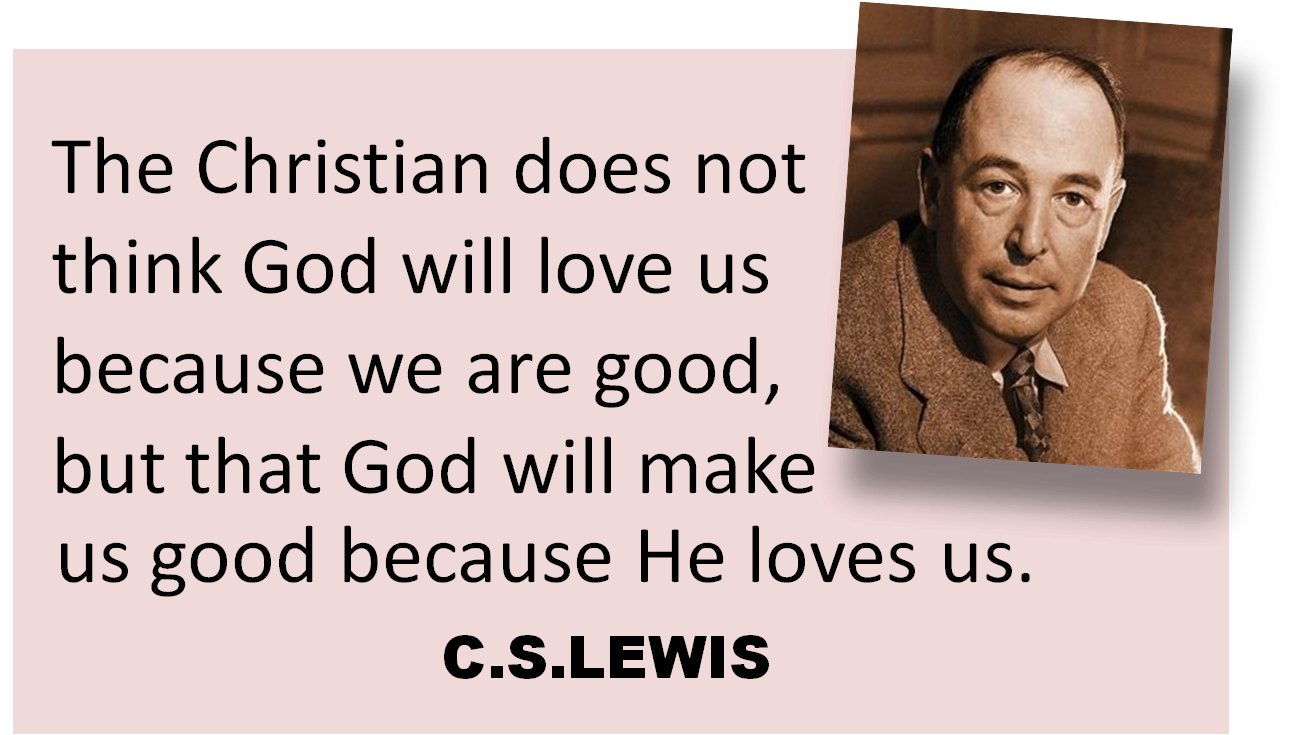
This
is the sixth of a series of posts on Mere
Christianity by C. S. Lewis.
You
can find Post #1 here.
Post #2 here.
Post #3 here.
Post #4 here.
Post #5 here.

The last two posts were summaries from Book 3, “Christian Behavior.” I did not have the space to post notable quotes, so I will take this entire post to quote important passages from all twelve chapters. I hope you enjoy these quotes.
###
From Chapter 1: The Three Parts of
Morality
In reality, moral rules
are directions for running the human machine. Every moral rule is there to
prevent a breakdown, or a strain, or a friction, in the running of that
machine. That is why these rules at first seem to be constantly interfering
with our natural inclinations. When you are being taught how to use any
machine, the instructor keeps on saying, “No, don’t do it like that,” because,
of course, there are all sorts of things that look all right and seem to you
the natural way of treating the machine, but do not really work.
⁂
Morality, then, seems to
be concerned with three things. Firstly, with fair play and harmony between
individuals. Secondly, with what might be called tidying up or harmonising the
things inside each individual. Thirdly, with the general purpose of human life
as a whole: what man was made for: what course the whole fleet ought to be on:
what tune the conductor of the band wants it to play.
From Chapter 2: The Cardinal Virtues
According to this longer
scheme there are seven “virtues.” Four of them are called “Cardinal” virtues,
and the remaining three are called “Theological” virtues. The “Cardinal” ones
are those which all civilised people recognise: the “Theological” are those
which, as a rule, only Christians know about…. They are Prudence, Temperance,
Justice, and Fortitude.
⁂
There is one further
point about the virtues that ought to be noticed. There is a difference between
doing some particular just or temperate action and being a just or temperate
man. Someone who is not a good tennis player may now and then make a good shot.
What you mean by a good player is the man whose eye and muscles and nerves have
been so trained by making innumerable good shots that they can now be relied
on. They have a certain tone or quality which is there even when he is not
playing, just as a mathematician’s mind has a certain habit and outlook which
is there even when he is not doing mathematics. In the same way a man who
perseveres in doing just actions gets in the end a certain quality of
character. Now it is that quality rather than the particular actions which we
mean when we talk of a “virtue.”
⁂
The point is not that God
will refuse you admission to His eternal world if you have not got certain
qualities of character: the point is that if people have not got at least the
beginnings of those qualities inside them, then no possible external conditions
could make a “Heaven” for them—that is, could make them happy with the deep,
strong, unshakable kind of happiness God intends for us.
From Chapter 3: Social Moraility
The first thing to get
clear about Christian morality between man and man is that in this department
Christ did not come to preach any brand new morality. The Golden Rule of the
New Testament (Do as you would be done by) is a summing up of what every one,
at bottom, had always known to be right.
⁂
The second thing to get
clear is that Christianity has not, and does not profess to have, a detailed
political programme for applying “Do as you would be done by” to a particular
society at a particular moment. It could not have. It is meant for all men at
all times and the particular programme which suited one place or time would not
suit another. And, anyhow, that is not how Christianity works.
⁂
All the same, the New
Testament, without going into details, gives us a pretty clear hint of what a
fully Christian society would be like. Perhaps it gives us more than we can
take. It tells us that there are to be no passengers or parasites: if man does
not work, he ought not to eat. Every one is to work with his own hands, and
what is more, every one’s work is to produce something good…
From Chapter 4: Morality and
Psychoanalysis
When a man makes a moral
choice two things are involved. One is the act of choosing. The other is the
various feelings, impulses and so on which his psychological outfit presents
him with, and which are the raw material of his choice. Now this raw material
may be of two kinds. Either it may be what we would call normal: it may consist
of the sort of feelings that are common to all men. Or else it may consist of
quite unnatural feelings due to things that have gone wrong in his
subconscious. Thus fear of things that are really dangerous would be an example
of the first kind: an irrational fear of cats or spiders would be an example of
the second kind.
⁂
That is why Christians
are told not to judge. We see only the results which a man’s choices make out
of his raw material. But God does not judge him on the raw material at all, but
on what he has done with it. Most of the man’s psychological make-up is probably
due to his body: when his body dies all that will fall off him, and the real
central man, the thing that chose, that made the best or the worst out of this
material, will stand naked.
⁂
One last point. Remember
that, as I said, the right direction leads not only to peace but to knowledge.
When a man is getting better he understands more and more clearly the evil that
is still left in him. When a man is getting worse, he understands his own
badness less and less.
From Chapter 5: Sexual Morality
We must now consider
Christian morality as regards sex, what Christians call the virtue of chastity.
The Christian rule of chastity must not be confused with the social rule of
“modesty” (in one sense of that word); i.e. propriety, or decency. The social rule
of propriety lays down how much of the human body should be displayed and what
subjects can be referred to, and in what words, according to the customs of a
given social circle. Thus, while the rule of chastity is the same for all
Christians at all times, the rule of propriety changes.
⁂
Chastity is the most
unpopular of the Christian virtues. There is no getting away from it: the
Christian rule is, “Either marriage, with complete faithfulness to your
partner, or else total abstinence.” Now this is so difficult and so contrary to
our instincts, that obviously either Christianity is wrong or our sexual
instinct, as it now is, has gone wrong. One or the other. Of course, being a
Christian, I think it is the instinct which has gone wrong.
⁂
In the first place our
warped natures, the devils who tempt us, and all the contemporary propaganda
for lust, combine to make us feel that the desires we are resisting are so
“natural,” so “healthy,” and so reasonable, that it is almost perverse and
abnormal to resist them…Like all powerful lies, it is based on a truth—the
truth, acknowledged above, that sex in itself (apart from the excesses and
obsessions that have grown round it) is “normal” and “healthy,” and all the
rest of it. The lie consists in the suggestion that any sexual act to which you
are tempted at the moment is also healthy and normal. Now this, on any
conceivable view, and quite apart from Christianity, must be nonsense.
⁂
Finally, though I have
had to speak at some length about sex, I want to make it as clear as I possibly
can that the centre of Christian morality is not here. If anyone thinks that
Christians regard unchastity as the supreme vice, he is quite wrong. The sins
of the flesh are bad, but they are the least bad of all sins. All the worst pleasures are purely spiritual:
the pleasure of putting other people in the wrong, of bossing and patronising
and spoiling sport, and back-biting; the pleasures of power, of hatred. For
there are two things inside me, competing with the human self which I must try
to become. They are the Animal self, and the Diabolical self. The Diabolical
self is the worse of the two.
From Chapter 6: Christian Marriage
The Christian idea of
marriage is based on Christ’s words that a man and wife are to be regarded as a
single organism—for that is what the words “one flesh” would be in modern
English. And the Christians believe that when He said this He was not
expressing a sentiment but stating a fact—just as one is stating a fact when
one says that a lock and its key are one mechanism, or that a violin and a bow
are one musical instrument. The inventor of the human machine was telling us
that its two halves, the male and the female, were made to be combined together
in pairs, not simply on the sexual level, but totally combined.
⁂
But, of course, ceasing
to be “in love” need not mean ceasing to love. Love in this second sense—love
as distinct from “being in love”—is not merely a feeling. It is a deep unity,
maintained by the will and deliberately strengthened by habit; reinforced by
(in Christian marriages) the grace which both partners ask, and receive, from
God. They can have this love for each other even at those moments when they do
not like each other; as you love yourself even when you do not like yourself.
They can retain this love even when each would easily, if they allowed
themselves, be “in love” with someone else. “Being in love” first moved them to
promise fidelity: this quieter love enables them to keep the promise. It is on
this love that the engine of marriage is run: being in love was the explosion
that started it.
⁂
This is, I think, one
little part of what Christ meant by saying that a thing will not really live
unless it first dies. It is simply no good trying to keep any thrill: that is
the very worst thing you can do. Let the thrill go—let it die away—go on through
that period of death into the quieter interest and happiness that follow—and
you will find you are living in a world of new thrills all the time. But if you
decide to make thrills your regular diet and try to prolong them artificially,
they will all get weaker and weaker, and fewer and fewer, and you will be a
bored, disillusioned old man for the rest of your life.
⁂
There ought to be two
distinct kinds of marriage: one governed by the State with rules enforced on
all citizens, the other governed by the Church with rules enforced by her on
her own members. The distinction ought to be quite sharp, so that a man knows
which couples are married in a Christian sense and which are not.
From Chapter 7: Forgiveness
I said in a previous
chapter that chastity was the most unpopular of the Christian virtues. But I am
not sure I was right. I believe there is one even more unpopular. It is laid
down in the Christian rule, “Thou shalt love thy neighbour as thyself.” Because
in Christian morals “thy neighbour” includes “thy enemy,” and so we come up
against this terrible duty of forgiving our enemies.
⁂
I am not trying to tell
you in this book what I could do—I can do precious little—I am telling you what
Christianity is. I did not invent it. And there, right in the middle of it, I
find “Forgive us our sins as we forgive those that sin against us.” There is no
slightest suggestion that we are offered forgiveness on any other terms. It is
made perfectly clear that if we do not forgive we shall not be forgiven. There
are no two ways about it.
⁂
Now a step further. Does
loving your enemy mean not punishing him? No, for loving myself does not mean
that I ought not to subject myself to punishment—even to death. If one had
committed a murder, the right Christian thing to do would be to give yourself
up to the police and be hanged. It is, therefore, in my opinion, perfectly
right for a Christian judge to sentence a man to death or a Christian soldier
to kill an enemy.
From Chapter 8: The Great Sin
The vice I am talking of
is Pride or Self-Conceit: and the virtue opposite to it, in Christian morals,
is called Humility. You may remember, when I was talking about sexual morality,
I warned you that the centre of Christian morals did not lie there. Well, now,
we have come to the centre. According to Christian teachers, the essential
vice, the utmost evil, is Pride. Unchastity, anger, greed, drunkenness, and all
that, are mere fleabites in comparison: it was through Pride that the devil
became the devil: Pride leads to every other vice: it is the complete anti-God
state of mind.
⁂
Now what you want to get
clear is that Pride is essentially competitive—is competitive by its very
nature—while the other vices are competitive only, so to speak, by accident.
Pride gets no pleasure out of having something, only out of having more of it
than the next man. We say that people are proud of being rich, or clever, or
good-looking, but they are not. They are proud of being richer, or cleverer, or
better-looking than others. If every one else became equally rich, or clever,
or good-looking there would be nothing to be proud about. It is the comparison
that makes you proud: the pleasure of being above the rest. Once the element of
competition has gone, pride has gone. That is why I say that Pride is
essentially competitive in a way the other vices are not.
⁂
For Pride is spiritual
cancer: it eats up the very possibility of love, or contentment, or even common
sense.
From Chapter 9: Charity
Charity means “Love, in
the Christian sense.” But love, in the Christian sense, does not mean an
emotion. It is a state not of the feelings but of the will; that state of the
will which we have naturally about ourselves, and must learn to have about
other people.
⁂
The rule for all of us is
perfectly simple. Do not waste time bothering whether you “love” your
neighbour; act as if you did. As soon as we do this we find one of the great
secrets. When you are behaving as if you loved someone, you will presently come
to love him. If you injure someone you dislike, you will find yourself
disliking him more. If you do him a good turn, you will find yourself disliking
him less. … But whenever we do good to another self, just because it is a self,
made (like us) by God, and desiring its own happiness as we desire ours, we
shall have learned to love it a little more or, at least, to dislike it less.
⁂
Good and evil both
increase at compound interest. That is why the little decisions you and I make
every day are of such infinite importance.
From Chapter 10: Hope
Hope is one of the
Theological virtues. This means that a continual looking forward to the eternal
world is not (as some modern people think) a form of escapism or wishful
thinking, but one of the things a Christian is meant to do. It does not mean
that we are to leave the present world as it is. If you read history you will
find that the Christians who did most for the present world were just those who
thought most of the next.
⁂
The Christian says,
“Creatures are not born with desires unless satisfaction for those desires
exists. A baby feels hunger: well, there is such a thing as food. A duckling
wants to swim: well, there is such a thing as water. Men feel sexual desire: well,
there is such a thing as sex. If I find in myself a desire which no experience
in this world can satisfy, the most probable explanation is that I was made for
another world. If none of my earthly pleasures satisfy it, that does not prove
that the universe is a fraud. Probably earthly pleasures were never meant to
satisfy it, but only to arouse it, to suggest the real thing. If that is so, I
must take care, on the one hand, never to despise, or be unthankful for, these
earthly blessings, and on the other, never to mistake them for the something
else of which they are only a kind of copy, or echo, or mirage. I must keep
alive in myself the desire for my true country, which I shall not find till
after death; I must never let it get snowed under or turned aside; I must make
it the main object of life to press on to that other country and to help others
to do the same.”
From Chapter 11: Faith
Now Faith, in the sense
in which I am here using the word, is the art of holding on to things your
reason has once accepted, in spite of your changing moods. For moods will
change, whatever view your reason takes. I know that by experience. Now that I
am a Christian I do have moods in which the whole thing looks very improbable:
but when I was an atheist I had moods in which Christianity looked terribly
probable. This rebellion of your moods against your real self is going to come
anyway. That is why Faith is such a necessary virtue: unless you teach your
moods “where they get off,” you can never be either a sound Christian or even a
sound atheist, but just a creature dithering to and fro, with its beliefs
really dependent on the weather and the state of its digestion. Consequently
one must train the habit of Faith.
⁂
Now I must turn to Faith
in the second or higher sense… We never find out the strength of the evil
impulse inside us until we try to fight it: and Christ, because He was the only
man who never yielded to temptation, is also the only man who knows to the full
what temptation means—the only complete realist. Very well, then. The main
thing we learn from a serious attempt to practise the Christian virtues is that
we fail.
From Chapter 12: Faith
I am trying to talk about
Faith in the second sense, the higher sense. I said just now that the question
of Faith in this sense arises after a man has tried his level best to practise
the Christian virtues, and found that he fails, and seen that even if he could
he would only be giving back to God what was already God’s own. In other words,
he discovers his bankruptcy.
⁂
All this trying leads up
to the vital moment at which you turn to God and say, “You must do this. I
can’t.” Do not, I implore you, start asking yourselves, “Have I reached that
moment?” Do not sit down and start watching your own mind to see if it is
coming along. That puts a man quite on the wrong track. When the most important
things in our life happen we quite often do not know, at the moment, what is
going on.
⁂
Christians have often disputed as to whether what leads the Christian home is good actions, or Faith in Christ. I have no right really to speak on such a difficult question, but it does seem to me like asking which blade in a pair of scissors is most necessary. A serious moral effort is the only thing that will bring you to the point where you throw up the sponge. Faith in Christ is the only thing to save you from despair at that point: and out of that Faith in Him good actions must inevitably come.
###
This
video is a reading from passages from Book 3.