The
actual feast day for Our Lady of Mt. Carmel was Wednesday, July 16th,
but we celebrated it with a Mass, an Italian marching band, a procession, and
then a parish BBQ on Sunday the 13th.
The
feast day is a special to the Carmelite Order, commemorating the giving of the
brown scapular in 1287 by Our Lady to St. Simon Stock, an English member of the
Carmelite Order.
Our
pastor, Fr. Eugene, is also a Third Order Carmelite, and we had many from his
chapter at the Mass.We also had people
attend from the Padre Pio Society and of course the Our Lady of Mt. Carmel organization
which is located in Brooklyn, NY.We
also had an Italian band.
Fr.
Eugene, who is Italian-American, included in his homily a funny little
story.I’ll put this in quotes, but it’s
not a direct quote.He said, “so deep is
the Italian devotion to Our Lady of Mt. Carmel, that his mother once asked where
in Italy is Mt. Carmel located?”The
love of this feast is so pervasive among Italians that his mother assumed the
mountain was in Italy.But it’s
not.It’s in Isarel.
Now
back in 2017, I posted that year’s procession with plenty of pictures.If you want to see stills, go here.
For
this year, I’m going to post three videos from the procession.First coming out of Church.
The
grand exit of our beloved Lady and being put on the rolling cart.
Viva
Maria!
And
finally the procession.
Seminarians
and altar servers in the front, banners and flags next, the rolling cart, the
band, and finally the parishioners.That’s
Fr. Eugene in his vestments directing the rolling cart.We processed about two blocks, up an avenue,
and then back around.As you can see,
our parish is not just full of Italian-Americans but quite diverse.
Today is the second of the three feasts that
reveal the nature of God, the Solemnity of the Body and Blood of Jesus Christ,
also known as Corpus Christi.The Gospel in Year A is one we all know.
Jesus said to the Jewish crowds:
"I am the living bread that
came down from heaven;
whoever eats this bread will live
forever;
and the bread that I will give
is my flesh for the life of the
world."
The Jews quarreled among
themselves, saying,
"How can this man give us his
flesh to eat?"
Jesus said to them,
"Amen, amen, I say to you,
unless you eat the flesh of the
Son of Man and drink his blood,
you do not have life within you.
Whoever eats my flesh and drinks
my blood
has eternal life,
and I will raise him on the last
day.
For my flesh is true food,
and my blood is true drink.
Whoever eats my flesh and drinks
my blood
remains in me and I in him.
Just as the living Father sent me
and I have life because of the
Father,
so also the one who feeds on me
will have life because of me.
This is the bread that came down
from heaven.
Unlike your ancestors who ate and
still died,
whoever eats this bread will live
forever."
Jn
6: 51-58
Jeff Cavins provides a wonderful explanation.
Now, a tradition of a procession with the Body of Christ has been
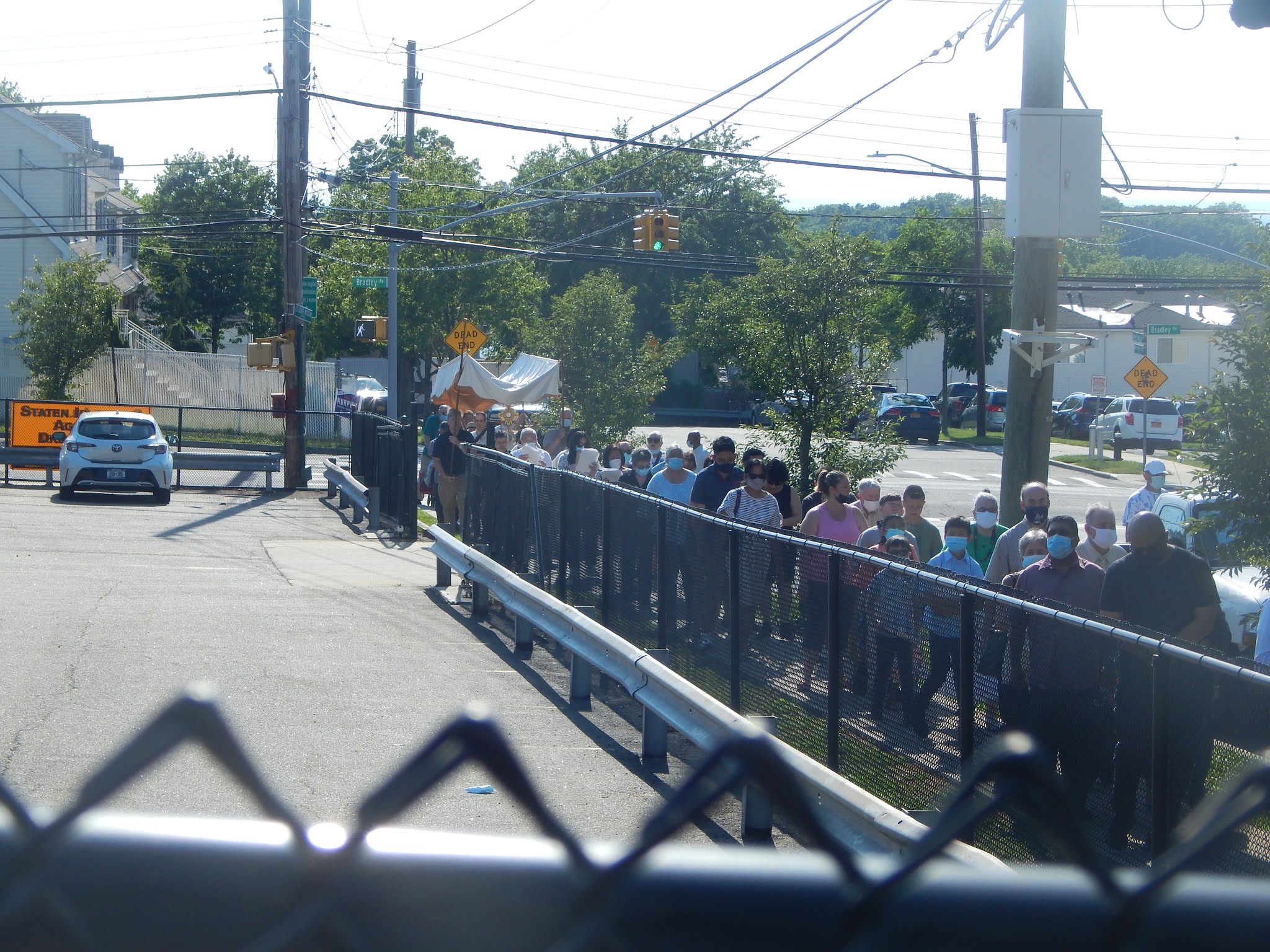
revived, and I have posted in the past on my parish’s Corpus Christi procession.Well, we did it again in this year of the Eucharistic Revival, this time
following the Saturday Vigil Mass,Here
are pictures and a video clip of our procession
And you can see us coming out of the church with an Italian Marching band
playing some hymns.
We
had a few children who had received their First Communion last month to
sprinkle rose petals ahead of the Blessed Sacrament.
“This
is the bread that came down from heaven…whoever eats this bread will live
forever.”
Today is the Solemnity of the Most Holy Body
and Blood of Christ otherwise known as the Feast of Corpus Christi.It’s interesting to read that this most holy
feast goes back to the 12th century and is technically supposed to
be celebrated on a Thursday, replicating the institution of the Eucharist at
the Last Supper on Holy Thursday.It
gets transferred to Sunday for convenience.And so, meditate on this reading from today’s Gospel.
“While they were eating, he took
bread, said the blessing, broke it, and gave it to them, and said, “Take it;
this is my body.”Then he took a cup,
gave thanks, and gave it to them, and they all drank from it.He said to them, “This is my blood of the
covenant, which will be shed for many.Amen,
I say to you, I shall not drink again the fruit of the vine until the day when
I drink it new in the kingdom of God.”
-Mark 14:22-25
This year at my church, St. Rita in
Staten Island, we started the ancient practice of processing with the Blessed
Sacrament through the neighborhood after Mass.We did this after the Saturday vigil Mass yesterday.I took some pictures of the procession.
Here we are coming out of the
church.There would be a canopy for
Blessed Sacrament.
We went around the block, two by two,
either praying out loud or signing some hymns. Our musical director brought in a trumpet
player to accompany the hymns at Mass, and he followed with his trumpet too.The kid there in the grey shirt is Matthew.
That’s the procession from behind
me.I was about a third from the
front.In front is our pastor Fr. Eugene
with the altar servers carrying a crucifix.
Our Assistant Pastor, Fr. Anthony,
carried the monstrance with the Blessed Sacrament the whole way.Apparently tradition is that the Blessed Sacrament goes in the rear of
the procession under the canopy.
Finally we turned the corner and
headed back into the church.
But from here the angle I had was
focused to the center of the canopy.I
had not wanted to go directly up to the Blessed Sacrament to take a
picture.It felt so irreverent.But from here I could capture it and zoom
in.Here.
There!There is Jesus, Body, Blood, Soul, and
Divinity.It is that which gives us
everlasting life.
Edit: I must add this in. I just came across the most brilliant homily by Bishop Robert Barron explaining this feast. It's almost 14 minutes long, but it's worth every second.
Today,
arguably the holiest day of the year, as my custom now for the last five years,
I participated in the annual Way of the Cross over the Brooklyn Bridge. It’s a sort of mini Stations of the Cross
procession, we only do five stations, but the distanced walked is about two and
three quarter miles. It starts in
Brooklyn at the St. James Cathedral-Basilica, and then the pilgrimage ensues by
crossing over the Brooklyn Bridge, stops at Manhattan’s City Hall, stops at the
World Trade Center, and concludes at lower Manhattan’s St. Peter’s Church. It’s organized by local chapter of the Communion and Liberation Movement, which is a Catholic religious organization of
religious and lay members. Fr. Richard Veras seems to be the primary
coordinator, though I don’t know if that is his role. Fr. Veras was the pastor at my parish, St.
Rita’s on Staten Island, for a number of years but has moved on. He has published a number of books and is a
monthly contributor to Magnificat
magazine.
The
form of the events has not changed in the five years. I detailed them in my 2014 entry, which you
can read here.
I
didn’t take a lot of pictures this year.
It was overcast. But here’s one
picture of the procession ahead of me on the Brooklyn Bridge.
You
can see how far long pilgrimage of people ahead of me, and I was toward the
front. The local news lists us in the
hundreds, but it seems more to my non-expert eye.
I
was able to film one of the pieces sung by the wonderful—and I do mean
wonderful with no exaggeration—Communion and Liberation choir. At the St. James Cathedral, they sing “Go to
Dark Gethsemane.” Let me preface, for
some reason my camera just would not focus on the choir. The video is blurred but I did capture the
singing.
We
passed a little garden as you come off the Brooklyn Bridge on the Manhattan
side and the tulips were in bloom.
And
of course we passed the new Liberty Tower at the World Trade Center. I don’t know what that weird sculpture is out
in front, but who understands modern art?
For
Good Friday I was going to post some pictures and video of my annual procession
of the Way of the Cross over the Brooklyn Bridge, but
the batteries in my camera crapped out just after I turned the camera on.This was the 23rd year of the
March, and that surprised me.I didn’t
realize it went back that far.I think
this was my fifth year attending.I
blogged about the first time in 2014, here.
Since
I didn’t get pictures t post, I’m going to provide one last Caryll Houselander
way of the cross station.What could be
more fitting for today, than the twelfth station.
Christ
Dies on the Cross
To His enemies this seems
to be the hour of their triumph and Christ’s defeat, but in fact it is the
supreme hour of His triumph. Now when He seems to be more helpless than He has
ever been before, He is in fact more powerful. When He seems to be more limited,
more restricted, His love is boundless, His reach across the world to the
hearts of men in all ages is infinite.
But to those who look on,
how different what appears to be happening seems to what is really happening.
How certain it seems that Christ has been overcome, that His plan of love for
the world has failed utterly, that He Himself is a failure, His “kingdom” a
pitiful delusion.
Can this be the same
Christ who only three short years ago went up into another mountain and spoke
to the multitudes, filling the heart of each individually with secret joy and
hope?—teaching the poor their own glory, revealing the secret of his personal
beatitude to each one who suffered, to each who was downtrodden or unjustly
treated, showing them each the reality of the poetry of life, the inwardness of
the kingdom which was already theirs if they could receive it with simplicity
and the values of unspoilt children?
Did he not tell them, and
did they not believe, that their very poverty clothed them, not in drab, worn garments,
but in those that, seen by the true vision, are richer than Solomon’s robes,
lovelier than the iridescent lilies growing in the fields of Palestine?
Did he not convince them
that if their hearts were pure, the kingdom of heaven was already theirs—and he
himself, who strewed the wild flowers under their feet and gave them the
morning star, their king?
But now on this other
mountainside how different everything seems to be. What hope is there now for
them? Their king is poorer than any of them. He is stripped of all that he has;
his crown is a ridiculous crown of thorns; he has nothing left of his own, not
even a grave to receive his dead body. Far from being clothed in splendour that
rivals the glory of Solomon, or beauty that rivals the wild flowers, his own
natural beauty is hidden under wounds and bruises.
“He has no comeliness
whereby men shall know him.”
He has never seemed so
helpless as He seems now, not even as a little infant in Bethlehem.
The hands that could
raise the dead to life with a touch, could heal the sick and give sight to the
blind, are nailed to the hard wood: unforgettable, stiffening in death. The
feet that blessed the delicate grass by their touch, that walked on the swiftly
moving waves of the storm at sea, are fastened down to the rough trunk and held
still. The eyes that could see into the depths of the soul are darkening with
the blindness of death. The tongue that spoke the words of eternal love is
swollen with thirst, and stiffened in death. The heart of the man who is love
is turning to a small, hard stone that a man could hold in his hand!
More bitter than all His
other suffering is the desolation of His soul, His own unutterable loneliness,
the sense of being wholly unsupported by any love, emptied out, forsaken even
by God: “. . . and at the ninth hour Jesus cried out with a loud voice, ‘Eloi,
Eloi, lama sabachthani?’ which means, ‘My God, my God, why hast thou forsaken
me?’” (Mark xv. 34).
He seemed to be quite
alone, quite defeated, dying a useless death at the end of a useless life, the
tragic life of a poor deluded dreamer who, because of his fondest delusion that
his love for the world could save it, had come to a still more tragic death, to
die alone, an object only of scorn or pity—not even hated now, since now he is
powerless—beaten. Men hate only when they fear.
“The passers-by
blasphemed against him, tossing their heads. ‘Come now,’ they said, ‘thou who
wouldst destroy the temple and build it up in three days, rescue thyself; come
down from that cross, if thou art the Son of God.’”
But Christ would not come
down from the cross—“I, if I be lifted up,” He said, “will draw all men to me.”
Now He had done just that, He had drawn all men to Him because He was dying all
of their deaths for them; He was giving Himself to them in death, so that in
their turn they would die His death, with His courage, His love, His power to
redeem.
From that moment when He
bowed His head, crying out: “Father, into thy hands I commend my spirit” and
died, everyone indwelt by Him to the end of time would die His death, with His
power to heal and strengthen and redeem themselves and other men by their
dying.
He
came to the tremendous mystery of His death alone, He felt forsaken even by
God; but from that moment until the end of time, no Christian man or woman or
child will die alone. Each one will die Christ’s death, their hands in His
hands, their feet folded upon His feet, the last beat of their hearts the beat
of His heart; and because He has made their deaths His own, theirs too will have
the power of His to save themselves and those whom they love.
Houselander, Caryll. The
Way of the Cross (pp. 79-82). Angelico Press. Kindle Edition.
Let
me leave you with this glorious hymn that is so fitting for today, “What
Wondrous Love is This.”
WE ADORE YOU, O CHRIST, AND
WE PRAISE YOU, BECAUSE BY YOUR HOLY CROSS YOU HAVE REDEEMED THE WORLD.
This
was the second year our parish—St. Rita’s Church in Staten Island, NY—celebrated
the Feast of Our Lady of Mount Carmel. I
took pictures last year and thought I posted them on the blog, but apparently
not. I couldn’t find any post. I took pictures again this year and so I’ll
post now.
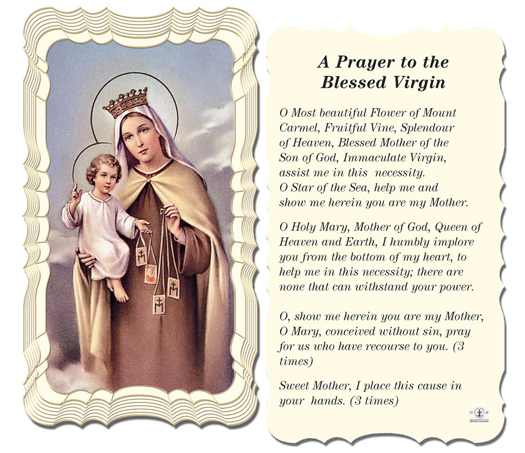
OurLady of Mount Carmelis the title of our Blessed Mother as
patroness of the Carmelite Order. Mount Carmel is the group of mountains in
northern Israel where the Carmelite hermits gathered and founded the order
shortly after the Crusades had retaken the Holy Land. The Carmelite Order has had a long and
glorious tradition all the way to today.
July 16th is the feast day, established by the appearance of
the Holy Virgin to Carmelite friar, St. Simon Stock on that day in 1251. And so Carmelites, lay and religious, have
been celebrating this feast for centuries.
This year July 16th fell on a Sunday, and so we celebrated
right after the 12:30 PM mass.
Now
the celebration of OLMC is basically an Italian feast event, and like many
summer time Italian feasts, there is a statue of the saint which is carried out
of the church, placed on a large rolling cart or dolly, and paraded through the
neighborhood with a marching band.
So
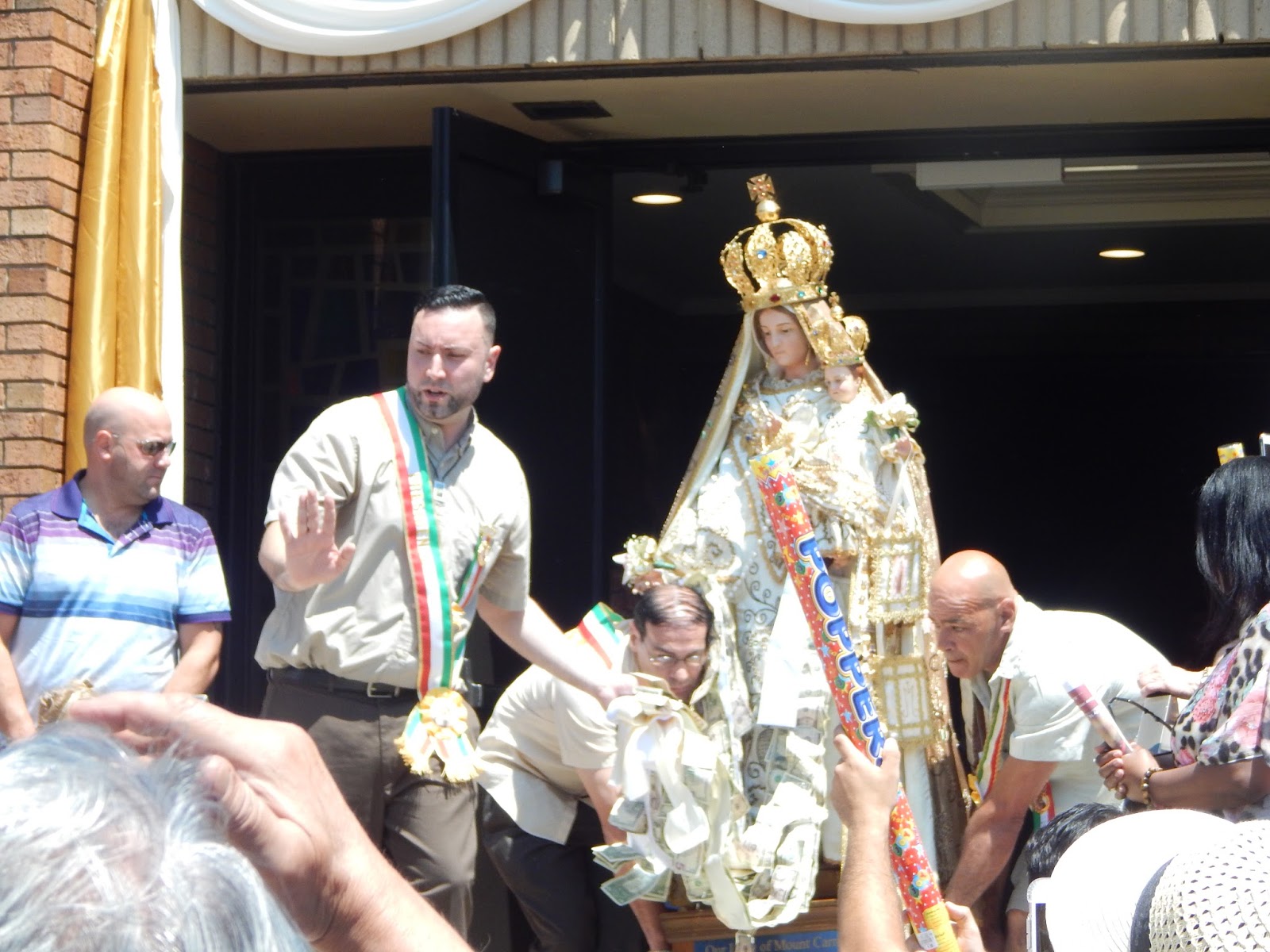
here is the statue being carried out of the church.
We
had an explosion of confetti once it was out and my camera caught it.
The
professionals then placed it on top of the dolly and locked it in.
The
statue is beautifully dressed. Here are
some close ups.
There
are lots of banners and flags in the procession.
Since
this is their feast day, here’s one of the Lay Carmelites.
We
actually had two Italian marching bands, one in the front and one in the
back. Here’s the one in the front.
And
the procession went through the neighborhood.
Last year we handed out prayer cards and scapulars as we walked. For some reason we didn’t do it this year.
It
was a very hot and humid day. We only
marched a few blocks and around, maybe amounting to a half mile. Finally we concluded with pizza and cookies
and fresh soft drinks at the church auditorium.
The
dress’s train are actually ribbons pinned with money that parishioners
donated.
I
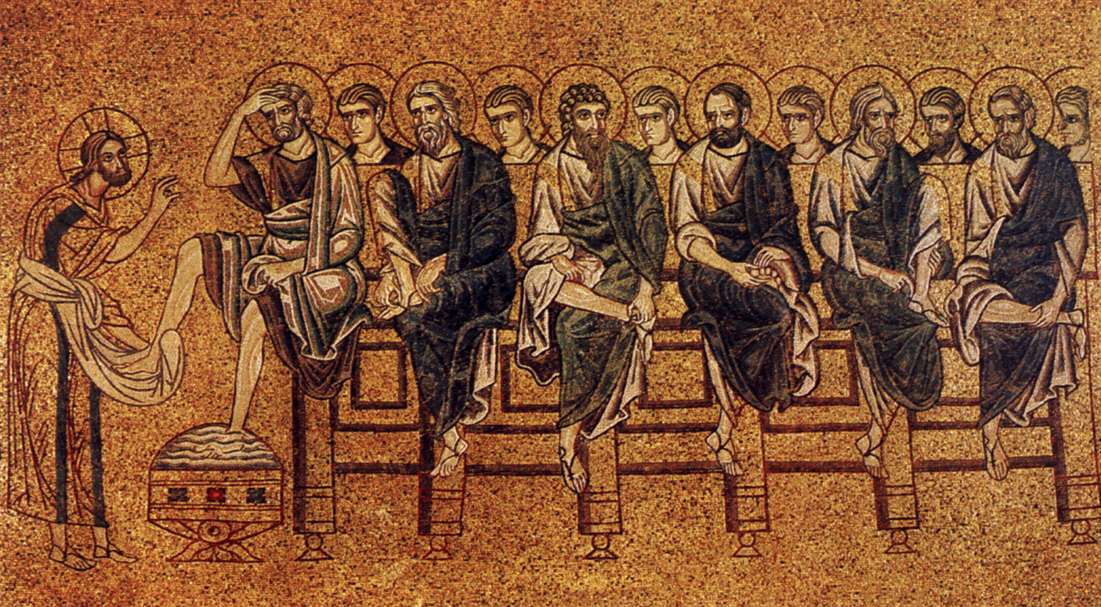
never got to mention last week’s Easter Triduum events. I had the honor of being asked to be one of
the twelve that had their feet washed at the Holy Thursday Mass. At least I think it was an honor. Given
that Pope Francis the last few years has been picking criminals to wash their
feet I hope the new pastor at our church who picked me doesn’t think I’m a
crook…lol. Seriously, it was a huge
honor. Actually there was an interesting
mix of people: six men and six women, some old and young, and couple of people
who were converting at the Easter Vigil.
The pastor only washed our right feet.
My wife has long made fun of my toes (they tend to curl up—don’t laugh—I
know reader you’re laughing!) so I was a little self-conscious. Someone suggested I get a pedicure, but no I
couldn’t stoop to that. I wouldn’t even know
where to get one. I did make sure my toe
nails were clean, especially underneath.
Unfortunately there were no pictures, but I’ll leave you with a painting
from an unknown artist. I assume it goes
back to the Middle Ages.
On
Good Friday I went on the Way of the Cross procession as I did last year. You can read about last year’s procession and
see pictures at the photo essay I posted.
It was essentially the same thing. I did get to see Fr. Richard Veras, who
organizes it, again. He was the pastor
at my parish who to my displeasure was transfer from our parish last June. I blogged about it last year here.
Here
are a few additional pictures from this year’s procession.
Here’s
the absolutely wonderful Communion and Liberation choir that sang at each
station. Here at the St. James
Cathedral-Basilica in Downtown Brooklyn.
Here
on top of the Brooklyn Bridge. It was a
drizzly day.
The
choir at the final stop, St. Peter’s Church in Lower Manhattan.
You can see the contrast in church alter styles from the previous church. And
finally Fr, Veras giving a homily.
Fr,
Veras gave the very best homilies I’ve ever had the privilege of hearing. I so miss them.
I mentioned yesterday I was participating in the Way of the Cross GoodFriday procession in New York City.You can find links on yesterday’s post to
what The Way of the Cross entails.Well,
I participated and here is a little photo essay of the procession.
One correction from yesterday’s post.There weren’t fourteen stops on the procession reflecting the fourteen
stations of the cross.That was an
assumption on my part that turned out to be wrong.There were five stops where we came to a halt
and read a Gospel reading (from the Passion chapters of St. John’s Gospel), read
a meditation from the writings of Luigi Giussani (the event was sponsored by
the local Communion and Liberation movement), listened to a mini homily by Fr.
Richard Veras (my pastor at St. Rita’s who I mentioned here
), and sang hymns.The five stations
were (1) at St. James Cathedral in Brooklyn, (2) at the Brooklyn Bridge, (3) at
City Hall in Manhattan, (4) at Ground Zero where 9-11 World Trade Center
tragedy occurred, and (5) at St. Peter’s Church in Lower Manhattan.
This is inside the St. James Cathedral where the Communion and Liberation Choir were
magnificent.
And then onto the Brooklyn streets.
The highlight for me was the procession over the Brooklyn Bridge.I had never walked over before. I took lots of wonderful pictures which I'll have to reserve for another photo essay. The tall building on the left with the antenna is the new Liberty Tower that replaced the Twin Towers that collapsed.
You can see the hundreds of people in front of me, and I would say there were even more behind me. There must have been a thousand people that participated. At the head of the procession was a man carrying a wooden cross, but
within the crowd there was a man carrying a statue of a black Jesus carrying
his cross.
At Ground Zero. We weren’t actually at Ground Zero since the
construction has closed it off, but about a block away.I didn’t get a good picture but I have this.
And finally at St. Peter’s. It looks a lot prettier on the inside than the outside.
It was a great experience.The
only difficulty was getting to a bathroom.The bus left in the morning at 8:30 and the last station was at about
1:30 PM.Thank God St. Peter’s had a
bathroom for us to use, even though the line was very long.
UPDATE (April, 19, 2014 @ 9:19 AM):
New York Post reports this morning that over 3000 participated in the
procession.Whoo hoo!That’s a better turn out than I imagined.

.jpg)