"Love follows knowledge."
"Beauty above all beauty!"
– St. Catherine of Siena

Showing posts with label St. Dominic. Show all posts

Friday, October 31, 2025

All Saints Day Meditation: Solemnity of All Saints

Tomorrow is the Solemnity of All Saints, commonly called All Saints Day.  It is normally a holy day of obligation but in my neck of the world, since it falls on a Saturday this year, we are excused from the obligation.  Still we are having a special Mass at my parish for those who wish to attend.  Last year we had Cardinal Dolan come in to celebrate the display of relics our pastor, a great collector of relics, placed in cabinets situated about the Church.  https://ashesfromburntroses.blogspot.com/2024/11/faith-filled-friday-all-saints-day-at.html  There will not be a special celebrant this year, but we will celebrate All Saints through those same relics.  It will be special. 

The Gospel passage for All Saints Day is the same every year, the Beatitudes from the Sermon on the Mount in Matthew’s Gospel.


Here is the Gospel passage.


When Jesus saw the crowds, he went up the mountain,

and after he had sat down, his disciples came to him.

He began to teach them, saying:


"Blessed are the poor in spirit,

for theirs is the Kingdom of heaven.

Blessed are they who mourn,

for they will be comforted.

Blessed are the meek,

for they will inherit the land.

Blessed are they who hunger and thirst for righteousness,

for they will be satisfied.

Blessed are the merciful,

for they will be shown mercy.

Blessed are the clean of heart,

for they will see God.

Blessed are the peacemakers,

for they will be called children of God.

Blessed are they who are persecuted for the sake of righteousness,

for theirs is the Kingdom of heaven.

Blessed are you when they insult you and persecute you

and utter every kind of evil against you falsely because of me.

Rejoice and be glad,

for your reward will be great in heaven."

~Mt 5:1-12


This is a beautiful explanation of what All Saints Day is and why we celebrate it, put together by the YouTube channel, Catholic Saints and Feasts.


The one homily I will embed will come from Cardinal Wilton Gregory of Washington DC speaking on the heroic virtues of St. Dominic de Guzmán.


To pray, to bless, to preach!


All Saints Day Meditation: "The only real sadness, the only real failure, the only great tragedy in life, is not to become a saint."  (French Catholic novelist Leon Bloy)


Let us honor one of the new saints recently canonized in the last few months, one that is ideal with today’s Gospel, the “Man of the Beatitudes.”


“Jesus comes to me every morning in Holy Communion, and I return the visit in the poor.”  -St. Pier Giorgio Frassati.

Friday, August 8, 2025

Faith Filled Friday: Memorial of St. Dominic

Today, August 8th, is the Memorial of St. Dominic de Guzman, founder of the Order of Preachers, commonly referred to as the Dominican Order.  But the official name is the Order of Preachers, and all Dominican religious have an “O.P.” suffice after their name.


As you may know, I am a Lay Dominican.  (Actually I am about three months from being fully professed!  It’s getting here!)  If you don’t know what a Lay Dominican is, I explained in detail about four years ago.   As a Lay Dominican, I have a special devotion to St. Dominic, and I have read three biographies, and in the middle of a fourth.  If you are looking for biography of St. Dominic to read, I recommend this one, St. Dominic (Cross and Crown Series of Spirituality) by Sister Mary Jean Dorcy O.P.  


Some of the other biographies may be more detailed or may have more hagiography, if that is what you like, but none are better written than Sister Mary Jean’s.  Her prose is extraordinary. 

To commemorate his feast day, I thought today’s Office of Readings from the Divine Office was captured St. Dominic the man beautifully.  Let me post it.


Second reading

From various writings on the history of the Order of Preachers

He spoke with God or about God


Dominic possessed such great integrity and was so strongly motivated by divine love, that without a doubt he proved to be a bearer of honor and grace. He was a man of great equanimity, except when moved to compassion and mercy. And since a joyful heart animates the face, he displayed the peaceful composure of a spiritual man in the kindness he manifested outwardly and by the cheerfulness of his countenance.


Wherever he went he showed himself in word and deed to be a man of the Gospel. During the day no one was more community-minded or pleasant toward his brothers and associates. During the night hours no one was more persistent in every kind of vigil and supplication. He seldom spoke unless it was with God, that is, in prayer, or about God, and in this matter he instructed his brothers.


Frequently he made a special personal petition that God would deign to grant him a genuine charity, effective in caring for and obtaining the salvation of men. For he believed that only then would he be truly a member of Christ, when he had given himself totally for the salvation of men, just as the Lord Jesus, the Savior of all, had offered himself completely for our salvation. So, for this work, after a lengthy period of careful and provident planning, he founded the Order of Friars Preachers.


In his conversations and letters he often urged the brothers of the Order to study constantly the Old and New Testaments. He always carried with him the gospel according to Matthew and the epistles of Paul, and so well did he study them that he almost knew them from memory.


Two or three times he was chosen bishop, but he always refused, preferring to live with his brothers in poverty. Throughout his life, he preserved the honor of his virginity. He desired to be scourged and cut to pieces, and so die for the faith of Christ. Of him Pope Gregory IX declared: “I knew him as a steadfast follower of the apostolic way of life. There is no doubt that he is in heaven, sharing in the glory of the apostles themselves.”


I suspect this came mostly from Jordan of Saxony's writings on St. Dominic or perhaps from his canonization.

St. Dominic pray for us.


Friday, October 21, 2022

Faith Filled Friday: St. Dominic Receiving the Rosary

October 7th was the Feast of Our Lady of the Rosary.  Last year I wrote up a detailed post on the history of the feast day, how it was originally called the Feast of Our Lady of Victory and linked to the Battle of Lepanto.  Read that post because it was very informative.  

I know it’s a few weeks late but I took the pictures and I want to post them.  The pastor at our parish, Fr. Eugene, loves sacramental and seems to have an affinity for statues and relics.  When the feast day of a particular saint comes around, Fr. Eugene will set up a statue of that saint off to the left side of the altar decorated with flowers.  Now this year for Our Lady of the Rosary he set up a small statue of the Blessed Mother handing St. Dominic a rosary. 

Before I get to the pictures, let me tell of the legend of how we got the rosary.  In 1208, it was held that St. Dominic prayed to the Virgin Mary for help in overcoming the Albigensian heresy in southern France and she in a vision gave him the rosary.  From John Roskoski at Catholic365:


It was during this time that the tradition of the Rosary comes to us. The form in which it has come down to us will best be stated in the words of P. Corneluis de Snecka, a disciple of the French Dominican Alan de la Roche:


We read that at the time when he was preaching to the Albigenses, St. Dominic at first obtained but scanty success: and that one day, complaining of this in pious prayer to our Blessed Lady, she deigned to reply to him, saying: ’Wonder not that you have obtained so little fruit by your labors, you have spent them on barren soil, not yet watered with the dew of Divine grace. When God willed to renew the face of the earth, He began by sending down on it the fertilizing rain of the Angelic Salutation. Therefore, preach my Psalter composed of 150 Angelic Salutations and 15 Our Fathers, and you will obtain an abundant harvest.’


The place of the revelation was the church of Prouille and the time was 1208. The claim of place and time are most strongly supported by the tradition of the Dominican Order. Pope Leo XIII affirmed over and over the Dominican origin of the Rosary and in a letter to the Bishop of Carcassone (1889), he accepts the tradition of Prouille as the place where the Blessed Virgin Mary appeared to St. Dominic, revealing this devotion. The tradition that Mary first revealed the Rosary devotion to St. Dominic is supported by 13 popes. St. Dominic went into the villages of the heretics, gathered the people, and preached to them the mysteries of salvation – the Incarnation, the Redemption, Eternal Life. As the Holy Virgin had taught him to do, he distinguished the different kinds of mysteries and after each short instruction he had ten Hail Marys recited. St. Dominic found great success in this new devotion, bringing about the conversion of the Albigensians.

Well, it is a disputed story, but we Dominicans believe it. 

Here is a picture of the statue at my parish, St. Rita’s Church in Staten Island, NY, and then a zoomed in picture.


Afterwards I asked Fr. Eugene where that statue was normally placed.  I had never seen it before.  He said it was in his office.  I found that strange.  Fr. Eugene is a Lay Carmelite.  Why would he have a statue f St. Dominic in his office?  Then I remembered.  St. Rita many years back had a chapter of Dominican Sisters at the parish, teaching at the parish school. 

Well, it made my Dominican heart jump for joy when I saw it at Mass.

Tuesday, October 19, 2021

What is a Lay Dominican?

No, it’s not a person who comes from the island nation of the Dominican Republic, though the island nation was named after the same St. Dominic de Guzman, the founder of what is informally referred to as the Dominican Order.  So the Lay Dominicans are the lay (non-consecrated) branch of the Catholic religious order formally known as the Order of Preachers, founded by St. Dominic and officially approved by the papacy on December 22nd 1216.  Yes, we had our 800th anniversary a few years ago.  That still might be a bit much to comprehend, especially if you are not Catholic.  Let me break this down in a scholastic way—in the fashion of St. Thomas Aquinas the premier Dominican of scholasticism—so that Catholics and non-Catholics alike can understand.


What is a religious order? 

A religious order is a community of people who come together to live under a rule of life.  The first communities that could be construed as religious orders, though there was nothing official about them, were the desert fathers and mothers of the fourth century.  Once the Roman persecution of Christianity ended under the Emperor Constantine, life for Christians suddenly became easier and less stressful.  Not only were they no longer persecuted, but they were exalted.  You would think everyone would be happy with that.  However, many felt that Christianity should have a certain sense of carrying the cross for one’s faith. 

When Christianity came out from underground and became the accepted religion, some people found living out their faith too easy and somewhat tainted by the worldliness of everyday life.  So some decided to remove themselves from society and go to the desert to live out their faith away from the world.  They came to be known as the Desert Fathers and Mothers.  Over time groups formed and decided to live in common, and that became the start of monasticism.  People formed religious groups with rules of practice to try to live out their version of the Gospel. 


I should emphasize that all religious orders are attempting to emulate some aspect of life as portrayed in the Gospels.
  I imagine the early hermits were trying to emulate Christ or John the Baptist alone in the desert.  When communities in common formed and created monasteries to seclude themselves from worldly society, monastic life then was an emulating of the apostles and the common life as delineated in the early chapters of Acts of the Apostles.  Both the Western Latin and Eastern Greek sides of the Church created monasteries that lived under their specific rules.  In fact as I looked it up, all the Apostolic Churches (Coptic, Byzantine, Eastern, Roman, and others) have some form of monastic life with religious called monks and nuns.  I don’t know that much about the others, so I will limit myself to those of the Roman Catholic Church.

In the west, monasteries in time essentially gravitated to the Rule of St.Benedict, and the most well-known of the medieval monasteries were Benedictine.  It should be pointed out here that monasteries were either all male or all female, which gave women in their monasteries an unprecedented amount of freedom and autonomy and access to education, administering and leading their monasteries.  Saints Scholastica (St. Benedict’s sister) and Hildegard of Bingen had notable accomplishments as women that were not possible in the secular world.  Benedictine monasteries became so popular that various versions formed, such as Cistercian, Trappist, and Carthusians, each with their own version of the Rule.  At the heart of St. Benedict’s rule is the notion of work and pray.  The day was divided into the eight liturgical hours where community prayer was held and in between was either work or sleep: ora et labora, pray and work. 

It is a misunderstanding of the early Middle Ages to think that learning and knowledge degenerated as a result of Christianity.  These Christian monasteries actually preserved knowledge as the Classical World underwent a collapse from the barbarian take over.  Today there are those who call for the Benedictine Option in dealing with the current collapse of Judeo-Christian values, recalling the early Benedictine monasteries as they preserved learning and culture.  Even Protestants have talked about segregating themselves from the caustic post-Christian culture we have today.  But I think most religious at some point wish to separate from the surrounding culture.  It’s a recurring impulse among religious people.

So all these orders of the first millennia were essentially separatists from society but by the high Middle Ages when cities became more prominent again across Europe there was a need to engage with the general population.  Orders formed to address various public needs: Franciscans, Dominicans, Carmelites, and others.  These orders were not separated in monasteries but engaged the general public, mostly fulfilling some sort of role and providing a service to the community.  So instead of separating from society the new orders were itinerant, moving about, and teaching.  The Dominicans were established to combat the heretical theological groups that had formed in Southern France (the Albigensians) but also to address the general ignorance of the faith that was about.  Ignorance of the faith has not been limited to our times.

And in time more religious orders formed.  By the late middle ages you had the Jesuits, whose charism is missionary, and then by the Renaissance and up to this day you have a plethora of orders who go out and address needs such as poverty or health.  Little Sisters of the Poor is one that's been in the news that you may have heard; or you may have heard of Mother Teresa's order (Sisters of Charity), or the Salesians, who are known for helping and teaching poor children across the world. 

Notice the trend over the two millennia.  What started from individual hermits developed to communities, then to groups that engage the public, and finally to activist groups.  These orders which at one time were limited to enclosed monasteries spread across the world, attempting to deal with the direct needs of others.  While there are still hermits and monasteries, the impulse over time has been not inward nor secluded but outward.

This impulse to strive for holiness by forming a community and living under a rule is not limited to Catholics and Orthodox.  In some ways Protestants also have informal orders, though they may not call it that.  Protestants send out missionaries across the world.  Some live in separated communities.  Take the Amish, for instance.  They live under a rule based on a Biblical understanding of holiness.  One of my favorite historical Protestant denominations are the Shakers who secluded themselves under a very strict rule, which unfortunately caused their extinction.  I also think of the Salvation Army as an informal Protestant order.  And this phenomena is not limited to just Christians.  We know Buddhists have monasteries with monks and nuns.  Can’t the Hasidim in Judaism be thought of as living in a community under a rule of life?  It’s more complicated than that, but on some level there are similarities. 

So in summary a religious order is a community that have ordered their lives around a particular rule in effort to achieve a greater holiness.


What is the Dominican Order?

Having outlined the essence of a religious order, what then is specifically the Order of Preachers, which is the official name of the Dominicans?  St. Dominic in his humility emphatically did not to want the order to be named after him, but reverence held for the founding father could not totally honor that wish.  Just as the Franciscans are named after their founder, St. Francis of Assisi, the Order of Preachers are informally, though fairly commonly, referred to as the Dominicans.


As I mentioned, the need for the Dominican Order came about by a particular heresy that had formed in southern France by the 12th century, but the need was compounded by an awareness of a general ignorance about the faith.
  Frankly I’m inclined to believe that such ignorance exists in every century; just look around us today.  One can understand the ignorance of a non-literate agrarian society, but what’s our excuse?  So the Order of Preachers were set up to explain the faith, and one can only credibly communicate the faith if one lives the faith.  So those consecrated to religious life take vows of chastity, poverty, and obedience. 

To combat ignorance and heresy, what was required then was study and learning.  St. Dominic’s great innovation on the Benedictine Rule was to replace work with study.  So the Dominican approach to holiness was to study the faith and communicate it to others.  And so, he called it the Order of Preachers.  Here too they saw themselves as fulfilling an aspect of Gospel life.  The same impulse to strive to a greater holiness than the world offered was still at work.  The Dominicans can trace their charism to a passage in the first chapter of Mark:


Rising very early before dawn, he [Jesus] left and went off to a deserted place, where he prayed.  Simon and those who were with him pursued him and on finding him said, “Everyone is looking for you.”  He told them, “Let us go on to the nearby villages that I may preach there also. For this purpose have I have come.”  So he went into their synagogues, preaching and driving out demons throughout the whole of Galilee. (Mk 1:35-39)

As the Desert Fathers saw themselves as embracing Christ’s life in the desert, and as the Benedictines saw themselves as embracing the apostles after the Ascension, the Dominicans saw themselves as embracing Christ the preacher, at times retreating to be contemplative, and then other times engaging the public with His Word.  Notice the contemplation, which amounts to study and prayer, but then the going out and preaching, the engagement with the world.  That's the heart of Dominican spirituality.  

While the first Dominicans were mostly students in the universities, in short order the universities across Europe were filled with Dominican friars teaching and leading studies.  It’s possible to see a synergistic effect between the rise of the universities in the High Middle Ages and the rise of the Dominican Order.  As the Universities grew, so did the Dominican Order; as the Dominican Order grew, so did learning, publishing, and debate accelerate in the universities.  It is interesting to see how spread across Europe were those early Dominicans.  Just to name a few from its first two generations: St. Dominic was from Spain; his successor, Bl. Jordan of Saxony (Northern Germany), St. Albert the Great (Southern Germany), Giles of Santarém (Portugal), Reginald of Orleans (France), St. Hyacinth of Poland, St. Thomas Aquinas (Italy), and Gilbert of Fresney, who established the first chapter at Oxford in 1221, just five years after the Order was officially formed.  If there was a university in your medieval city, there were friars teaching in it.

One of the ways to describe the nature of Dominican spirituality is by listing the four pillars of Dominican life: prayer, study, community, and apostolate.  Prayer and study are rather obvious, and community is simply the fact that the religious live in common, such as a convent for nuns, a priory for sisters, or a friary for friars.  But community can also imply a larger shared community of the heart for all Dominicans, not just those you share an abode.   Apostolate is a personal or group activity that one does to bring Christ to the world.  It’s roughly synonymous with how people use the word “ministry” such as some might consider providing or working at a soup kitchen “their ministry.”  For Dominicans, it’s usually more of an intellectual endeavor, though it doesn’t have to be.  A Dominican’s life, then, is centered on those four pillars.

The other way to explain Dominican spirituality is understand three mottos of the order.  First is Veritas, or “Truth,” and this refers to communicating the Truth of the Gospel.  “For this I was born and for this I came into the world, to testify to the truth” Jesus says in Jn 18:37.  So one of the Dominican missions is to testify to the Truth.  A second motto is Laudare, benedicere, praedicare, “To praise, to bless, and to preach.”  That I think shows the dual nature of Dominican spirituality: contemplative prayer (blessing and praising) and reaching out to communicate (preaching). 

The third motto is I think the most insightful: Contemplata aliis trader, or “to hand down to others the fruits of contemplation."  A Dominican doesn’t study for the sake of study or for the sake of mere contemplation.  He must hand down and share the fruits of his learning and his contemplation.  He or she studies to bring the wisdom and truth of the Gospels into the world, and therefore shine a light to testify to the light that enlightens everyone. 


I should also point out how varied the Order has been over the centuries.  Yes, Thomas Aquinas, perhaps the most well-known Dominican, is known for his philosophic and theological writings, and to many that is the ideal when they think of Dominicans.  But Dominicans have been part of many disciplines.  Quite a number were leaders in medieval law.   A number of Dominicans were missionaries across the globe as they followed the great explorers.  Friar Bartolome de las Casas may have been one of the first human rights activists in history as he pleaded to the King of Spain for the rights and dignity of the natives in the New World.  There were Dominicans who explored the sciences, such as St. Albert the Great.   Famous mystics like Catherine of Siena and Meister Eckhart.  Writers and poets such Henry Susso, Matteo Bandello, who a few of his stories found their way into Shakespeare’s plays, and Sigrid Undset, the 20th century Norwegian novelist who won the Nobel Prize in literature.  There were great painters such as Fra Bartolomeo and the extraordinary Fra Angelico.  All Dominicans who preached the faith through their special God given talents nurtured through Dominican spirituality.


What is a Lay Dominican?

We finally come to the question.  A Lay Dominican, also referred to as a Third Order Dominican—the friars being the First Order, the sisters being the Second, and the laity being the Third—are a branch of the Order of Preachers reserved for the laity.  Lay people began being attracted to the overall Order almost immediately after the Order’s founding, culminating in an official recognition by the year 1286.  We are approaching 750 years of existence.  Some of the Dominican’s most famous saints were actually Third Order, such as St. Catherine of Siena.  A Lay Dominican is obviously a non-consecrated member, who does not take vows of poverty and chastity.  Instead of vows we do make promises, which are to live to the rule as modified for the laity and live out a Dominican spirituality. 


What does that mean exactly?  That can be answered by how we address the four pillars I mentioned above. 

(1) Prayer:  We are required to pray daily two of the liturgical hours of the Divine Office, Lauds (Morning Prayer) and Vespers (Evening Prayer) and to pray a daily rosary.  Each of the three takes about fifteen minutes.  We are required to attend Mass daily if possible (not possible for me, I work, but I try to catch a service on TV) and go to Confession once a month, which I admit am woefully delinquent. 

(2) Study.  We are required to read scripture constantly, read religious books that enlighten scripture and increase devotion, and whatever may help support your particular apostolate.  The formation process, which lasts five years—which follows the same process as the religious, that is Novice, Postulant, Temporary Promise, Final Promise—requires one to learn the faith and its history through a series of study modules.

(3) Community.  One participates in and supports the Dominican community.  The Order is an international organization, broken down into provinces, sub broken down into regions, and finally chapters.  The headquarters are located in Rome at the Basilica of Santa Sabina, which is a church that dates back to the year 432.  I count about forty provinces worldwide, and there are four in the United States.  A chapter meeting is once a month, unless you have some special activities that could lead to meet more frequently.  A regional meeting is about once a quarter, but attendance to those are optional, unless you’re an officer in the chapter.  I’ve never attended above a regional meeting.  Annual dues are a very reasonable roughly $100 per year, depending on your chapter. 

(4) Apostolate.  First each chapter is assigned an apostolate to work on together.  Our chapter has been assigned ending human trafficking, which is not an easy endeavor to work toward.  There aren’t any national or local marches and events to participate in.  What we’ve done is mostly written to legislators and pray on the issue and when the subject happens to come up in conversation try to raise awareness.  Second, we each have our own personal apostolate, which doesn’t have to be very elaborate.  Some of the older members mostly support through prayer.  Some teach catechism at parishes or help out their churches in some way.  My apostolate includes moderating a Catholic book club at Goodreads, maintaining this blog where I write about the goodness, truth, and beauty of literature (sometimes dabbling in art and music as well), and where I also post devotional meditations and other Catholic information.  Well, you know what I do here.  I also participate in the pro-life movement, such as praying in front of abortion facilities and attending the annual March in Washington.  My apostolate keeps me busy.

God bless.  If any of this interests you and you feel you have a calling to be a Lay Dominican, either contact me or try one of these links: The Northeast Province in the United States, or the link on laity from the main Order of Preachers website.  

I hope that gave people an understanding of religious orders, of the Dominican Order, and of Lay Dominicans.  I do try to live my faith.  As C.S. Lewis said, “I believe in Christianity as I believe that the sun has risen: not only because I see it, but because by it I see everything else.”


Friday, August 6, 2021

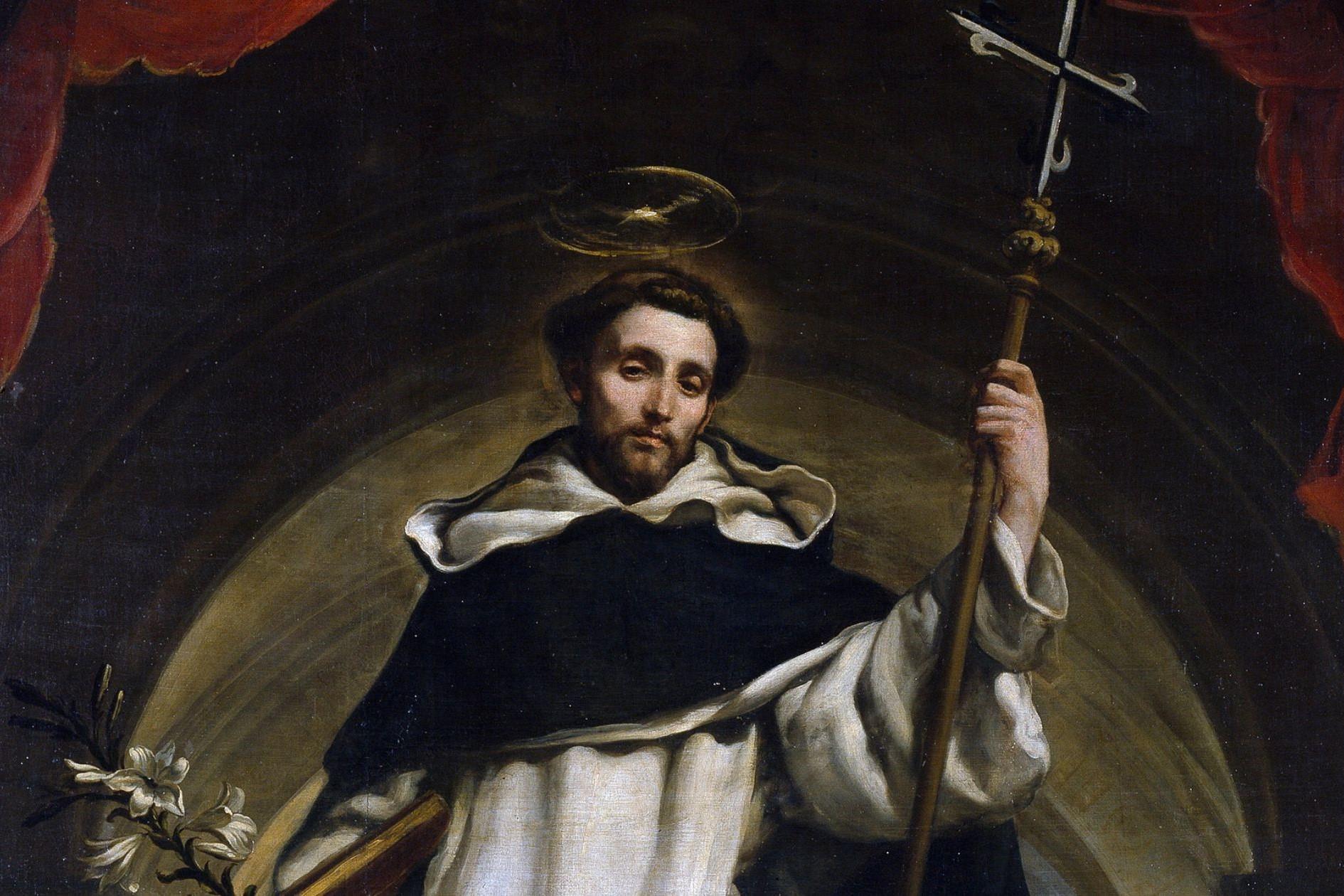
Faith Filled Friday: Saint Dominic de Guzman

On Sunday August 8th will be the feast day of St. Dominic de Guzman, founder of the Order of Preachers, commonly known as the Dominicans.  This is not only the annual feast day, but, having died in 1221, the 800th anniversary of his death. 

St. Dominic is not as well-known as his contemporary, St. Francis of Assisi, but both near simultaneously founded mendicant orders which almost defined Catholicism in the late Middle Ages.  St. Dominic had the vision to realize that a religious order was needed to preach the Gospel to overturn the heresies that had built up in his time.  As I think about all times build up heresies.  We have had heresies from the first century on, and just look around today and notice how many heresies exist.  In order to preach, St. Dominic realized that his friars needed to study, and so learning and communicating became a foundational element to the charism of Dominicans.  Ultimately all learning gained must be shared as a fruit of the prayerful process.  It is meant for the salvation of souls.

By the way, St. Dominic, ever so humble, never wanted his order to be named after him, and so it is not.  It is and has always been officially the Order of Preachers.  It was after his death that his name was unofficially linked to the order.

What was Dominic like?  A couple of years ago I reviewed here The Life of Saint Dominic by Augusta Theodosia Drane.  I have lots of little excerpts to provide a portrait.  If I were to provide some adjectives I would say: humility, kindness, gentleness.  He connected with people that made others feel dignified.  He was just loved as a man and leader.  The Middle Ages are not known as a time where women were allowed to self-determination, but one of the first acts Dominic ever did was create a place and sanctuary for the women who converted from the Albigensian heresy and allowed them self-government in their own monastery.  I wrote about the establishment of one of these convents in highlighting the icon called “The Madonna Advocata.”  

Sr. Marie Trainar, O.P. writes at the Order of Preachers website that while learning was important to evangelization, what must go along with it is personal holiness.  To preach the holy, one had to live holy.


What is striking about Dominic is that he was perfectly attuned to “the urgent need of his time” (PG 2). Now, as Pope Francis points out, this need was twofold. There was the need for a new evangelization, to which St. Dominic responded with poor, itinerant preaching; but there was, “equally important, […] a summons to holiness in the living communion of the Church” (PG 2). And Dominic understood at once that without a lived holiness, his own and that of his communities, preaching would sooner or later be doomed to failure, that without this resolute return to the way of life of the first Christian community, the word of the Gospel would be lost in the hubbub of the din of the times.

Last year I also reviewed In the Image of Saint Dominic: Nine Portraits of Dominican Life by Guy Bedouelle, O.P. where the author, a Dominican himself, provides portraits of nine famous Dominicans and how their personas somehow reflect and exude St. Dominic, their founder.  You can read about it here and in Part 2 here.   

Now I’m going to provide another little insight in the great man.  This is a passage from The Gifts of the Holy Spirit in the Dominican Saints by Ambroise Gardeil, O. P.  The premise of the book is that Gardeil takes one of the gifts of the Holy Spirit and demonstrating how they are manifest in particular Dominican saint.  For St. Dominic Gardeil attributes the gift of knowledge, but he goes back to an episode in Dominic’s life that reveals innate knowledge beyond his youth.


His vocation is foreshadowed in that distant episode of his student life when a famine was raging in Polencia.  Dominic sold his books, his treasure, saying, “How can one study upon dead skins while there are men dying of hunger?”  When one day a more fearful error which poison’s men’s souls, was revealed to a heart thus disposed from on high, the whole of the knowledge which he had acquired during twenty years of silent study adapted itself to save them.  Behold him on that night in Toulouse when the divine call was revealed to him in that discussion with the host he sought to convert.  The same spirit which had wrung from his compassionate heart that cry of pity for the starving now animated him “to give knowledge of salvation to his people.”  All the while he was conversing, he sought earnestly for some arguments which could affect his host.  He made himself aware of his moral and intellectual condition: he wished to discover the common idea, the truth admitted by both parties, a ray of God still preserved by the misled spirit, upon which he could draw to rekindle the light.  At this moment, unquestionably he would sell, as “dead skins,” all the knowledge he had acquired by the labor and meditations of twenty years to find the right word, the decisive phrase, which would deliver and satisfy this soul.  (p. 72-3)

So think of it.  There are a couple of parts to that passage that require some explanation.  Here is Dominic a student at a university and while a famine is causing local starvation, Dominic sells his books to raise money for others to eat.  Just think how in the 13th century books were preciously difficult to come by and the sacrifice one must make to sell them.  If Dominic were anything like me, giving up ones books is like tearing part of my insides out.  And yet he did it.

The other part of that passage refers to the host of an Inn Dominic was staying in his travels who believed in the Abignesian heresy. The legend goes that Dominic stayed up all night with the man speaking theology, and by the morning had converted the man out of his heresy.  It was this incident that gave Dominic the idea of a preaching order, which of course would ultimately become his order.

So as you can see I have written much about St. Dominic and the Dominican Order over the years.  I may have alluded to this in passing, but I’m going to reveal it now officially.  I have been studying and undergoing the process of being a Lay Dominican.  I have completed postulancy and novitiate years, and am ready to take my temporary promise, also called the first promise.  Covid has slowed things down but God willing I will take that promise in the fall.  Three years from temporary promise one becomes fully professed with a final promise.  May I also be shaped into the image of St. Dominic.  Pray for me that I complete it.

Finally I leave you with this picture of a statue of St. Dominic.  You don’t see too many statues of St. Dominic.


I took this while at a funeral Mass for a close friend of 43 years—we knew each other since our teens!—at a church in Brooklyn named after St. Dominic.   And get this, my friend’s middle name I found out was Dominic.  I had never known that in all the years.  There are no coincidences in life!  So say a prayer also for the repose of my friend Joseph Dominic. 

Pray for us St. Dominic and happy anniversary of the 800th year entering heaven.

Edit:  Great article from Catholic World Report commemorating the feast day, “In praise of St. Dominic and the Dominicans” by Peter M.J. Stravinskas.  Well worth reading.


Friday, March 5, 2021

Faith Filled Friday: The Madonna Advocata

I had never heard of this icon, and I thought I knew a lot about the Dominican Order, the Order of Preachers.  The story goes back 800 years ago when on February 28th, 1221 St. Dominic de Guzmán established a monastery of nuns in Rome.  From the Catholic News Agency, "St. Dominic entrusted this Marian icon to nuns in Rome 800 years ago":  

Eight hundred years ago, a barefoot St. Dominic carried an icon of the Virgin Mary across Rome to entrust the Marian image to a new community of cloistered nuns, who have safeguarded the icon within the walls of their convent to this day.


The icon, known as the “Advocata,” can be found today in a small chapel on Rome’s highest hill, in the Church of Santa Maria del Rosario on Monte Mario.

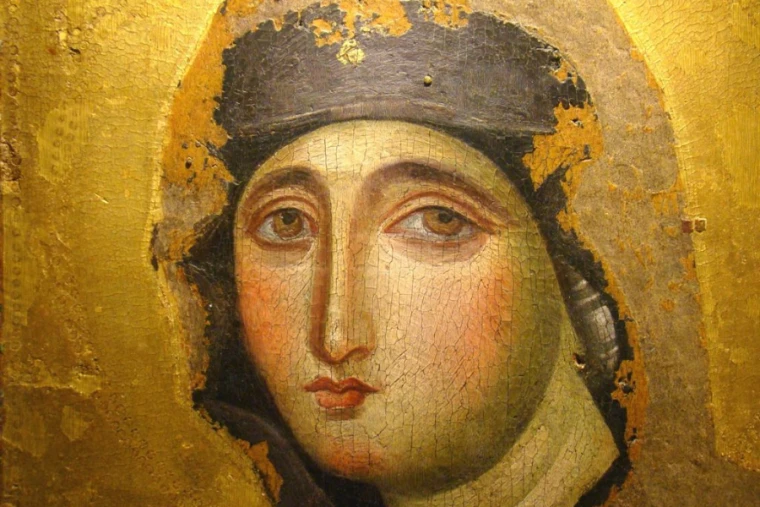
The image is absolutely stunning.  Here is the entire image, which has been damaged.


Miraculously the face has not been damaged, and it’s well worth cropping that part of the painting.


My goodness, what a stately, beautiful face.  Who and when was it painted?  Apparently it “dates back to at least the 7th century and has been revered over the centuries as having been painted by St. Luke.”  I’m not sure how it could be dated to the 7th century and be painted by St. Luke, but it says “at least the 7th century,” so who knows. 

I find it amazing that this community of nuns have kept the icon in their possession for 800 years.  According to the article they have moved twice in those years, but careful to preserve the icon.  If the procession took place in February of 1221and St. Dominic died in August of that year, so it was six months before he passed away.  So I went looking through my St. Dominic biographies for this event.  I couldn’t find anything but I was looking toward the end of the biographies since it happened toward the end of his life.  But one of my Lay Dominican sisters found it in the Augusta Theodosia Drane biography, detailed in pages 112 through 117.  Let me quote some key passages.


The most refractory of these religious [sisters] were some who were living at the time in the monastery of Santa Maria in Trastevere, in which was kept a celebrated picture of our Blessed Lady, said to have been painted by St. Luke.  This picture was a particular favorite with the Roman people.  Tradition said that it had been brought to Rome, many centuries before, from Constantinople; that it was the same that had been borne processionally by St, Gregory in the time of the plague, on that Easter day when the words of the Regina Caeli were first heard sung overhead by the voices of the angelic choirs.  After that Sergius III had caused it to be placed in the Lateran Basilica, but in the middle of the night it found its own way back to the majestic old church which seemed its chosen resting place.  The possession of this picture was no inconsiderable addition to the power and popularity of the nuns; without it they were determined never to stir, and there seemed great difficulties in the way of removing it.  (Drane, 112-3)


Quotes taken from The Life of Saint Dominic by Augusta Theodosia Drane, sixth edition, Tan Books, Charlotte, North Carolina, 1988.  [First published in 1857, London]


Well, that’s quite a story of movement, from Constantinople to Rome to the nuns to the Lateran Basilica and then miraculously back to the nuns.  But Dominic proposed and convinced the nuns to relocate to the convent of St. Sixtus, associated with the Basilica of St.Sixtus, a Roman basilica dating back to the seventh century.  One of St. Dominic’s most notable charism was his power of speech and persuasion, and it was evident here.  Thinking on my engineering work, St. Dominic would have been a great project manager and leader.  The story continues onto Ash Wednesday, which in 1221 fell on February 28th.


On Ash Wednesday, which fell that year on the 28th of February, the cardinals assembled at St. Sixtus, wither the Abbess and her nuns also proceeded in solemn procession.  (115)

And later,


Four days after, on the first Sunday in Lent, the nuns took possession of their convent.  They were forty-four in all, including a few seculars, and some religious of other convents.  (116)

But the painting was still not at St. Sixtus.


Dominic waited until nightfall before he ventured to remove the picture so often named; he feared lest some excitement and disturbance might be caused by this being done in broad day, for the people of the city felt a jealous unwillingness to suffer it to depart.  However at midnight, accompanied by the two cardinals Nicholas and Stephen and many other persons, all barefoot and carrying torches, he conducted it in solemn procession to St. Sixtus, where the nuns awaited its approach with similar marks of respect.  It did not return; and its quiet domestication in the new house completed the settlement of the nuns.  They were soon after joined by twenty-one others from various other houses, and thus was formed the second house of religious women living under the rule of St. Dominic.  (117)

So the story in the book differs somewhat from the article.  Nonetheless a beautiful and historic painting with quite a story.

By the way, I posted on the book, The Life of Saint Dominic, when I first read the biography two years ago.