"Love follows knowledge."
"Beauty above all beauty!"
– St. Catherine of Siena

Showing posts with label Repent. Show all posts

Sunday, January 25, 2026

Sunday Meditation: Uniting the Kingdom of God

In the Third Sunday of Ordinary Time in Year A we see Jesus starting His ministry.  But wait a second.  Didn’t we see Jesus in the First Sunday, two Sunday’s ago, being baptized.  Wasn’t that the start of His ministry?  And last Sunday, didn’t we see John the Baptist declare Jesus the Lamb of God after that baptism?  Wasn’t that the start of His ministry?  Well, yes to both of those Sundays and to this one too.  The Baptism is the start by God’s anointing; the second is start by John’s declaration; and today is the start by Jesus’s activities.

Three years ago for this Third Sunday in Ordinary Time of Year A, I embedded Dr. Prant Pitre’s explanatory breakdown of this Gospel.  One of the homilies I provide below will reference it, so it might be worthwhile to go back and watch it.  It is important to know that the significance of withdrawing to Zebulun and Naphtali was that those were the first two regions that went into exile when the northern kingdom was conquered.  So by Jesus going there, He will be reconstituting David’s kingdom, but only this time it will be a spiritual kingdom.

The Gospel passage divides into two parts.  We see Jesus in the first starting His ministry with the preaching of repentance.  And we see in the second, Jesus selecting apostles for His ministry.  In these apostles we the very turning away from ordinary life to a life in Jesus, which is exactly what Jesus is asking us to do.  We see the apostles giving up their business and their families, and we see them accepting their calling without knowing any details nor outcome.  Later in Matthew 19:27, Peter tells Jesus they have given up everything.  And Jesus responds, in  the Kingdom the twelve will be on thrones judging the twelve tribes of Israel.


Here is today’s Gospel reading.


When Jesus heard that John had been arrested,
he withdrew to Galilee.
He left Nazareth and went to live in Capernaum by the sea,
in the region of Zebulun and Naphtali,
that what had been said through Isaiah the prophet
might be fulfilled:
Land of Zebulun and land of Naphtali,
the way to the sea, beyond the Jordan,
Galilee of the Gentiles,
the people who sit in darkness have seen a great light,
on those dwelling in a land overshadowed by death
light has arisen.
From that time on, Jesus began to preach and say,
“Repent, for the kingdom of heaven is at hand.”


As he was walking by the Sea of Galilee, he saw two brothers,
Simon who is called Peter, and his brother Andrew,
casting a net into the sea; they were fishermen.
He said to them,
“Come after me, and I will make you fishers of men.”
At once they left their nets and followed him.
He walked along from there and saw two other brothers,
James, the son of Zebedee, and his brother John.
They were in a boat, with their father Zebedee, mending their nets.  He called them, and immediately they left their boat and their father and followed him.
He went around all of Galilee, teaching in their synagogues, proclaiming the gospel of the kingdom, and curing every disease and illness among the people.

~Mt: 4:12-23


I have explained some up above, but I haven’t explained everything.  Fr. Cajetan Cuddy O.P. will explain the significance.


So with John the Baptist’s ministry over, Jesus receives the baton and starts His ministry, proclaiming the need for repentance as John had done.  “The Kingdom of God is the overarching theme of the entire economy of salvation.”  Jesus teaches, therefore, “the union of repentance and the kingdom.”  Since Jesus is the Kingdom, your turning—repentance—is a turning to Jesus.

Fr. Terrance Chartier provides an interesting pastoral homily.  If Jesus’s mission is to unite, those that create occasions of division are working against the Kingdom of God.


“Jesus of Nazareth comes to restore light and hope and unity to his people. He comes to reunite his people under one faith. He also comes to engraft...the Gentiles…Our Lord works to bring hope and unity and healing to places torn by division and destruction.”  The significance of this unity is that, as the second reading points out, the introduction of divisions into the Kingdom of God is working against the work of Jesus.  Beware of the schismatic elements you bring to the Body of Christ.  Surely fragmentation into denominations is working against Christ’s unity.  But so is obstinate fighting against the Pope and the Bishops, as we have seen in recent years.  Cum Petro et Sub Petro  (With Peter and Under Peter).  “The work of the devil is to divide and pit God's children against each other.  And the devil continues his work to this day.” 


Sunday Meditation: “He went around all of Galilee,

teaching in their synagogues, proclaiming the gospel of the kingdom, and curing every disease and illness among the people.”


Let’s return to John Michael Talbot for the hymn, and this lesser know but still lovely hymn, “Walk and Follow Jesus.”


“I will walk and follow Jesus.”  How about you?


Sunday, December 7, 2025

Sunday Meditation: Repent, for the Kingdom of Heaven is at Hand

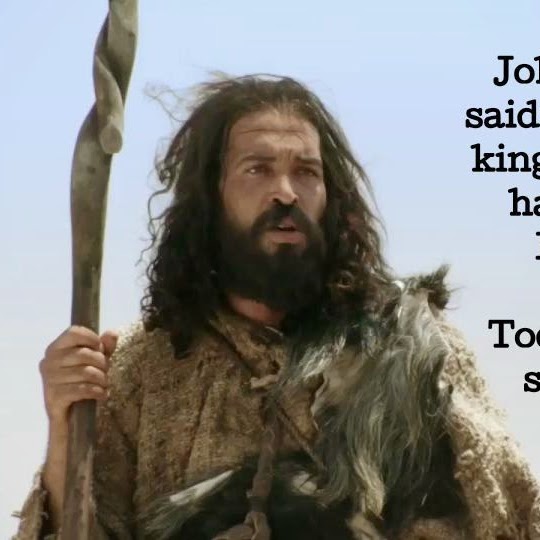
For the second Sunday of Advent in Year A, we meet John the Baptist and he bellows out his message of repentance for the coming of the Messiah. 


Here is the Gospel passage.


John the Baptist appeared, preaching in the desert of Judea

and saying, "Repent, for the kingdom of heaven is at hand!"

It was of him that the prophet Isaiah had spoken when he said:

A voice of one crying out in the desert,

Prepare the way of the Lord,

make straight his paths.

John wore clothing made of camel's hair

and had a leather belt around his waist.

His food was locusts and wild honey.

At that time Jerusalem, all Judea,

and the whole region around the Jordan

were going out to him

and were being baptized by him in the Jordan River

as they acknowledged their sins.


When he saw many of the Pharisees and Sadducees

coming to his baptism, he said to them, "You brood of vipers!

Who warned you to flee from the coming wrath?

Produce good fruit as evidence of your repentance.

And do not presume to say to yourselves,

'We have Abraham as our father.'

For I tell you,

God can raise up children to Abraham from these stones.

Even now the ax lies at the root of the trees.

Therefore every tree that does not bear good fruit

will be cut down and thrown into the fire.

I am baptizing you with water, for repentance,

but the one who is coming after me is mightier than I.

I am not worthy to carry his sandals.

He will baptize you with the Holy Spirit and fire.

His winnowing fan is in his hand.

He will clear his threshing floor

and gather his wheat into his barn,

but the chaff he will burn with unquenchable fire."

~Mt 3:1-12


I’m really enjoying Archbishop Edward Wiesenberger’s homilies.  Here is another fine homily on this Gospel passage.


No Jesus without John the Baptist first.  No Christmas joy without the stern message of John.  No Jesus without metanoia, “an internal change of heart along with a very real external change of life.”

The archbishop alludes to this, but it should be noted more clearly that baptism of John was not a sacramental baptism.  There is a distinction.  John’s baptism is only a baptism of repentance.

Now for a homily that bucks the trend.  I would say just about all the homilies on today’s Gospel emphasizes the sternness of John the Baptist’s message, just as Archbishop Wiesenberger does above.  Even my pastor, Fr. Eugene at St. Rita, who almost never has a stern homily emphasized the Baptist’s sternness.  Now here is a homily that looked at this Gospel and found something in it that was not so stern.  This is someone new again, a Dominican priest from the Central Province (St. Albert Province), Fr. Samuel Hakeem. 


“Acknowledge, let us acknowledge our sins” as we do at every Mass.  When one acknowledges ones sins he is nine tenths the way to repentance.


Sunday Meditation: "Therefore, stay awake!  For you do not know on which day your Lord will come.”


One of my favorite hymns that comes up at Mass this time of year, Bernadette Farrell’s “Christ Be Our Light.”


Longing for light, we wait in darkness.

Longing for truth, we turn to you.

Make us your own, your holy people,

Light for the world to see.


Christ, be our light! Shine in our hearts.

Shine through the darkness.

Christ be our light!

Shine in your church gathered today.

Just lovely.

Sunday, March 23, 2025

Sunday Meditation: Tragedy and Still Bearing Fruit

On the First Sunday of Lent, we saw Jesus meet the Devil in the desert as He underwent temptations.  On the Second Sunday, we saw Jesus go up a mountain and be transfigured before three of His disciples.  So one comes to the Third Sunday of Lent expecting an even greater scene, but what we get is a simple parable of the fig tree.  That would strike us as a letdown.  But Jesus prefaces the parable with two monumental events: Pilate butchering some Galileans at the Temple and the collapse of a tower killing eighteen people.  What’s the connection?  It’s a very Lenten connection.


Some people told Jesus about the Galileans

whose blood Pilate had mingled with the blood of their sacrifices.

Jesus said to them in reply,

“Do you think that because these Galileans suffered in this way

they were greater sinners than all other Galileans?

By no means!

But I tell you, if you do not repent,

you will all perish as they did!

Or those eighteen people who were killed

when the tower at Siloam fell on them—

do you think they were more guilty

than everyone else who lived in Jerusalem?

By no means!

But I tell you, if you do not repent,

you will all perish as they did!”


And he told them this parable:

“There once was a person who had a fig tree planted in his orchard,

and when he came in search of fruit on it but found none,

he said to the gardener,

‘For three years now I have come in search of fruit on this fig tree

but have found none.

So cut it down.

Why should it exhaust the soil?’

He said to him in reply,

‘Sir, leave it for this year also,

and I shall cultivate the ground around it and fertilize it;

it may bear fruit in the future.

If not you can cut it down.’”

~Lk 13:1-9

What really catches my eye on this passage are the two tragedies that Jesus alludes to.  I can’t say I ever really noticed them before.  First He says that the sins of those who met the tragic ends were not the cause of the tragedy.  And then He implores everyone to repent of their sins.  Is this a contradiction?  Fr. Tim Peters in his Catholic Bible Studies explains.


Untimely death can cause you to be perished if you have not repented.  So which is the real tragedy, the catastrophic death or the forever separated from God?  I hadn’t posted Fr. Tim before, but I really like his Bible Studies.

Here is another priest I have not posted before for the pastoral homily, Fr. Eric De La Pena, a Franciscan Friar of the Companions of St. Anthony.


Sunday Meditation: “Sir, leave it for this year also, and I shall cultivate the ground around it and fertilize it; it may bear fruit in the future.”


Instead of a hymn, I want to share this short homily by Fr. Vincent Bernhard who provides another great insight on this rich Gospel passage. 


Prayer, fasting, and almsgiving tends to the ground which will bear fruit. 

Sunday, June 9, 2024

Sunday Meditation: His Brothers and Mother

We are now fully back in Ordinary Time, and the Gospel reading picks where we left Jesus before Lent and Easter entered the liturgical season.  Jesus had been preaching in Galilee with His disciples and now this Sunday returns home.  This passage is an example of what some scholars call a Markan Sandwich, that is, a technique that Mark likes to use in telling a story.  A Markan Sandwich is one where Mark starts with one story, transitions to another, and then returns—thereby creating the sandwich—to complete the original story. 


Jesus came home with his disciples.

Again the crowd gathered,

making it impossible for them even to eat.

When his relatives heard of this they set out to seize him,

for they said, "He is out of his mind."

The scribes who had come from Jerusalem said,

"He is possessed by Beelzebul,"

and "By the prince of demons he drives out demons."


Summoning them, he began to speak to them in parables,

"How can Satan drive out Satan?

If a kingdom is divided against itself,

that kingdom cannot stand.

And if a house is divided against itself,

that house will not be able to stand.

And if Satan has risen up against himself

and is divided, he cannot stand;

that is the end of him.

But no one can enter a strong man's house to plunder his property

unless he first ties up the strong man.

Then he can plunder the house.

Amen, I say to you,

all sins and all blasphemies that people utter will be

forgiven them.

But whoever blasphemes against the Holy Spirit

will never have forgiveness,

but is guilty of an everlasting sin."

For they had said, "He has an unclean spirit."


His mother and his brothers arrived.

Standing outside they sent word to him and called him.

A crowd seated around him told him,

"Your mother and your brothers and your sisters

are outside asking for you."

But he said to them in reply,

"Who are my mother and my brothers?"

And looking around at those seated in the circle he said,

"Here are my mother and my brothers.

For whoever does the will of God

is my brother and sister and mother."

~Mk 3:20-35

So the first story is that of Jesus’ family thinking He’s gone insane.  The middle part of the story is the conflict with the Scribes and His answers to their claims.  And finally He returns to conclude with a resolution to the first story.

Fr, Joseph Mary of the Capuchin Franciscans offers a pertinent homily.


Now some may be shocked by the verse about the unforgivable sin.  Jesus says, “But whoever blasphemes against the Holy Spirit will never have forgiveness, but is guilty of an everlasting sin.”  What is this unforgivable sin, because I want to make sure I never commit it?  An old favorite of mine, Fr. John Corapi explains, taken from St. Augustine I might add.


Got that?  The unforgivable sin is refusing final repentance.  


Sunday Meditation: “For whoever does the will of God is my brother and sister and mother.”


Let’s end with a hymn from John Michael Talbot, “One Faith.”


Sunday, January 21, 2024

Sunday Meditation: Repent and Believe in the Gospel

After Jesus is baptized (see last week’s Gospel) by John the Baptist, John’s fortunes “decrease” while Jesus’s begins His ministry.  Today, in gathering some of His disciples, He announces the Kingdom of God.

After John had been arrested,

Jesus came to Galilee proclaiming the gospel of God:

"This is the time of fulfillment.

The kingdom of God is at hand.

Repent, and believe in the gospel."


As he passed by the Sea of Galilee,

he saw Simon and his brother Andrew casting their nets into the sea;

they were fishermen.

Jesus said to them,

"Come after me, and I will make you fishers of men."

Then they abandoned their nets and followed him.

He walked along a little farther

and saw James, the son of Zebedee, and his brother John.

They too were in a boat mending their nets.

Then he called them.

So they left their father Zebedee in the boat

along with the hired men and followed him.

~Mk 1:14-20

This week Fr. Joseph Mary of the Capuchin Franciscans makes you feel the full force of Christ’s call to repent. .


Fr. Joseph Mary does not seem like an introvert to me, but that may be deceptive.  I had no idea what menudo is.  I never had it.  I looked it up and yuck.  We never do hear how that young man resolved his anger that evening.  Do you think that young man repented?  My intuition tells me he did. 

Meditation: "This is the time of fulfillment.  The kingdom of God is at hand.  Repent, and believe in the gospel."

A clip from The Chosen.


Friday, November 25, 2022

Faith Filled Friday: Uncover to Bear Fruit for Advent

Since I’ve started my “Sunday Meditations” posts, I have unfortunately not had as many “Faith Filled Friday” posts.  Well, there is only so much I can get in.  This coming Sunday starts Advent, but I wanted to get a pre-Advent post in to focus your thinking and devotions for Advent proper.

This quote comes from a book recommended to me by a friend on Advent written Fleming Rutledge, an Episcopal Priest.  She has her own Wikipedia entry, so she must be of some notoriety.  (No I don’t support women priests in the Catholic Church, but who am I to opine on Episcopal Church matters?)  The book, Advent: The Once and Future Coming of Jesus Christ (currently on sale in Kindle format), is organized around sermons she has given over the years on Advent.  I’m 50 pages or so in, and I’m quite impressed with her literary knowledge—the main reason I think the book was recommended—and her homiletics, if that is the correct word.  Though there might be an item or two we Catholics might have a different way of seeing, for the most part I’m surprised how much we have in common here. 

The quote I want to highlight from her book was from a sermon on “Advent II”—I take that to be the second Sunday of Advent, but I’m not entirely sure—given in 1999, titled “Cover-Ups.”


The premier personage of Advent is John the Baptist. When he appears on the banks of the Jordan, the cover-ups come to their appointed end. Two thousand years before all the Watergates, Irangates, and other sordid “-gates,” John came proclaiming God’s imminent judgment on the venality of governments, the corruption of police departments, the greed of financiers, the selfishness of the rich, the self-righteousness of the religious establishment. In the end, he became one of los desaparecidos himself, executed without a trial in the dank dungeon of the local strongman, thus becoming truly the precursor of the One whose way he prepared, the One whose death at the hands of the political and religious ruling classes signified the final judgment of God on all the powers and principalities.


There are cover-ups of all sorts. There are families that will not acknowledge the alcoholism that is destroying them. There are people who are making their loved ones miserable but will not go to a therapist. There are secretaries who cover up for bosses, business partners who cover up for each other, colonels for generals, bishops for clergy, parents for children. Advent is the season of the uncovering: “Bear fruit that befits repentance. . . . Even now the axe is laid to the root of the trees”! This is the right time to root out the cover-ups in our own lives, as we wait with bated breath for the lights to come on and the announcement of the angel that God is not against us but for us. (p. 42, Eerdmans. Kindle Edition.)

What caught my eye here was the term, los desaparecidos, which my poor Spanish initially took for “the deplorables.”  Perhaps politics has more an influence on my word associations than I think.  Still, despite several years of schooling in Spanish, I decided to look it up.  From Wikipedia:


Desaparecidos are people who were victims of enforced disappearance, who were secretly arrested and killed in Argentina during the "dirty war", between 1976 and 1983 during the military dictatorship of General Videla.

So what started as a specific immoral, political action in Argentina in the late 1970s, took on a more comprehensive definition:


The Inter-American Convention on Forced Disappearance of Persons, signed in 1994, considers it an imprescriptible crime against humanity and defines it as follows:


“Enforced disappearance is the deprivation of the liberty of one or more persons, in whatever form, committed by agents of the State or by persons or groups of persons who act with the authorization, support or State approval, followed by the absence of information or the refusal to recognize said deprivation of liberty or to inform about the whereabouts of the person, by which the exercise of legal remedies is prevented and relevant procedural safeguards.

The forced disappearances of people in Latin American countries fall under the term los desaparecidos.  It is a word I want to remember, and perhaps use myself somewhere.  It is unfortunately too common for people in Latin America to just disappear, but frankly as one thinks about it, the practice has to be internationally widespread.  Dictators and criminal organizations have forever made people they had issues with disappear. 


That is Caravaggio's The Beheading of Saint John the Baptist.


And Rutledge points out how deep in history this practice is, even foundational in our Christian history.  John the Baptist was “executed without a trial in the dank dungeon of the local strongman, thus becoming truly the precursor of the One whose way he prepared, the One whose death at the hands of the political and religious ruling classes signified the final judgment of God on all the powers and principalities.”  This is certainly something for us to meditate upon.  John the Baptist and Jesus Christ are architypes for all those poor prisoners around the world who have done nothing wrong and are at the mercy of political power.  I am now specifically thinking of those in the underground prisons of China.  They need our prayers.

And Rutledge closes with an exhortation to our personal lives: “This is the right time to root out the cover-ups in our own lives, as we wait with bated breath for the lights to come on and the announcement of the angel that God is not against us but for us.”  What personal sins do we cover up, sins we wish would not be exposed?  I am not advocating we make these open for the world or even our loved ones.  But they become a point for personal reflection.  If we are covering up something from the world, even from ourselves, then it probably is not something wholesome.  This is a time to strive to overcome it, put it to an end.  Advent is here.  Christ is coming.