"Love follows knowledge."
"Beauty above all beauty!"
– St. Catherine of Siena

Showing posts with label Archbishop Edward Weisenburger. Show all posts

Sunday, November 8, 2026

Sunday Meditation: When the Saints Go Marching In

A note.  This was last Sunday’s Gospel reading.  I’m still a week behind but I should have this Sunday’s shortly.


This year the Thirty-First Sunday in Ordinary Time was superseded by the Solemnity of All Saints because November 1st fell on a Sunday.  The Gospel reading for All Saints Day are the Beatitudes because it is the saints that live out the Beatitudes to the fullest. 

The Beatitudes are blessings.  Each Beatitude describes a state such as being “poor in spirit.”  Jesus goes on to say what blessing you will acquire because of being in that state.  In the case of being “poor in spirit,’ the blessing given to you is the kingdom of God.  “Blessed are the poor in spirit, for theirs is the Kingdom of heaven.”

It is observed that Jesus perfectly embodies the Beatitudes.  But it can also be observed that Jesus shining through the saints enlightens their blessed state, the state of the beatific.  When we humble sinners are made saints in heaven—perhaps having the need to be purged prior—and are allowed to gaze upon the Beatific vision, then we will perfectly exhibit the Beatitudes ourselves.


Today’s Gospel:


When Jesus saw the crowds, he went up the mountain,

and after he had sat down, his disciples came to him.

He began to teach them, saying:


"Blessed are the poor in spirit,

for theirs is the Kingdom of heaven.

Blessed are they who mourn,

for they will be comforted.

Blessed are the meek,

for they will inherit the land.

Blessed are they who hunger and thirst for righteousness,

for they will be satisfied.

Blessed are the merciful,

for they will be shown mercy.

Blessed are the clean of heart,

for they will see God.

Blessed are the peacemakers,

for they will be called children of God.

Blessed are they who are persecuted for the sake of righteousness,

for theirs is the Kingdom of heaven.

Blessed are you when they insult you and persecute you

and utter every kind of evil against you falsely because of me.

Rejoice and be glad,

for your reward will be great in heaven."

~Mt: 5:1-12


For the exegetical homily, I will return to Archbishop Edward Wiesenberger of Detroit.


Archbishop Wiesenberger:

Brothers and sisters in Christ, it happens infrequently, but when All Saints Day, a Holy Day of Obligation, falls on a Sunday, it becomes the celebration for the Sunday. And so instead of this weekend's Mass being the 31st Sunday in Ordinary Time, the Universal Church will be celebrating All Saints Day, with the Gospel text being that one we know so well, the Beatitudes. And so, let's look at both the Gospel, and also the reason for celebrating "All Saints." 


First, the Gospel. It's from Matthew, who, as I've often said, was writing primarily for Jewish converts to Christianity. And so, his gospel is filled with Old Testament images revealing Jesus as the long-awaited Messiah, the fulfillment of all of the prophecies and hopes. Recall, too, that one of the most critical, pivotal moments in  Jewish history was when Moses went up the mountain to commune with God, and then came down from the mountain and brought back with him the Law. The Law. A great gift from God. Especially seen in that gift of the Ten Commandments. A gift that was indeed good. God doesn't give bad things. It revealed only to the Jewish people, God's chosen ones, what He desired from them at that moment in time. It revealed to them what would please God. Move forward in time to Jesus, then going up the mountain, communing with His Heavenly Father, and then coming down the mountain with the Beatitudes described as the "new law." This one, the law of love. Jesus is revealed by Matthew as the new and greater Moses. The one who, in the Beatitudes, reveals what truly and completely fulfills God's will.  What pleases God for all time. And what pleases our God is actually the reversal, the turning upside down of the secular world's sinful values. What pleases God and creates saints are those who work for peace, replacing the "might-makes-right" or glorification of violence we see in our world today. What pleases God is the humble and the poor, not so much the arrogant, or those who believe in the security of their wealth or power. What pleases God is the merciful, not those creative enough to exact vengeance.  What pleases God is the meek, those hungering for righteousness, the pure of heart, and those persecuted for their commitment to Him. Yes, these are both the signs of saints, as well as the attributes that cooperate with God's grace to create saints.


That's the Beatitudes, our Gospel for the day. But turning our thoughts to "why All Saints," I would note I'm influenced by the writing of Fr. Roy Donner, a very fine homilist, author, and priest of the Sacramento diocese.  He notes that Easter is clearly the greatest feast of the Church's liturgical year. We know that it's the day of the Lord's resurrection, His victory over sin and death. He then notes that the celebration of All Saints could be called a little Easter because it's the day we anticipate our own resurrection and celebrate our own victory over sin and death. And we hope to arrive at that great day having spent our lives as the great saints did; making them holy as our God is holy.  It began for each of them as it has for us.  Baptism washing our robes and making them white sin the blood of the lamb. Baptism washes away Original Sin, along with any personal sins. It opens the door to salvation. But it's not an act of magic. Rather, it's the essential foundational step upon which we then spend our lives building a relationship with God. Building upon baptism around the age of reason, we begin being fed with the Body and Blood of Christ from the Table of the Lord, the altar of Sacrifice. The fathers of the Second Vatican Council referred to the Eucharist as the "Source and Summit" of our Christian life. It's the Eucharist that strengthens us and, with our cooperation, further fashions us into the saint God created each of us to be. The final sacrament that initiates us into full and complete relationship with the Father is the gifts of the Holy Spirit in the Sacrament of Confirmation.  Those seven gifts: wisdom, understanding, counsel, fortitude, knowledge, piety, and reverential fear of God. Those seven gifts are attributes only Jesus enjoys in their fullness. But He shares them with us uniquely in Confirmation, even if in a host of lesser, but still miraculously important ways by grace.


Brothers and sisters, with this background, these three Sacraments of Initiation build that very relationship with God. They help to bring to completion the works of salvation begun on that first Easter in Jesus himself. They help us to be poor in spirit. They help us to be empathetic toward those who grieve. They empower us to be meek and unassuming in our relationships, to be pure in our motives, to be peacemakers through reconciliation, and to be courageous in defending our Lord's teachings and values in the face of persecution.


We become saints as we are transformed into the state of blessedness, into the Beatitudes.


For the pastoral sermon, we go not to a priest’s homily but to a video from Catholic Saints and Feasts.


Catholic Saints & Feasts:

November 1st, All Saints.  Heaven is populated with holy people known to God alone.  Martyrs were so revered in the early church that their places and dates of death were sanctified by the candles, prayers, and votive offerings of the faithful, grateful for their witness.  So many were the martyrs, though, that by the early 4th century, it became impossible to solemnize each individually on the church's crowded calendar. There thus arose over centuries and in different ways in different regions the custom of commemorating the memory of all the holy ones on one specific day of the year. By the early 8th century, the feast of all saints was celebrated in Rome on November 1st. The feast was extended to the entire church in the next century.


The church defines a saint as a soul enjoying the beatific vision in heaven. So besides the famous saints found on the universal calendar and the lesser known saints not on that calendar, there are still many more souls in heaven not officially recognized as saints at all. These are the saints we celebrate in a particular way today.  The Solemnity of all Saints commemorates all those holy men, women, children, martyrs, confessors, and unknown others who lived lives of such holiness that upon death, they either entered directly into God's presence in heaven or duly purified their soul of every imperfection in purgatory before then advancing into his presence.  All star saints such as St. Augustine and St. Francis of Assisi stand shoulder to shoulder in heaven with forgotten grandmas, quiet uncles and unknown martyrs.  These unrecognized but holy souls did not convert entire tribes, found religious communities, or have their bones crushed by the jaws of lions in the arena. Maybe they just kept their mouth shut when they had just the right words to humiliate a family member.


It is difficult to be a saint!  But with God’s grace, may we all reach that blessed state.


Sunday Meditation: “Rejoice and be glad, for your reward will be great in heaven."


Let’s go with what all accounts are from a saintly man, Louis Armstrong, playing and singing, “When The Saints Go Marching In.”


O, when the saints go marching in,

O, when the saints go marching in.

Lord, I want to be in that number

when the saints go marching in.


Man, you have to have God’s grace shining through you to play like that.  May we all be in that number! 

Sunday, October 18, 2026

Sunday Meditation: Testing a Truthful Man

For the Twenty-Nineth Sunday in Ordinary Time of Year A, we are still in what  Dr. Nina Heereman calls the “Temple Discourse,”  as I explained last week.  At the Temple during Christ’s last week leading to His passion, He comes in direct confrontation with the Jewish leaders.  In today’s passage the Jewish groups of the Pharisees and the Herodians try to lay a trap for Jesus. 

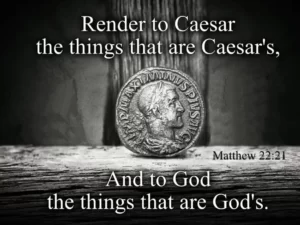
This passage is well-known for Christ’s saying of giving unto Caesar what is Caesar’s and onto God what is God’s, but what I find fascinating, and perhaps less mentioned is how the Pharisees deviously egg Jesus into being as frank as possible.   They tell Him He is a “truthful man.”  The irony is Jesus is the Truth, the Truth with a capital “T.”  Buttering Him up is a means of getting Him to answer their question. 

And He will answer their question, and He will answer it with Truth but it is not as the Pharisee’s expected.  Jesus will have none of it.  He calls them hypocrites to their face.

The key to this passage is not so much the implied division of church and state from Jesus’s answer, but the play on the word “image”: the image of Caesar versus the image of God in which humanity was made in. 


Today’s Gospel:


The Pharisees went off

and plotted how they might entrap Jesus in speech.

They sent their disciples to him, with the Herodians, saying,

"Teacher, we know that you are a truthful man

and that you teach the way of God in accordance with the truth.

And you are not concerned with anyone's opinion,

for you do not regard a person's status.

Tell us, then, what is your opinion:

Is it lawful to pay the census tax to Caesar or not?"

Knowing their malice, Jesus said,

"Why are you testing me, you hypocrites?

Show me the coin that pays the census tax."

Then they handed him the Roman coin.

He said to them, "Whose image is this and whose inscription?"

They replied, "Caesar's."

At that he said to them,

"Then repay to Caesar what belongs to Caesar

and to God what belongs to God."

~Mt: 22:15-21


I’m returning to Archbishop Edward J. Weisenburger from the diocese of Detroit for the exegetical homily.


Archbishop Weisenburger:

Now, recall that there were three taxes for the Jews of Jesus' day. First, an income tax, about 1% of your annual income. Second, a 10% tax on grain and grapes used for wine, but then a third tax that was the same for every adult Jewish citizen, roughly the equivalent of a day's wage. That third tax historically began as a way to rebuild the Great Temple in Jerusalem, but when the Roman armies overtook and occupied Palestine during Jesus' era, the Romans shifted this sacred temple tax to pay for the upkeep of their own temple to the pagan gods in Rome. And thus, you can see the crisis. Many faithful Jews saw the payment of that tax as an evil cooperation in reusing a tax meant for the holiest of purposes instead for something blasphemous. Notably, the Herodians quietly had no problem with it. They were actually the ones cooperating with King Herod and the Roman occupiers, and their cooperation with them brought them wonderful privilege.  The Pharisees, for their part, were less open about it, but they also pretty much had free movement in the culture, and so they may quietly have grumbled about paying that blasphemous tax, but few took a public stance, knowing it easily could lead to their being disappeared.  And so now in the temple precincts, these two groups try to force Jesus to either one, be a sellout with the Romans, with overtones of blasphemy, or two, the other option, publicly place a target on his back with the Romans.


Okay, it's at this point that Jesus, standing on sacred temple ground, asks them to show him a Roman coin, which of course was imprinted with the emperor's face.  It also bore an inscription we know for a fact indicating Caesar was God's "high priest."  A blasphemous statement. And two, most biblical scholars note that for a faithful Jew to simply have that coin on his person while on holy temple ground was itself blasphemous.  Which perhaps explains the reason why Jesus had to ask someone to "show me the coin,"   not having one on him himself. And revealing the Pharisees' own hypocrisy.  Okay, with that background in mind, Jesus takes the dilemma of them trying to trap him, and as we so often see, flips it right back on their heads. The coin itself is a blasphemous thing. Money in Jesus' day, much like our own day, technically belonged to the government, with citizens being able to use it for commerce.  Technically, in the law, it did belong to Caesar.  So, it seems Jesus says: give that horrible thing back to a horrible person. But if that's really more context or background, then I think there's still a deeper meaning of the encounter. A deeper meaning for those with the ears to hear and the eyes to see.  And that real or deeper meaning of the encounter was the remainder of what Jesus said to them.  "Give to God what belongs to God." And to the extent that we focus too much on what the coin meant might be the extent to which we too missed the point. Rather, Jesus' intent was the teaching. Give to God what belongs to God.


Brothers and sisters, just as a coin in Jesus' day was stamped with an image, you and I have been created, stamped if you will, in God's image. And you and I are no investment of which he wants simply a part. He really, really wants all of us. And he wants all of you. Moreover, God calls us to recognize and reverence that image of him imprinted on every human being.  And to be sure, the image has little or nothing to do with physical appearance.   Being in the image of God is to reflect God's love in creative and redemptive ways…. Brothers and sisters, I pray that you will have what Jesus would call  "the ears to hear, and the eyes to see."  Be not like the Pharisees or Herodians, twisting religion into something self-serving with a hefty benefit of status and stature. Rather, in recognizing first and foremost in whose image you have been created, and from there recognizing that same divine imprint on every human being, your task is to find ways in life to give to God what belongs to God. Trust me, the Caesars of today can take care of themselves.

And what belongs to God?  Your worship and your service.


For the pastoral sermon (not a homily) I’m going to turn to someone new, Susan Breton of U. S. Catholic Magazine.


Ms. Breton:

Have you ever lost something? How did you get it back?  Maybe it was your purse, your wallet, your phone, your keys, something of sentimental value.  When someone found it, they knew it belonged to you because there was something on it that identified it as being yours. Your name, your picture, something that said, "This belongs to someone." And maybe that's what we are being asked today.  What Jesus is asking us, who do we belong to?


So Jesus asks for a coin. He asks whose image is this and whose inscription? And they answer Caesar. And Jesus says, then repay to Caesar what belongs to Caesar and to God what belongs to God. The word Jesus uses for image is the Greek word eikōn which means icon, image and likeness. The coin bears the icon, the image and likeness of Caesar. So Jesus is acknowledging that the coin belongs to Caesar. But Jesus's answer goes much deeper than taxes. In another place in scripture, we hear this word image. In Genesis, we hear God created human beings in his image and likeness. And in the Greek translation of Genesis, that same word icon is used, icon.  The coin bear Caesar's image or icon. We bear God's image, his icon.  Maybe that's the deeper question that Jesus is putting before us today.  If the coin bears Caesar's image and therefore belongs to Caesar, then if we bear God's image, to whom do we belong?  We belong to God.

There’s an interesting perspective.  Your image stamped by God identifies you as God’s possession!


Sunday Meditation: “Teacher, we know that you are a truthful man."


One of my son Matthew’s favorite hymns as a child, “We Are the Light of the World.”  Here is Chris Brunelle performing.


Chorus: We Are the light of the world, may our light shine before all, that they may see the good that we do, and give glory to God


Vs.1

Blessed are they who are poor in spirit, theirs is the kingdom of God. Bless us, O Lord, make us poor in spirit


Vs. 2

Blessed are they who are meek and humble, they will inherit the earth. Bless us, O Lord, make us meek and humble; bless us, O Lord, our God


Vs. 3

Blessed are they who will mourn in sorrow, they will be comforted. Bless us, O Lord, when we share their sorrow; bless us, O Lord, our God


Vs. 4

Bless those who hunger and thirst for justice, they will be satisfied. Bless us, O Lord, hear our cry for justice; bless us, O Lord, our God


We, whose image is of God, are the light of the world!


Sunday, September 13, 2026

Sunday Meditation: You Must Forgive

On the Twenty-Fourth Sunday in Ordinary Time for Year A, Jesus completes His Community Discourse with the requirement to forgive wrongs.   To Peter’s well-known question as to how many times one should forgive a “brother or sister,” Jesus responds “not seven times but seventy-seven times” (or sometimes translated as “seventy times seven,” RSV, 2ndCE).  This is to say infinite.  Jesus then follows that up with the Parable of the Unforgiving Servant.

The infinite number of times one is to forgive, set in the context of the first reading, “Forgive your neighbor’s injustice; then when you pray, your own sins will be forgiven” (Sir 28:2) and combined with the Our Father’s “forgive us our trespasses as we forgive those who trespass against us” makes forgiveness a requirement for salvation.  But it’s even more than that.  In forgiving, God allows you to participate in His Divine action.  You become Godlike in the act of forgiveness.

The parable is a fascinating one.  It will be explicated by the homilists, but I want to touch on one element.  An internet homilist, who I won’t mention by name, but I have embedded his homilies here in the past, last week made a remark about empathy which I think misses the mark.  From a book he read called Suicidal Empathy he reached a conclusion that “empathy is not a supreme value” but acting in love to will the good of the other is.  That’s a false dichotomy.  I will get to the problem with that in a second, but to make matters worse, the homilist framed the issue in political terms: “I think it's the best exposure and take-down of the lunacy at the heart of much of the wokeist philosophy that dominates things today.”  So my first reaction to that was then Jesus doesn’t have a Sacred Heart of infinite compassion?  What then does the Sacred Heart of Jesus mean and what does Divine Mercy mean?

What the homilist gets wrong, in my humble opinion, and I admit I don’t have his stature or education, is that empathy starts the process, and then once connected to the other person’s heart (cor ad cor loquitur, heart speaks to heart from St. John Henry Newman) one reaches a rational plan of action that will address the good of the other.  But empathy is the entrance to that love.  Yes it is a supreme value.

The Parable of the Unforgiving Servant from today's Gospel is a perfect example.  The Master empathizes with the first debtor and releases him from his debt.  That was willing his good and it was a result of his heart being moved.  That debtor then refuses to empathize with the second debtor.  No connection in the heart is sparked, and so he throws second debtor in jail, justice without any empathy.  Jesus then sums it up, “So will my heavenly Father do to you, unless each of you forgives your brother from your heart.”  "From the heart," the center of empathy, is Jesus’s final word on the subject.


Today’s Gospel:


Peter approached Jesus and asked him,

“Lord, if my brother sins against me,

how often must I forgive?

As many as seven times?”

Jesus answered, “I say to you, not seven times but seventy-seven times.

That is why the kingdom of heaven may be likened to a king

who decided to settle accounts with his servants.

When he began the accounting,

a debtor was brought before him who owed him a huge amount.

Since he had no way of paying it back,

his master ordered him to be sold,

along with his wife, his children, and all his property,

in payment of the debt.

At that, the servant fell down, did him homage, and said,

‘Be patient with me, and I will pay you back in full.’

Moved with compassion the master of that servant

let him go and forgave him the loan.

When that servant had left, he found one of his fellow servants

who owed him a much smaller amount.

He seized him and started to choke him, demanding,

‘Pay back what you owe.’

Falling to his knees, his fellow servant begged him,

‘Be patient with me, and I will pay you back.’

But he refused.

Instead, he had the fellow servant put in prison

until he paid back the debt.

Now when his fellow servants saw what had happened,

they were deeply disturbed, and went to their master

and reported the whole affair.

His master summoned him and said to him, ‘You wicked servant!

I forgave you your entire debt because you begged me to.

Should you not have had pity on your fellow servant,

as I had pity on you?’

Then in anger his master handed him over to the torturers

until he should pay back the whole debt.

So will my heavenly Father do to you,

unless each of you forgives your brother from your heart.”

~Mt: 18:21-35


For the exegetical homily I go the USCCB’s Fr. Greg Friedman OFM.  This is a short but perfectly explained exegesis.


Fr. Greg:

Today's gospel parable is about the servant whose massive debt had been most generously forgiven by his master, but who in turn refuses to let a fellow servant off forgiving a very minor debt.  When the original master hears of this cruelty, we hear the result. Jesus concludes the parable with a harsh judgment by the master. Should you not have had pity on your fellow servant as I had pity on you? Jesus concludes the parable by describing how in anger his master handed him over to the torturers until he should pay back the whole debt.  After that conclusion, Jesus adds his teaching. So will my heavenly father do to you unless each of you forgives your brother from your heart. Like so many of Jesus parables, the ending shocks us in more than one way. And yet the responsibility for forgiveness is consistent with Jesus teaching earlier in the gospel in the sermon on the mount and with the prayer Christians pray daily. The Lord's prayer forgive us our trespasses as we forgive those who trespass against us.


The parable today is given as a response to the exchange between Jesus and Peter which precedes it in today's gospel to Peter's question about forgiveness.  Lord, if my brother sins against me, how often must I forgive? As many as seven times. Jesus gives the well-known answer, I say to you, not seven times, but 77 times. The offer of forgiveness seven times seems a reasonable attitude, one I suspect most people today actually would find rather extravagant. As Father Raymond Brown notes in his observations about Peter, Father Brown suggests that most of us might forgive once or twice but let someone offend a third time and we'd probably say enough is enough.  Peter, Father Brown suggests, was being very generous. And yet, the parable is about extreme forgiveness.  The standard Jesus sets is also staggering in its demand. Forgive 77 times which really suggests unending forgiveness.

The parable may be extreme, but Jesus is being serious: forgive or our heavenly Father will not forgive you.


For the pastoral homily, I’m returning to Archbishop Edward J. Weisenburger who knocks it out of the park with a great example of extreme forgiveness.


Archbishop Weisenburger:

"And so it shall be with each of you, unless  you forgive your brother from your heart."  Okay, this is serious stuff, a serious  demand. But brothers and sisters, this passage conveys an essential element  of Christianity. It's not something nice, extra. This is of the essence of our faith, and  it cannot be glossed over or denied. Moreover, I fear many of us, and I surely include myself  in that group, many of us would rather apply this demand of Jesus to others, rather than to  ourselves. It's a reflection on that line of the Our Father, where we pray as Jesus did,  saying, "forgive us our sins, as we forgive those who trespass against us." Yes, this teaching  serves as a lasting reminder of our God's demand that we have not simply been called to revel or  glory in His mercy for us, but rather we are to live that same kind of profoundly challenging,  difficult, or daunting mercy in our own lives.


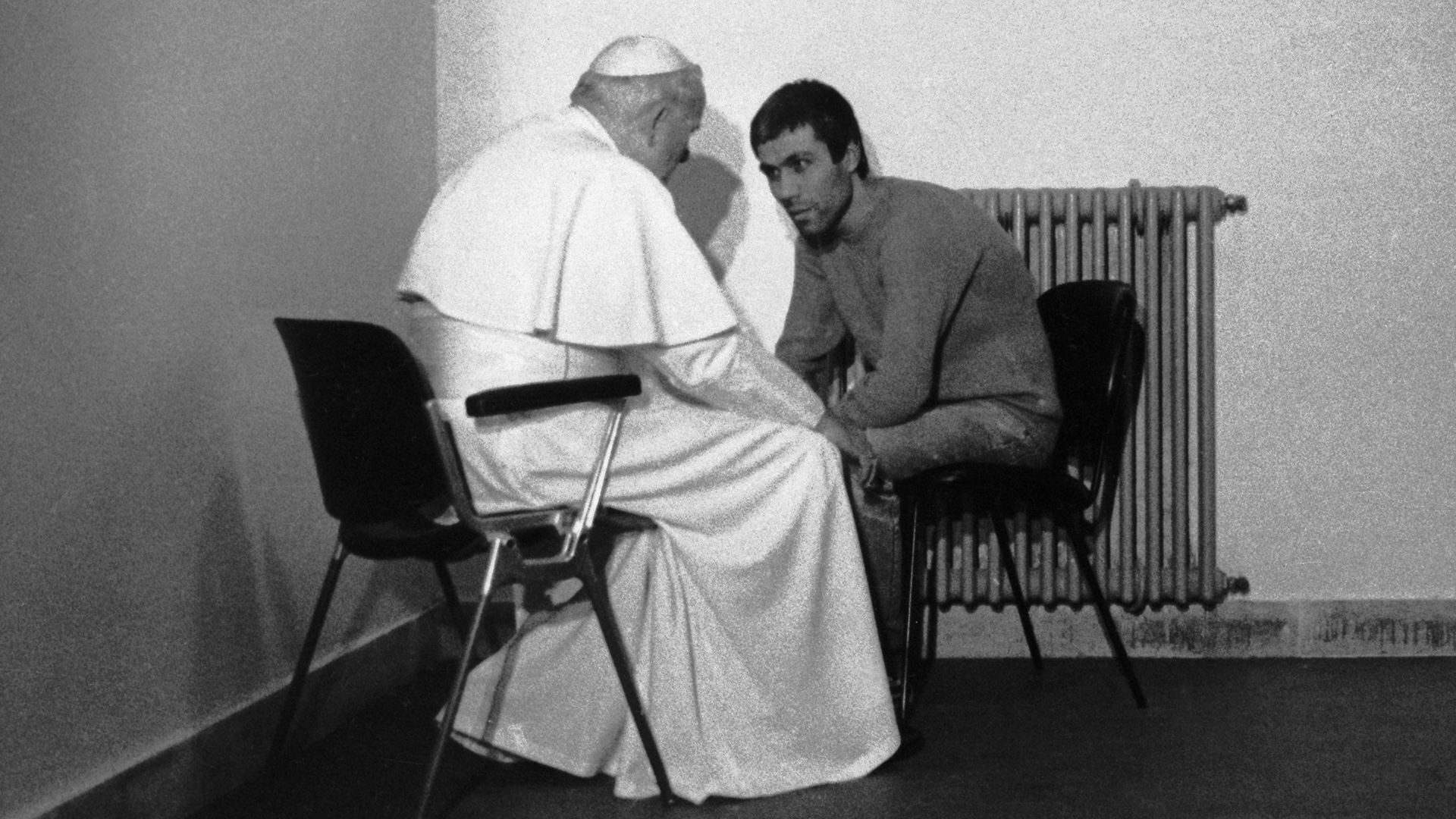
Now, as I pondered the parable, I was  reminded of something that happened in my senior year of seminary college. It was during Christmas season of 1983. A photo from Rome flashed across the scene. All around the world, it was the corner of a prison cell.  The subject of the photo: two men hunched over, sitting close together on molded plastic chairs. One in a white cassock with white skull cap, the other in a blue sweater, jeans, and running shoes with no laces. Time magazine told the story accurately, and I quote, "Last week, in an extraordinary moment of grace, the violence in St. Peter Square was transformed.  In a bare, white-walled cell in Rome's Rebibbia Prison, Pope John Paul II tenderly held the hand that held the gun that was meant to kill him. For 21 minutes, the Pope sat with his would-be assassin, Mehmet Ali Agca. The two talked softly. Once or twice, Agca laughed.  The Pope forgave him for the shooting. At the end of the meeting, Agca either kissed the Pope's ring or pressed the Holy Father's hand to his forehead in a Muslim gesture of respect."  End of quote. We're then told later that when asked about what they had talked about, Pope John Paul II responded, "That will have to remain a secret between him and me.  I spoke to him as a brother whom I have pardoned and who has my complete trust."


Okay, brothers and sisters, that picture, more expressive than a thousand words. That simple phrase, "a brother whom I have pardoned," continues to challenge us mightily more than four decades after the event took place. It actually gives life to the words of our Gospel today. And in doing so, it challenges us. And not because Pope St. John Paul provides a simple solution to the world's problems of "retaliation versus reconciliation." But quite the contrary, the Pope's words, "I pardoned him," compels me to ask what being a Christian demand of me today in a world that seems increasingly saturated with the cravings of revenge.


A picture and a real life example is worth a thousand homiletical words.


Sunday Meditation: “Should you not have had pity on your fellow servant, as I had pity on you?"


Here is a hymn I have never heard before but so beautiful, “Give Me a Heart of Forgiveness” credited to PureFire Worship.


Give me a heart of forgiveness, Lord,

Soft and open, like Yours before.

Help me to let go and to love again,

To break these chains and heal within.

Oh, give me a heart,

A heart of forgiveness.


Jesus, make my heart like yours.