This
quote will require some context.It
comes from a poem by Thomas Merton, the Trappist monk, mystic, writer, and
poet.His prose writing is quite good,
known for his spiritual biography, The
Seven Story Mountain, but also known for his books on the contemplative
life, social issues, literary works, and whole host of other topics.His
poetry in my opinion is hit and miss, but his hits can be exceptional.I think this poem is exceptional.
The
first thing to keep in mind is that the poem was written subsequent to Ernest
Hemingway’s suicide by self-inflicted shotgun shot.The second thing to remember is that Merton
was influenced by Hemingway as a young man.Merton was born in 1915, and had wanted to be a writer from a very young
man.Hemingway was perhaps the central
writer of the post WWI era, commonly called “the lost generation” which
documented the trauma of the war. Merton
as a young man felt the post war angst and ultimately led him to reject his
atheism, convert to Catholicism, and become a Trappist monk at the monastery, Abbey
of Our Lady of Gethsemani in Kentucky.His
life perhaps flows in the opposite direction from Hemingway’s life.The third thing to remember is that Merton,
now twenty years a monk, and also a writer, can identify as Hemingway’s doppelgänger, his literary twin but with
a very different side.
An Elegy For Ernest
Hemingway
By
Thomas Merton
.
Now for the first time on the night of your death
your name is mentioned in convents, ne
cadas in
obscurum.
Now with a true bell your story becomes final. Now
men in monasteries, men of requiems, familiar with
the dead, include you in their offices.
You stand anonymous among thousands, waiting in
the dark at great stations on the edge of countries
known to prayer alone, where fires are not merciless,
we hope, and not without end.
You pass briefly through our midst. Your books and
writing have not been consulted. Our prayers are pro defuncto N.
Yet some look up, as though among a crowd of prisoners
or displaced persons, they recognized a friend
once known in a far country. For these the sun also
rose after a forgotten war upon an idiom you made
great. They have not forgotten you. In their silence
you are still famous, no ritual shade.
How slowly this bell tolls in a monastery tower for a
whole age, and for the quick death of an unready
dynasty, and for that brave illusion: the adventurous
self!
For with one shot the whole hunt is ended!
The
poem is not written in meter but in straight prose, which I think is a nice tip
of the cap to Hemingway’s great prose, which at its best could be poetic.There are several references to monastery
life that one should know to fully understand the poem.In the first stanza, he mentions that now
that Hemingway has died, the convents will be adding his name to the prayers
for the dead, ne cadas in obscurum,
“unless they fall into the darkness.”It
is a line from a Mass for the dead, and the line can be translated as “Deliver
them from the lion's mouth, lest hell swallow them up, lest they fall into
darkness.”It is noteworthy that
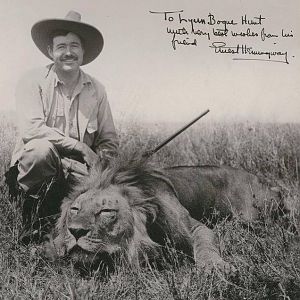
Hemingway had hunted lions and featured them in a couple of his short stories.
The
second stanza is an elaboration of the first.Now that Hemingway’s story has become final, he will be included in the
monk’s daily “offices,” which refer to the Liturgy of the Hours which monastics
pray seven times a day.
The
third stanza I believe is an allusion to Dante’s Divine Comedy, where Hemingway’s soul stands among thousands of
those entering the afterlife, especially referring to Purgatory here since he
hopes the fires will end.The fourth
stanza refers to prayers prayed for the deceased, “pro defuncto,” N
referring to a name to be added, Nominatim.The interspersing of Latin and the slow
prosaic lines gives the poem a praying quality, as if it were Gregorian
chant.I can see this poem being
chanted.
The
fifth stanza is Merton’s homage to Hemingway.In the crowd of souls he is recognized, and a reference is made to
Hemingway’s post WWI novel, The Sun Also
Rises, and to Hemingway’s great prose that captured the trauma of the war.
If
the fifth stanza is a homage, the sixth stanza captures the tragedy of Hemingway’s
life.It also alludes to another of
Hemingway’s novels, For Whom the Bell
Tolls, and to the unquenchable desire for adventure that consumed Hemingway’s
life.It alludes to a morbid fascination
that Hemingway had with death, both with killing animals in hunts or in bull
fights and with killing people in wars, and with his own death which in his
adventures could be seen as a death wish.Merton refers to these adventures as “brave illusions, which seen from
Merton’s religious point of view was a sign of a hurt inside of Hemingway’s
heart which was never healed from the trauma of the First World War.Merton healed his hurt through his Catholic
faith.
Which
brings us to the final one line seventh stanza, which ends the poem like the
gunshot it alludes to.“For with one
shot the whole hunt is ended!”The
hunter hunts himself!Ernest Hemingway
killed himself on July 2nd, 1961 bringing his adventures, his
writing, and his life to an end.
###
Postscript:
As
I’ve thought about this more, the parallels between Hemingway and Merton are
even stronger.It’s not that widely
known but Hemingway converted to Catholicism, and though he considered himself
a bad Catholic, he he never left it.He
was instrumental it seems in leading Gary Cooper, one of his best friends, into
also converting.A very good article on
Hemingway’s Catholicism is “The troubled Catholicism of Ernest Hemingway,” by
Robert Inchausti.From the article:
Hemingway was raised in a
Congregationalist Protestant home, and his first conversion to Catholicism
occurred when he was a 19-year-old and volunteer ambulance driver in Italy
during World War I. Two weeks into the job, he was delivering candy to soldiers
on the frontlines when he was hit by machine-gun fire and more than 200 metal
fragments from an exploding mortar round. An Italian priest recovered his body,
baptized him right on the battlefield and gave him the last rites.
Hemingway later described
what happened this way:
“A big Austrian trench
mortar bomb of the type that used to be called ash cans, exploded in the
darkness. I died then. I felt my soul or something come right out of my body,
like you’d pull a silk handkerchief out of a pocket by one corner.It flew around and then came back and went in
again and I wasn’t dead anymore.”
After having been
anointed, Hemingway described himself as having become a “Super-Catholic.” It
was a near-death experience that changed the course of his life. After the war,
he went to work as a foreign correspondent in Paris. And eight years later —
after his first marriage failed — he undertook a second, more formal conversion
process in preparation for marriage to his second wife, devout Catholic Pauline
Pfieffer.
It was at this time that
Hemingway changed the title of his unpublished first novel, tentatively titled
“Lost Generation,” to “The Sun Also Rises.” And writing to another friend, he
declared, “If I am anything I am a Catholic . . . I cannot imagine taking any
other religion seriously.”
He attended Mass (albeit
irregularly) for the rest of his life and went on pilgrimages, received
confession, had Masses said for friends and relatives, and raised his three
sons as Catholics. Most of his novels are set in Catholic countries, and his
last great hero (Santiago of “The Old Man and the Sea”) was a devout suffering
servant, much in the cruciform mold of most of his heroes. When he won the
Nobel Prize for Literature in 1954, he gave away the medal as a votive offering
to “Our Lady of Cobre” in Havana.
But
Hemingway considered himself a bad Catholic, one who could not live up to the discipline
of the Christian life.Again from the Inchausti
article:
In a letter to his friend
Father Vincent Donavan in 1927 just before he married his second wife,
Hemingway wrote, “I have always had more faith than intelligence or knowledge
and I have never wanted to be known as a Catholic writer because I know the
importance of setting an example — and I have never set a good example.”
Unlike James Joyce,
Hemingway didn’t renounce his faith; and unlike Flannery O’Connor, he never
promoted it. He thought of himself, like many of his protagonists (Nick Adams,
Jake Barns, Robert Jordan, Francis McComber and Santiago), as a man struggling
to live with grace and die a good death in a violent, unforgiving world where
all of us must suffer.
Though
not a formal Catholic ceremony, the graveside services were conducted by Rev.
Robert J. Waldmann, pastor of St. Charles Roman Catholic Church in Hailey and
of Our Lady of the Snows in Ketchum as stated in this contemporaneous NY Times article.
So
the parallels and differences are stark.Hemingway converted to Catholicism but led a seeker’s life of “brave
illusions.”Merton converted to
Catholicism but settled into a monastic life, which is a life of total
stability, the very opposite of the restless heart.
“Our
hearts are restless, O Lord, until they rest in you.”-St. Augustine of Hippo.
Chapter
4: History of my Religious Opinions from 1841 to 1845, Part 1
Summary
In
Part 1 of this chapter, Newman finds himself in a sort of no man’s land, neither
in the Catholic Church, which he is now convinced of her authority, nor with
his heart in the Anglican Church which has fallen in his eyes.He recapitulates why the Catholic Church is
holy and why the Via Media is
lacking.He speaks of the rise of a new
Oxford movement, one in which he mostly looks on from the outside, finding
himself in a difficult position given it is now apparent he has Catholic
sympathies.He spends a good deal of
space in this half chapter rebutting the charges he has been a closeted
Catholic all along, refuting individual claims against his theology.He ponders what his future might look like,
continuing in this half in, half out state, still deciding he could never
convert to the Catholic Church.
###
There
isn’t much in this first section of chapter four that I think needs a lot of
discussion to tease out the thought.I
think the summary captures it well.But
there is this one paragraph that I found interesting, and as I look at it might
be considered the whole of Section 1 of Chapter Four in a microcosm.It’s a really long paragraph, and it has
several twists and turns of thought which baffles me as to why Newman wrote it
this way.When a good writer writes a
paragraph, he normally considers a paragraph thesis that holds it
together.A paragraph thesis might be
contain subdivisions, and so a writer has to decide if each subdivision is a
thesis onto itself, and thereby create multiple paragraphs, or the thesis is so
cohesive that a single paragraph does it justice.I will say that writers in contemporary times
trend toward breaking up large thoughts into multiple paragraphs.Newman is not a contemporary writer.
So
here’s the paragraph.I’m going to break
it up to show his progression of thought, but remember it’s all one
paragraph.Here’s the first chunk.
While my old and true
friends were thus in trouble about me, I suppose they felt not only anxiety but
pain, to see that I was gradually surrendering myself to the influence of
others, who had not their own claims upon me, younger men, and of a cast of
mind in no small degree uncongenial to my own. A new school of thought was
rising, as is usual in doctrinal inquiries, and was sweeping the original party
of the Movement aside, and was taking its place.
So
Newman talks about the new Oxford Movement rising with a new generation, but
even there he juxtaposes two thoughts.(1) That his friends were “troubled” he was drifting from their
influence and (2) coming under the influence of a new group that was “rising.”
The most prominent person
in it, was a man of elegant genius, of classical mind, of rare talent in
literary composition:—Mr. Oakeley. He was not far from my own age; I had long
known him, though of late years he had not been in residence at Oxford; and
quite lately, he has been taking several signal occasions of renewing that
kindness, which he ever showed towards me when we were both in the Anglican
Church. His tone of mind was not unlike that which gave a character to the
early Movement; he was almost a typical Oxford man, and, as far as I recollect,
both in political and ecclesiastical views, would have been of one spirit with
the Oriel party of 1826-1833. But he had entered late into the Movement; he did
not know its first years; and, beginning with a new start, he was naturally
thrown together with that body of eager, acute, resolute minds who had begun
their Catholic life about the same time as he, who knew nothing about the Via Media, but had heard much about
Rome.
From
those two half points of that first subdivision, he turns in what feels like a
digression into a characterization of “the most prominent person” of that new
movement, Mr. Oakeley.It’s a lovely
piece of writing, but it feels connected to the first sentences.But then he returns to the thesis of the new
movement.
This new party rapidly
formed and increased, in and out of Oxford, and, as it so happened, contemporaneously
with that very summer, when I received so serious a blow to my ecclesiastical
views from the study of the Monophysite controversy. These men cut into the
original Movement at an angle, fell across its line of thought, and then set
about turning that line in its own direction. They were most of them keenly
religious men, with a true concern for their souls as the first matter of all,
with a great zeal for me, but giving little certainty at the time as to which
way they would ultimately turn. Some in the event have remained firm to
Anglicanism, some have become Catholics, and some have found a refuge in
Liberalism.
So
after concentrating on Mr. Oakeley, he gives a generalization of the other men
in the new movement.He continues on the
men of the new movement but notice his thesis has expanded.
Nothing was clearer
concerning them, than that they needed to be kept in order; and on me who had
had so much to do with the making of them, that duty was as clearly incumbent;
and it is equally clear, from what I have already said, that I was just the
person, above all others, who could not undertake it.
These
men of the new movement were in need of a leader, and he would have been the
logical person to lead them but because of his sympathies to Rome (unmentioned
but implied from the general context) he was not the logical person.When I say this paragraph is this section of
the chapter in a microcosm, I am referring to this tension of one foot with the
Anglicans and one foot with the Catholics.Next Newman returns to the “old friends” of the first sentence.
There are no friends like
old friends; but of those old friends, few could help me, few could understand
me, many were annoyed with me, some were angry, because I was breaking up a
compact party, and some, as a matter of conscience, could not listen to me.
When I looked round for those whom I might consult in my difficulties, I found
the very hypothesis of those difficulties acting as a bar to their giving me
their advice. Then I said, bitterly, "You are throwing me on others,
whether I will or no." Yet still I had good and true friends around me of
the old sort, in and out of Oxford too, who were a great help to me. But on the
other hand, though I neither was so fond (with a few exceptions) of the
persons, nor of the methods of thought, which belonged to this new school, as
of the old set, though I could not trust in their firmness of purpose, for,
like a swarm of flies, they might come and go, and at length be divided and
dissipated, yet I had an intense sympathy in their object and in the direction
in which their path lay, in spite of my old friends, in spite of my old
life-long prejudices.
Now
that is an extended riff on his alienation from his compatriots of the original
Oxford movement.I use the word “riff”
because if this paragraph were music, this subdivision would be in a different
musical key from before.On the one hand
it appears to be a completely different topic.And yet, that topic was there in the opening sentence of this great
paragraph.It is integrated as a
thought.And now he shifts to another
subject.
In spite of my ingrained
fears of Rome, and the decision of my reason and conscience against her usages,
in spite of my affection for Oxford and Oriel, yet I had a secret longing love
of Rome the Mother of English Christianity, and I had a true devotion to the
Blessed Virgin, in whose College I lived, whose Altar I served, and whose
Immaculate Purity I had in one of my earliest printed Sermons made much of. And
it was the consciousness of this bias in myself, if it is so to be called,
which made me preach so earnestly against the danger of being swayed in
religious inquiry by our sympathy rather than by our reason.
In
this subdivision, he captures the tension within himself, the fear of Rome and
the love of Rome, justifying why he has been forced into this alienation of his
own volition.Perhaps this whole book,
this testimony, can be reduced to those two sentences.Finally he concludes by bringing together all
the motifs of the subdivisions into a coherent whole.
And moreover, the members
of this new school looked up to me, as I have said, and did me true kindnesses,
and really loved me, and stood by me in trouble, when others went away, and for
all this I was grateful; nay, many of them were in trouble themselves, and in
the same boat with me, and that was a further cause of sympathy between us; and
hence it was, when the new school came on in force, and into collision with the
old, I had not the heart, any more than the power, to repel them; I was in
great perplexity, and hardly knew where I stood; I took their part; and, when I
wanted to be in peace and silence, I had to speak out, and I incurred the
charge of weakness from some men, and of mysteriousness, shuffling, and
underhand dealing from the majority.
The
old movement in conflict with the new movement, and he caught in between which
results in his alienation.Remember this
is all one paragraph.I chose to break
it into seven subdivisions, and you might have a slightly different way to
break it up, but you can see how it appears to meander.But does it really meander?Or is it a cohesive thought?
Depending
on how you answer that, you might consider it a masterpiece of a paragraph—and
I’ve come to the conclusion it is—or you might find it a rambling thought that
somehow got pulled together at the end.I doubt any contemporary editor would keep that paragraph as is
today.I have to say, I enjoyed it!
###
Chapter
4: History of my Religious Opinions from 1841 to 1845, Part 2
Summary
In
Part 2 of this chapter, Newman still finds himself in “no man’s land” but here
focuses on the events and mindset that pushed him to convert to
Catholicism.There were two key events
that shaped this section of chapter four: (1) his formal retraction of the
negative things he had said about the Catholic Church over the years and (2)
his resignation of his position and living at St. Mary’s Church, which stood as
a symbol of his connection to Anglicanism.He returns repeatedly to these two events as he works through the logic
and feelings of his decision.One thig
is evident throughout his process of thought, he has grown to respect the
Catholic Church, has grown even to have affection for her, and has come to an
understanding of the deficiencies of not just Anglicanism, but of Protestantism
in general.By the close of the chapter,
Newman has left Oxford, left Anglicanism, and has entered the Catholic Church.
###
So
what intellectually pushed Newman over into Catholicism were two books: Veron's
Rule of Faith and some Treatises of the Wallenburghs and a volume of St. Alfonso
Liguori's Sermons.Newman was surprised
by the Liguori sermons in that he had expected Italian Catholicism to be overly
focused on Mary.
Such devotional
manifestations in honour of our Lady had been my great crux as regards
Catholicism; I say frankly, I do not fully enter into them now; I trust I do
not love her the less, because I cannot enter into them. They may be fully
explained and defended; but sentiment and taste do not run with logic: they are
suitable for Italy, but they are not suitable for England.
His
biggest hang up it seems was that he could not accept an intermediary between
man and God.His term for this is
"solus cum solo,” which Newman translate as “face to face.”Newman feels that one is only face to face
with God at judgment.It seems that for
Newman’s Protestantism the “cloud of witnesses” on Hebrews 12:1 have no bearing
with God.But through Liguori’s sermons,
he had the intuition that certain Catholic doctrines that appeared to him to be
outside of Christinaity were indeed found in kernel form in early Christianity,
and so the idea of the development of doctrine came to him and would justify
these Catholic practices.This
intellectual process Newman summarizes in six points, but I’ll quote the fourth
through sixth.
4. And thus I was led on
to a further consideration. I saw that the principle of development not only
accounted for certain facts, but was in itself a remarkable philosophical
phenomenon, giving a character to the whole course of Christian thought. It was
discernible from the first years of the Catholic teaching up to the present
day, and gave to that teaching a unity and individuality. It served as a sort
of test, which the Anglican could not exhibit, that modern Rome was in truth
ancient Antioch, Alexandria, and Constantinople, just as a mathematical curve
has its own law and expression.
5. And thus again I was
led on to examine more attentively what I doubt not was in my thoughts long
before, viz. the concatenation of argument by which the mind ascends from its
first to its final religious idea; and I came to the conclusion that there was
no medium, in true philosophy, between Atheism and Catholicity, and that a
perfectly consistent mind, under those circumstances in which it finds itself
here below, must embrace either the one or the other. And I hold this still: I
am a Catholic by virtue of my believing in a God; and if I am asked why I
believe in a God, I answer that it is because I believe in myself, for I feel
it impossible to believe in my own existence (and of that fact I am quite sure)
without believing also in the existence of Him, who lives as a Personal,
All-seeing, All-judging Being in my conscience. Now, I dare say, I have not
expressed myself with philosophical correctness, because I have not given
myself to the study of what metaphysicians have said on the subject; {199} but
I think I have a strong true meaning in what I say which will stand
examination.
6. Moreover, I found a
corroboration of the fact of the logical connexion of Theism with Catholicism
in a consideration parallel to that which I had adopted on the subject of
development of doctrine. The fact of the operation from first to last of that
principle of development in the truths of Revelation, is an argument in favour
of the identity of Roman and Primitive Christianity; but as there is a law
which acts upon the subject-matter of dogmatic theology, so is there a law in
the matter of religious faith.
And
this thought process was conclusive.
I have nothing more to
say on the subject of the change in my religious opinions. On the one hand I
came gradually to see that the Anglican Church was formally in the wrong, on
the other that the Church of Rome was formally in the right; then, that no
valid reasons could be assigned for continuing in the Anglican, and again that
no valid objections could be taken to joining the Roman. Then, I had nothing
more to learn; what still remained for my conversion, was, not further change
of opinion, but to change opinion itself into the clearness and firmness of
intellectual conviction.
So
he was there intellectually, but he still he found it difficult at the time to
convert.
###
There
were two actions that Newman took which in today’s parlance might be considered
psychological breaks with the Church of England:
In 1843, I took two very
significant steps:—1. In February, I made a formal Retractation of all the hard
things which I had said against the Church of Rome. 2. In September, I resigned
the Living of St. Mary's, Littlemore included…
The
word actually is “Retractation.”I
thought it was a typo, retractation but Oxford Diction provides a definition:
1. A reconsideration or
re-examination of something previously discussed. Usually in plural.
Chiefly in the title of
or with reference to a book by St Augustine containing further treatment and
corrections of matters dealt with in his earlier writings.
2. The action or an act
of withdrawing a statement, accusation, etc., which is now admitted to be
erroneous or unjustified; = "retraction". Chiefly formal in later
use.
It
is synonymous with “retraction” but it’s a retraction based on a re-examination
rather than a mistake.It is also more
formal in nature.
Newman’s
excuse for his prior attacks on Catholic theology were based on purely what he
had been taught, and that when he examined the original documents (Church
Fathers) of what he had been taught he found the error on the side of what the
Church of England taught, not on Catholicism.From his Retractation which he quotes in this chapter:
"If you ask me how
an individual could venture, not simply to hold, but to publish such views of a
communion so ancient, so wide-spreading, so fruitful in Saints, I answer that I
said to myself, 'I am not speaking my own words, I am but following almost a
consensus of the divines of my own Church. They have ever used the strongest
language against Rome, even the most able and learned of them. I wish to throw
myself into their system. While I say what they say, I am safe. Such views,
too, are necessary for our position.' Yet I have reason to fear still, that
such language is to be ascribed, in no small measure, to an impetuous temper, a
hope of approving myself to persons I respect, and a wish to repel the charge
of Romanism."
He
goes on to show why the language of the Anglican Church was so polemic against
Catholicism:
Therefore, though I
believed what I said against the Roman Church, nevertheless I could not
religiously speak it out, unless I was really justified, not only in believing
ill, but in speaking ill. I did believe what I said on what I thought to be
good reasons; but had I also a just cause for saying out what I believed? I
thought I had, and it was this, viz. that to say what I believed was simply
necessary in the controversy for self-defence. It was impossible to let it
alone: the Anglican position could not be satisfactorily maintained, without
assailing the Roman.
This
I believe is a truth for all Protestantism.Protestantism doesn’t exist except in contrast and repudiation by all
means of Catholic doctrine.
As
to his second action, resigning from the Oxford parish of St. Mary’s
Littlemore, his reasoning is that he could no longer preach the Anglican
theology.He quotes from one of his
letters of resignation:
"May 4, 1843 … At
present I fear, as far as I can analyze my own convictions, I consider the
Roman Catholic Communion to be the Church of the Apostles, and that what grace
is among us (which, through God's mercy, is not little) is extraordinary, and
from the over-flowings of His dispensation. I am very far more sure that
England is in schism, than that the Roman additions to the Primitive Creed may
not be developments, arising out of a keen and vivid realizing of the Divine
Depositum of Faith…”
And
then quotes from a May 18, 1843 letter:
"I do not see how I
can either preach or publish again, while I hold St. Mary's;—but consider again
the following difficulty in such a resolution, which I must state at some
length.”
And
with these two events he broke from the Church of England and Protestantism for
good.However, he did not immediately
join the Catholic Church.
###
Until
he actually converted, Newman’s expressions of doubt reveal a tension that is
quite genuine.I particularly thought
this passage remarkable, especially with the opening simile of walking on ice.
Supposing I were crossing
ice, which came right in my way, which I had good reasons for considering
sound, and which I saw numbers before me crossing in safety, and supposing a
stranger from the bank, in a voice of authority, and in an earnest tone, warned
me that it was dangerous, and then was silent, I think I should be startled,
and should look about me anxiously, but I think too that I should go on, till I
had better grounds for doubt; and such was my state, I believe, till the end of
1842. Then again, when my dissatisfaction became greater, it was hard at first
to determine the point of time, when it was too strong to suppress with
propriety. Certitude of course is a point, but doubt is a progress; I was not
near certitude yet. Certitude is a reflex action; it is to know that one knows.
Of that I believe I was not possessed, till close upon my reception into the
Catholic Church. Again, a practical, effective doubt is a point too, but who
can easily ascertain it for himself? Who can determine when it is, that the
scales in the balance of opinion begin to turn, and what was a greater
probability in behalf of a belief becomes a positive doubt against it?
So
he creates this tension from two conflicting sets of data.If the soundness of the ice represents the
soundness of Catholicism, he sees a group of people safely crossing it.But he also hears a voice warning of its
dangers.He is caught in a sort of
existential middle.In summing this he
provides a great and memorable quote: “Certitude of course is a point, but
doubt is a progress; I was not near certitude yet.”
So
what pushes him over the edge to certitude?He comes to this question in January of 1845: “The simple question is,
Can I (it is personal, not whether another, but can I) be saved in the English
Church? am I in safety, were I to die tonight? Is it a mortal sin in me, not
joining another communion?”So what
makes him feel that cannot be saved in the English Church.At the same time as this letter, he began
what is his most famous work.
I had begun my Essay on
the Development of Doctrine in the beginning of 1845, and I was hard at it all
through the year till October. As I advanced, my difficulties so cleared away
that I ceased to speak of "the Roman Catholics," and boldly called
them Catholics. Before I got to the end, I resolved to be received, and the
book remains in the state in which it was then, unfinished.
So
it was actually concluding the Catholic development of doctrine came from the
original Church, and that Catholics were not heretical.Now it seems to me he had concluded this
earlier but it took time and writing for it to make it true in his heart.Later that year he officially converted.
On October the 8th I
wrote to a number of friends the following letter:—
"Littlemore, October
8th, 1845. I am this night expecting Father Dominic, the Passionist, who, from
his youth, has been led to have distinct and direct thoughts, first of the
countries of the North, then of England. After thirty years' (almost) waiting,
he was without his own act sent here. But he has had little to do with
conversions. I saw him here for a few minutes on St. John Baptist's day last
year.
"He is a simple,
holy man; and withal gifted with remarkable powers. He does not know of my
intention; but I mean to ask of him admission into the One Fold of Christ …
"I have so many
letters to write, that this must do for all who choose to ask about me. With my
best love to dear Charles Marriott, who is over your head, &c., &c.
"P.S. This will not
go till all is over. Of course it requires no answer."
He
writes of his conversion so obliquely for so a momentous event.It seems to have been a tendency of English
Victorian writers.They build up a
tension and then slip the event indirectly.This reminds me of a Henry James novel.But Newman is now in the Catholic Church.
Chapter
3: History of my Religious Opinions from 1839 to 1841
Summary
Having
established the Oxford Movement and been a principle contributor to the Tracts
that defined the Via Media of Anglicanism,
Newman in chapter 3 traces the doubts of his belief in the very notions he had
articulated.Chronologically he starts
the chapter in 1839 when he is at the height of his status within the Anglican
Church and culminates in a fiery protest to his Church at the end of 1841, when
the Anglican Church through the British government tries to gain jurisdiction
over other Protestant groups overseas, thereby discrediting the notion of the
Anglican Church as Apostolic.Besides
the theological arguments casting doubt in those intervening years, it showed
the Anglican Church had been as heretical in its splintering from the Catholic
Church as the other Protestant denominations.
###
Peej
Commented:
The end of this chapter
struck me. Anglicanism derives it’s authority from being a primitive branch of
the Catholic Church, one that had to separate itself based on “Roman”
Catholicism’s dogmatic errors.
Yet Newman saw that same
Church claim authority over other Protestant sects without any formal
renunciation of heretical teachings. Hand in hand with Newman’s own
condemnation by certain Anglican bishops, the author realized the tendency of
schismatic sects to divide while relying upon political power to expand.
Truly a saint for unity
of the global Catholic Church.
My
Reply:
I'm trying to trace
Newman's logic between Antiquity and Catholicity. I don't think you hear the
argment any more because it's proven to be just a bunch of bull. The only
reason Anglicanism can trace itself to antiquity is because it was part of the
Catholic Church and because Henry VIII kept as many Catholic traditions as he
did. It makes the Anglicans stand out from the other Protestants, who shucked
as many as possible. I think Newman was under a delusion, of which he will be
come to realize.
###
Peej
Commented:
Newman addresses your
points in “Development of Christian Doctrine”, @Manny. The ultimate conceit of
the Antiquity argument is at which point does one draw the line? Which century?
And which doctrines preceded Nicene, and which doctrines came after which the
Anglicans still subscribe to? Sounds neat and clean, but it isn’t!
My
Reply:
That was what I thought,
only I wasn't sure since I haven't read it. It did catch my eye and I did make
the connection. When I looked it up, he published that in 1845, the same year
of his conversion. It might have been the first written work as a Catholic. I
wonder if that idea grows bigger here in his Apologia as we read further. It
may have been the most significant reason for his conversion.
###
At
the beginning of this chapter, Newman highlights that one of his guiding
principles of Anglicanism is its link to what he calls “primitive
Christianity.”So what exactly is
primitive Christianity?The Church
Fathers of the first five or six centuries?The Church Fathers of the first two centuries?Or the Apostolic Fathers that ended with the
first century?It does make a
difference, and I can’t seem to find any definition.
In
an article in 1839, Newman gives what he calls the last words as an Anglican.Here he describes his point on the
development of doctrine from which he saw Anglicanism derived:
The notice of these
incidental faults of opinion or temper in adherents of the Movement, led on to
a discussion of the secondary causes, by means of which a system of doctrine
may be embraced, modified, or developed, of the variety of schools which may
all be in the One Church, and of the succession of one phase of doctrine to
another, while that doctrine is ever one and the same. Thus I was brought on to
the subject of Antiquity, which was the basis of the doctrine of the Via Media, and by which was not to be
understood a servile imitation of the past, but such a reproduction of it as is
really new, while it is old. "We have good hope," I say, "that a
system will be rising up, superior to the age, yet harmonizing with, and
carrying out its higher points, which will attract to itself those who are
willing to make a venture and to face difficulties, for the sake of something
higher in prospect. On this, as on other subjects, the proverb will apply,
'Fortes fortuna adjuvat.'"
So
that is how he saw Anglicanism’s relationship to the past—surely developed, but
still “harmonizing” with the antiquity, for the “sake of something
higher.”Then he turns to the future
Anglican Church and hopes that it maintains its link to the “ancient
religion.”
Lastly, I proceeded to
the question of that future of the Anglican Church, which was to be a new birth
of the Ancient Religion. And I did not venture to pronounce upon it.
"About the future, we have no prospect before our minds whatever, good or
bad. Ever since that great luminary, Augustine, proved to be the last bishop of
Hippo, Christians have had a lesson against attempting to foretell, how
Providence will prosper and" [or?] "bring to an end, what it
begins." Perhaps the lately-revived principles would prevail in the
Anglican Church; perhaps they would be lost in "some miserable schism, or
some more miserable compromise; but there was nothing rash in venturing to predict
that "neither Puritanism nor Liberalism had any permanent inheritance
within her."
Notice
that he cast aside the competing Protestant denominations: the Puritans who at
their root had veered from the ancient religion and the Liberals who are in the
process of veering.He goes on to
develop these points about the competing Protestants, and I’m not going to
delve into it.He concludes his article
by laying down a fundamental option:
I concluded the Article
by saying, that all who did not wish to be "democratic, or pantheistic, or
popish," must "look out for some Via Media which will preserve us
from what threatens, though it cannot restore the dead. … Would you rather have
your sons and daughters members of the Church of England or of the Church of Rome?"
And
so, having cast aside the Low Church options, he will take on Rome.
###
With
that article he has defined theological space between Anglicanism and Low
Church Puritanism and Low Church Liberalism, and so, then, he turns to address
the controversy with Catholicism.
And thus I left the
matter. But, while I was thus speaking of the future of the Movement, I was in
truth winding up my accounts with it, little dreaming that it was so to
be;—while I was still, in some way or other, feeling about for an available Via
Media, I was soon to receive a shock which was to cast out of my imagination
all middle courses and compromises for ever. As I have said, this Article
appeared in the April number of the British Critic; in the July number, I
cannot tell why, there is no Article of mine; before the number for October,
the event had happened to which I have alluded.
But before I proceed to
describe what happened to me in the summer of 1839, I must detain the reader
for a while, in order to describe the issue of the controversy between Rome and
the Anglican Church, as I viewed it.
So
he takes his time to study Catholicism, and he mentions Robert Bellarmine,
saint and doctor of the Catholic Church, in particular.Bellarmine was perhaps the single most important
thinker behind the Council of Trent.Newman brings up a point that he studied both the doctrines of the
Church and the actual application.
First I saw, as all see
who study the subject, that a broad distinction had to be drawn between the
actual state of belief and of usage in the countries which were in communion
with the Roman Church, and her formal dogmas; the latter did not cover the
former. Sensible pain, for instance, is not implied in the Tridentine decree
upon Purgatory; but it was the tradition of the Latin Church, and I had seen
the pictures of souls in flames in the streets of Naples. Bishop Lloyd had
brought this distinction out strongly in an Article in the British Critic in
1825; indeed, it was one of the most common objections made to the Church of
Rome, that she dared not commit herself by formal decree, to what nevertheless
she sanctioned and allowed. Accordingly, in my Prophetical Office, I view as simply separate ideas, Rome
quiescent, and Rome in action. I contrasted her creed on the one hand, with her
ordinary teaching, her controversial tone, her political and social bearing,
and her popular beliefs and practices, on the other.
And
then he does the same thing for Anglicanism and compares.
While I made this
distinction between the decrees and the traditions of Rome, I drew a parallel
distinction between Anglicanism quiescent, and Anglicanism in action. In its
formal creed Anglicanism was not at a great distance from Rome: far otherwise,
when viewed in its insular space, the traditions of its establishment, its
historical characteristics, its controversial rancour, and its private
judgment. I disavowed and condemned those excesses, and called them
"Protestantism" or "Ultra-Protestantism:" I wished to find
a parallel disclaimer, on the part of Roman controversialists, of that popular
system of beliefs and usages in their own Church, which I called
"Popery." When that hope was a dream, I saw that the controversy lay
between the book-theology of Anglicanism on the one side, and the living system
of what I called Roman corruption on the other. I could not get further than
this; with this result I was forced to content myself.
And
then it dawned on him what the distinction was.
These then were the
parties in the controversy:—the Anglican Via Media and the popular religion of
Rome. And next, as to the issue, to which the controversy between them was to
be brought, it was this:—the Anglican disputant took his stand upon Antiquity
or Apostolicity, the Roman upon Catholicity. The Anglican said to the Roman:
"There is but One Faith, the Ancient, and you have not kept to it;"
the Roman retorted: "There is but One Church, the Catholic, and you are
out of it." The Anglican urged: "Your special beliefs, practices,
modes of action, are nowhere in Antiquity;" the Roman objected: "You
do not communicate with any one Church besides your own and its offshoots, and
you have discarded principles, doctrines, sacraments, and usages, which are and
ever have been received in the East and the West." The true Church, as
defined in the Creeds, was both Catholic and Apostolic; now, as I viewed the
controversy in which I was engaged, England and Rome had divided these notes or
prerogatives between them: the cause lay thus, Apostolicity versus Catholicity.
So
in his mind, Anglicanism had maintained the apostolic faith, or the faith of
antiquity, while Rome had kept the doctrines but evolved in application so that
Catholics had created a working system divergent from the apostolic faith.To Newman, the doctrines were the same but
the application was different.So this
is what Newman means as the faith of Antiquity (or Apostolic) and
Catholicity.It is important to
understand these terms as you read further.
###
Peej
Commented:
Thanks Manny. In this
line of clarification, focus on Newman’s historical metaphors:
Monophysites=Protestants
Anglicans=Oriental Church
influenced by Monophysites
Rome=Catholic Church,
today and always
Arians=Protestants
Anglicans=Semi-Arians
Rome=Catholic Church,
today and always
Newman’s reading drew out
these comparisons, attracting him further to the Catholic Church as the one,
holy, Catholic, and apostolic Church.
My
Reply:
Peej, that is so helpful.
The key there I think is that these are metaphors. For the longest time I was
trying to figure out why he considered Protestants monophysites but it's not
that they are theological monophysites but acted in the manner of the
monophysites. Yes, these are metaphors.
###
So
Newman in studying the history of Christianity in 1839 became absorbed in the develoment
of the Monophysites.
About the middle of June
I began to study and master the history of the Monophysites. I was absorbed in
the doctrinal question. This was from about June 13th to August 30th. It was
during this course of reading that for the first time a doubt came upon me of
the tenableness of Anglicanism. I recollect on the 30th of July mentioning to a
friend, whom I had accidentally met, how remarkable the history was; but by the
end of August I was seriously alarmed.
The
Monophysitic heresy was over the nature of Christ.The Council of Nicaea determined that Christ
was of two natures, divine and man.The
Monophysites were those that declared that Christ was only of one nature, of
strictly divine.Now there were
variations on this one, divine nature, so they were not all uniform in belief,
but they were all heretical.You can
read about the variations here.But in understanding the Monophysitic heresy,
he noticed Pope Leo the Great’s response to the heresy and he noticed the
Monophysitic reaction by attaching themselves to political power, and he came
to a startling realization.
I have described in a
former work, how the history affected me. My stronghold was Antiquity; now
here, in the middle of the fifth century, I found, as it seemed to me,
Christendom of the sixteenth and the nineteenth centuries reflected. I saw my
face in that mirror, and I was a Monophysite. The Church of the Via Media was in the position of the
Oriental communion, Rome was where she now is; and the Protestants were the
Eutychians. Of all passages of history, since history has been, who would have
thought of going to the sayings and doings of old Eutyches, that delirus senex,
as (I think) Petavius calls him, and to the enormities of the unprincipled
Dioscorus, in order to be converted to Rome!
He
realized the Protestant and Rome’s reactions of the sixteenth century were
similar to that of the Monophysites and Rome’s reaction of the fifth century.
"It was difficult to
make out how the Eutychians or Monophysites were heretics, unless Protestants
and Anglicans were heretics also; difficult to find arguments against the
Tridentine Fathers, which did not tell against the Fathers of Chalcedon;
difficult to condemn the Popes of the sixteenth century, without condemning the
Popes of the fifth. The drama of
religion, and the combat of truth and error, were ever one and the same. The
principles and proceedings of the Church now, were those of the Church then;
the principles and proceedings of heretics then, were those of Protestants now.
I found it so,—almost fearfully; there was an awful similitude, more awful,
because so silent and unimpassioned, between the dead records of the past and
the feverish chronicle of the present. The shadow of the fifth century was on
the sixteenth. It was like a spirit rising from the troubled waters of the old
world, with the shape and lineaments of the new. The Church then, as now, might
be called peremptory and stern, resolute, overbearing, and relentless; and
heretics were shifting, changeable, reserved, and deceitful, ever courting
civil power, and never agreeing together, except by its aid; and the civil
power was ever aiming at comprehensions, trying to put the invisible out of
view, and substituting expediency for faith. What was the use of continuing the
controversy, or defending my position, if, after all, I was forging arguments
for Arius or Eutyches, and turning devil's advocate against the much-enduring
Athanasius and the majestic Leo?
The
bold above is my emphasis.And then he
collaborates with a friend who reminds him of St. Augustine’s words when
dealing with the Donatist heresy, a different heresy than the Monophysites, but
a heresy nonetheless.
But my friend, an
anxiously religious man, now, as then, very dear to me, a Protestant still,
pointed out the palmary words of St. Augustine, which were contained in one of
the extracts made in the Review, and which had escaped my observation. "Securus judicat orbis terrarum." He
repeated these words again and again, and, when he was gone, they kept ringing
in my ears. "Securus judicat orbis
terrarum;" they were words which went beyond the occasion of the
Donatists: they applied to that of the Monophysites. They gave a cogency to the
Article, which had escaped me at first. They decided ecclesiastical questions
on a simpler rule than that of Antiquity; nay, St. Augustine was one of the
prime oracles of Antiquity; here then Antiquity was deciding against itself.
What a light was hereby thrown upon every controversy in the Church! not that,
for the moment, the multitude may not falter in their judgment,—not that, in
the Arian hurricane, Sees more than can be numbered did not bend before its
fury, and fall off from St. Athanasius,—not that the crowd of Oriental Bishops
did not need to be sustained during the contest by the voice and the eye of St.
Leo; but that the deliberate judgment, in which the whole Church at length
rests and acquiesces, is an infallible prescription and a final sentence
against such portions of it as protest and secede. Who can account for the
impressions which are made on him? For a mere sentence, the words of St.
Augustine, struck me with a power which I never had felt from any words before.
To take a familiar instance, they were like the "Turn again
Whittington" of the chime; or, to take a more serious one, they were like
the "Tolle, lege,—Tolle, lege," of the child, which converted St.
Augustine himself. "Securus judicat
orbis terrarum!" By those great words of the ancient Father,
interpreting and summing up the long and varied course of ecclesiastical
history, the theory of the Via Media
was absolutely pulverized.
Securus judicat orbis terrarium,
“The verdict of the world is conclusive.”The Church in its wisdom and authority from the Holy Spirit had made a
decision, and that decision was conclusive.It was no different in the sixteenth century as in the fifth.It “pulverized” the Protestant heresy, even
the Anglican supposed middle way.
However, my new
historical fact had already to a certain point a logical force. Down had come
the Via Media as a definite theory or
scheme, under the blows of St. Leo. My Prophetical
Office had come to pieces; not indeed as an argument against "Roman
errors," nor as against Protestantism, but as in behalf of England. I had
no longer a distinctive plea for Anglicanism, unless I would be a Monophysite.
I had, most painfully, to fall back upon my three original points of belief,
which I have spoken so much of in a former passage,—the principle of dogma, the
sacramental system, and anti-Romanism. Of these three the first two were better
secured in Rome than in the Anglican Church. The Apostolical Succession, the
two prominent sacraments, and the primitive Creeds, belonged, indeed, to the
latter; but there had been and was far less strictness on matters of dogma and
ritual in the Anglican system than in the Roman: in consequence, my main
argument for the Anglican claims lay in the positive and special charges, which
I could bring against Rome. I had no positive Anglican theory. I was very
nearly a pure Protestant. Lutherans had a sort of theology, so had Calvinists;
I had none.
And
so, he even realizes that his Via Media
had actually a lesser claim to challenge Rome than the other Protestant
denomination.Luther and Calvin had put
forth a different theology, however incorrect, than Catholicism.Anglicanism was essentially a qualification
to Catholicism, and so had even less of a right to protest.
Now
this came to Newman in 1839, but what held him back from conversion was his
hope that the Church of England would move toward Catholicity and eventually
return.But in 1841, with the Church of
England through the British government taking on the governance of foreign
Protestants who were not Anglican, it became apparent to Newman that the Church
of England was moving further afield from Catholicity, and so his hope was
dashed.His faith in the Anglican Church
at this point was “shattered.”
###
Peej
above gave us that great John Henry Newman quote, "To Be Deep in History
Is to Cease to Be Protestant.”
I've
known that quote for a long time and not having read the context I imagined it
was because Newman reading the Church Fathers saw the sacraments from their
origin and concluded Protestantism had deviated and that Catholicism had not. I
imagined he looked into the past and could not find Protestantism in the early
Church. But according to this chapter, it was not that at all. The history that
converted Newman was the history of the heresies and how Rome dealt with them.
He saw Protestantism as just another heresy.
###
Robert Barron explains Newman well in this little video clip.
###
Peej
Commented:
He sees this later with
Arianism as well. Arians spread throughout Rome during and after the
martyrdoms, and the heresy held a lot of influence before the edict of
toleration. It allowed pagans to acknowledge Christianity without radically
changing their lives and repenting.
Once again, the
connection between political power and splintering denominations.
My
Reply:
Yes, and Arianism was a
huge problem in the Eastern Church. It was almost all taken up by the heresy,
that is by the clergy and bishops. There's a quote from St. John Chrysostom
that I love to cite: “The road to hell is paved with the skulls and bones of
heretical bishops.” I use it against some of the current events going on, but I
suspect Chrysostom was using against the Arian heresy that was so widespread in
the church of his day.
Peej
Replied:
Thanks Manny.
I also notice Newman’s
attention to the Roman Catholic Church’s political and secular actions and
their inconsistencies with the Gospel. Moral scandal and supposed idolatry are
part of his hesitancy to convert, which he engages in the next chapter. I hear
these same arguments from modern Protestants.
Newman believes it’s
important for both churches to primarily work on evangelization and preaching
Christ crucified, as “approving ourselves as missionaries of Christ”, as he
quotes St. Paul. Political considerations should be secondary, which is why
he’s so disturbed by the Anglican bishopric of Jerusalem. This is one of the
factors of Newman’s influence on Vatican II.
In tying this chapter
back to the purpose of the entire work, Newman is defending himself against
accusations that he led other clerics and laypeople to Rome during the
“sickness” of his own faith.
Newman wrote the Apologia
to defend his name and clarify his religious journey against Kingsley. Newman
makes it very clear that he intended to step back from the clergy, become a lay
person, and retire his parish seat as he struggled with the Via Media and the
political scandal of the Anglican Church. He never intentionally led others to
Rome, while telling them to retain public positions.
Newman makes it clear
that this was a pilgrimage of conscience, striving for honesty in every aspect.
He really had no intention of leaving the Anglican Church, and even condemned
such an act as that of exclusively private judgement, betraying one’s own
community. He grew a lot over these years.
My
Reply:
Yes, we should keep his
objective in mind. Thanks Peej.
Kerstin
Commented:
Manny wrote:
"Chronologically he starts the chapter in 1839 when he is at the height of
his status within the Anglican Church and culminates in a fiery protest to his
Church at the end of 1841, when the Anglican Church through the British
government tries to gain jurisdiction over other Protestant groups overseas,
thereby discrediting the notion of the Anglican Church as Apostolic."
This is a major rift in the understanding what the Anglican Church is. Whereas
before Newman strives to make connections of the Anglican Church between
antiquity and the present, now these must seem increasingly tenuous. With this
political move the Anglican Church leaves him and his understanding of 'Church'
behind.
This sticks out at me because this is what gave me the final push to convert.
The Lutheran ELCA assembly was actually voting, cherry picking really, on what
in the Bible is applicable and what not regarding human sexuality. ...Ah yes,
the old temptation of remaking the Church in our own image... So what do you
do? Try to work within to help rectify an impossible situation or leave this
mess behind and cross the Tiber?
In hindsight trying to make tenuous connections or making excuses seem so
futile. Looking back one realizes that at this point in the journey reason
hasn't quite caught up to where the heart already is.