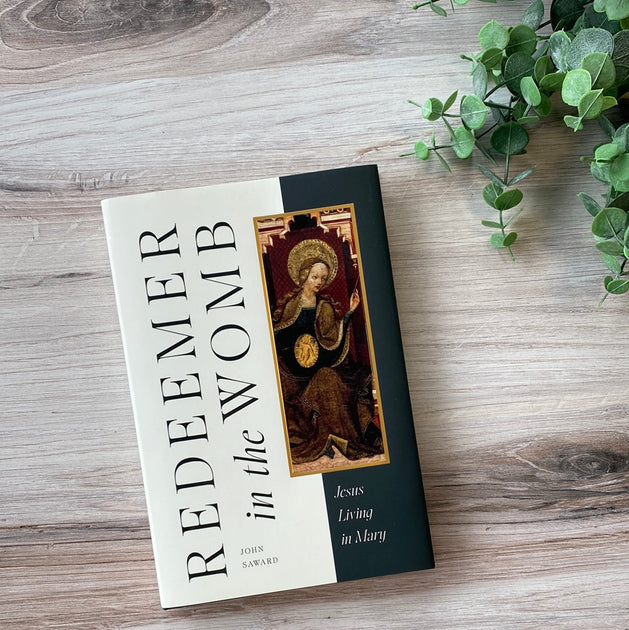
This is the fifth post of six posts on Redeemer
in the Womb: Jesus Living in Mary by John Saward.
You can find Post #1 here.
Post #2 here.
Post #3 here.
Post #4 here.
Chapter 5: First Step Into the World: The French School
Kerstin’s Summary:
In the seventeenth century the French School of Spirituality was
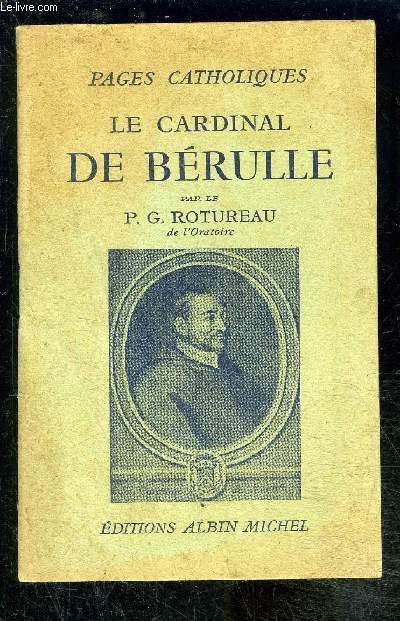
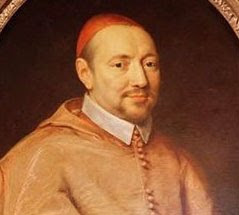
inspired by Pierre Cardinal de Bérulle (1575–1629). They devoted much time to
Jesus’ time in the womb. Bérulle is quoted throughout the chapter.
A ‘Copernican’ Christology
The most marked feature of the theology of Bérulle is its
Christ-centeredness. Pope Urban VIII called him “the Apostle of the Word
incarnate,” and one of his successors as superior general of the French
Oratory, Fr. Bourgoing, suggested he had been sent by God “as a new St. John to
point out Jesus Christ.” Bérulle worked a ‘Copernican revolution’ in the sacred
sciences. He attempted in theology what his older contemporary Galileo achieved
in astronomy.
“One of the outstanding intellects of this age has tried to maintain that the
sun, and not the earth, is at the center of the universe. . . . This novel
opinion, little followed in the science of the stars, is useful and must be
followed in the science of salvation. For Jesus is the sun, immobile in his
grandeur and moving all things. . . . Jesus is the true center of the world,
and the world must be in a continual movement towards him. Jesus is the sun of
our souls, from whom they receive all graces, lights, and influences.”
The Lodgings of the Son of God Like the Syriac theologians, Bérulle
compares and links the diverse lodgings (séjours) of Jesus: the bosom of God
the Father, the womb of the Blessed Virgin, and the altars of the Catholic
Church.
“There are three states of Jesus that deserve singular and daily consideration:
in the womb (sein) of the Father as Son of God, God from God, consubstantial
and equal with his Father; in the womb of the Virgin as Son of Man, both man
and God, the Mediator of God and men; in the womb of the Church, which is his
centre and altar, as Lamb of God and victim of praise and propitiation, which
she [the Church] presents to the eternal Father.”
The marvel of the Incarnation is this: it enables God to worship God. God the
Son in his humanity adores God the Father, with whom, in his divinity, he is
coequal. What is more, this filial worship of the Father begins at the first
moment of the Incarnation and has its first sanctuary in the Virgin’s womb.
[…]Bérulle follows St. Thomas’ teaching that, from the first moment of his
conception, Christ has the use of his human free will and at the summit of his
soul enjoys the beatific vision of God.
“He is living in the Virgin, and he is life itself. He is holy by the grace of
the hypostatic union, which is the grace of graces. He is in glory by the state
of his soul, established at the very hour of its making in the vision of God.
The Unborn State of Christ
The Christology of Bérulle is a doctrine of état, “state.” […] Bérulle
uses état in the latter sense to revive St. Irenaeus’ theology of
recapitulation and the Thomist doctrine of Christ’s headship. As man, but
because he is God, Christ is “the head of human nature.” In assuming a complete
and concrete human nature, the eternal Word in some way unites himself to all
men, and, by living a complete human life from conception to the last breath,
he touches and hallows every stage of every man’s journey through this world.
“By this high, divine, and lofty counsel, we do not just have a Man-God,
which is what the Incarnation gives us. We have an infant God, a mortal God,
suffering, trembling, weeping in a cradle; a God living and walking on earth,
in Egypt, in Judaea. . . . God wants us to have all the miseries, conditions,
and lowlinesses of our nature relieved by the divine subsistence and
personality, a God suffering and dying on the cross, a God dead in the tomb,
for he who took our nature by the mystery of the Incarnation wanted to take all
these states and conditions of our nature and to honour them with the divine
subsistence, what the ancient Fathers of the Church call the economy and
dispensation of the divine mystery. For the Incarnation of the Word is the
basis and foundation of a supreme dignity, in other words, not only of the
sanctification but also of the deification of all the states and mysteries that
share the life and wayfaring condition of the Son of God on earth.”
The human conception of the Son of God and his life in the womb have a
redeeming purpose. The virginal and miraculous character of his conception and
his perfections as a human child in the womb are intended “to repair the ruins
of our pitiful entry into the world as sinners.”
“Seeing that he wanted to be an infant on earth, in order to consecrate
and sanctify human infancy contaminated by Original Sin, could this infancy
have been better restored than by a Virginal Conception, a miraculous birth, a
light of glory before the light of the world, a divine power in the
powerlessness of the Child, the use of a holy and perfect life with God his
Father and the Virgin his Mother before the use of his senses and the force of
nature?”
“But we see sensibly that in this present state she is more close and
more conjoined, while he is in her, while he is part of her, while she lives
for him, and he lives by her, and he is in a continual state of dependence and
even of indigence with regard to her.”
The Visitation
The Visitation, says Bérulle, is the only visible work reported by
Scripture that Jesus and Mary performed during the nine months the divine baby
was in his Mother’s womb.
“God has become a child, and so he wants first to be known and adored by
a child, and this is one of the first emanations of the childhood of God,
manifesting himself to the universe. God is a child, the world ignores, heaven
adores, and a child is the first person in the universe to recognize and adore
him, and he does so by the homage and secret operation of God himself, who
wants to act upon children. He wants to honour himself as child by giving the
first knowledge of himself to a child in the world, making him his prophet in
the universe. Thus, the Infant-God is recognized and manifested, not by an
angel, but by a child. His first prophet is a child, just as shortly his first
martyrs will be children.”
Jesus in Mary: A Union of Hearts
Between any expectant mother and the child in her womb, there is more
than a merely physical presence of the one to the other, of the one in the
other. The bodily closeness is the basis of an intimacy of knowledge and love,
a union of hearts. This natural bond is wonderfully strengthened by the unique
fullness of grace with which the God-man and his Mother, each in their own way,
are endowed.
“All her senses are directed at him, for this is a sensible mystery, a
mystery that is sensible in her. And the whole of human sensibility owes homage
to its God made sensible for human nature. All her spirit is applied there. . .
. The grace infused into the Virgin, grace so excellent and exalted, applies
and absorbs all the senses, all the faculties, and all the spirit of the
Virgin. . . . Thus grace and nature conspire in her to establish an excellent disposition,
one that enraptures her heart and her soul in Jesus her Son and her God.”
The French Poet Paul Claudel expressed it in this way:
At the end of this third month after the Annunciation,
which is June,
The woman who is God’s has heard the tune
Of heartbeats under hers and felt the movement
of her Son.
Within the sinless Virgin’s womb commences a new era.
The Child who is before all time assumes time in his
Mother of his Mother,
And in the primal Mover man’s breathing is begun!
She moves not, speaks not a word. She adores.
She withdraws from the world. For her, God is not
outdoors:
He is her work, her Son, her Baby, borne as her All!
Satan rules and the whole wide world offers him incense
and gold.
God penetrates like a thief in this Eden of death
overbold.
A woman was once deceived, and now a woman
cheats hell.
O God, in a woman hid! O Cause, in this bondage
bound!
Jerusalem knows naught; even Joseph sees darkness
profound.
The Mother alone with her Child feels his ineffable
moving.
For nine months, says Bérulle, Mary is the only person on earth who
worships the mystery of the Incarnation. It takes place “on the earth, for the
earth, and yet is not known by the earth.” For the benefit of the whole world,
Mary alone in the world worships Jesus.
The Graces of Mary’s Womb Burden
Jesus . . . in his states and mysteries is himself our portion, and,
while giving us a universal share in him, he wants us also to have an
individual share in his diverse states depending on the different ways in which
he has elected us and we are devoted to him. Thus, he shares himself with his
children, making them partakers of the spirit and grace of his mysteries,
appropriating to some his life and to others his death, to some his infancy, to
others his power, to some his hidden life, to others his public life. . . . In
all these different states and conditions he gives himself to all. He gives us
his heart, his grace, and his spirit.
The infancy of the Son of God is a passing state. Its circumstances have
passed away. He is no longer a child. Nevertheless, there is something divine
in this mystery that continues in heaven and that effects a similar kind of
grace in the souls who are on earth, whom it pleases Jesus Christ to affect and
to dedicate to this humble and first state of his person.
The Good by God the Christ an Embryo:
From which His conceiving we may conceive His great love to us-ward.
Love, not only condescending to take our nature upon Him, but to take it by the
same way and after the same manner that we do, by being conceived. That, and no
other better beseeming way. The womb of the Virgin is surely no such place, but
He might well have abhorred it. He did not; pudorem exordii nostri non
recusavit, saith Hilary; “He refused not that ourselves are ashamed of,” sed
naturae nostrae contumelias transcurrit, “but the very contumelies of our
nature (transcurrit is too quick a word) He ran through them”; nay, He stayed in
them, in this first nine months. I say the contumelies of our nature not to be
named, they are so mean. So mean indeed as it is verily thought they made those
old heretics I named, and others more who yet yielded Him to be Man, to run
into such fancies as they did; only to decline those foul indignities as they
took them, for the great God of Heaven to undergo. . . . This sure is matter of
love; but came there any good to us by it? There did. For our conception being
the root as it were, the very groundsill of our nature; that He might go to the
root and repair our nature from the very foundation, thither He went; that what
had been there defiled and decayed by the first Adam, might by the Second be
cleansed and set right again. That had our conception been stained, by Him
therefore, primum ante omnia, to be restored again. He was not idle all the
time He was an embryo—all the nine months He was in the womb. . . . This honour
is to us by the dishonour of Him; this the good by Christ an embryo.
“Oh Wonderful and Incomprehensible Dependence of God”
St. Louis-Marie On Jesus in Mary’s Womb:
Jesus is at present, as much as he ever was, the fruit of Mary, as
heaven and earth tell him a thousand times every day, “And blessed is the fruit
of thy womb.” It is certain that, for every human being in particular who
possesses him, Jesus Christ is as truly the fruit and the work of Mary as he is
for the whole world in general, so that, if a faithful Christian has Jesus
Christ formed in his heart, he can boldly say, “Great thanks to Mary, what I
possess is her fruit and her work, and without her I would not have him.”
###
My Comment:
I found this surprising:
In the history of the Church, no school of theology and spirituality has
given Jesus’ life in Mary more attention than the seventeenth-century French
School, of which Pierre Cardinal de Bérulle (1575–1629)…was the chief
inspiration.
I suppose that’s true. Until this book I had not realized there had been much contemplation of Jesus inside of Mary’s womb.
Frances’s Reply:
I hadn’t either, Manny.
Michelle’s Reply:
This book is the first time I've come across it. It's pretty clueless, but I never really gave much thought to it.
Michael’s Reply on a Different Thought:
Manny wrote: "I found this surprising:
In the history of the Church, no school of theology and spirituality has given
Jesus’ life in Mary more attention than the seventeenth-century French School,
of which Pierre Cardinal de Bérulle (1575–1629)…was the chief
inspiration."
So interesting, Manny. I'll look into it. I think my wife has a book on French
Catholic Church spirituality.
###
My Comment:
I found this passage in chapter 5 fascinating and worth deeper
meditation.
The marvel of the Incarnation is this: it enables God to worship God. God the Son in his humanity adores God the Father, with whom, in his divinity, he is coequal. What is more, this filial worship of the Father begins at the first moment of the Incarnation and has its first sanctuary in the Virgin’s womb. Bérulle, who had a thorough knowledge of the Greek Fathers, repeats what Cyril, Proclus, and Andrew of Crete had recognized before him—namely, that the Virgin’s pure womb, unshadowed by any sin, containing the divine Word himself, is “the holy or sacred temple where Jesus reposes, the true Ark of the true Covenant . . . and the Virgin’s heart is the first altar on which Jesus offered his heart, his body, his spirit, as a victim of perpetual praise.” When Christ comes into the world, he surrenders his new human body and will to the service of the Father: “Lo, I have come to do thy will, O God” (Heb. 10:5–10; cf. Ps. 40:6–8).
That God the Son adores God the Father is evident in John’s chapter
seventeen when Jesus gives His farewell discourse and great final prayer.
When Jesus had said this, he raised his eyes to heaven and said,
“Father, the hour has come. Give glory to your son, so that your son may
glorify you, just as you gave him authority over all people, so that he may
give eternal life to all you gave him. Now this is eternal life, that they
should know you, the only true God, and the one whom you sent, Jesus Christ. I
glorified you on earth by accomplishing the work that you gave me to do. Now
glorify me, Father, with you, with the glory that I had with you before the
world began. (Jn 17:1-5)
I’m surprised Seward doesn’t allude to it, but here God worships God, the Father the Son and the Son the Father. I guess one could see this worship beginning in the womb with the Incarnation. John’s passage is a statement of the hour of His glory, when at the altar of the cross Jesus will offer Himself in sacrifice. Bérulle see the Virgin’s heart as the very first altar.
###
Note: While in discussion of Chapter 5, Kerstin received an emergency call that her mother in Germany, who was battling cancer, was in a critical state. She had to rush to Germany. I took over as lead moderator for the last three chapters.
###
Chapter 6: Our Lady of the Sign: The Liturgy and Sacred Art
My Summary:
This chapter explores how Our Lady, pregnant with Jesus, has shaped the
liturgical season, shaped various liturgies, and shaped sacred art.
Saward on the Liturgical Season:
When the eternal God enters time in the Virgin’s womb, time itself is
redeemed (see Eph. 5:16). Days and seasons can now be holy and sanctifying and
the year becomes liturgical. As she makes the journey from Advent to the last
Sunday after Pentecost, the Church relives the mysteries of the life of Jesus,
joyful and luminous, sorrowful and glorious, drawing from each a specific grace
and lesson. Pope Pius XII writes: The Liturgical Year, devotedly nourished and
accompanied by the Church, is not a cold and lifeless representation of the
events of the past, nor a simple and bare record of a former age. It is rather
Christ himself, ever living in his Church, continuing the journey of boundless
mercy that he began in his mortal life when he went about doing good (see Acts
10:38). Its compassionate purpose is to put the minds of men into contact with
his mysteries and somehow to live by them. . . . (p. 103)
In a sermon on the Annunciation, St. Aelred, Cistercian abbot of
Rievaulx (1109-1167), suggested we become contemporary with all the mysteries
of our lord’s life on earth, from the first moment of the Incarnation, through
the renewal and representation in the Mass of his sacrifice on the cross, which
summed up and perfected all the previous mysteries. (p. 105)
The mystery of Jesus’ life in Mary’s womb is always ‘recent’ in the
Church’s memory. Every evening she sings
the Magnificat, the song of the pregnant Virgin Mother, in order to share more
fully in her attitude of gratitude and obedience to God. And at the end of each year, in preparation
for the Saviour’s birthday, she enjoys a month’s contemplation of the same
mystery. (p. 105)
Saward on the Use of Mary in the Liturgy:
The traditional Advent liturgies thus clearly distinguish and separately
celebrate the first moment of the incarnation at the Annunciation, when the Son
of God took flesh upon himself in the Virgin’s womb without seed, from its
first manifestation at the Nativity, when the Son of God in the flesh came
forth from the Virgin’s womb without corruption. (p. 106)
The name of the Mother of God is found on almost every page of the
Byzantine liturgical books. In every
sacrament and office, in the celebration of each mystery of Christ’s life, the
Panagia (“All-Holy One”) is present, in and with the Church, interceding,
contemplating, and adoring. Her bearing
of the Father’s consubstantial Son for nine months in her womb is indelibly
imprinted on the liturgical consciousness of the East. (p.
109)
In the Akathist hymn of the Byzantine rite, now an indulgence prayer for
all Catholics, the Theotokos is
praised as the fulfillment of all the sanctuaries of the Old Testament.
All who hymn thy childbearing praise thee, Mother of God, as an animate
temple, for thy womb dwelt the Lord who holds thee in his hand. He it was who sanctified thee, glorified thee,
and taught all to cry out to thee:
Hail, tabernacle of God and the Word!
Hail, greater holy of holies!
Hail, Spirit-gilded ark!
Hail, treasury of unexhausted life!

Saward on Our Lady in Art:
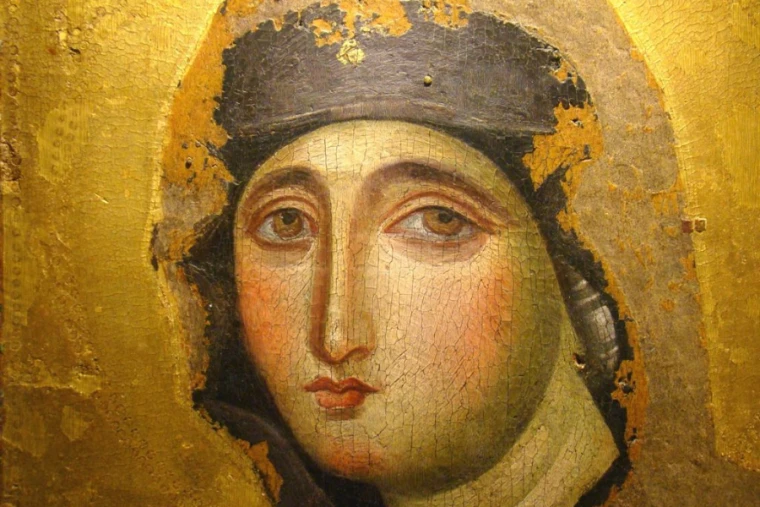
One of the most ancient and best-loved icons of the Byzantine tradition,
“Our Lady of Sign,” shows the Theotokos with
her hands extended in prayer and with the Holy Child in her womb. The “sign” is the Virginal Conception and
Birth prophesied by Isaiah, “the fifth evangelist”:
Therefore the Lord himself shall give you a sign. Behold a virgin shall conceive and bear a
son: and his name shall be Emmanuel.
(Isa. 7:14)
The Child visible in the womb is the pre-eternal God…The perpetual
virginity of God’s Mother is marked by the three stars on her veil, two on her
shoulder and one above her brow. Before
and in Jesus’ birth, and forever after, Mary is Virgin. (p. 112)
Images of Jesus in his Mother’s womb are also found in the West. For example, there is the relief carved by
Bartolomeo Buon in the middle of the fifteenth century for the tympanum over
the principal doorway of the Scuolo vecchia di Santa Maria della Misericordia
in Venice. Our Lady covers the kneeling
members of the Guild of Mercy with her cloak.
The Infant Jesus, his hand raised in blessing, is enthroned within a
mandorla in the center of the Virgin’s body.
In the Madonna del Parto of Piero della Francesca, painted in about
1460, the expectant Virgin stands motionless in regal dignity. Her left hand is on her hip. Her right points to her womb. On either side, angels hold back heavy velvet
drapes. They veil and guard the awful
mystery. (p. 114)




.jpg)