"Love follows knowledge."
"Beauty above all beauty!"
– St. Catherine of Siena

Showing posts with label Fourth of July. Show all posts

Sunday, July 5, 2026

Sunday Meditation: He That Gives You Rest

There are two halves to today’s Gospel, but with a subtle interconnection.  For the Fourteenth Sunday in Ordinary Time in Year A, Jesus first offers a prayer to the Father where He reveals the Father/Son relationship and then invites those listening into the heart of that relationship.

I think it would be helpful to read the entire chapter eleven of Matthew’s Gospel to understand the context of today’s passage.  Jesus has been preaching across the Galilean cities, and in some which He names He is rejected.  And so He thanks the Father for having revealed to children what the “wise” rejected.  What was revealed?  That there is a relationship between Father and Son.  In a sense, Jesus is exposing Himself as the child with the innocent heart.

Then Jesus turns to us and invites us as children to share His Passion.  His Passion?  He says to share His yoke, and isn’t it supposed to be easy?  Just last week we heard from the previous chapter in Matthew, that “whoever does not take up his cross and follow after me is not worthy of me.”  Can Jesus have changed His mind from one chapter to the next as to whether one needs to suffer with Him or one needs have their burden lifted?  These are not mutually exclusive.


Today’s Gospel:


At that time Jesus exclaimed:

"I give praise to you, Father, Lord of heaven and earth,

for although you have hidden these things

from the wise and the learned

you have revealed them to little ones.

Yes, Father, such has been your gracious will.

All things have been handed over to me by my Father.

No one knows the Son except the Father,

and no one knows the Father except the Son

and anyone to whom the Son wishes to reveal him."


"Come to me, all you who labor and are burdened,

and I will give you rest.

Take my yoke upon you and learn from me,

for I am meek and humble of heart;

and you will find rest for yourselves.

For my yoke is easy, and my burden light."

~Mt: 11:25-30


For the exegetical explanation, I’m going to turn to Raymond Ruan.  I don’t know who Raymond Ruan is.  His YouTube channel says he’s from Singapore and he has been publishing these exegetical videos since 2011.  The voice does not sound it belongs to a man, so I think he has a reader.  But I don’t know.  I have watched some of his videos and found them very good.  This one is excellent, and so I embed it.


Raymond Ruan:

We dive a little deeper into what's happening when Jesus prays to the father. We have two panels here. Panel one shows the high Christology. When Jesus says that all things have been handed over to me by my father, he is showing us his exclusive eternal relationship with God the father. He is the pre-existent son.  Moving to our next slide, we dive a little deeper into what's happening when Jesus prays to the father. We have two panels here. Panel one shows the high Christology. When Jesus says that all things have been handed over to me by my father, he is showing us his exclusive eternal relationship with God the father. He is the pre-existent son.  On this slide, we see how beautifully the whole Bible ties together. What we call the symphony of scripture. We have three images here. First, the meek king from Zechariah 9 who rides on a beast of burden to banish the warrior. Jesus fulfills this by ruling with breathtaking gentleness instead of military power.  The blueprint of discipleship. Here we have the greatest image of Jesus washing his disciples feet. His words are profound, but his life is the greatest lesson he offers. He teaches us how to bear the weight of human existence through radical love.


In Jewish tradition, a rabbi would invite disciples to take up the yoke of his teaching. Jesus invites us to tether ourselves to his divine wisdom. But there is also the yoke of Calvary.  Jesus says we must deny ourselves and take up our cross daily. We can't embrace his teaching while rejecting his suffering.  So here is the paradox. How can a yoke that includes the agonizing weight of the cross be considered easy?  Grace meets demand. The mechanics of the shared yoke. Here are the answers to the question by showing us the mechanics of the shared yoke. Look at the human reality. A radical demand plus human frailty equals crushing despair. Without grace, carrying our daily cross is impossible.  But look at the reality of grace.  Jesus doesn't just assign us a burden and walk away. He steps into the harness beside us. As the reflection from Epriest notes, when two people are yoked together, they are united in all they do. They are never alone. Christ always takes the heavy side of the beam. The cross remains real, but because grace bears the weight, the burden becomes wonderfully light.


We will all experience suffering.  But yoked with Jesus, the suffering becomes lighter.  When we enter the Sacred Heart of Jesus we receive His rest.

For the pastoral homily, I’m going to turn to the Order of Preachers in India, specifically, Fr. Pratik Pereira O.P.


Fr. Pratik:

Dear brothers and sisters, in today's gospel passage, we are invited into a deeply personal moment in the ministry of Jesus. To understand the weight of his words, we have to look at what was happening around him. Jesus had just finished preaching in the cities of Galilee where many had rejected his message. In response, Jesus turns to prayer. He praises the father for revealing the mysteries of the kingdom of God not to the wise but to children. Jesus is not dismissing intelligence here. Rather, he's teaching a profound theological truth. God is not a puzzle to be solved by human cleverness. God is a person to be known through love, humility, and a childlike trust. Jesus states clearly that no one knows the father except the son and no one knows the son except the father. This means that we cannot climb our way up to God through our own human efforts or sheer willpower. True knowledge of God is always a gift freely given to us by Jesus.  The relationship between the father and the son is one of perfect intimate love. And Jesus invites us directly into that inner life of God.


The image of a yoke is also deeply practical. A yoke was a wooden frame placed over the necks of a pair of oxen so they could pull a heavy load together. Crucially, a yoke is never meant for a single animal. It is designed for two. When Jesus says, "Shoulder my yoke," he's not asking us to carry a new set of heavy rules on our own. He's inviting us to harness ourselves to him. He's saying, "Let me walk right beside you. Let me pull the heaviest part of the weight." The rest that Jesus promises is not a life free of responsibilities, trials, or duties. Instead, it is a rest for our souls born from a security of knowing that we are never walking alone and that our worth is not [music] tied to how perfectly we perform.


Jesus then reveals his own character describing himself as gentle and humble in heart. This is the only place in the entire gospel where Jesus explicitly describes his own inner heart. He does not demand compliance through fear or intimidation. He draws us close through gentleness. His humility is the antidote to our pride and anxiety because he is gentle. We do not have to hide our weaknesses, our failures or our exhaustion from him. We can bring our messy burdened lives directly to him confident that he will meet a savior that each one of us will meet a savior who welcomes us with open arms rather than judgment.

He is gentle, so we must be gentle.  He is humble of heart, so we must be humble of heart.  He is childlike, so we must be childlike.  Lessons we need to internalize.


Sunday Meditation: “I give praise to you, Father, Lord of heaven and earth, for although you have hidden these things from the wise and the learned you have revealed them to little ones.”


Finally I have not posted on the 250th anniversary of our July 4th Declaration of Independence.  It’s a remarkable milestone in our history. I think a worthy hymn for this occasion is “My Country Tis of Thee.”


My country, 'tis of Thee,

Sweet Land of Liberty

Of thee I sing;

Land where my fathers died,

Land of the pilgrims' pride,

From every mountain side

Let Freedom ring.

My native country, thee,

Land of the noble free,

Thy name I love;

I love thy rocks and rills,

Thy woods and templed hills;

My heart with rapture thrills,

Like that above.


Let music swell the breeze,

And ring from all the trees

Sweet freedom's song;

Let mortal tongues awake;

Let all that breathe partake;

Let rocks their silence break,

The sound prolong.


Our fathers' God to Thee,

Author of liberty,

To Thee we sing.

Long may our land be bright,

With freedom's holy light,

Protect us by Thy might,

Great God our King.


That prayer at the end, “Protect us by Thy might,/Great God our King,”  is worth praying at every patriotic event.


Thursday, July 11, 2024

Personal Note: Fourth of July Fireworks

Shooting fireworks is illegal around here but lots of people buy them out of state and fire them off, saving most of them for the Fourth of July.  The block my mother lives on is particularly passionate about their fireworks.  People there must spend thousands of dollars on it.  Here is one series of volleys that I was able to film.


Very nice.  That’s about as good as a professional fireworks display.

Tuesday, July 4, 2023

Music Tuesday: America the Beautiful

I love this song.  A tear seems to always well up in my eye whenever I hear that first stanza.  It’s the perfect song for the Fourth of July.  There is something endearing about the lyrics as it calls up our nation’s natural beauty and attributes it to God.  The other stanzas are wonderful too as they recall various archetype American primogenitors.  The song was formed from an 1893 poem, “Pike’sPeak,” by Katherine Lee bates and after some slight evolution finally settled into these song lyrics.


O beautiful for spacious skies,

For amber waves of grain,

For purple mountain majesties

Above the fruited plain!

America! America!

God shed His grace on thee

And crown thy good with brotherhood

From sea to shining sea!


O beautiful for pilgrim feet,

Whose stern, impassioned stress

A thoroughfare for freedom beat

Across the wilderness!

America! America!

God mend thine every flaw,

Confirm thy soul in self-control,

Thy liberty in law!


O beautiful for heroes proved

In liberating strife,

Who more than self their country loved

And mercy more than life!

America! America!

May God thy gold refine,

Till all success be nobleness,

And every gain divine!


O beautiful for patriot dream

That sees beyond the years

Thine alabaster cities gleam

Undimmed by human tears!

America! America!

God shed His grace on thee

And crown thy good with brotherhood

From sea to shining sea!


What is especially moving for me is the appeal to God for perfection and brotherhood.  If you take God out of the nation’s identity as we have done in say the last couple of decades (but started earlier, of course), you can see the problemed nation we have become.  Perhaps I shouldn’t be such a downer on the Fourth of July but it is true: this nation is unrecognizable today.  But with faith, we can still turn this around. 

There have been some beautiful renditions.  Let me embed a few I really like.  Now artists have juggled the order of the stanzas, perhaps for particular emphasis.  Also, each artist arranges the song in a particular style.  I’ll post a few different arrangements.

The most iconic—can you use the word “iconic” for a song?—is the Ray Charles rendition.  Charles gives a soulful arrangement, and interestingly sings stanzas three first and ends with stanza one.


Why stanza three first?  I think it emphasizes the “liberation” theme, and he is able then to end with the beautiful first stanza.

Elvis Presley sings it in a ballad arrangement and only sings the first stanza, but repeats it in a speaking tone. 


What does the speaking tone add?  I think it gives it a preacher’s sermon’s tone that emphasizes the link to God.  And Elvis has such a rich speaking voice.

Country singer Alan Jackson sings it with a traditional western country arrangement.  He starts with the traditional first stanza and sings the fourth stanza, emphasizing the “patriot” verse. 


That western twang in his voice makes it so American.

Marilyn Horne sings it as only an opera singer can sing it, with a full orchestra and backing chorus.  She only sings the first stanza but like Elvis above repeats it but lets the full chorus carry the energy of the song. 


It’s heartwarming as she pride fully sings it in what seems an international context and overlooking New York Harbor. The orchestral cadenza is punctuated with fireworks recalling Independence Day.

Another opera singer, Denyce Graves, sings it in a string quartet plus guitar (is that a quintet or a guitar quartet?) and sings three verses, One, three, and four.


The accentuating guitar tints it with a folk sound color while still keeping it solidly classical.

Also in a classical orchestral arrangement, but minus the chorus and less operatic, is Jackie Evancho’s version.  She too sings the first and fourth stanzas, emphasizing the theme of American “brotherhood.”


Her sublime voice just makes the song float in divine grace.

I have not embedded any versions with the second stanza, which seems to be in less favor.  Is it because the march of freedom across the wilderness suggests a less-than-embraced today manifest destiny?  Or is the theme of “self control” and “liberty law” just not as lyrically interesting?  I didn’t post it because of length but the opera singer Leontyne Price has a beautiful version with that second stanza.

My favorite, though all beautiful, is the Evancho rendition, a simple and beautiful voice underscoring the “O beautiful” of each opening stanza.  And I do like the first and fourth stanzas best if I were limited to two.  Which do you like best?  Any other favorites?

Happy Fourth of July!


Monday, July 4, 2022

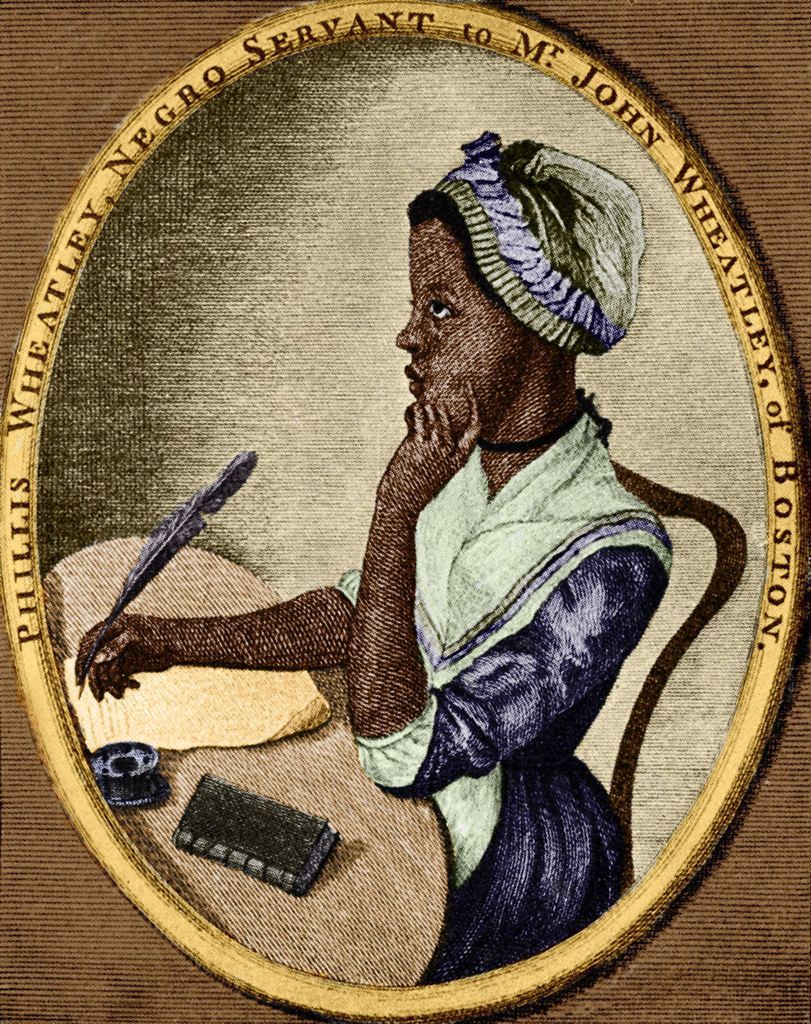
Poetry: For the Fourth of July, “His Excellency General Washington” by Phillis Wheatley

Who was Phyllis Wheatley?  She was an African-American who was a slave but taught to read and write and showed a natural gift toward poetry.  According to Wikipedia, she was born in West Africa, enslaved at about seven or eight, brought to the colonies where she was sold to the Wheatley family in Boston.  This was quite fortunate (not the enslavement, but being sold to the Wheatley family) in that she was taught to read and write, and once showing talent in poetry was encouraged.  Phyllis Wheatley was the first African-American to publish a book, titled, Poems on Various Subjects.  Her masters even took her to London, which must have been a great experience for her.


PoetryFoundation also has a fuller biography (read this one if you’re only going to read one) and a brief analysis of her poetic style. 


Poems on Various Subjects revealed that Wheatley’s favorite poetic form was the couplet, both iambic pentameter and heroic. More than one-third of her canon is composed of elegies, poems on the deaths of noted persons, friends, or even strangers whose loved ones employed the poet. The poems that best demonstrate her abilities and are most often questioned by detractors are those that employ classical themes as well as techniques.

Upon publication of her book, she was freed and went on to live a difficult and relatively short life.  But her life did overlap the beginning of the Revolutionary War and she wrote this one poem in praise of George Washington, the Commanding General of the Continental Army.  I think it’s worth reading today on the Fourth of July, 2022.  This poem fits right into Poetry Foundation’s analysis.


His Excellency General Washington

Phillis Wheatley (1753-1784)


   Celestial choir! enthron'd in realms of light,

Columbia's scenes of glorious toils I write.

While freedom's cause her anxious breast alarms,

She flashes dreadful in refulgent arms.

See mother earth her offspring's fate bemoan,

And nations gaze at scenes before unknown!

See the bright beams of heaven's revolving light

Involved in sorrows and the veil of night!


   The Goddess comes, she moves divinely fair,

Olive and laurel binds Her golden hair:

Wherever shines this native of the skies,

Unnumber'd charms and recent graces rise.


   Muse! Bow propitious while my pen relates

How pour her armies through a thousand gates,

As when Eolus heaven's fair face deforms,

Enwrapp'd in tempest and a night of storms;

Astonish'd ocean feels the wild uproar,

The refluent surges beat the sounding shore;

Or think as leaves in Autumn's golden reign,

Such, and so many, moves the warrior's train.

In bright array they seek the work of war,

Where high unfurl'd the ensign waves in air.

Shall I to Washington their praise recite?

Enough thou know'st them in the fields of fight.

Thee, first in peace and honors—we demand

The grace and glory of thy martial band.

Fam'd for thy valour, for thy virtues more,

Hear every tongue thy guardian aid implore!


   One century scarce perform'd its destined round,

When Gallic powers Columbia's fury found;

And so may you, whoever dares disgrace

The land of freedom's heaven-defended race!

Fix'd are the eyes of nations on the scales,

For in their hopes Columbia's arm prevails.

Anon Britannia droops the pensive head,

While round increase the rising hills of dead.

Ah! Cruel blindness to Columbia's state!

Lament thy thirst of boundless power too late.


   Proceed, great chief, with virtue on thy side,

Thy ev'ry action let the Goddess guide.

A crown, a mansion, and a throne that shine,

With gold unfading, WASHINGTON! Be thine.

You can hear the poem read if you prefer here.


I’m not a fan of 18th century poetry but this is as good as most of that era.  Though educated, I can’t imagine she was sent to prominent teachers and had a disciplined education.  She probably read a lot on her own and was self-taught.  She seems like a wonderful woman.  If I had the time I would love to read more about her.  She needs to be better remembered.  God bless her.

This short biographical video captures her story.


Happy Independence Day!

Monday, July 3, 2017

Matthew Monday: Putting Up Old Glory

Tomorrow is the Fourth of July and, since we haven’t had a flag up in front of the house for a couple of years now, we decided to put one up.  The flag we had up was faded and shredded from wear.  Of course this is a Father/Son thing.  We had a bright new flag which I put on the flag pole and Matthew kept cautioning me that under no circumstances is a flag allowed to touch the ground. 

Here are some pictures.


Now if this looks familiar to you, it might be.  Back in July of 2013 I published a similar post with Matthew holding up a flag.  So if he is two months shy of eight today, he was two months shy of four in that post.  He’s definitely grown even though out of pure chance he has the same color scheme for his clothing.  But I do notice he didn’t have glasses back then.  

Monday, July 4, 2016

List: Literary Books That Have Shaped American Life


I came across this list of “The books that have shaped American life” by Tracy Mumford from Minnesota Public Radio.  It’s a list of the most influential books that have shaped American life as voted by their listeners.  But more importantly, they got the inspiration to compile such a list from The Library of Congress, which put together list of “Books that have Shaped America.”  Their website doesn’t say how they compiled and discriminated to form this list, but it’s a much better list than the listener generated from Minnesota Public Radio.

Well, that gave me an idea of me putting together such a list from my perspective, and what better day than the Fourth of July to celebrate American literature.  What I listed here is what I perceived as the 50 most influential literary works of American literature.  They may not be the best literary works, but I think they had the most impact on American literary culture.  I limited myself to one work per author, and in some cases I listed collections put together posthumously.  I know; there may be some glaring omissions but I either have not read them or I did not perceive them to have had a cultural impact yet.

So without further ado, here are what I think are the 50 most influential literary works in American literature, in no particular order.

1.      The Adventures of Huckleberry Finn by Mark Twain
2.      The Great Gatsby by F. Scott Fitzgerald
3.      Little Women by Louisa May Alcott
4.      Gone With the Wind by Margaret Mitchell
5.      Walden; or, Life in the Woods by Henry David Thoreau
6.      On the Road by Jack Kerouac
7.      Moby-Dick; or, the Whale by Herman Melville
8.      Catch-22 by Joseph Heller
9.      Leaves of Grass by Walt Whitman
10.  Uncle Tom's Cabin; or, Life Among the Lowly by Harriet Beecher Stowe
11.  To Kill a Mockingbird by Harper Lee
12.  Atlas Shrugged by Ayn Rand
13.  All the King's Men by Robert Penn Warren
14.  The Sun Also Rises by Ernest Hemingway
15.  Slaughterhouse-Five by Kurt Vonnegut
16.  The Grapes of Wrath by John Steinbeck
17.  The Red Badge of Courage by Stephen Crane
18.  The Scarlet Letter by Nathaniel Hawthorne
19.  The Catcher in the Rye by J. D. Salinger
20.  Narrative of the Life of Frederick Douglass by Frederick Douglass
21.  In Cold Blood by Truman Capote
22.  Poems by Emily Dickenson
23.  Long Day's Journey into Night by Eugene O'Neill
24.  The Sound and the Fury by William Faulkner
25.  The Maltese Falcon by Dashiell Hammett
26.  The Autobiography of Benjamin Franklin by Benjamin Franklin
27.  The Education of Henry Adams by Henry Adams
28.  The Portrait of a Lady by Henry James
29.  Harmonium by Wallace Stevens
30.  Invisible Man by Ralph Ellison
31.  A Streetcar Named Desire by Tennessee Williams
32.  The Essays of Ralph Waldo Emerson by Ralph Waldo Emerson
33.  The Autobiography of Malcolm X by Malcolm X
34.  The Last of the Mohicans by James Fenimore Cooper
35.  Tales by Edgar Allan Poe
36.  Ethan Frome by Edith Wharton
37.  My Ántonia by Willa Cather
38.  Blood Meridian by Cormac McCarthy
39.  Beloved by Toni Morrison
40.  The Complete Stories by Flannery O'Connor
41.  Native Son by Richard Wright
42.  The Collected Stories of O. Henry by O. Henry
43.  Winesburg, Ohio by Sherwood Anderson
44.  Look Homeward, Angel by Thomas Wolfe
45.  The Complete Tales of Washington Irving by Washington Irving
46.  The Poetry of Robert Frost by Robert Frost
47.  Collected Stories by Raymond Carver
48.  The Good Earth by Pearl S. Buck
49.  Elmer Gantry by Sinclair Lewis
50.  Rabbit, Run by John Updike

So, out of curiosity, what would you take off this list and what would you add?


Happy Fourth of July!