"Love follows knowledge."
"Beauty above all beauty!"
– St. Catherine of Siena

Showing posts with label Thomas a Kempis. Show all posts

Wednesday, November 13, 2019

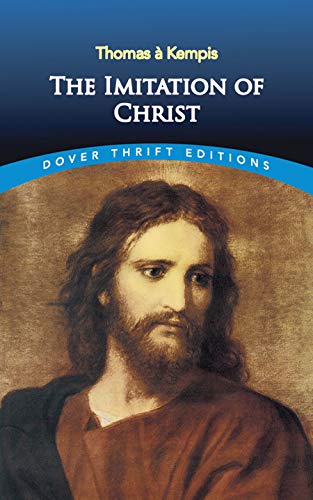
The Imitation of Christ by Thomas à Kempis, Post 4


This is my final post on The Imitation of Christ.  At the end is my book review I posted on Goodreads.  I gave the book three stars.


You can find Post 1 on this read, here, 
You can find Post 2 here.  
You can find Post 3 here. 

Still on Book 3, “Internal Consolation”:


Comment 8:
So I’ve been critical, as you’ve seen my comments, calling à Kempis “semi-gnostic.” If he values the spirit over the corporeal so much, why isn’t he fully gnostic? Let’s look carefully at why he considers the spiritual so much more important. In Book Three, chapter 35, he says through the Voice of Christ:

If you look for rest in this life, how will you attain to everlasting rest? Dispose yourself, then, not for much rest but for great patience. Seek true peace, not on earth but in heaven; not in men or in other creatures but in God alone. For love of God you should undergo all things cheerfully, all labors and sorrows, temptations and trials, anxieties, weaknesses, necessities, injuries, slanders, rebukes, humiliations, confusions, corrections, and contempt. For these are helps to virtue. These are the trials of Christ's recruit. These form the heavenly crown. For a little brief labor I will give an everlasting crown, and for passing confusion, glory that is eternal....


The key sentence I think there is “For these are helps to virtue.” Later in chapter 54 of that book, he creates a dichotomy between “nature,” which stands of the corporeal, and “grace,” which stands for the spiritual. I’m not going to quote it, but it’s quite a list of contrasts between nature and grace. He concludes that rhetorical tour de force with this:

The more, then, nature is held in check and conquered, the more grace is given. Every day the interior man is reformed by new visitations according to the image of God....


So then the mortifications of the body he advocates are a process of personal reform to build virtue. How is this different than Gnosticism? In Gnosticism the body is just evil. In à Kempis the body is a temptation from which you can succumb to sin. There is a subtle distinction. If you want to ensure yourself of purity, if you want to ensure virtue, radically eliminate the temptations. Actually even more than elimination. Train your body through asceticism and excoriations to not find pleasure in the corporeal. It’s not that the corporeal is evil for à Kempis, though his language sometimes slips to sound that way, but something to be feared. It’s a view of Christianity that suggests you need to suffer in order to love, and to be ready for when real suffering comes your way you induce suffering to yourself to build strength.

In the fifty-fifth chapter, he brings this to full expression:

Thus nature itself, which You created good and right, is considered a symbol of vice and the weakness of corrupted nature, because when left to itself it tends toward evil and to baser things. The little strength remaining in it is like a spark hidden in ashes. That strength is natural reason which, surrounded by thick darkness, still has the power of judging good and evil, of seeing the difference between true and false, though it is not able to fulfill all that it approves and does not enjoy the full light of truth or soundness of affection.


It is not that nature is evil but that it tends to evil if left unchecked

Commnet 9:
In Book Three à Kempis provides the objective of all this discipline. In chapter 49 he tells us through the voice of Christ, “You must put on the new man. You must be changed into another man.” He builds on that in chapter 53, again through the voice of Christ:

If you completely conquer yourself, you will more easily subdue all other things. The perfect victory is to triumph over self. For he who holds himself in such subjection that sensuality obeys reason and reason obeys Me in all matters, is truly his own conqueror and master of the world.


And then augments this point further in chapter 56, again in the voice of Christ:

My child, the more you depart from yourself, the more you will be able to enter into Me. As the giving up of exterior things brings interior peace, so the forsaking of self unites you to God. I will have you learn perfect surrender to My will, without contradiction or complaint.


The subjugation of oneself for the self of Christ is the spiritual objective of every Christian. à Kempis is right on target with this. We get this from St. Paul in Galatians, “It is no longer I who live, but it is Christ who lives in me” (Gal 2:20). I think it’s Fulton Sheen who phrases it as every Christian needs a heart transplant, replacing one’s heart with that of Christ’s. St. Catherine of Siena actually has a mystical experience where her heart is exchanged with Christ’s heart.

What’s in question, then, is how one arrives at this objective. The à Kempis way is strict asceticism and withdrawal from the world. However, St. Paul wasn’t a recluse. While Christ had his 40 days in the desert, he also had the wedding feast at Cana, Passover dinners, and engaged large crowds for healing and feeding. The history of Christian spirituality is varied on how to achieve this heart replacement. The desert fathers start this asceticism and reclusion. The monastics modify it by segregating themselves away from the heart of the world but certainly more engaged than the desert hermits. In the twelfth century you start getting the itinerant orders, the Franciscans, the Dominicans, the Carmelites (to a lesser degree), and then later followed by the Jesuits who engage society. And from the sixteenth century on to ours we get what I’ll call the charitable orders, the Vincentians, the Sisters of Charity, the Little Sisters of the Poor, the orders who embrace society to feed, educate, and cure the needy. One can say this culminates in Mother Teresa’s brand of spirituality. So then one can see the trajectory of Christian spirituality as going from the desert to the multitude, just as in the course of Christ’s journey.

The à Kempis way is quite narrow, and even anachronistic for its own time. However, for those that are attracted to this brand of spirituality, the book is a perfect guide. Most of us, mix and match our forms of spirituality, and so we still can get many benefits from his advice.

###

Note: I did not have any comments on Book 4, “An Invitation to Holy Communion.”

###

Final Review

I may be an outlier when it comes to The Imitation of Christ.  I don’t find it engaging, either as a devotional or as a guide.  This was my second read and it remains at three stars. 

Yes, there are parts that very spiritual.  That’s why it’s three stars and not one.  But there are also parts that are dry, very dry, parts where the advice is extremely ascetic, parts where the recommendations require disengagement from the world, and parts I felt that were semi-gnostic.  One has to balance the spiritual with the corporeal, and not everything involved with the corporeal is bad or harmful for one’s soul.  Ultimately, if we are granted heavenly existence, our bodies will be reunited with our souls, and so our bodies are not inherently base.  In many places à Kempis presents the flesh as detestable.  This didn’t sit well with me.

Perhaps part of the extreme ascetic and disengagement from the world was because of the times it was written.  In the early 15th century, Europe was still undergoing the Black Plague, the Church was in schism, and there was a lot of social turmoil.  It was a difficult time, and what is strange is that in a time of declining monasteries, the authors of were advocating a return to monastic life.  This was completely understandable.  It was the Benedict Option of its day.  One can understand it but it feels anachronistic for today.

Besides disengagement, the authors (there are more than one under the Thomas à Kempis nom de plume) do provide consolation for a devout life.  They do coach and inspire.  This is the most read devotional in the Christian world other than the Bible, and is a must read. 



Wednesday, November 6, 2019

The Imitation of Christ by Thomas à Kempis, Post 3

You can find Post 1 on this read, here, 
You can find Post 2 here.  

From Book 3, “Internal Consolation”:

Comment1:
Madeleine highlighted this prayer from Book 3, chapter 3:
"Lord, teach me to do Thy will, teach me to walk humbly and uprightly before Thee, for Thou art my wisdom, who knowest me in truth, and knowest me before the world was made and before I was born into the world."

My response to Madelieine: That is a beautiful prayer. Given that pride is one of my biggest obstacles, I do on occasion ask Jesus, "Jesus, may my heart be as humble as Yours when you call."

Comment 2:
I have to tell a funny story about chapter 24. There's a Catholic blog I sometimes visit, Virginia Lieto's "Evangelizing Through the Catholic Arts." She is a Goodreads author here and one day I noticed her Goodreads page. I commented on her blog to a post where she was reviewing a book she had just read and I told her I was a moderator to this blog at Goodreads. I invited her to join and told her we were shortly starting The Imitation of Christ.

She replied that both her and her husband had read The Imitation of Christ together and that they had an inside joke. Whenever her husband looked out the window seeing what their neighbors were up to, she would just say, "Book 3, Chapter 24." And that would stop him from snooping. It became a running joke in their marriage. Now you'll have to go and see what chapter 24 is about.

You can see that exchange and check out her blog here.

  
Comment 3:
Kerstin wrote: "I'm still in the beginning of the chapter. I find I can't just "power through" the pages if I want to get anything out of them."

My response to Kerstin: I know what you mean. Chapter 3 is quite enjoyable to me. I don't seem to have any criticism. You know, there are multiple authors all absorbed under Thomas à Kempis. We have no indication who wrote what. I wonder if a different author wrote a different chapter. The three chapters so far seem to be different from each other. I don't know if it's because the focus is different or if the author's perspectives are different.

Comment 4:
Some of these passages should be highlighted. Take this from the opening chapter of Book 3. It’s the second paragraph but I’m going to separate the sentences out so you can notice the emphasis.

Blessed is the soul who hears the Lord speaking within her, who receives the word of consolation from His lips.
Blessed are the ears that catch the accents of divine whispering, and pay no heed to the murmurings of this world.
Blessed indeed are the ears that listen, not to the voice which sounds without, but to the truth which teaches within.
Blessed are the eyes which are closed to exterior things and are fixed upon those which are interior.
Blessed are they who penetrate inwardly, who try daily to prepare themselves more and more to understand mysteries.
Blessed are they who long to give their time to God, and who cut themselves off from the hindrances of the world.


As you can see this is modeled on the beatitudes. Notice how everything is inward. Everything in the book seems to deal with the isolation of the self. Compare this with Christ’s beatitudes:

“Blessed are the poor in spirit, for theirs is the kingdom of heaven.
Blessed are they who mourn, for they will be comforted.
Blessed are the meek, for they will inherit the land.
Blessed are they who hunger and thirst for righteousness, for they will be satisfied.
Blessed are the merciful, or they will be shown mercy.
Blessed are the clean of heart, for they will see God.
Blessed are the peacemakers, for they will be called children of God.
Blessed are they who are persecuted for the sake of righteousness, for theirs is the kingdom of heaven.
Blessed are you when they insult you and persecute you and utter every kind of evil against you [falsely] because of me.” (Matt 5:3-11)


Notice the difference. Those in à Kempis are all interiorizing virtues. It’s almost as if the outside world doesn’t exist. Look at his very next paragraph:

Consider these things, my soul, and close the door of your senses, so that you can hear what the Lord your God speaks within you. "I am your salvation," says your Beloved. "I am your peace and your life. Remain with Me and you will find peace. Dismiss all passing things and seek the eternal. What are all temporal things but snares? And what help will all creatures be able to give you if you are deserted by the Creator?" Leave all these things, therefore, and make yourself pleasing and faithful to your Creator so that you may attain to true happiness.


The theme there is to “close the door of your senses,” which in effect is to close the door to the outside world. Now Christ’s beatitudes isn’t rejecting the interior. He talks of mourning and clean of heart, which are interior virtues, but He also talks of meekness, righteousness, mercifulness. These virtues are concerned with interacting with the outside world, the outside world being your neighbor. It calls to mind Christ’s two commandments: love God with all your heart and love your neighbor as yourself.

This book is called The Imitation of Christ. So if it ignores half of Christ’s commandment—and I say ignore, not reject, for there’s nothing I can see that rejects Christ’s second commandment—is the exhortation really being in imitation of Christ?

Comment 5:
Kerstin says in response to my comment: “The title of Book III is On Interior Consolation and the title of the Chapter 1, Christ Speaks Interiorly to the Faithful Soul. This says to me that the focus is interior. I see this whole section more in light of detachment.

Does your edition give you the Scripture quotes? In mine, which is the same as the book icon for this discussion, they are set in italics with an endnote number.”

My response to Kerstin: My edition cites the allusion but doesn't supply the text. I didn't follow up on it. The citation for me is Psalm 84:9. When I read psalms 35 and 84, they both seem very exterior to me. I really don't see the interior. "Brandish lance and battle-ax against my pursuers," that sounds exterior to me. Read the entire psalm and see if it feels interior or exterior. Maybe my perception is wrong.

Comment 6:
Here is a fine article I found this morning on how gnosticism - the heresy of the bodily as seen as evil - has infiltrated contemporary Christianity.


Read at least the first several paragraphs. To create a dichotomy of spiritual being good and corporeal being bad is not really in line with the core of Christianity. I'm not saying à Kempis and the other writers of this book are gnostic heretics, but they do drift into a semi-gnostic view of Christianity.

Here is a quote from St. Thomas Aquinas that I think says what I've been trying to say:
"We ought to cherish the body. Our body's substance is not from evil principle but from God and therefore we ought to cherish the body by a friendship of love."

Comment 7:
Kerstin says: “On the authorship of The Imitation of Christ. I re-read the intro in my copy, and it goes into it to some detail. I will give you the gist:

That Kempis is not the sole author has been asserted for some time, and there are among others three primary persons who are named in conjunction to be possible co-authors. Yet when taking a closer look the likelihood seems less certain given background, location, local language variants, etc. Kempis didn't write the 'Imitation' in one setting. Book III and VI are later compositions…”


My response to Kerstin: Thanks Kerstin. That is interesting. I guess I'll just refer to the writer as Kempis.

Friday, November 1, 2019

The Imitation of Christ by Thomas à Kempis, Post 2


You can find my Post #1 on The Imitation of Christ here.  

Still on Book 1, there were some comments and replies.

Gerri Commented:
Having spent 12 of my working years at a university, I saw people who thought way too much of their own intellectualism. Humility they knew not. And, given the chaos of the times of Imitation, especially the Papal split, I imagine the intellectuals of the era were full of their own viewpoints. Kempis makes more sense to me against such a backdrop. I can even understand how he makes the Gnostic-leaning anti-physicality comments.

My Reply:
Yes, they (it's actually multiple writers) are reacting against the intellectualism of their day. Perhaps this is why I bristle at some of the comments. What's odd is that they are Augustinians, which I thought are supposed to uphold an intellectual rigor. But I have to admit I don't know that much about them. I'll try to explore it when I get some time.

One more thing: I too have had a sense that, 'gosh, I can never live up to this,' while reading the impossible (for me) standards of Kempis. But I can strive to be better. That's the takeaway for me.

Agreed. Even if you exclude the parts specific to monasticism, I could never live up to it either.

Other saints that were married: St. Gianna Molla, St. Rita, St. Monica. We do need more. Marriage certainly makes you holier. Lord knows what I would have gotten myself into if I had not married.


Susan Commented:
This is the point of "hating the world" - meaning I think, 'hating' the pride and rebellion against God that -> the 'world' as we know it - post-Fall; re-directing our mind and heart to God where it belongs...(I don't think he is necessarily saying hate the things of the world, the body, animals etc.)

My Reply:
I don't know if he's saying that or not but the emphasis is so heavily on rejection of the physical world that it certainly feels semi-Gnostic. And that's part of our world view today. Outside an occasional acknowledgement in the "Theology of the Body" the physical world is seen as bad while the spiritual world is seen as good.

That said, I acknowledge the really good spiritual advice that's in the book.

--------------------------------------------------------------------------------------------------------------------

From Book 2:

Comment 1:
I found Book 2 more to my liking.  Here the authors focus on the interior life, and it’s hard to disagree with anything they say here.  Chapter 4, “Purity of Mind and Unity of Purpose,” is a case in point.  Here are the first two paragraphs:

A man is raised up from the earth by two wings -- simplicity and purity. There must be simplicity in his intention and purity in his desires. Simplicity leads to God, purity embraces and enjoys Him.

If your heart is free from ill-ordered affection, no good deed will be difficult for you. If you aim at and seek after nothing but the pleasure of God and the welfare of your neighbor, you will enjoy freedom within.

Perhaps all the advice à Kempis and the other writers offer are in support of shaping the Christian reader to these two virtues: simplicity and purity.  Simplicity and purity are the foundations from which will achieve the sole objective of life for à Kempis.  And what is that?  He tells us it will require two steps.  First in Chapter 11, “Few Love the Cross of Jesus,” he tells us what simplicity and purity conform us to:

If a man give all his wealth, it is nothing; if he do great penance, it is little; if he gain all knowledge, he is still far afield; if he have great virtue and much ardent devotion, he still lacks a great deal, and especially, the one thing that is most necessary to him. What is this one thing? That leaving all, he forsake himself, completely renounce himself, and give up all private affections. Then, when he has done all that he knows ought to be done, let him consider it as nothing, let him make little of what may be considered great; let him in all honesty call himself an unprofitable servant. For truth itself has said: "When you shall have done all these things that are commanded you, say: 'we are unprofitable servants.'

Then he will be truly poor and stripped in spirit, and with the prophet may say: "I am alone and poor."(2) No one, however, is more wealthy than such a man; no one is more powerful, no one freer than he who knows how to leave all things and think of himself as the least of all.

It is to “renounce” oneself completely.  Simplicity and purity require us to be “poor and stripped in spirit.”  It is a deconstruction of oneself to its essence, a squeezing out of the imperfections to become a pure image of Christ..

The second step is elucidated in Chapter 12, “The Royal Road of the Holy Cross.”  à Kempis starts with a quote from Jesus from Matthew: “Deny thyself, take up thy cross and follow Me” (Matt 16:24).  The entire Imitation of Christ can be summarized in that quote.  The deconstructing of oneself is lodged in the “deny thyself.”  “Take up thy cross and follow me” is the second step.

Why, then, do you fear to take up the cross when through it you can win a kingdom? In the cross is salvation, in the cross is life, in the cross is protection from enemies, in the cross is infusion of heavenly sweetness, in the cross is strength of mind, in the cross is joy of spirit, in the cross is highest virtue, in the cross is perfect holiness. There is no salvation of soul nor hope of everlasting life but in the cross.

But what does it entail to take up the cross?

Either you will experience bodily pain or you will undergo tribulation of spirit in your soul. At times you will be forsaken by God, at times troubled by those about you and, what is worse, you will often grow weary of yourself. You cannot escape, you cannot be relieved by any remedy or comfort but must bear with it as long as God wills. For He wishes you to learn to bear trial without consolation, to submit yourself wholly to Him that you may become more humble through suffering. No one understands the passion of Christ so thoroughly or heartily as the man whose lot it is to suffer the like himself.

In short it means suffering.  That is the ultimate goal, to suffer like Jesus on the cross because such suffering brings salvation.  This is the part of Christ’s life we are to imitate which the title alludes to:

The whole life of Christ was a cross and a martyrdom, and do you seek rest and enjoyment for yourself? You deceive yourself, you are mistaken if you seek anything but to suffer, for this mortal life is full of miseries and marked with crosses on all sides. Indeed, the more spiritual progress a person makes, so much heavier will he frequently find the cross, because as his love increases, the pain of his exile also increases.

So when you imitate the suffering Christ, you reach perfection.

When you shall have come to the point where suffering is sweet and acceptable for the sake of Christ, then consider yourself fortunate, for you have found paradise on earth. But as long as suffering irks you and you seek to escape, so long will you be unfortunate, and the tribulation you seek to evade will follow you everywhere. If you put your mind to the things you ought to consider, that is, to suffering and death, you would soon be in a better state and would find peace.

And finally à Kempis punctuates his thesis in his final paragraph of the twelfth chapter:

When, therefore, we have read and searched all that has been written, let this be the final conclusion -- that through much suffering we must enter into the kingdom of God.

So follow the arch of his logic.  Simplicity and purity lead us to deny oneself, and by denying ourselves, we take up the cross and follow Jesus, which must inevitably lead to suffering.  In this we achieve salvation.

Sunday, October 27, 2019

The Imitation of Christ by Thomas à Kempis, Post 1


Back in May, the Catholic Thought Book Club read The Imitation of Christ by Thomas à Kempis This and subsequent posts are my end of the conversation and constitute my thoughts.  The book is divided into four parts each called a “Book.”  I did not make any comments on the last book. 

This is my second reading of this famous work.  Back in April of 2014 I posted on my first read.


As a short introduction, The Imitation of Christ is a devotional book composed in the early 15th century by a group of German/Dutch Augustinian monks, of which Thomas à Kempis is one.  The book is usually attributed to à Kempis, but more than one monk had a hand in the writing.  It was written prior to the Protestant Reformation and the book is the most widely read Christian devotional other than the Bible.

I'm using the Dover Thrift Edition which I must have bought a number of years ago for a dollar or two. The translators are Croft and Bolton.  You can find this edition online, here 

From Book 1, "Thoughts Helpful in the Life of the Soul":

Comment 1:
Good comments Nikita. You conveyed well. I echo your concerns. I'm going to wait a little longer before I give some less favorable comments. I don't think you're going to be alone in the criticism.
But I agree, there are wonderful nuggets everywhere in the book.

One of the fundamental questions in reading the book, and you touched on it, is who is the author writing for? We in the general population read it today, and the general population derives all sorts of spiritual wisdom from it. But it does strike me the author's intent was toward a very specific readership. For instance, take the second sentence in Book 1, Chapter 8:
"Do not keep company with young people and strangers."

What an odd recommendation. How can one actually observe that, or is it even wise to do it? Obviously this could not be recommended for the general secular population. It certainly could not be intended for priests either. It certainly can't be intended for people who are to evangelize. I share your Dominican ethos. I think this is a problematic book for we who want to engage the world.

Comment 2:
Yes, Augustinian monks, which I don't know that much about. I'm trying to research it as I take breaks from work...lol. Interestingly, Martin Luther was an Augustinian monk.

Comment 3:
Chapter 16, “Bearing the Faults of Others” is absolutely perfect and one that hits home for me. It’s just four paragraphs long. First, he a person bearing faults may be there to test your patience. Correct them and then pray for them. Second, if that person does not amend, one has to bear it patiently. God will eventually turn that problem (a Kempis calls it an evil, but I think that might be too harsh) into a good. Then he advises to bear patiently the faults of others because you have faults too that others must endure. It reminds me of the passage in Matthew where Christ says “"Why do you look at the speck that is in your brother's eye, but do not notice the log that is in your own eye?” (Matt 7:3).

Then in the third paragraph he comes to the heart of the problem.

“If you cannot make yourself what you would wish to be, how can you bend others to your will? We want them to be perfect, yet we do not correct our own faults. We wish them to be severely corrected, yet we will not correct ourselves.”


The question is of will, conforming your will to God’s and the impossibility of trying to conform another person’s will.

Then in the final paragraph a Kempis draws a more philosophical conclusion:

“If all were perfect, what should we have to suffer from others for God's sake? But God has so ordained, that we may learn to bear with one another's burdens, for there is no man without fault, no man without burden, no man sufficient to himself nor wise enough. Hence we must support one another, console one another, mutually help, counsel, and advise, for the measure of every man's virtue is best revealed in time of adversity -- adversity that does not weaken a man but rather shows what he is.”


We are here on earth to interact and love one another. These irritations are actually here for a divine purpose.

Comment 4:
The Eighteenth Chapter, “The Example Set Us By The Holy Fathers” is so beautifully written I want to quote the first three paragraphs, which almost the entire chapter.

Consider the lively examples set us by the saints, who possessed the light of true perfection and religion, and you will see how little, how nearly nothing, we do. What, alas, is our life, compared with theirs? The saints and friends of Christ served the Lord in hunger and thirst, in cold and nakedness, in work and fatigue, in vigils and fasts, in prayers and holy meditations, in persecutions and many afflictions. How many and severe were the trials they suffered -- the Apostles, martyrs, confessors, virgins, and all the rest who willed to follow in the footsteps of Christ! They hated their lives on earth that they might have life in eternity.

How strict and detached were the lives the holy hermits led in the desert! What long and grave temptations they suffered! How often were they beset by the enemy! What frequent and ardent prayers they offered to God! What rigorous fasts they observed! How great their zeal and their love for spiritual perfection! How brave the fight they waged to master their evil habits! What pure and straightforward purpose they showed toward God! By day they labored and by night they spent themselves in long prayers. Even at work they did not cease from mental prayer. They used all their time profitably; every hour seemed too short for serving God, and in the great sweetness of contemplation, they forgot even their bodily needs.
They renounced all riches, dignities, honors, friends, and associates. They desired nothing of the world. They scarcely allowed themselves the necessities of life, and the service of the body, even when necessary, was irksome to them. They were poor in earthly things but rich in grace and virtue. Outwardly destitute, inwardly they were full of grace and divine consolation. Strangers to the world, they were close and intimate friends of God. To themselves they seemed as nothing, and they were despised by the world, but in the eyes of God they were precious and beloved. They lived in true humility and simple obedience; they walked in charity and patience, making progress daily on the pathway of spiritual life and obtaining great favor with God.

One of the strengths of the Kempis’ work is the beautiful prose.  Look at how rhythmic is that first paragraph.  “The saints and friends of Christ served the Lord in hunger and thirst, in cold and nakedness, in work and fatigue, in vigils and fasts, in prayers and holy meditations, in persecutions and many afflictions.”  Listing always makes for wonderful prose, but listing in doublets creates a wonderful see saw rhythm: saints and friends, hunger and thirst, cold and nakedness, and so on.  And he continues it on in the following paragraphs: strict and detached, long and grave, pure and straightforward, precious and beloved, humility and simple, charity and patience.  It really creates a unified prose.

As to the content of theme of this chapter, it provides a connection to earliest followers of Christ and those that followed his example best.  We call them saints but really they are imitators of Christ.  But à Kempis selects the most ascetic elements of saintliness to idealize.  The value he highlights is “renouncing” things of the body or perhaps better stated, things that do not gratify the body.  He even mentions the desert fathers by name as the models to emulate, those that may have been the most ascetic of saints.

But I do think one sentence is telling of à Kempis’s inclinations, and I have to say while the advice throughout is sound, this one sentence takes thigs too far.  It’s the last sentence of that first paragraph: “They hated their lives on earth that they might have life in eternity.” 

Is that really what we’re supposed to do, hate our lives on earth?  I just got finished reading Dante and he glorifies the body.  Certainly not glorifying it at the expense of sin, but in concert with goodness.  Dante makes the point in heaven we will eventually be rejoined with our bodies, and that is the ultimate glorification.  Our bodies are good things in themselves.  Yes, we are supposed to tame our urges, but be repulsed by our physical nature.  I don’t think we’re supposed to “hate” our lives on earth.  If this asceticism is adhered to in despising our lives, then we are acting in opposition to the Creator who created us in love. 

Finally I’m reminded of a wonderful quote by St. Catherine of Siena, who was known to perform such extreme mortifications herself.  Her quote is, “Every step on the way to heaven is heaven.”  For Catherine, there is joy in her asceticism.  I never sense that joy in à Kempis.

Comment 5:
I think to answer some of the questions brought up, we should look at the historical context the work was written.  The actual dates The Imitation of Christ was composed are from 1418-1427.  This is the late middle ages and already a number of social pressures are causing the nature of society to change.  While the plague that came to be called The Black Death had peaked about fifty years before in Europe, taking over a third to half of the population, it still resurged every so often.  More importantly it had left its cultural stamp in the European consciousness.  Some of the cultural changes were a more cynical outlook, a loss of faith, and those that maintained faith emphasized the importance of the spiritual over the physical.  Ideally in Christianity (and in Judaism, I suppose as well) there is a balance between the spiritual and the physical.  Remember we are to regain our bodies at the end of time, so there is nothing per se wrong with our physical beings.  But in the second century there grew the gnostic heresy which uncompromisingly maintained that the physical was evil and the spiritual was good.  While the gnostic heresy was eventually stamped out, this type of heresy returns to varying degrees, rebounding and retreating, many times in western culture.  Because of the horrid physical nature of the Black Plague’s disease, European culture at the end of the Middle Ages were in a period of rejection of the physical.  The Protestant Reformation, which would come in a few generations, I think picked up on this and carried it into the modern world. 

The other great historical event that had been going on the previous fifty years was the Great Schism in the Catholic Church.  From 1378 to 1417 the Church was in a severe crises where at first two men claimed the legal right to be Pope, and Europe divided herself over loyalty to one of these “Popes.”  And still at another point in that span of time a third man claimed as having the legitimate claim to the papacy.  Yes it reached a point of three factions were fighting over the head of the church.  You’ll have to read the disgraceful details because it gets complicated, but the effect on the general population was a loss faith in the church and further cynicism for institutions as a whole.  It really set the stage for the Protestant Reformation.  Add famine, wars, and political in-fighting, and you can see the times not conducive to harmony.  It’s in this context that Machiavelli writes his political works. 

The writers of The Imitation of Christ also had a reaction to the times around them, but instead of the Machiavellian reaction, à Kempis and company had a different sort of reaction.  Many of you may have heard of Rod Dreher’s Benedict Option as a strategy for Christians to retreat from the toxic culture of the 21st century.  The Imitation of Christ is the 15th century version of the Benedictine Option.  It’s a retreat from the chaos of the late middle ages.  Our views of the Middle ages are skewed by the struggles to eke out a life in the period from the collapse of Rome to about 1000 and this chaos of the late middle ages I’ve described above.  But the High Middle Ages (1000 to 1300) were actually a period where European civilization flourished and prospered.  à Kempis and company were looking back to a better time, a time where monasteries provided stability.  

But monasteries had been declining by the end of the Middle Ages.  The Franciscans and Dominicans had been pulling the religious out into the culture, not separating itself away.  The writers of The Imitation of Christ may have looked at this as part of the problem.  And so, given the chaos and the cynicism of the times, they called for a monastic resurgence to withdraw from the culture.  But along with it, they brought with them the semi-gnostic emphasis of the spiritual over the physical.  They now saw the physical as part of the problem of its contemporary times.  Christ is just as much physical in the Gospels as spiritual.  Everyone reads the Gospels with their own biases.  I think à Kempis and company brought their spiritual biases as to what aspect of Christ’s life we are to imitate.


Now this is all my perception, and I’m no historical scholar, so take it with a grain of salt.  But if you think I’m off in any of this, speak up.  I’m open for discussion.  But surely the historical context of which these writers were generating these thoughts had to have some bearing on their world view.

Friday, April 11, 2014

Faith Filled Friday: The Imitation of Christ

This year for my Lenten read I selected the fifteenth century devotional The Imitationof Christ by Thomas à Kempis.  The work was completed in 1427 and probably written by more than one man, two or three priests at a religious community in Netherlands named Brethren of the Common Life.  Later the work was attributed to a particular priest, who was probably involved in the writing, Thomas à Kempis.   

I knew very little about the work when I picked it.  What lured me was that it was a medieval work—and I wanted to diversify my reading periods—and that The Imitation of Christ comes with the designation of being the “most widely read devotional work next to the Bible.”  How could I not want to read it?   

However, I was warned that it was a dry (shall we say, boring?) work.  I do have to admit it’s not my cup of tea as a devotional, and I think for two reasons.  First the thematic development was extremely drawn out.  For most of the time I was reading, I kept telling myself that this is all repetition and à Kempis never reaches any culmination.  However, I have to say, that is not true.  There is thematic development; it goes from internal consolation to acceptance of Christ, which is about as slow a movement as a glacier, but it is a movement.  But it is drawn out and overly repetitive.  However, this is a devotional, and devotionals are mostly static. 

What really didn’t agree with me was that this was a work for those in monastic life.  It’s a withdrawal from the world.  He states in the Twenty-Fifth Chapter in Book One: “Be watchful and diligent in God’s service and often think of why you left the world and came here.”  There are too many references to being a hermit and restricted to one’s cell.  From the Twentieth Chapter of Book One: “Your cell will become dear to you if you remain in it, but if you do not, it will become wearisome.  If in the beginning of your religious life, you live within your cell and keep to it, it will soon become a special friend and a very great comfort.”   

Was Jesus a hermit?  He had his moments of asceticism.  He spent forty days in the desert, but He came out of the desert and lived with His apostles and was surrounded by thousands and dined with Pharisees and tax collectors and prostitutes and other sinners.  I see Christ as an extrovert and gregarious.  Perhaps I’m projecting in Him parts of my personality, but I don’t think so.  He was a working man, and working men have to deal with the world. 

Though The Imitation of Christ was written in the late medieval period, it really has an outlook of an early medieval period, when monasteries and hermitages were abundant.  But from the twelfth century on, medieval life shifted from predominantly agrarian to urban towns, and so there was a shift from monastic religious orders to evangelizing orders, such as the Franciscans and Dominicans and, a few centuries later, the Jesuits.  They engaged the populace, not retreated from it.  Those are the types of religious orders I identify with, and if I had to pick one that fit my personality I would probably pick the Dominicans.   

Nonetheless, The Imitation of Christ has wonderful passages.  It is a great devotional.  If you opened a page randomly you would find lots of wisdom.  And here I’ll share a few. 

From the Seventeenth Chapter of Book One:
     He who seeks anything but God alone and the salvation of his soul will find only trouble and grief, and he who does not try to become the least, the servant of all, cannot remain at peace for long.
     You have come to serve, not to rule.  You must understand, too, that you have been called to suffer and to work, not to idle and gossip away your time.  Here men are tried as gold in a furnace.  Here no man can remain unless he desires with all his heart to humble himself before God.
             
From the Eighth Chapter of Book Two:

In what can I hope, then, or in whom ought I trust, save only in the great mercy of God and the hope of the heavenly grace?  For though I have with me good men, devout brethren, faithful friends, holy books, beautiful treatises, sweet songs and hymns, all these help and please but little when I am abandoned by grace and left to my poverty.  At such times there is no better remedy than patience and resignation of self to the will of God.
 

In Books Three and Four, à Kempis creates a dialogue between “The Voice of Christ” and “The Disciple.”

From the Eleventh Chapter of Book Three:
The Voice of Christ: My child, it is necessary for you to learn many things which you have not yet learned well.
The Disciple: What are they Lord?
The Voice of Christ: That you conform your desires entirely according to My good pleasure, and be not a lover of self but an earnest doer of My will. Desires very often inflame you and drive you madly on, but consider whether you act for My honor, or for your own advantage. If I am the cause, you will be well content with whatever I ordain. If, on the other hand, any self-seeking lurk in you, it troubles you and weighs you down. Take care, then, that you do not rely too much on preconceived desire that has no reference to Me, lest you repent later on and be displeased with what at first pleased you and which you desired as being for the best. Not every desire which seems good should be followed immediately, nor, on the other hand, should every contrary affection be at once rejected. 

From the Fifty-Second Chapter of Book Three, The Disciple:
What do you especially demand of a guilty and wretched sinner, except that he be contrite and humble himself for his sins? In true sorrow and humility of heart hope of forgiveness is born, the troubled conscience is reconciled, grace is found, man is preserved from the wrath to come, and God and the penitent meet with a holy kiss.
To You, O Lord, humble sorrow for sins is an acceptable sacrifice, a sacrifice far sweeter than the perfume of incense. This is also the pleasing ointment which You would have poured upon Your sacred feet, for a contrite and humble heart You have never despised. Here is a place of refuge from the force of the enemy's anger. Here is amended and washed away whatever defilement has been contracted elsewhere. 

From the Seventh Chapter of Book Four, The Voice of Christ:
Lament and grieve because you are still so worldly, so carnal, so passionate and unmortified, so full of roving lust, so careless in guarding the external senses, so often occupied in many vain fancies, so inclined to exterior things and so heedless of what lies within, so prone to laughter and dissipation and so indisposed to sorrow and tears, so inclined to ease and the pleasures of the flesh and so cool to austerity and zeal, so curious to hear what is new and to see the beautiful and so slow to embrace humiliation and dejection, so covetous of abundance, so niggardly in giving and so tenacious in keeping, so inconsiderate in speech, so reluctant in silence, so undisciplined in character, so disordered in action, so greedy at meals, so deaf to the Word of God, so prompt to rest and so slow to labor, so awake to empty conversation, so sleepy in keeping sacred vigils and so eager to end them, so wandering in your attention, so careless in saying the office, so lukewarm in celebrating, so heartless in receiving, so quickly distracted, so seldom fully recollected, so quickly moved to anger, so apt to take offense at others, so prone to judge, so severe in condemning, so happy in prosperity and so weak in adversity, so often making good resolutions and carrying so few of them into action.

It was certainly worthy of a Lenten read, despite its dryness.