"Love follows knowledge."
"Beauty above all beauty!"
– St. Catherine of Siena

Showing posts with label St. Francis of Assisi. Show all posts

Saturday, October 10, 2026

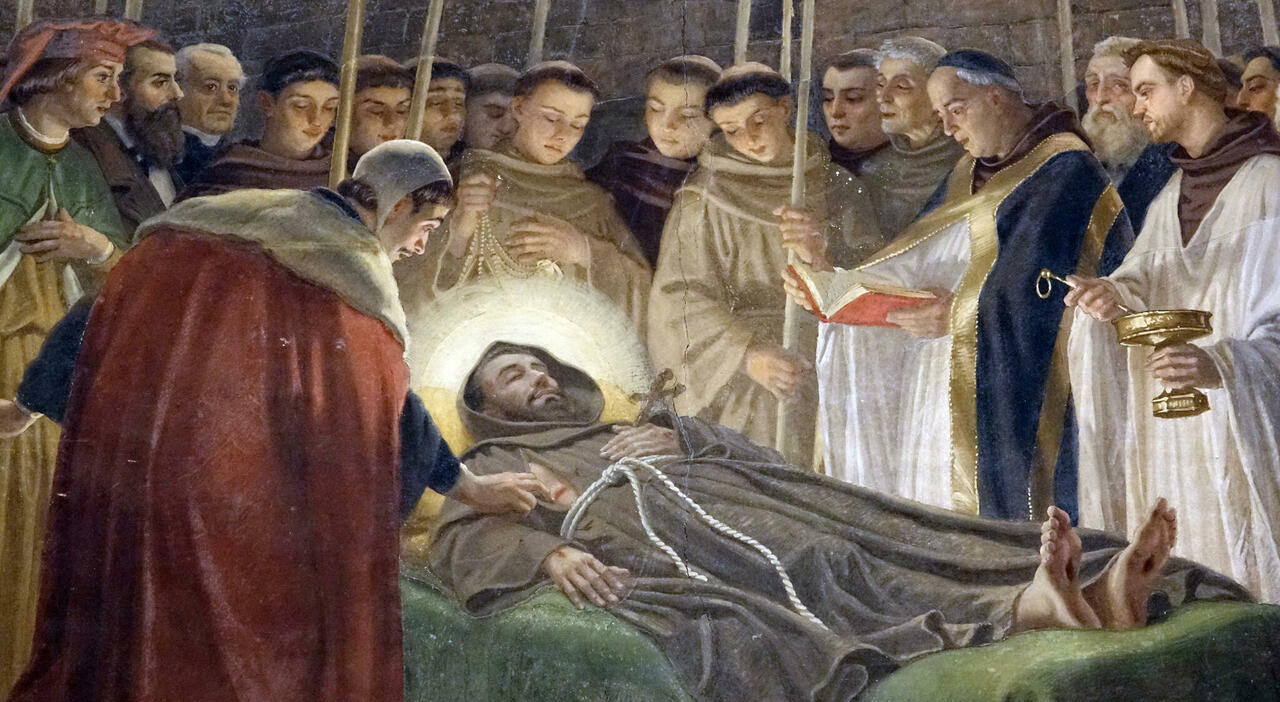
Faith Filled Friday: The Transitus of St. Francis of Assisi

I am a Lay Dominican, and the Dominican charism is the one that most fits me.  As youth, however, though not religious, I idolized St. Francis of Assisi.  I took Francis as my confirmation name.

October 4th was the Memorial of Saint Francis of Assisi but because it fell on a Sunday, the memorial was deferred to the Sunday celebration.  That was unfortunate this year, for this year marked the 800th anniversary of St. Francis’ death.  I wanted to commemorate the anniversary, but I will do so here. 


Death must have been on Francis’ mind frequently.  One of his writings that has come down to us is a letter to the rulers of his day, warning them of the failure of their obligations.  Up front he asks them to consider their deaths:

To all podestàs, and consuls, judges and governors, in whatever part of the world, and to all others to whom this letter may come, Brother Francis, your little and contemptible servant, wishes health and peace to you.

Consider and see that the day of death draws nigh. I ask you, therefore, with such reverence as I can, not to forget the Lord on account of the cares and solicitudes of this world and not to turn aside from His commandments, for all those who forget Him and decline from His commandments are cursed and they shall be forgotten by Him.  And when the day of death comes, all that which they think they have shall be taken away from them.  And the wiser and more powerful they may have been in this world, so much the greater torments shall they endure in hell.

Repent, for the day of death is near!  That would be a short summary and a paraphrase from our Lord, who said, “The time is fulfilled, and the kingdom of God is at hand; repent and believe in the Gospel” (Mk 1: 15). 

St. Francis speaks of death in his famous poem, “The Canticle of the Sun.”  Toward the end, he devotes two stanzas to death.


Praised be You, my Lord,
through our Sister Bodily Death,
from whom no living man can escape.


Woe to those who die in mortal sin.
Blessed are those whom death will find in Your most holy will,
for the second death shall do them no harm.

SG News has this little video bio that will give you the salient marls of St. Francis’ life if you were not aware.


Which brings us to the Transitus of St. Francis.  What is the Transitus of St. Francis?  From the Franciscan Media:

On October 3, 1226, Francis of Assisi died. Franciscans worldwide observe this day as the Transitus: his journey from this life to the next. Every year, Franciscans all over the world celebrate the Transitus, or passing, of St. Francis with a memorial service that often includes a reenacting of St. Francis’ final hours, storytelling, and singing, keeping alive the spirituality that Francis and his early companions left us.

There is a wealth of information in that article written by Fr. Murray Bodo, OFM.  Fr. Murray recounts some of St. Francis’ aspects of his death.  For instance,

One of the brothers once asked St. Francis what kind of a death he hoped for: a quick, unexpected death or a prolonged, painful death. And St. Francis said, “Brother, I want whatever death God wants for me.”

I have always wanted a peaceful, easy death, but now St. Francis has challenged me.  I will have to want whatever God wants and needs for His purposes.

The last few year’s of Francis’s life, filled with illness and the painful effects of his stigmata, were difficult.  Fr. Murray tells of his condition shortly after receiving the stigmata, two years before his death.

When, a month or so later, he finally returned to Assisi, he went first to the monastery of St. Clare and her sisters, where a humble lean-to had been constructed on the side of the monastery. He was, practically speaking, blind from trachoma, an eye disease he had picked up in 1219 in Egypt during the Fifth Crusade. He was also suffering from what seems to have been tubercular leprosy, and he was hemorrhaging from the wounds of Christ.

This was the Middle Ages where medical science had not progressed very far, and Francis was probably one who was not cautious with his health.  Fr. Murray continues.

When he had been laid on the barren ground, Francis asked that the passage in John about Jesus washing the feet of his disciples be read aloud. When the Gospel words had been spoken, Francis responded by reciting his favorite psalm, 142, and asked those present to join in. A few days later, according to St. Bonaventure, “When all of the mysteries were fulfilled in him and that most holy soul was released from the flesh and absorbed into the abyss of the divine brightness, the blessed man fell asleep in the Lord.”

And finally,

It is said that one of the brothers saw the soul of Francis ascending straight to heaven. Brother Thomas of Celano, Francis’ first biographer, added these details about St. Francis’ death in his Treatise on the Miracles:

The larks are friends of daylight and shun the shadows of twilight. But on the eve that St. Francis passed from this world to Christ, just as twilight was descending, the larks rose up to the roof of his cell and began circling it with clamor of wingbeat and song. No one knew if they were singing with joy or sadness, for their voices were filled with joyful tears and sad joy, as if they were orphaned children weeping and singing their father into heaven. The city guards who were keeping watch there were filled with wonder, and they summoned others to witness the sight.

Even the birds were made aware of his death.  How fitting for the saint who loved all creatures. 

So the tradition among the Franciscans is to celebrate the Transitus with a reenactment of St. Francis’ passing.  My friend Kelly who is a Secular Franciscan—the name of their third order—has gone to many Transitus.  I would love to go one year.  Fr. Jim Kent OFM Conv at the Conventional Franciscan Friars website explains the ritual.

There is no one ritual for Transitus, and therefore many expressions have developed for this liturgy.  Certain prayers or writings of St. Francis and accounts from his early biographers are common.  One of them, “The Life of St. Francis” by Thomas of Celano, recalls how when Francis was dying he asked that the washing of the feet from Gospel of John be read.  This Scriptural passing is often included in the Transitus.  Since Francis spoke of dying as embracing Sister Death, the ritual is solemn but not sad and inspires the participants to richly live the Gospel until the end of their days.

Here is a three minute explanation of the Transitus with clips from an actual ceremony.


If you want to experience an actual full length Franciscan Transitus, here is an hour plus ceremony live by the Franciscan Sisters of Little Falls, Minnesota. 


Peace and all good. 


Monday, October 5, 2026

Sunday Meditation: The Confrontation Parable

In the Twenty-Seventh Sunday in Ordinary Time of Year A, Jesus comes to what amounts to a final confrontation with the temple elders.  He has entered Jerusalem as a messiah, He has taught as a prophet, He has violently cleansed the Temple with one of authority, He has made claims of hypocrisy against the elders, He has told them a parable of their disobedience, and now He will tell them a parable of their wickedness and God’s condemnation.  This will be the final straw for the religious hierarchy. 

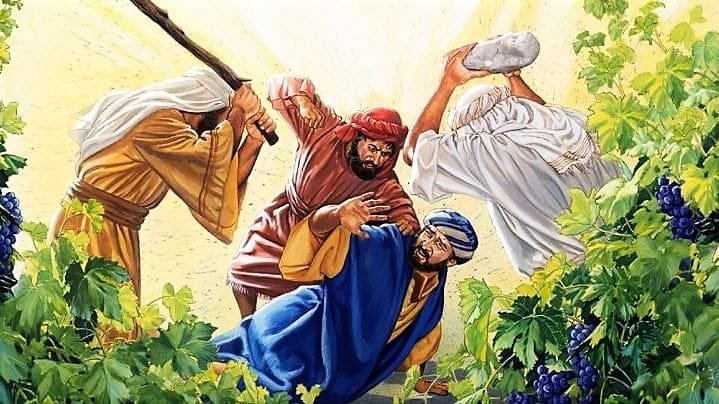
The Parable of the Wicked Tenants is not opaque.  The reference to Isaiah would have been widely known, especially to religious authorities.  The allegorical identifications are obvious.  The vineyard stands for Israel, the tenants in the parable stand for the religious leaders, the servants who are sent before the son are the ancient prophets, and the son who will be killed is the Son of God.  The parable becomes a clear indictment of the religious leaders.  Three years ago I embedded Dr. Brant Pitre’s explanation of the parable and it’s still worth going back to. 

Above I referred to this as Jesus’s final confrontation with the religious leaders, but perhaps the best characterization would be as “a decisive confrontation.  When asked by Jesus what the owner of the vineyard will do, one (or several) of the religious leaders heedlessly says the owner will put the tenants “to a wretched death.”  At that point Jesus has raised the stakes to an existential level, and the only way for the elders to win would be to put Jesus to death.  Or so they think.  Jesus concludes His exchange with “the kingdom of God will be taken away from you.”  Though it’s not in today’s lectionary passage, Matthew includes this coda to this section:


When the chief priests and the Pharisees heard his parables, they knew that he was speaking about them.  And although they were attempting to arrest him, they feared the crowds, for they regarded him as a prophet (45-46). 

That is the exegesis of this Gospel reading.  I’ve noticed in my survey of homilies on this passage, the homilists may explain the rudiments of the exegesis, but the better homilies will tend toward the pastoral application for the congregation.  Are you like the religious leaders not bearing fruit?  Will you be put to a wretched end after your time has run out?


Today’s Gospel:


Jesus said to the chief priests and the elders of the people:

"Hear another parable.

There was a landowner who planted a vineyard,

put a hedge around it, dug a wine press in it, and built a tower.

Then he leased it to tenants and went on a journey.

When vintage time drew near,

he sent his servants to the tenants to obtain his produce.

But the tenants seized the servants and one they beat,

another they killed, and a third they stoned.

Again he sent other servants, more numerous than the first ones,

but they treated them in the same way.

Finally, he sent his son to them, thinking,

'They will respect my son.'

But when the tenants saw the son, they said to one another,

'This is the heir.

Come, let us kill him and acquire his inheritance.'

They seized him, threw him out of the vineyard, and killed him.

What will the owner of the vineyard do to those tenants when he comes?"

They answered him,

"He will put those wretched men to a wretched death

and lease his vineyard to other tenants

who will give him the produce at the proper times."

Jesus said to them, "Did you never read in the Scriptures:

The stone that the builders rejected

has become the cornerstone;

by the Lord has this been done,

and it is wonderful in our eyes?

Therefore, I say to you,

the kingdom of God will be taken away from you

and given to a people that will produce its fruit."

~Mt: 21:33-43


Dr. Matthew Patrick Barber, a Catholic theologian with the Augustine Institute who I have heard speak elsewhere but only now discovered has a YouTube channel, finds a theological wrinkle that I did not hear elsewhere.


Dr. Barber:

And let's talk about the end of the parable. We read, "The kingdom of God will be taken away from you and given to a people that will produce its fruit." Now, this has often been read in terms of what is called replacement theology, and that is the idea that God is rejecting the Jewish people and now replacing Israel with a gentile church.  There are lots of problems with that reading. For one thing, it imagines that the early believers in Jesus, the early followers of Jesus, stopped seeing themselves as Israelites, as Jewish.  That's incorrect. When you read the New Testament, you see Paul, for example, is emphatic on this point. And in the Gospel according to Matthew, Jesus speaks of how the disciples will be punished in the synagogues. This is really important. For example, in Matthew 23, Jesus is condemning Pharisees for various things. And he says that he will send prophets and wise men and scribes. And says, "And some of them you will flog in your synagogues." That's Matthew 23:34.  Now, some will seize on the language there of their synagogues as evidence that the readers of the Gospel of Matthew no longer see themselves as Jewish. These approaches take their synagogues to imply the Jewish synagogues, right?


So what does it mean then when Jesus says the kingdom of God will be taken away from you and given to others? Who is the you Jesus is speaking to there? Well, it's important. Matthew makes it clear at the end of the scene, the end of the

Chapter 4: Leadership replacement story. Jesus tells the parable. We read, "Now the chief priests and the Pharisees heard this parable and they knew that he was speaking about them." So the point is not that the kingdom is being taken away from the Jews in general and given to non-Jewish people. The point is that the leaders are being replaced and they know the story is being told about them.  So the question is who are the new leaders? And I think it's clear the new leaders are the apostles. This is already suggested by a close reading of the gospel Matthew and other places. In Matthew 19 Jesus says that the 12 the 12 apostles will sit on 12 thrones and judge the 12 tribes. They are the eschatological judges, the eschatological leaders of Israel. Moreover, there are some fascinating parallels. I don't have time to get into all of this, but in Matthew 16, Jesus is talking to Peter and in Matthew 23, Jesus condemns the the Pharisees. There's some interesting connections here. Jesus gives to Peter the keys of the kingdom.  In Matthew 16, and Matthew 23, we read that the Pharisees literally key shut the kingdom. They lock people out of the kingdom. In Matthew uh 16, Jesus gives to Peter the authority to bind and loose. And in Matthew 23, the Pharisees bind heavy burdens. So there's a parallel there between Matthew 16, Matthew 23, I think the larger point is that the kingdom is being taken away from these leaders and given to new leaders that Jesus has appointed.

I have to admit, I was under the impression it was replacement theology.  That is brilliant. 


For the pastoral homily I’m going to turn to a Franciscan given that today happens to also be the Feast of St. Francis of Assisi on the 800th anniversary of his passing.  Let’s turn to Fr. Jonathon St. André, TOR of Franciscan University, who combines this homily with St. Francis.


Fr. Jonathon:

So I think I hit the jackpot today. I get to share reflection with you not only on the 27th Sunday in ordinary time but also on October 4th which is the feast of our holy father St. Francis of Assisi in the Jubilee year of St. Francis.  Last night in many places throughout the world was celebrated the transitus a beautiful prayer service where we commemorate Francis's death and passing into eternal life. And this is not just a celebration for Franciscan friars or sisters, but it's for everyone for the gift of St. Francis to the church and the gift of the gospel. And the gospel today for the 27th Sunday in ordinary time is the parable of the landowner.  And we hear about this land owner and he has builds a vineyard, puts a hedge around it, uh builds a well within it, then goes away on a journey and as it says he leased it to tenants and went on a journey.  Then he sends his servants as we know in the parable to come back and to reclaim the produce from the tenants. And of course the story goes that the tenants reject the servants who come and reject the overtures of the master to claim what is rightly his own.  There's a lot of ways we could go into this parable, but one of them that really strikes me today is to recognize that we are tenants of the Lord's vineyard. That we everything we have been given is from the Lord. Our bodies, our minds, our souls, it is all his. It belongs to him. In fact, St. Francis himself would say, "You only possess one thing, your sins.  That's the only thing that's our own.  Everything else is God's." And so, it makes sense that everything we do in our life would return, give an abundant return to the Lord…


Interestingly one of the main themes of the life of St. Francis was living penance. And we hear that word penance and sometimes we can think of that as what we say or do after our confession or we can think of it as a penitential practice in our life or what the attitude we should have during Lent and all those are true but a deeper fuller scriptural sense of penance means a love of God and a love of neighbor. It means an openness to conversion from our sins. It means a closeness to the Eucharist. And interestingly St. Francis says penance is about producing fruits.  So it matches the parable here. What are the fruits? The fruits of the Holy Spirit. The fruits of the Holy Spirit should be visible in our life. Love, joy, peace, patience, kindness, gentleness, self-control.  That people should see that we are living our lives in such a way that the kingdom of God is bearing fruit in us, that we the tenants of the vineyard are helping and cultivating the vines so that the new wine of the Holy Spirit is pouring out of us is pouring out upon people is pouring out upon the church.  So on this feast of St. Francis of Assisi. And at this occasion when we hear the parable of the landowner and in this time when we're called to recognize how am I a good tenant of what the Lord has given me in my life, we should ask ourself, how am I showing forth the fruits of the Holy Spirit?


That is excellent.  I hope to have a blog post during the week on the 800th anniversary of St. Francis’ passing into new life.


Sunday Meditation: “Therefore, I say to you, the kingdom of God will be taken away from you and given to a people that will produce its fruit."


For the hymn, how could we not have the “Prayer of St. Francis”?


Make me a channel of Your peace

Where there is hatred, let me bring Your love

Where there is injury, Your pardon Lord

And where there's doubt, true faith in You


Make me a channel of Your peace

Where there's despair in life, let me bring hope

Where there is darkness, only light

And where there's sadness, ever joy


Oh Master, grant that I may never seek

So much to be consoled as to console

To be understood as to understand

To be loved as to love with all my soul


Make me a channel of Your peace

It is pardoning that we are pardoned

In giving to all men that we receive

And in dying that we're born to eternal life


And in dying we are born to eternal life

Eternal life


I love this hymn, and St. Francis of Assisi is one of the greatest saints ever. 


Saturday, April 6, 2019

Comments to Dante’s Paradiso, Cantos X thru XIV

The sphere of the sun is so rich; there is so much I could discuss.  First of all it's a dividing line in the organization of paradise.  Dante makes it clear with a sort of new preamble.  Those inward from the sphere of sun (that is the moon, Mercury, Venus) contain souls who had some sort of limitation from full completeness.  At the sun and then beyond, all souls are complete, and so there is actually no hierarchy, just diversity.  Is there a hierarchy for those inward from the sun?  It's not spelled out but the further one gets away from the earth, the less distinct the souls features become.  Dante (the character) can almost make out Piccarda's features at the moon.  Less so for those at Mercury and even less at Venus.  Once he reaches the sun, the souls are just pure light.  That would suggest some sort of hierarchy.

But if you think of it this way, the light emanating from the sun is so intense that it obliterates all detail of feature, and the further away from the sun the more detail is possible.  The moon is the furthest away, so Dante (the character) can almost make out Piccarda's features.  So perhaps there isn't a hierarchy, distance from the sun.  That would make a two part hierarchy, those before the sun and those from the sun and after.  I'm not sure which of these two possibilities Dante is suggesting.

Also, the sunlight causes shadows, and, though we don't have any mention of shadows, there is a metaphoric shadow, the limitations on the souls in from the sun.  But this only works in one direction, toward the earth.  We can see the souls at the moon, Mercury, and Venus as casting a shadow, their limitation.  Behind the sun is the same intense light as at the sun.  Shadows are obliterated.

So at the sun, we have a major division, and it's noteworthy that it's in the tenth canto.  In Inferno, Dante entered the City of Dis at the tenth canto.  In Purgatorio, Dante entered purgatory proper at that tenth canto.  All three cantica have a divisional transition at the tenth canto.  I have said how integrated is the Divine Comedy.  Here is another example.

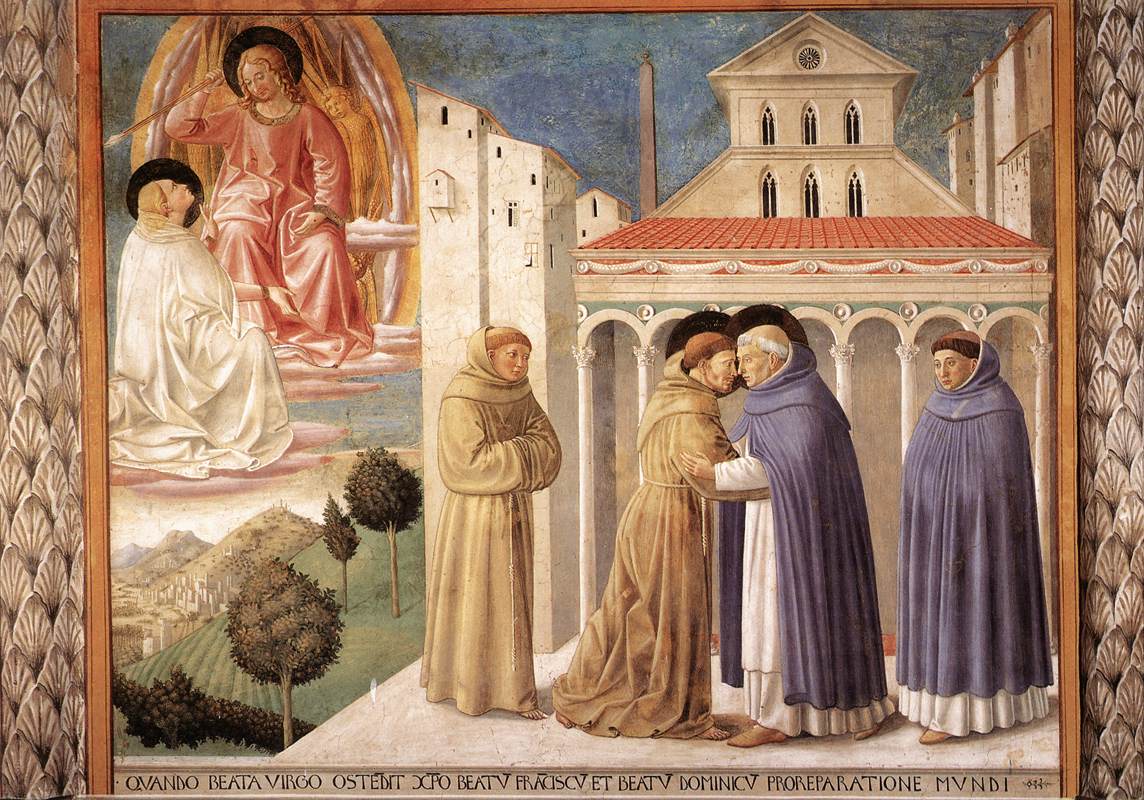
At the sphere of the sun, there are five prominent characters not including Dante and Beatrice.  There is St. Thomas Aquinas, St. Bonaventure, Solomon, and though they are only described, St. Francis of Assisi and St. Dominic de Guzman, both founders of respective orders and perhaps the preeminent saints of the middle ages.  The sphere of the sun are for the souls who were paragons of wisdom, either through learning-as seen with the souls in the first garland-or through mysticism-as seen with those in the second garland. 

St. Thomas is the principal representative of the sphere of the sun, and we know of his great effort at absorbing all knowledge into his Summa Theologica.  Hollander points out a fascinating parallel, the very first word that Thomas speaks is "Quando," and it's placed as the last word of a line.  Back in Inferno, the character whose very first word was also "Quando" and also oddly placed as the last word of a line was Ulysses (see Inf.XXVI.90).  Did I mention how incredibly integrated is La Commedia?  Indeed, both characters were people who strove for total knowledge, knowledge of all things in the universe.  They are two characters of same coin. 

But while Ulysses strove only for his own prideful self, Thomas accumulated knowledge to preach the divine Word.  He strove for no personal honors, and so notice his humility when he speaks.  He calls himself a "lamb" when we know he was nicknamed an ox.  When he goes through his catalogue of saints in the first garland, he puts himself second.  He gives deference to his "brother and teacher" Albert the Great and to the founder of his order, St. Dominic.  He doesn't say that he is the greatest of the lights at the sun, but another, Solomon. 

Thomas the Dominican goes on to delineate the virtues of St. Francis of Assisi.  Thomas's central point of St. Francis is that he was the lover of Lady Poverty, and the personification is significant.  Indeed, at one point it sounds like almost a sexual union, "he joined himself to her" (XI.62).  When Francis marries Lady Poverty, she is a widow, her first husband being Jesus Christ.  In embracing Lady Poverty like a bride, Francis has restored virtue to a church that had become too worldly.

As a complement to Thomas, St. Bonaventure, the Franciscan, goes on to laud the virtues of St. Dominic.  St. Dominic is portrayed as taking Lady Faith as his love and bride, and, as a knight fighting for his lady fair, combats the heresies that taint the virtue of Lady Faith.  He too seems joined in sexual union ("amorous lover of the Christian faith") with his lady.  By embracing Lady Faith, Dominic has restored has restored truth to the church, traveling "through the vineyard/which quickly withers if the keeper is corrupt" (l. 86-87).  The other controlling metaphor in describing Dominic is that of a paladin. 

'Then, both with learning and with zeal,
secure in apostolic office, he went forth,
like a torrent gushing from its lofty source,

'and fell upon the tangled weeds of heresy,
attacking with his overwhelming force
wherever the resistance was most stubborn. (XII.97-102)

Hollander points out, and I agree, that Dante (the author) goes overboard with this imagery of militarism.  He says that St. Dominic was "gentle to his own and savage to his foes" (l.57).  Unfortunately the average person knows a lot less about St. Dominic than St. Francis.  St. Dominic was a gentle soul, hardly savage.  One of the first stories about St. Dominic is how he converted an innkeeper.  The innkeeper followed the Albigensian heresy, and when St. Dominic found out stayed up all night conversing with the man, and by the break of morning, the Innkeeper had converted to doctrinal faith.  It has been said Dominic "befriended" an order, meaning his order grew by his ability to embrace people in friendship.  There was no sense of fighting in anything he did that I know of.  Either Dante was under a wrong impression or he takes his metaphor too far.

This crisscrossing of Dominican praising a Franciscan and a Franciscan praising a Dominican is a wonderful touch.  It was said that at this time the two orders were rivals and some bad blood had developed between the two.  I don't know if that is true, but it sounds correct.  Dante (the author) ends each of the two discourses on the two founding saints in a similar way.  The Dominican, who has been praising Francis, points out how untrue the Dominicans of today (Dante's day) have become.  And the Franciscan, who has been praising Dominic, speaks of how the Franciscans of the day have lapsed from the rule.  Dante (the author) as his custom throughout the Commedia highlights a degeneration from an ideal height to his day.  If the two orders were quarreling, neither could claim the moral high ground.

It should be pointed out that Dante (the author) was a Lay Franciscan but one who was a great admirer of St. Thomas Aquinas.  Indeed, the whole Divine Comedy owes so much to Thomistic thought.  Obviously he had read much of St. Thomas' work.  He places St. Thomas as the central character under the sphere of the sun, and though St. Thomas says that Solomon is the brightest light, we can see that Thomas is the pinnacle of the sphere.

The two garlands of saints is such a wonderful image.  It suggests a laurel wreath placed on a hero's head.  The twelve blessed in each ring suggest the twelve apostles.  The two wreaths heighten a couplet imagery than runs in this section: Thomas and Bonaventure, Francis and Dominic, learning and mysticism, spirit and flesh.  The couplets could all fit the metaphor of two wheels of a single chariot (XII.106), the chariot being the Church.  At the end, shattering the duality that has prevailed, Dante (the author) brings in a third set of lights. 

And just as, at the approach of evening,
new lights begin to show throughout the sky,
so faint they seem both real and yet unreal,

it seemed to me that I began to see
new subsistences there that formed a ring
beyond the other two circumferences.

Ah, true incandescence of the Holy Breath!
How suddenly its glowing shone before me,
so bright my eyes could not endure it! (XIV.70-78)

The third ring is analogized as being formed like the Holy Spirit is formed, that is as a function of the love between the Father and the Son.  The wreaths are now a Trinity!  But who would reside in the third wreath?  Hollander provides a couple of theories but there is nothing conclusive.  I personally like the thought that Christ's twelve apostles reside in that third ring.

###

Some random thoughts on these cantos.

A motif that’s been running through the entire Paradiso is that of the souls dancing.  I think it’s been noted at every sphere so far.  We see here at the opening of Canto XII when the second wreath approaches the first and “matches it motion for motion and song for song” (l.6)  But what is the nature of this dance?  I think we get more detail further down:

When the dance and all the other celebration --
the singing and the brilliant blaze of flames,
light with light blent in ardent joy –

came to a stop together and of one accord,
as eyes, when beauty moves them,
must open wide or close as one,

from the core of one of these new lights,
as the north star makes a compass needle veer,
rose a voice that made me turn to where it came from. (XII.22-30)

The dancers “match motion for motion,” and come “to a stop together of one accord” like a pair of eyes must open and shut together.  What a brilliant simile.  Eyes move in unison.  All the motion of the dance is in unison.  Medieval dancing was not like disco dancing where everyone moves to their personal rhythm, or even couples dancing where each couple differently than another.  Here we have twenty-four spirits dancing in unison.  I picture it more like the Olympic sport, synchronized swimming, where everyone performs the same motion in harmony. 

The Holy Spirit is a strong presence in these cantos.  Dante starts with the Holy Spirit in the opening lines of Canto X, “Gazing on His Son with the Love/the One and the Other eternally breathe forth” (l.1-2) and ends with the Holy Spirit as the third garland suddenly comes forth from the splendor of the other two.  Well, that would make sense since the Holy Spirit is associated with wisdom.

A motif that runs through this section is that of begetting and fertility.  From Canto X:

So brilliant the fourth family of the highest Father,
who forever gives it satisfaction, shone,
revealing how He breathes and how begets. (l.49-51)

The “fourth family” refers to the fourth sphere, the sun, who the Father pleases by showing how the Holy Spirit (breathes) and how he creates.  I also think there is a pun here on the Father’s direct and indirect creation.  He breathes life in Adam (direct creation) but has created the means for populating the world, indirectly creating life through begetting.  And when St. Thomas first speaks later in the canto, he refers to love as being “increased” and “multiplied in you” (l.84-85).  “Multiplied” echoes Genesis command to go out and multiply. 

We see the fertility imagery with the saints Francis and Dominic, each married to their Lady, and begetting virtue and faith in the Church.  We see fertility of the garden—both Francis and Dominic are referred to as gardeners, growing fruit and crops for the sheep to fatten on.

Ingesting food to fatten is another motif that runs here.  Francis, for instance, finds the Muslims (those under the Sultan) “unripe for conversion” while he returns “to reap the harvest of Italian fields” (XI.106).  Dante even has Solomon speak in these cantos, echoing his Song of Solomon (XIV.37-60), which describes a physical love.  All these motifs seem to coordinate together.  Physical love leads to begetting, which is an indirect creation, which require proper ingesting of the harvest, both physical and spiritual, which require Francis and Dominic to lead them to heaven where eventually they will reunite with their flesh.  And while on earth in their earthly flesh, they will need a wise ruler—Solomon being the wisest—to rule them so they don’t need to scatter like lost sheep.  This is Dante (the author) painting a picture of Edenic ideal.

I loved the way the souls jump for joy at the thought of the return of the flesh. 

As, impelled and drawn by heightened joy,
dancers in a round may raise their voices,
their pleasure showing in their movements,

so, at that eager and devout appeal,
the holy circles showed new joy in wheeling
as well as in their wondrous song. (XIV.19-24)

And then they go one to sing a song of praise to the Trinity.  I think we today have become much more gnostic in that we emphasize the spirit over the flesh.  Perhaps this is a reaction to the today’s secular emphasis on pleasure, but Christianity properly understood is a union of the flesh and spirit.  This is why in these passages Dante alludes to the Annunciation, the moment Christ became man.  And this is why Solomon is so important.  He was the wisest ruler who guided fleshly beings, a ruler who properly combined the spiritual with the material.

That image of what souls will be like when their flesh returns is spectacular:

But like a coal that shoots out flame
and in its glowing center still outshines it
so that it does not lose its own appearance,

'just so this splendor that enfolds us now
will be surpassed in brightness by the flesh
that earth as yet still covers. (XIV.49-54)

The flesh will be like a piece of coal that is burning hot, the glow permeating the material.  Wow!

At the end of Canto XIII, Thomas Aquinas in chastising rash judgement, recalls a ship. 

and once I saw a ship, which had sailed straight
and swift upon the sea through all its voyage,
sinking at the end as it made its way to port. (136-138)

That’s an allusion to Ulysses who back in Inferno, recounts his final, disastrous journey where he sinks his ship and crew.  Not only is Thomas contrasted against Ulysses but so is Solomon, who is prudent, not rash, and who governed well so that his people did not perish. 

The closing image in Canto X of the heavens as a “glorious wheel in motion” fits the harmony of the universe and the creator, and fits the aesthetics of the entire Commedia.  Dante compares it to a clock with cogs pulling wheels and driving others, “chiming its ting-ting with notes so sweet” (139-148).  Hollander points out that this may be the first reference to a clock in all of literature.

I should point out the Cristo rhymes.  In all of Inferno, the name of Christ is never spoken.  I think he was referred to indirectly.  The name of Christ comes up in Purgatorio, but never at the end of a line.  If it comes up at the end of a line, it needs to be rhymed.  Hollander points out that in a previous work Dante rhymed Cristo with tristo (distraught) and malo acquisto (ill-gotten gains) and in retrospect it left a bad taste in his mouth.  But what then to rhyme Cristo with?  Dante solves it here by rhyming Cristo only with itself.

'He was called Dominic, and I shall speak of him
as that laborer chosen by Christ
to help Him dress and keep His garden.

'He seemed indeed a messenger and intimate of Christ,
since the first affection manifest in him
was for the initial precept taught by Christ. (XII.71-75)

You can check the corresponding Italian.  Dante does this four times in Paradiso: XIV.104-108, XIX.104-108, and XXXII.83-87.

Finally I should note that St. Thomas Aquinas’ complement is St. Bonaventure.  St. Bonaventure is probably the Franciscan Order’s greatest intellectual saint and was a fellow teacher with Thomas at the University in Paris.  He wrote a work called The Journey of the Mind into God.  It’s supposed to be one of the great works of mysticism, and perhaps was the inspiration for the entire Commedia.  As we see throughout the Divine Comedy, Dante (the character) is on a journey into God.  It’s only 60-ish pages.  We should read this in the book club one day.

I’m going to have to end it here.  This is getting long.  I didn’t even discuss the saints included in the two catalogues of saints.  I said this was a rich section. 


Monday, October 8, 2018

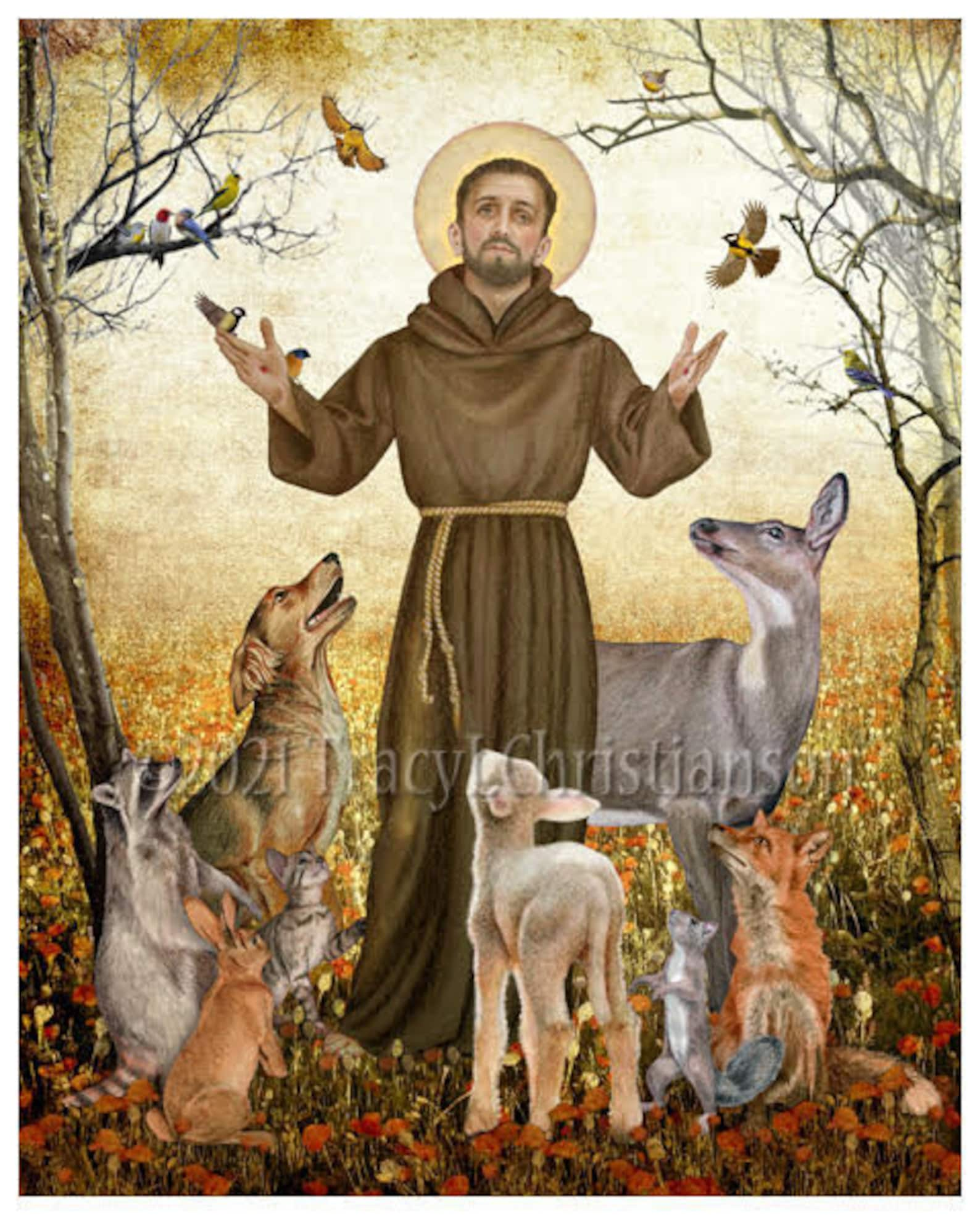
Matthew Monday: The Blessing of the Animals


October 4th is the feast day of St. Francis of Assisi, and because St. Francis had a particularly strong love for God’s creatures –he referred to them as brothers and sisters – the Catholic Church across the world has an annual blessing.  You can read about it and see some adorable pictures of animals being blessed from around the world, here.  

Our church had the blessing on the Saturday after the 4th rather than on the feast day proper.  This makes sense when you consider during the week most work during the day and children are in school.  I wonder if other churches did as well.

This is our second year we did this.  We took Rosie down to the church, and unlike some of the pictures in that link I provided the blessing at our church was performed outside.  It was amazing how many people brought their pets.  Over forty and one person literally brought Noah’s ark with him: two cats, several Guinee pigs, parakeets and cockatiels, and I don’t what else.

Rosie was excited as you can imagine.  She wants to sniff and greet and play with all other animals, friendly or not.  And at eighty pounds she’s hard to handle when she wants to rush over to someone or something.  I got a couple of pictures. 

I was able to click Matthew calming Rosie down.


And I couldn’t snap one while Rosie was actually getting blessed, I did have someone take a picture of us with Fr. Eugene, our pastor.


The reason I couldn’t snap a picture was because I had Tiger’s photo on the screen while we were up there so Fr. Eugene could bless Tiger too.  There was no way I could take Tiger over.  Some had their cats in the traveling bags, but it’s impossible for us to get Tiger in his.  He fights tooth and nail to prevent us from getting him in.


On a separate but related matter I do want to tell about my October 4th.  As you may know I live on Staten Island, which is part of New York City but unlike the rest of New York City we still have woods and some wild animals.  On the morning of the fourth, on my way to work as I was driving I saw a creature rush across the street and scurry behind some garbage pails.  When I got a better look I saw it was a possum.  Half a mile later I had to stop because a raccoon decided to cross the street.  He took his sweet time, but I was just glad to watch him.  Later that night, while coming back from the gym, on the corner near a wooded stood a deer nibbling on the grass.  Now I could go a whole year and not see a possum or a raccoon, and while deer are now more out in the open it’s not exactly an everyday event to see one.  To see all three of these creatures in one day—the day of St. Francis of Assisi’s feast day—is certainly a grace from above.  Thank you Lord.