"Love follows knowledge."
"Beauty above all beauty!"
– St. Catherine of Siena

Showing posts with label Les Misérables. Show all posts

Sunday, May 8, 2022

Sunday Meditation: The Good Shepherd and Mother’s Day

Today’s Gospel reading is very short, the reading on The Good Shepherd Sunday.


Jesus said:

“My sheep hear my voice;

I know them, and they follow me.

I give them eternal life, and they shall never perish.

No one can take them out of my hand.

My Father, who has given them to me, is greater than all,

and no one can take them out of the Father’s hand.

The Father and I are one.”        

- John 10:27-30

Contemplate that for a bit and then contemplate this for Mother’s Day.  Who is our first human shepherd but our mother?  Whose voice do we first hear but our mother’s, probably from inside the womb?  We hear that voice in the womb and we pine for it.  What must that child feel after the trauma of exiting into a new world?  How comforting then to hear the mother’s voice, familiar to him or her that was from the security of the amniotic sac.  We are then placed on our mother’s breast and we feel the comfort of a greater hand.  The Good Shepherd works through our mother.

So on this Mother’s Day I want to contemplate some mothers who were good shepherds, and I’ll do it through the various novels I can recall where mothers were good shepherds.  So I made a list of mothers who played central roles in various novels.  Here are the best five mothers in no particular order that I can recall from novels I have read.  I’ll provide a bare summary of their heroism.

1. Katie Nolan from A Tree Grows in Brooklyn by Betty Smith.

Katie is an immigrant to the US who struggles to raise her daughter despite an alcoholic and ne’er-do-well husband.  Her strength is what makes her daughter Francie succeed. 


2. Fantine from Les Misérables by Victor Hugo.

A young woman who bears a child out of wedlock and is forced to prostitution to support the child.  Tears still come to my eyes when I recall Fantine on her death bed pinning for her little Cosette.


3. Hester Prynne from The Scarlett Letter by Nathaniel Hawthorne.

Believing her husband had died, Hester Prynne bears a child out of an adulterous relationship.  Hester, ostracized by her Puritan society, raises her daughter Pearl in quiet dignity. 


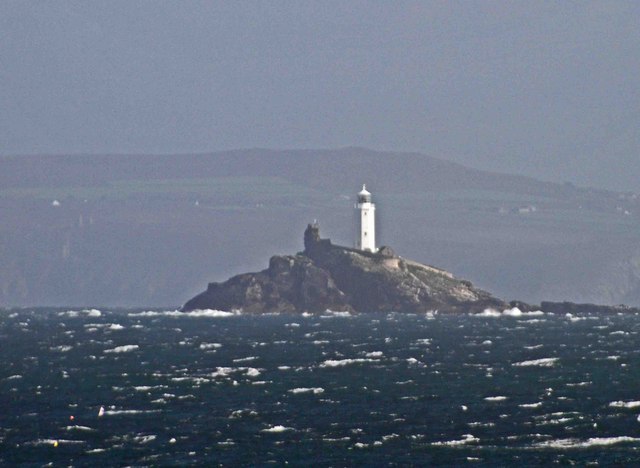
4. Mrs. Ramsey from To The Lighthouse by Virginia Woolf.

Mrs. Ramsey, mother of a large family, is the cornerstone of the family, and the lighthouse that guides the children’s vision.  Her sudden death leaves a disintegrated family, but ultimately her memory heals the wounds.


5. Ántonia Shimerda from My Ántonia by Willa Cather.

Ántonia, a ten year old immigrant to the prairies of US, overcomes cultural differences and poverty, overcomes having a child out of wedlock, and ultimately through her hard work and sacrifices buys her own farm and raise ten more children.


All five of these mothers shepherd their children in a most moving way that should be recalled on a day dedicated to motherhood.  Can you think of any others?

Happy Mother’s Day.


Saturday, May 29, 2021

List of Books I Wish I Had Read Earlier

I recently came across a book list where the creator of the list opined on wishing he had read those books earlier.  I thought that an interesting list.  So I decided to create my own. 

Now the first thing to decide was at what point would I consider as the dividing line as earlier?  I could say of any novel I really enjoyed and thought of highly should have been read earlier.  But “earlier” could be as early as a child.  No, the list had to be after a significant moment of my reading life.  Notice I said, “reading life.” 

I would say that the moment I got my Master’s Degree in English Literature to be such a dividing moment in my reading life.  Anything I read after would have been out of my mature years and from my free will.  Such books I read beyond that moment could have shaped my younger self, either as a person or as a lover of literature.

So finally, these books will be novels—I limit it to novels since novels are the art form I most enjoy—that I read since my 39th birthday that I wish I had read prior.  I’ll limit it to ten novels I have read in these past twenty years.  They are not necessarily the greatest novels I wished I had read earlier, but the most potentially impactful.  I’ll list them backwards, least wished to most wished.

10.  The Hobbit, by J.R.R. Tolkien. 

I was never a big Lord of the Rings fan, but I do acknowledge its greatness.  I read Lord of the Rings for the first time as a teenager, and then read it again in my twenties.  It’s a fun read, but I never saw the literary significance of it.  I know there is a core of Tolkien readers of good literary taste who rate it very high as a literary work.  I was never that passionate about it.  So I never read The Hobbit, the predecessor of LOTR, thinking it was along the same lines.  I finally read The Hobbit in 2012 and found it superb!  I think it’s a greater work than LOTR, perfectly written and not weighed down with stray adventures and characters.  It is a much more focused work, and so its moral is clearer and more direct.


9. The Power and the Glory by Graham Greene.

It is possibly the greatest overtly Catholic novel ever written.  It is perfection in structure and storytelling.  It is powerful in its moral conception, capturing the weakness of man and man’s strength given a dedication to a higher cause.  The character of the “whiskey priest” is Everyman who feels caught between faith and doubt, between perseverance and cowardice.  It is tragic and heroic and will make you yearn for a life dedicated to a higher cause. 


8. Lord of the World by Robert Hugh Benson.

Famous Catholic convert, Catholic priest, and son of an Anglican Archbishop, Robert Hugh Benson was a gifted writer and wrote in different modes at the beginning of the twentieth century.  He wrote several novels, and this one praised by Popes Benedict XVI and Francis.  It’s an apocalyptic novel where a government of Freemasons have conquered the world and extinguished all religions except Catholicism.  The novel climaxes in a battle of Armageddon.  This is truly an underrated novel that should get more readership.  I read it last year and wished I read it as a young man.


7. Mariette in Ecstasy by Ron Hansen

This is another perfect gem of a novel by a writer who attempts various genres.  This novel is of a young lady entering a closed religious order as a novice at the turn of the 20th century and who experiences several ecstatic experiences.  The other sisters in the order divide between those who believe her and those who think she is faking them.  The novel brings into question the inability of science to understand religious experiences.  I read this novel in 2019 and was overwhelmed by the beauty of the writing, the psychological depth of the characters, and the profound modernist themes.


6. My Ántonia by Willa Cather.

This was my first Willa Cather novel, and it blew me away.  The depth of character, the beautiful prose, and perfect story structure should make this one of the great modernist novels.  My hunch is that Cather’s more traditional views holds this novel back from being more situated in the 20th century canon, but I would rank it with any American novel.  I don’t have a record of when I read it, but it should have been assigned in college.


5. Silence by Shūsaku Endō.

This too rivals for the greatest Catholic novel ever written.  A historical novel set in 16th century Japan where a Portuguese Jesuit priest sneaks into Japan to find out about an apostate priest and to serve the secret Catholic community.  He is captured and put into an existential situation where has to apostatize himself or have innocent peasants tortured and killed.  I read this in 2016, the year the movie version came out. 


4. Les Misérables by Victor Hugo.

My wife and I saw the musical many years ago on Broadway and loved it.  We’ve watched the PBS singing of the songs, and watched the movie.  I have the CD.  It’s been a particular favorite.  But I had not read the novel.  The novel is great!  Yes, it’s a tome of a book, and I read it over five years, one of the five parts of the novel in each year.  Yes, there is some expository digressions that interrupts the narrative.  That’s Victor Hugo.  But the narrative is fantastic.  The character of Jean Valjean captures my heart.  There are so many great moments.  The novel turns out to be much more religious than the modern adaptations.  I read Les Misérables from 2014 to 2019.  I wish I had read it earlier.


3. Crime and Punishment by Fyodor Dostoevsky.

I thought that The Brothers Karamazov was Dostoevsky’s great novel, and it is, but Crime and Punishment is its equal.  What a powerful all comprehensive work of art.  No one can better capture the psychological depth of characters than Dostoevsky.  And not just a momentary psychology but a psychology in development and transition.  This story is powerful for its Christian world view, its superb characters (I love Sonya!), and its intricate plot.  You know Raskolnikov is the killer.  It’s a question of whether he gets caught, and if you the reader want him to get caught.  I won’t spoil it.  For a novel that was written in 1866, it is so current today.  I read it in 2015. 


2. To Kill a Mockingbird by Harper Lee.

Another great novel.  You, dear reader, probably read this in high school.  For some reason I never was assigned this novel.  It’s also not one you would get assigned in college, and that is a pity.  I love the telling of the story from the point of view of a pre-teen girl, with all its implications of oncoming puberty.  I love the character of Atticus Finch, the heroic father and lawyer, and the implications of a little girl’s admiration for a moral and duty-bound hero.  I love the way Lee captures the South, both in its positive and negative attributes.  I read this in 2016 at the age of 54.  I should have read it forty years earlier.


1. The Chronicles of Narnia by C. S. Lewis.

The number one book I wish I had read earlier is not a single book but a series, C. S. Lewis’ great interlocking series of novels affectionately just referred to as Narnia.  Actually I haven’t even finished the whole series of seven.  I have been reading one per year and have completed the first four.  The main characters in each of the novels are children, and there is a strong Christian themes and symbolism.  I have been reading this with my son, who claims he doesn’t like it, but seems interested every time we get into it.  On one hand, Narnia is a set of children’s or young adults’ novels, but really anyone of any age can and should read them.  I should have read it as a pre-teen.  I’m joyfully reading them now!


I’ve have posts on most of these ten novels.  Just do a search in that little box at the upper left of the blog page.

What novels do you wish you had read earlier?

Thursday, October 10, 2019

Lines I Wished I’d Written: In the Sewers of Paris, from Les Misérables

One of the great extended scenes from the novel is Jean Valjean’s saving of Marius by carrying him through the sewers of Paris, from section of the Barracades, which are being destroyed and where Marius’ companions are being annihilated, to somewhere downstream of the Seine, to freedom.  Neither the play nor the last movie really develops the sewer scene.  For the play, they set up the barricade defeat as the climax, but the story is far from over then.  That traveling through the sewers carries several metaphors.  It’s certainly the leveling of humanity, where it makes no difference if you’re an aristocrat or a slave.  It’s also a traveling into the underworld, a trip into hell.  It’s no coincidence that at the end an Jean Valjean, who is unrecognizable from all the mud, mire, and slime, separately meets Thernadier and Javert, the former the personification of greedy evil and the latter the personification of evil through the over scrupulous adherence to the law.

I’m going to present two scenes.  The first is when Valjean first enters the sewer.  From Volume Seven, Jean Valjean, Book Third, Mud but the Soul, chapter 1, “The Sewer and Its Surprises.”

It was in the sewers of Paris that Jean Valjean found himself.

Still another resemblance between Paris and the sea. As in the ocean, the diver may disappear there.

The transition was an unheard-of one. In the very heart of the city, Jean Valjean had escaped from the city, and, in the twinkling of an eye, in the time required to lift the cover and to replace it, he had passed from broad daylight to complete obscurity, from midday to midnight, from tumult to silence, from the whirlwind of thunders to the stagnation of the tomb, and, by a vicissitude far more tremendous even than that of the Rue Polonceau, from the most extreme peril to the most absolute obscurity.

An abrupt fall into a cavern; a disappearance into the secret trap-door of Paris; to quit that street where death was on every side, for that sort of sepulchre where there was life, was a strange instant. He remained for several seconds as though bewildered; listening, stupefied. The waste-trap of safety had suddenly yawned beneath him. Celestial goodness had, in a manner, captured him by treachery. Adorable ambuscades of providence!

Only, the wounded man did not stir, and Jean Valjean did not know whether that which he was carrying in that grave was a living being or a dead corpse.

His first sensation was one of blindness. All of a sudden, he could see nothing. It seemed to him too, that, in one instant, he had become deaf. He no longer heard anything. The frantic storm of murder which had been let loose a few feet above his head did not reach him, thanks to the thickness of the earth which separated him from it, as we have said, otherwise than faintly and indistinctly, and like a rumbling, in the depths. He felt that the ground was solid under his feet; that was all; but that was enough. He extended one arm and then the other, touched the walls on both sides, and perceived that the passage was narrow; he slipped, and thus perceived that the pavement was wet. He cautiously put forward one foot, fearing a hole, a sink, some gulf; he discovered that the paving continued. A gust of fetidness informed him of the place in which he stood.

After the lapse of a few minutes, he was no longer blind. A little light fell through the man-hole through which he had descended, and his eyes became accustomed to this cavern. He began to distinguish something. The passage in which he had burrowed--no other word can better express the situation--was walled in behind him. It was one of those blind alleys, which the special jargon terms branches. In front of him there was another wall, a wall like night. The light of the air-hole died out ten or twelve paces from the point where Jean Valjean stood, and barely cast a wan pallor on a few metres of the damp walls of the sewer. Beyond, the opaqueness was massive; to penetrate thither seemed horrible, an entrance into it appeared like an engulfment. A man could, however, plunge into that wall of fog and it was necessary so to do. Haste was even requisite. It occurred to Jean Valjean that the grating which he had caught sight of under the flag-stones might also catch the eye of the soldiery, and that everything hung upon this chance. They also might descend into that well and search it. There was not a minute to be lost. He had deposited Marius on the ground, he picked him up again,-- that is the real word for it,--placed him on his shoulders once more, and set out. He plunged resolutely into the gloom.

The truth is, that they were less safe than Jean Valjean fancied. Perils of another sort and no less serious were awaiting them, perchance. After the lightning-charged whirlwind of the combat, the cavern of miasmas and traps; after chaos, the sewer. Jean Valjean had fallen from one circle of hell into another.

When he had advanced fifty paces, he was obliged to halt. A problem presented itself. The passage terminated in another gut which he encountered across his path. There two ways presented themselves. Which should he take? Ought he to turn to the left or to the right? How was he to find his bearings in that black labyrinth? This labyrinth, to which we have already called the reader's attention, has a clue, which is its slope. To follow to the slope is to arrive at the river.

This Jean Valjean instantly comprehended.

He said to himself that he was probably in the sewer des Halles; that if he were to choose the path to the left and follow the slope, he would arrive, in less than a quarter of an hour, at some mouth on the Seine between the Pont au Change and the Pont-Neuf, that is to say, he would make his appearance in broad daylight on the most densely peopled spot in Paris. Perhaps he would come out on some man-hole at the intersection of streets. Amazement of the passers-by at beholding two bleeding men emerge from the earth at their feet. Arrival of the police, a call to arms of the neighboring post of guards. Thus they would be seized before they had even got out. It would be better to plunge into that labyrinth, to confide themselves to that black gloom, and to trust to Providence for the outcome.

He ascended the incline, and turned to the right.

When he had turned the angle of the gallery, the distant glimmer of an air-hole disappeared, the curtain of obscurity fell upon him once more, and he became blind again. Nevertheless, he advanced as rapidly as possible. Marius' two arms were passed round his neck, and the former's feet dragged behind him. He held both these arms with one hand, and groped along the wall with the other. Marius' cheek touched his, and clung there, bleeding. He felt a warm stream which came from Marius trickling down upon him and making its way under his clothes. But a humid warmth near his ear, which the mouth of the wounded man touched, indicated respiration, and consequently, life. The passage along which Jean Valjean was now proceeding was not so narrow as the first. Jean Valjean walked through it with considerable difficulty. The rain of the preceding day had not, as yet, entirely run off, and it created a little torrent in the centre of the bottom, and he was forced to hug the wall in order not to have his feet in the water.

Thus he proceeded in the gloom. He resembled the beings of the night groping in the invisible and lost beneath the earth in veins of shadow.

Still, little by little, whether it was that the distant air-holes emitted a little wavering light in this opaque gloom, or whether his eyes had become accustomed to the obscurity, some vague vision returned to him, and he began once more to gain a confused idea, now of the wall which he touched, now of the vault beneath which he was passing. The pupil dilates in the dark, and the soul dilates in misfortune and ends by finding God there.


Now only Victor Hugo could have a character find God in the bowels of a sewer!  The second passage is also from Volume Five, Book Third, but from Chapter VI, “The Fontis.”  Here we see the epic strength of Jean Valjean.  He has been walking through the sewer unknown amount of time, perhaps a day, carrying the unconscious body of Marius on his shoulders.  Valjean is close to eighty years in age, so not a youth, and carrying a lifeless body is no small feat even for twenty minutes.

Jean Valjean found himself in the presence of a fontis.

This sort of quagmire was common at that period in the subsoil of the Champs-Elysees, difficult to handle in the hydraulic works and a bad preservative of the subterranean constructions, on account of its excessive fluidity. This fluidity exceeds even the inconsistency of the sands of the Quartier Saint-Georges, which could only be conquered by a stone construction on a concrete foundation, and the clayey strata, infected with gas, of the Quartier des Martyrs, which are so liquid that the only way in which a passage was effected under the gallery des Martyrs was by means of a cast-iron pipe. When, in 1836, the old stone sewer beneath the Faubourg Saint-Honore, in which we now see Jean Valjean, was demolished for the purpose of reconstructing it, the quicksand, which forms the subsoil of the Champs-Elysees as far as the Seine, presented such an obstacle, that the operation lasted nearly six months, to the great clamor of the dwellers on the riverside, particularly those who had hotels and carriages. The work was more than unhealthy; it was dangerous. It is true that they had four months and a half of rain, and three floods of the Seine.

The fontis which Jean Valjean had encountered was caused by the downpour of the preceding day. The pavement, badly sustained by the subjacent sand, had given way and had produced a stoppage of the water. Infiltration had taken place, a slip had followed. The dislocated bottom had sunk into the ooze. To what extent? Impossible to say. The obscurity was more dense there than elsewhere. It was a pit of mire in a cavern of night.

Jean Valjean felt the pavement vanishing beneath his feet. He entered this slime. There was water on the surface, slime at the bottom. He must pass it. To retrace his steps was impossible. Marius was dying, and Jean Valjean exhausted. Besides, where was he to go? Jean Valjean advanced. Moreover, the pit seemed, for the first few steps, not to be very deep. But in proportion as he advanced, his feet plunged deeper. Soon he had the slime up to his calves and water above his knees. He walked on, raising Marius in his arms, as far above the water as he could. The mire now reached to his knees, and the water to his waist. He could no longer retreat. This mud, dense enough for one man, could not, obviously, uphold two. Marius and Jean Valjean would have stood a chance of extricating themselves singly. Jean Valjean continued to advance, supporting the dying man, who was, perhaps, a corpse.

The water came up to his arm-pits; he felt that he was sinking; it was only with difficulty that he could move in the depth of ooze which he had now reached. The density, which was his support, was also an obstacle. He still held Marius on high, and with an unheard-of expenditure of force, he advanced still; but he was sinking. He had only his head above the water now and his two arms holding up Marius. In the old paintings of the deluge there is a mother holding her child thus.

He sank still deeper, he turned his face to the rear, to escape the water, and in order that he might be able to breathe; anyone who had seen him in that gloom would have thought that what he beheld was a mask floating on the shadows; he caught a faint glimpse above him of the drooping head and livid face of Marius; he made a desperate effort and launched his foot forward; his foot struck something solid; a point of support. It was high time.

He straightened himself up, and rooted himself upon that point of support with a sort of fury. This produced upon him the effect of the first step in a staircase leading back to life.

The point of support, thus encountered in the mire at the supreme moment, was the beginning of the other water-shed of the pavement, which had bent but had not given way, and which had curved under the water like a plank and in a single piece. Well built pavements form a vault and possess this sort of firmness. This fragment of the vaulting, partly submerged, but solid, was a veritable inclined plane, and, once on this plane, he was safe. Jean Valjean mounted this inclined plane and reached the other side of the quagmire.

As he emerged from the water, he came in contact with a stone and fell upon his knees. He reflected that this was but just, and he remained there for some time, with his soul absorbed in words addressed to God.

He rose to his feet, shivering, chilled, foul-smelling, bowed beneath the dying man whom he was dragging after him, all dripping with slime, and his soul filled with a strange light.


The heroic carrying of Marius is emulating the passion of Christ to the cross.  The water spewing wall that Valjean comes to a metaphor for a baptismal font, where he and Marius are reborn before God.

Monday, October 7, 2019

Lines I Wished I’d Written: Jean Valjean Takes His Revenge, from Les Misérables


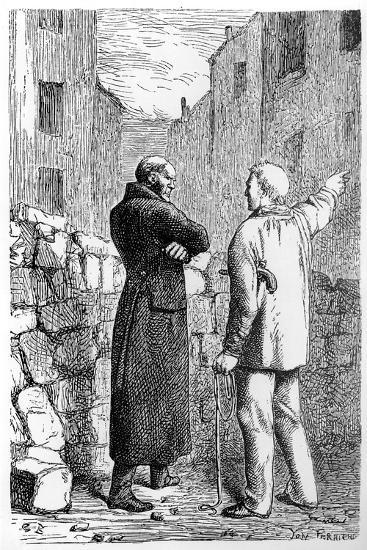
I’m nearing the end of Les Misérables and there are a number of scenes that are so rich I really have to post them.  Here is one.  There will be more.  Let me set this up.  The revolutionaries are at the barricades and the fighting is not going well.  Jean Valjean is there just to watch and protect Marius and his hated nemesis, Javert is a prisoner.  Since the battle is about to begin, there is an order to execute the prisoner, since he could no longer be guarded, and Jean Valjean volunteers.  This is from Volume Five, Jean Valjean, Book First, The War Between Four Walls, Chapter XIX, “Jean Valjean Takes His Revenge.”
 
When Jean Valjean was left alone with Javert, he untied the rope which fastened the prisoner across the middle of the body, and the knot of which was under the table. After this he made him a sign to rise.

Javert obeyed with that indefinable smile in which the supremacy of enchained authority is condensed.

Jean Valjean took Javert by the martingale, as one would take a beast of burden by the breast-band, and, dragging the latter after him, emerged from the wine-shop slowly, because Javert, with his impeded limbs, could take only very short steps.

Jean Valjean had the pistol in his hand.

In this manner they crossed the inner trapezium of the barricade. The insurgents, all intent on the attack, which was imminent, had their backs turned to these two.

Marius alone, stationed on one side, at the extreme left of the barricade, saw them pass. This group of victim and executioner was illuminated by the sepulchral light which he bore in his own soul.

Jean Valjean with some difficulty, but without relaxing his hold for a single instant, made Javert, pinioned as he was, scale the little entrenchment in the Mondetour lane.


When they had crossed this barrier, they found themselves alone in the lane. No one saw them. Among the heap they could distinguish a livid face, streaming hair, a pierced hand and the half nude breast of a woman. It was Eponine. The corner of the houses hid them from the insurgents. The corpses carried away from the barricade formed a terrible pile a few paces distant.

Javert gazed askance at this body, and, profoundly calm, said in a low tone:

"It strikes me that I know that girl."

Then he turned to Jean Valjean.

Jean Valjean thrust the pistol under his arm and fixed on Javert a look which it required no words to interpret: "Javert, it is I."

Javert replied:

"Take your revenge."

Jean Valjean drew from his pocket a knife, and opened it.

"A clasp-knife!" exclaimed Javert, "you are right. That suits you better."

Jean Valjean cut the martingale which Javert had about his neck, then he cut the cords on his wrists, then, stooping down, he cut the cord on his feet; and, straightening himself up, he said to him:

"You are free."

Javert was not easily astonished. Still, master of himself though he was, he could not repress a start. He remained open-mouthed and motionless.

Jean Valjean continued:

"I do not think that I shall escape from this place. But if, by chance, I do, I live, under the name of Fauchelevent, in the Rue de l'Homme Arme, No. 7."

Javert snarled like a tiger, which made him half open one corner of his mouth, and he muttered between his teeth:

"Have a care."

"Go," said Jean Valjean.

Javert began again:

"Thou saidst Fauchelevent, Rue de l'Homme Arme?"

"Number 7."

Javert repeated in a low voice:--"Number 7."

He buttoned up his coat once more, resumed the military stiffness between his shoulders, made a half turn, folded his arms and, supporting his chin on one of his hands, he set out in the direction of the Halles. Jean Valjean followed him with his eyes:

A few minutes later, Javert turned round and shouted to Jean Valjean:

"You annoy me. Kill me, rather."

Javert himself did not notice that he no longer addressed Jean Valjean as "thou."

"Be off with you," said Jean Valjean.

Javert retreated slowly. A moment later he turned the corner of the Rue des Precheurs.

When Javert had disappeared, Jean Valjean fired his pistol in the air.

Then he returned to the barricade and said:

"It is done."

Excerpt taken from The Literature Network.  

As we will see, allowing him to live becomes a devastating blow to Javert.  Such an act of kindness from a person he had tortured many times in life pierces his heart and disturbs his conscience.  He cannot live with such an act of love.