"Love follows knowledge."
"Beauty above all beauty!"
– St. Catherine of Siena

Showing posts with label Friendship. Show all posts

Tuesday, July 28, 2026

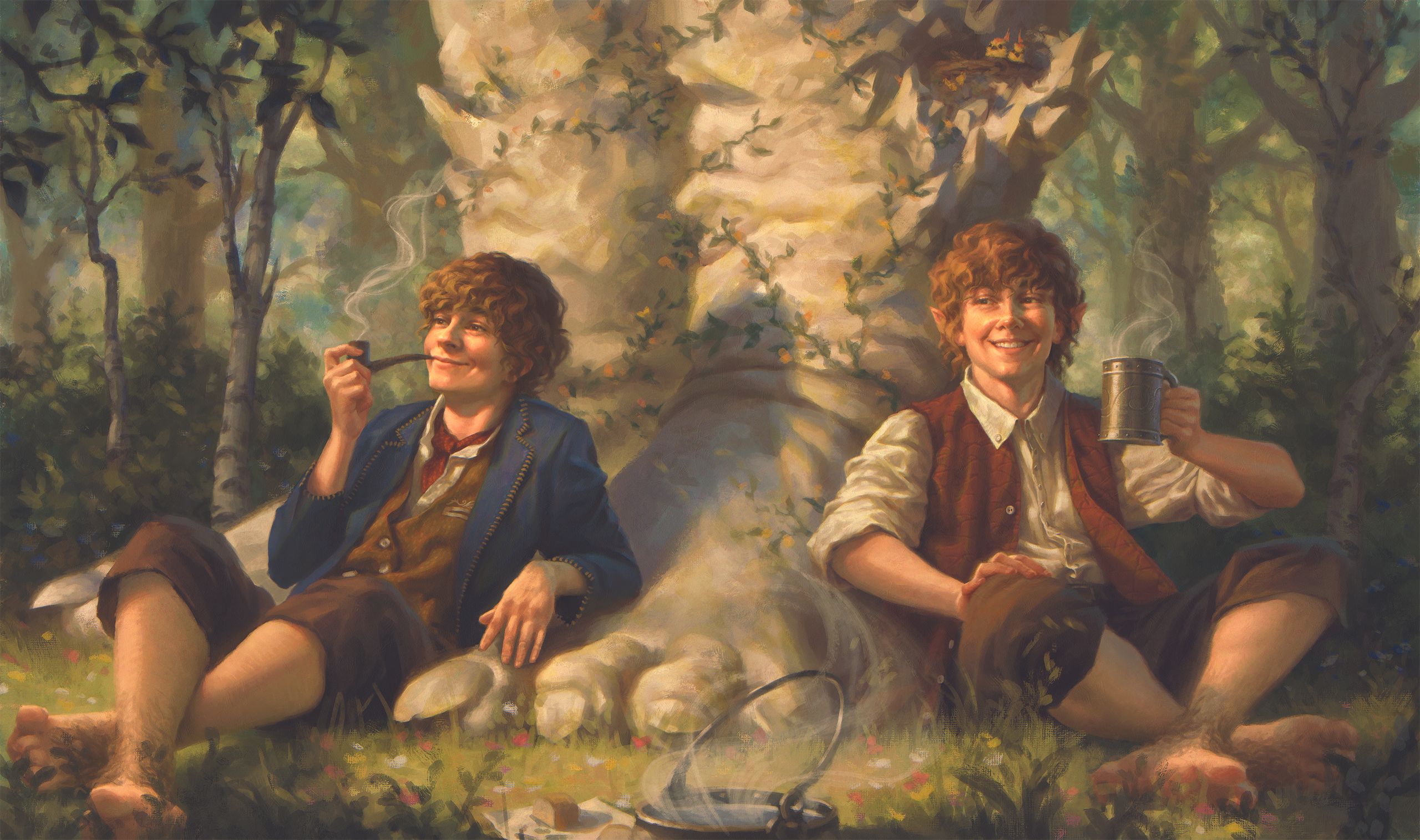
LOTR, The Fellowship of the Ring, Post 4

This is the fourth post of a series of posts on J. R. R. Tolkien’s The Lord of the Rings.  This series focuses on the first volume of the trilogy, The Fellowship of the Ring.

You can find the first post here. 

The second post here.

The third post here.


Summary: Bk1 Ch 4_5_6

Chapter 4: A Shortcut to Mushrooms

The next morning the hobbits awoke to find the elves gone, but they had left some of their delicious bread.  From the elves’ warning the night before, Frodo wanted to leave for Bucklebury immediately and insisted that the other hobbits let him go alone.  The other hobbits refused leaving him and reaffirmed their commitment to their journey.  Frodo then insisted that they take a shortcut through the forest rather than travel by the road.  As they started off, they heard a distant shrieking cry which made they move on.

Once they came to the end of the forest they were forced to turn southward and they came upon a section of land that was “well-ordered.”  They recognized it as the land of Farmer Maggot, a farmer who many years before had terrified Frodo with his dogs when Frodo was a lad.  Frodo then had been caught stealing some of Maggot’s wild mushrooms, and Frodo had never forgotten.  As they approached the house, they were confronted by Maggot and his three dogs.  After recognizing Pippin and then the others, Maggot invited them in for supper with his wife.  After supper and reminiscing discussion, Maggot with his sons decided to drive them in his wagon the five miles to the ferry.  At the ferry they met Merry who has been waiting for them.  Maggot had left them a surprise of mushrooms.

Chapter 5: A Conspiracy Unmasked

Merry led the others to a flat-bed ferry boat which he had moored at a bank, and climbing on board with the ponies they pushed off.  During the slow float across the river, Frodo felt his life transformed.  When they got to the other side, Sam and Frodo looked back across the river and could see a dark figure that had been following them. 

It was still some distance to go from the Brandywine River to Frodo’s house at Crickhollow, but that dark figure on the other side without a boat would have to spend a day to get to a crossing bridge and another day to get down,  The hobbits felt safe enough to spend one night at Frodo’s house before moving on.  Once they got to the house, where the fifth hobbit, Fatty Bolger, was waiting, Frodo felt it was just like home since the other hobbits had moved his old furniture in.  Each hobbit took a bath, singing and splashing each other, and they had a late supper.  Again Frodo wanted to leave the other hobbits behind because the quest was going to be too dangerous, but to his surprise the other hobbits revealed that they knew about the ring and the quest all along and insisted on going.  So they ate, drank, and sang a song of fellowship.  They decided in the morning to be off and not go by the road but through the Old Forest.  Fatty would not be going.

Chapter 6: The Old Forest

The hobbits got up very early in the morning and headed out.  Fatty Bolger was happy he would be staying behind. 

It was difficult making it through the forest, and it seemed that the surroundings were forcing them in directions they did not want to go.  At one point they realized the trees were shifting to guide them in a particular direction.  At another point the trees allowed them to pass into an opening in the forest, and the hobbits rushed through it.  Merry recognized the valley as leading to the Withywindle River, and they realized they were headed in the wrong direction.  So they veered northward, into a dense wood again. 

It was hot and they were tired.  They had been traveling a fortnight by now, and suddenly as they reached a bank of a stream drowsiness came upon them.  Frodo felt this was an unnatural drowsiness and wanted to move on.  But they laid down, Merry and Pippin down against a huge willow tree.  Sam got up to look for the ponies when he heard a plash.  Frodo was in the water, and when he got out said the tree had pushed him in.  When they looked for the others, Merry and Pippin were trapped inside the crevice of the big willow tree.  The tree had swallowed them up.  They didn’t have an axe, so they decided to try to burn the tree.

Suddenly they heard a strange singing and a man came upon them singing a nonsensical song.  It was Tom Bombadil, and when Frodo and Sam told him about Merry and Pippin, he yelled at Old Man Willow to let them out.  He broke a branch off the willow and started hitting the tree.  Tom started singing inside the crack and lo and behold the willow tree let Merry and Pippin out.  Tom invited the four house to his house for supper, and they accepted.  Tom moved too fast for the hobbits to follow but they followed his voice which continued to sing his nonsensical song.

###


Michelle Comment:

Tom Bombadil is almost like an angel, appearing suddenly when needed, and advising the hobbits 🙂

Ellie Comment:

What I noticed in these chapters was the emphasis on companionship and fellowship, which I think is very important not only in Catholicism but in Christianity in general. Frodo could have left alone, but his friends were there to support him and I think Tolkien wanted to show how important companions are for an individual.


I've also always thought of Tom Bombadil as Tolkien personified in his own book and looking at chapter 6 as well as future chapters, I think Tom Bombadil might be Tolkien, the 'subcreator' who knows a whole lot about what's going on but also he seems like some sort of God-figure, if I can call it that... but that's for future discussions. I think Tom Bombadil is a really fun character but one who has a lot of wisdom to share, somebody who doesn't judge and takes in these stray hobbits

My Reply to Ellie:

Yes, I think you're absolutely right. I planned to elaborate on that in the coming days. But you almost took the words out of my mouth.

Patrick Comment:

Does anybody connect Tom Bombadil with the concept of the Numinous presented in "The Wind in the Willows" chapter 7, "Piper at the Gates of Dawn"?


The god of nature, Pan, a satyr, appeals to the characters in that chapter. Early Christians saw Pan as a Christ-figure.


I mention this because Tolkien loved Kenneth Grahame as a child, and Tom Bombadil fits in the mold of mystical caretaker of nature.

My Reply to Patrick:

Patrick, I am not familiar with The Wind in the Willows (though I have a vague memory of reading some of it years ago) but you might be onto something there. The tree that swallowed Merry and Pippin was a willow tree and was referred to as Old Man Willow. Thanks for that insight.

Kerstin Reply to Patrick:

Tom Bombadil is one of the hardest characters to classify. The mystical caretaker of nature seems to me a favorite one especially from a secular perspective. But I find that too limited. He exudes the joy of life like no other character I know of. Always cheerful and fully aware of his surroundings, probably to a deeper extend than we are. He reminds me of the famous quote by St. Irenaeus, The glory of God is man fully alive. Tom Bombadil is fully alive. The negative things of life don't touch him because he is too alive for them. Julian of Norwich comes to mind as well, All shall be well, and all shall be well, all manner of things shall be well.

My Reply:

Let's hold off discussing Tom Bombadil. The very next chapter is devoted to him. Let's wait for the next section.

L Comment:

Thank you very much for the helpful summary, Manny. The sixth chapter really stood out for me with Tolkien's depiction of the awful unending confusion of the hobbits lost amid the quiet menace of the trees. I felt nearly as dizzy reading it as the poor hobbits must have been trying to find their way through the Old Forest! Tom Bombadil's nonsense verses again reminded me of George McDonald's character Curdie, who makes up nonsense rhymes to ward away goblins in 'The Princess and the Goblin'. I think Curdie is the purest human depiction of courage that I have ever come across in fiction.

My Reply to L:

You're welcome, and that is anoher allusion that is quite possible. I believe Tolkien was a fan of McDonald. I have not read McDonald's The Princess and the Goblin, from which Curdie is from, so I can't comment.

Kerstin Reply to L:

Oh that's a great comparison! I hadn't thought of that at all, and I lead the discussion on the book in 'Victorians!' last year, lol.

Now my follow-up thought would be, what is it about nonsense rhymes that wards off evil? I'll have to think about that.

My Reply to Kerstin:

That is a very interesting question. Late 19th and early 20th century English literature is populated with nonsense rhymes, both as stand alone poems or set pieces within novels. I'm thinking of Lewis Carrol's Alice in Wonderland which contains nonsense rhymes and the poetry of Edward Lear. You can read about nonsense verse here:


There are various forms of nonsense verse. Here are some that I can think of. One is employing words that make sense but together do not seem like a logical statement; second is employing language that is completely made up or are just phonemes; third is a combination of one and two; fourth is a creation of a whole language (here I'm thinking of James Joyce's Finnigan's Wake which is a whole novel in nonsensical language). There may be more. That article doesn't mention it, but I think nonsensical language is linked to folklore.


With Tom Bombadil, my guess is to set him apart from a common society. Shared language is at the basis of a shared community. Someone with his own language and sense is apart from the community or is from a community in one's past. Just like when we read Old English and it seems nonsense to us, so could a person who speaks in an older version of a language suggest a hereditary lineage.


Or he could just be crazy....lol. 


###

Have you noticed how in almost every single chapter, there is a meal shared between several persons? 

From chapter 2, on the last night at Bag Ends:


The four younger hobbits were, however, in high spirits, and the party soon became very cheerful in spite of Gandalf’s absence. The dining-room was bare except for a table and chairs, but the food was good, and there was good wine: Frodo’s wine had not been included in te sale to the Sackville-Bagginses.


‘Whatever happens to the rest of my stuff, when the S.-B.s get their claws on it, at any rate I have found a good home for this!’ said Frodo, as he drained his glass. It was the last drop of Old Winyards.

Later in that chapter, after being on the road and meeting the elves, the hobbits join them for supper.


Pippin sat up and rubbed his eyes. He shivered. ‘There is a fire in the hall, and food for hungry guests,’ said an Elf standing before him.


At the south end of the greensward there was an opening. There the green floor ran on into the wood, and formed a wide space like a hall, roofed by the boughs of trees. Their great trunks ran like pillars down each side. In the middle there was a wood-fire blazing, and upon the tree-pillars torches with lights of gold and silver were burning steadily. The Elves sat round the fire upon the grass or upon the sawn rings of old trunks. Some went to and fro bearing cups and pouring drink; others brought food on heaped plates and dishes.


‘This is poor fare,’ they said to the hobbits; ‘for we are lodging in the greenwood far from our halls. If ever you are our guests at home, we will treat you better.’


‘It seems to me good enough for a birthday-party,’ said Frodo.

Indeed, the next morning after the elves have departed, the hobbits had breakfast with the leftover bread.  In chapter 4, Farmer Maggot invites the hobbits in for supper with his family.


Frodo now accepted the invitation gratefully, to the relief of Pippin and Sam. The sun was already behind the western hills, and the light was failing. Two of Maggot’s sons and his three daughters came in, and a generous supper was laid on the large table. The kitchen was lit with candles and the fire was mended. Mrs. Maggot bustled in and out. One or two other hobbits belonging to the farm-household came in. In a short while fourteen sat down to eat. There was beer in plenty, and a mighty dish of mushrooms and bacon, besides much other solid farmhouse fare. The dogs lay by the fire and gnawed rinds and cracked bones.

In chapter 5, when the hobbits reach Frodo’s house at Crickhollow and have their splashing fun in their baths, they have a late supper.


They had supper in the kitchen on a table near the fire. ‘I suppose you three won’t want mushrooms again?’ said Fredegar without much hope.


‘Yes we shall!’ cried Pippin.


‘They’re mine!’ said Frodo. ‘Given to me by Mrs. Maggot, a queen among farmers’ wives. Take your greedy hands away, and I’ll serve them.’

There are more instances, and let’s not forget the novel starts with a birthday party and moves in short order to another birthday party years after.   This gathering for a meal is certainly more in the novel than just the natural need for people to eat at certain time intervals.  Tolkien, with this rhythmic punctuating of gathering for a meal, is raising the meal to something more than the obvious.  Can we think of it as a metaphor?  I would. 

So what does this metaphor stand for?  When people come together for a meal, they come together in a bond or through the meal they form bonds.  There is a shared goodwill between those at the table.  Family and friends come together for a meal.  You are in communion with those at the table.  Indeed, communion implies Holy Communion.  In Holy Communion one is in communion within the Body of Christ.  Notice at Mass the taking of Holy Communion comes after the Eucharistic prayer that stitches together the whole Church body (living and dead), after the community praying of the Our Father—if we share a Father, then we are brothers and sisters—and after we offer peace to all in the Body.  The holy meal follows that bonding process.  This is what I think Tolkien is suggesting with his rhythmic pacing of meals.  Those at table come into communion.  This is why such a good feeling is shared after the dinner with the elves.  This is why the hobbits have such shared fun in splashing each other as they bathe at Crickenhollow. 

One step then from communion I think is fellowship.  What is fellowship?  From Merriam-Webster’s, and I’ll only include the definitions that apply here:  (1) companionship, (2) community of interest, activity, feeling, or experience, (3) a company of equals or friends; an association, (4) the quality or state of being comradely.  


Fellowship, then, is being in communion of friends with a particular shared interest or activity.  The hobbits are in fellowship with each other with the shared interest of the quest to dispose of the ring.  This fellowship is formed, stitched, and sealed through the process of shared meals.  (Let me guess, there will never be a shared meal between the hobbits and orcs.)  The novel’s first volume is called “The Fellowship of the Ring.”  In time, if I remember correctly, I think the whole first volume is an enlarging of this fellowship. 

###

Kerstin Comment:

Yes! If I remember correctly there is only Gollum in the entire book who goes off and eats alone, but that won't be until "The Return of the King".


There is something so deeply mystical about sharing a meal. We do it all the time and don't think much about it. Yet it gives us sustenance far beyond the nourishment of the body. Who would ever think of having a get-together without a meal or at least some kinds of refreshments?


Thinking about this I am reminded of the Odyssey and how hospitality takes on a very different character than what we're used to today. The arriving stranger, mostly Odysseus or in the beginning his son Telemachus, is offered a meal first, then his name is asked, and what brings him to this particular place. The meal goes before everything else, even asking the stranger his name or who he is!

Bruce Comment:

Also the Iliad and American Indian stories have multiple stories of how a brave soul faces down death by walking fearlessly into an enemy camp to retrieve a daughter, wife, or even a corpse, and there stories nearly always include calmly sharing a meal with an enemy who respects your courage. The story of Leo the Great and Attila the Hun may be another version of this story.


Iliad, Blog 3, Visiting the Enemy Camp, Greeks vs Indians


The Warrior Cultures of the Iliad and the American Indian, Bravely Visiting the Enemy Camp


Friday, February 21, 2025

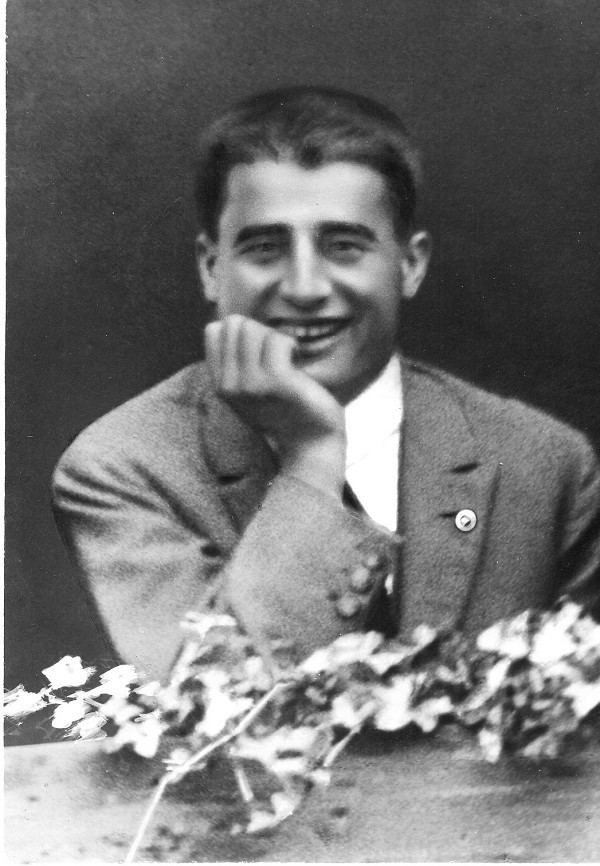
Faith Filled Friday: Blessed Pier Giorgio’s Letter to a Friend

This is a letter written almost exactly one hundred years ago from Blessed Pier Giorgio Frassati to a friend.  We know that it was written early in the year 1925 since the letter in the opening paragraph refers to the year of Jubilee, and 1925 is the only year Frassati lived that had a Jubilee year.  From the reference to Advent, which seems to have just passed, the letter must have been written early in the year, possibly January or February.  Later this year, Blessed Pier Giorgio will be fully canonized into a saint. 

Blessed Pier Giorgio Frassati was a young man from Turin, Italy who came from a prominent family but spent his spare time and money secretly helping the poor. He was a devout young Catholic, a mining engineer, a Lay Dominican, a social activist, a jokester, a mountain climber, a pipe and cigar smoker, and a friend to all.  He died at the tender age of 24, but after his death his life of charity became public, even surprising his parents.  He was beatified by Pope St. John Paul II in 1990 and is slated to be canonized this summer by Pope Francis.  There is a website devoted to his memory where you can find a lot more information about his wonderful life.  


As a Lay Dominican I hold a special bond with Blessed Pier Giorgio.  Not only was he a Lay Dominican, but also like me he was an engineering student and a person who studied literature and theology.  We have a lot in common.  You will see references to all that in this excerpt of one of his letters, a letter to a friend.  Another thing you could notice in the letter is how affectionate a friend he was.  He starts the letter with some reference to a possible bit of friction with the friend, all of which seems nothing to him. 


Dearest friend, no ill feelings, as they are not worthy of the Holy Year; since the Vicar of Christ has indeed opened the Holy Doors I offer you the olive branch which is the sign of peace….In fact, during Advent I prepared for the Holy Year by reading Saint Augustine, reading which I haven’t yet finished, but from which I have received immense happiness, a profound joy, which until now unfortunately had not penetrated my soul.  I’m also doing some literary studies…and then I’ll move to studies of philosophy, if I find a good translation of the works of Thomas Aquinas.  You see that my plans for the Holy Year are grand.  I believe that I had thus found a better way to alternate my boring study of mechanical technology with delightful readings.


And what are you doing?  When will you be coming?  Turin is anxious to hear from you….When will you return?


The year has begun well, after toasting it with my family I went to Holy Martyrs Church; there in the church, crowded with people, we prayed that there would be peace in Italy and peace among us.  And this peace, which is the burning desire of us all, we hope will come this year in which the graces of the Lord are multiplied….


I am delighted to close my student career in such a beautiful year.  And now I should bid you farewell, because study is calling me back to work and meanwhile all the best for a good prosecution, best wishes above all that you will always possess the True Peace, which is the best gift that one can possess on this earth.

The excerpt comes from the magazine Magnificat, January 2025 (Vol. 26, No. 11) edition, pages 130-31.

I love this excerpt.  We see so much into his personality.  He was studious like a good Dominican should be, and he was very gregarious and very humble.  When I pray for the well being of my friends, I appeal to the intercession of Blessed Pier Giorgio Frassati.  I don’t know if he will have this patronage, but I consider him the patron saint of friendship.  If I had realized at the time, I might have taken the name Pier Giorgio as my Lay Dominican name.  If you are a friend of mine, I have put you in my prayers through the intercession of Pier Giorgio.

I had the good fortune last year to come across a rosary with the centerpiece comprising of a picture of Pier Giorgio and a relic (third class I think) of his.  I have been using it at my Lay Dominican chapter meetings for the praying of our rosary.  Here is a picture of it.  First with the front of his centerpiece, and second of the flip side.


The relic side states “Ex Indumentis” which is Latin for “from the clothes.”  Apparently it’s from a piece from his clothing.

Sadly, Pier Giorgio would pass away later in the year of 1925, on the fourth of July, I think. 

Blessed Pier Giorgio, soon to be saint, pray for us and pray for my friends.

Tuesday, September 17, 2024

In Memoriam: Jeanette Lucey

I received some bad news the other day, my friend Jeanette Lucey passed away.  If there are any followers of my blog from the very first years of my blogging here, they may remember I was blogging at two places, this blog as my own blog, and Jeanette’s blog, J’s Café Nette, as part of a team of three, Jeanette, Sue, and me.  Jeanette’s blog was a political blog, and the three of us commented on the politics of the day.  I started this blog as a refuge from the grind of daily politics, which in time I came realize is caustic to one’s soul.  I set up my personal blog to get away from the political wars and dwell on things I enjoyed.  I have been mostly true to that.

The J’s Café Nette blog was definitely commenting from a conservative perspective, and from what I remember—and I could be remembering incorrectly—Jeanette was probably the most balanced of the three of us.  She tried to be fair and give the Democrats and Liberals the benefit of the doubt, while I jumped on the most cynical elements of the left.  I was convinced—and still am—that the left was out to destroy the traditions of this country and Western culture, and I think my posts tended in that vitriolic direction.  As I think back on it, perhaps Jeanette may have been embarrassed by my style.  I wouldn’t be surprised.  Politics could stir a lot of passion out of me, and I wasn’t shy with expressing it.  Jeanette, ever the lady, accepted me while trying to soften my approach.

How we met and how I was invited to blog at Jeanette’s blog is worth telling.  We both frequently commented on The Anchoress blog.  It was a Catholic blog but Anchoress (Elizabeth Scalia) often spoke on the politics of the day, and she rooted her politics to her Christian, and more specially, Catholic principles.  Both Jeanette and I enjoyed that blog and commented frequently.  Now in those days it was common for blogs to keep a roll of sympathetic other blogs on their page, and J’Café Nette was one on Anchoress’s page.  I clicked it and found it to my liking.  I became a frequent commenter there and one day Jeanette sent me an email inviting me to join her and Sue on her blog.  Actually as I was reminiscing through my past emails with Jeanette, I found the very one.  Here is a screenshot of that email.


You can see Jeanette’s faith on display with her email footer: “Trust in the Lord…”

Although Jeanette liked The Anchoress, I need to stipulate Jeanette was not Catholic.  She was a Baptist, and she early on reassured me she was not one of those anti-Catholic Protestants.  For one thing she told me a joke about Baptists in heaven. 


A man dies and he’s led through the corridors of heaven, and he sees various rooms with doors ajar.  That room is for the Methodists; that room is for the Presbyterians; that room is for the Catholics.  Then they pass a room with the door closed.  Don’t look into that room the guide says, that room is for the Baptists.  But why is the door closed?  They think they’re the only ones in heaven. 

After she told me that joke, I knew we would be good friends.  She also told me about an anti-Catholic who criticized the praying of the Hail Mary.  When she looked into it, she told me, the words are taken right out of the Bible.

She asked about certain Catholic rituals.  I did my best to explain them, though I don’t think I was at the time able to make them clear.  I remember she asked about Catholic funerals.  My memory is a little vague here but I think she said her mother, who was Native-American, returned to her Catholic faith late in life and had a Catholic funeral. 

Of course I accepted Jeanette’s invitation to blog, but now if you look at the date of the Jeanette’s email, it was in March of 2010.  That was a month and a half before my wife and I went to Kazakhstan to adopt our son Matthew.  We were gone for another month and a half.  It was quite an experience and if I remember correctly I gave updates from Kazakhstan on how the process was going.  I think I posted to her blog from abroad, but my memory is vague.  I wish I could get a hold of the old J’s Cafe Nette posts but she dissolved them all into the nether sphere when she closed down the blog.

Over the years, Jeanette would always ask me about my son.  (And I should mention that Sue is also very good about asking on how Matthew is doing.)  Jeanette had a theory on why my son was so friendly with strangers.  As an infant in an orphanage, he was picked up by lots of strangers and just did not develop a fear.  It’s quite a plausible theory.  She asked for pictures of Matthew even after we had stopped blogging. 

I loved going through our past email exchanges.  Here is a paragraph from an exchange back in February of 2016.  The Republican Primary was coming up in her state, and I asked who she was voting for.


For the first time in my life I am truly undecided.  Definitely not Trump!  Enough of Bushes and Clintons, not Cruz as he is too stringent and the Canadian thing might bite him in the butt; especially if Trump decides to pursue it.  If he doesn’t you can count on the Dems doing it, but he’s the Republican version of Obama.  His way or no way.  Carson is inexperienced and doesn’t have a chance.  That leaves Rubio and Kasich.  Rubio is a first-term senator and we already have that and look where that got us.  Kasich wants to cut the military but probably civilian jobs that are redundant.  So I don’t know and won’t know until I touch the screen on Saturday.

That was the theme in that primary, “Definitely not Trump!”  I shared that sentiment too, and I don’t have a recollection on who she actually voted for in the primary, but we both voted for Trump in the general.

There was another email about waiting at the hospital while the doctors performed a delicate operation on her husband’s spine.

I could feel the presence of the Lord as I sat there all day Monday waiting to hear it was over.  I got butterflies in my stomach when they told me the operation had started and I said a silent prayer to ask Him to calm me.  It must have happened immediately because I do not recall having butterflies after that.

If there is one single comment that characterizes Jeanette, it’s that one.  She was a woman of faith and family and love.  The operation went well I was told.   

In time both Jeanette and Sue began to grow tired of blogging.  Perhaps it was the dark days of the Obama administration that made us all so cynical.  (She sent me a link to a clock that counted down the days to Obama being out of office!)  So around August of 2013, Jeanette officially closed down her blog.  I posted here about that day, and I urge you to read it.   Jeanette posted a comment, and just like these quotes I posted here it’s wonderful to relive her words and with a little imagination I can hear her voice as I read them.

I will be forever grateful to Jeanette for introducing me to blogging.  I would never have started this blog if not for her and Sue.  They were my mentors.  In honor of Jeanette I will do something that this blog has resisted for these dozen years.  I will break my rule of not going into politics and announce who I will vote for and why in the coming presidential election, and no it is not either of the major candidates.  So stay tune for that.

It is with a tear in my eye I went through these past email exchanges.  She passed away much too young.  You can read her public obituary here.  Oh wow, she had the same birthday as my father.  I never knew.


Eternal rest grant unto Jeanette, O Lord, and let perpetual light shine upon her.

May her soul and the souls of all the faithful departed rest in peace.  Amen.


We never did meet in person Jeanette .  If someday I am led to that room with all the Baptists, I’m going to knock, have you come out, and give you a big hug we never had a chance to give in life.  Take care, my friend.


Thursday, November 2, 2017

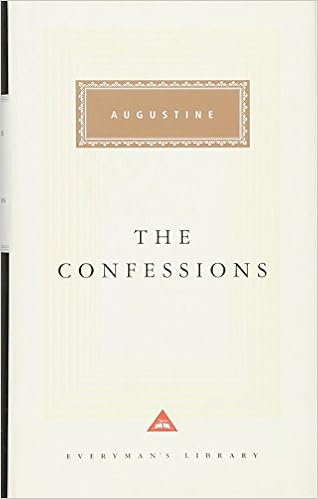
Lines I Wished I’d Written: On the Passing of a Friend, by St. Augustine from The Confessions.

At Goodreads Catholic Thought Book Club we are currently reading The Confessions by St. Augustine of Hippo, and given today is All Souls Day, I thought this passage from Chapter Four was very fitting to commemorate today’s feast day.  The passage consists of three chapters, identified as 4.3.7-9. 

 
To set the context, Augustine is in his early twenties, a teacher of rhetoric in his home town of Thagaste, where he had made a friend of approximate age and who dies.  If you haven’t read The Confessions before, it is an autobiographical work where Augustine confesses to God the various parts of his sinful life.  He is still here a pagan, and you can see how he ridicules the ritual of baptism.

It was during those years, when I had first begun to teach in my home town, that I made a friendship.  My friend shared in my studies, and was very dear to me; we were contemporaries, both blooming in the flower of youth.  He had grown up with me as a boy; we had been to school together, and played together.  But at that time he was not such a friend of mine—although not even at that time I am speaking of was he a friend in the true sense, for it is only true friendship when you glue together those who cleave to you by diffusing your love in our hearts through the Holy Spirit (Rom 5.5), which you have given us.  Nevertheless, it was indeed a sweet friendship, fired in the heart of our shared studies.  While he was still a schoolboy, I had turned him away from true faith, which by reason of his years he did not cling to truly or with any depth, and towards the superstitious and pernicious tales which made my mother weep for me.  Now, as a man, he strayed in spirit with me, and my soul could not be without him.  And behold, you stood over the backs of these fugitives from you, O God of vengeance (Ps. 94.1 [Ps. 93.1]) and fount of mercy alike, who turn who turn us again to you (Ps. 51.15 [Ps. 50.15]) in wondrous ways; and behold, when he had reached manhood you took him from this life, when he had been my friend for barely a year—a friendship sweeter to me than all the sweetness of my life, as it then was.

Who can alone tell all your praises (Ps. 106.2 [Ps. 105.2]), all the works of yours that he has known in himself alone?  What did you do then for me, my God, and how unsearchable are the depths of your judgements (Ps. 36.6 [Ps. 35.7]; cf Rom. 11.13)?  My friend fell ill with a fever, and for a long time lay unconscious in a mortal sweating fit.  When those around him had abandoned hope of his recovery, he was baptized without his knowing.  I was indifferent to this, confident that his soul would retain what he had learnt from me, not what was done to his body without his knowing.  But the truth was far different.  My friend rallied and recovered, and as soon as I could talk to him—and that was not long, no longer than it took for him to be able to talk to me, since I would not leave his side, and we were inseparable from one another—I tried to tease him about it, thinking that he would join me in laughing at a baptism he had received while wholly unconscious and insensible.  He, however, had learnt beforehand of the baptism he had received, and shrank from me as if from an enemy.  In a remarkable and sudden burst of plain speaking he warned me that if I wanted to be his friend, I would have to stop talking to him like that.  For my part, I was astonished and upset at this, and put all my own feelings on one side until he had recovered and had regained full vigour of health; then, I thought, I would be able to deal with him as I wished.  But he was rescued from my madness, so that in you he might be reserved for my consolation; a few days later, when I was away, the fever struck again, and he died.

What pain darkened my heart! (Lam. 5.17).  All that I saw was death.  My home town was a torment to me, my home strangely cursed; all the things I had shared with him were, without him, transformed into grievous tortures.  My eyes looked expectantly for him everywhere, but he was denied to their sight.  I hated everything, because it did not contain him; nor could anything now say to me, ‘Look, he is coming,’ as they could when he had been absent during his life.  I became the object of my own investigation, and asked my soul repeatedly why it was sorrowful, and why did it trouble me so deeply; and it did not know what to say in return.  And if I said, Hope in God (Ps. 42.05, 11, Ps. 43.5 [Ps. 41.6, 12, Ps. 42.5]), it would not obey, and rightly; for the friend I had lost, though a man, a thing more real and better than the illusion in which I bade my soul trust.  Weeping alone was sweet to me, and took the place of my friend among the pleasure of my mind.
            -Translation and quote identification by Philip Burton from the Everyman’s Library edition, p. 69-70.

Troubled by his grief, Augustine goes on to leave his home town and move to the big city of Carthage.  I think one here sees the seeds of the importance and vitality of baptism being planted in him.  But I’m struck with how skillfully Augustine tells us in three paragraphs of his friendship, the death of his friend, and the grief over it. 


Say a prayer for you beloved departed on this All Souls Day.