"Love follows knowledge."
"Beauty above all beauty!"
– St. Catherine of Siena

Showing posts with label T.S. Eliot. Show all posts

Wednesday, February 18, 2026

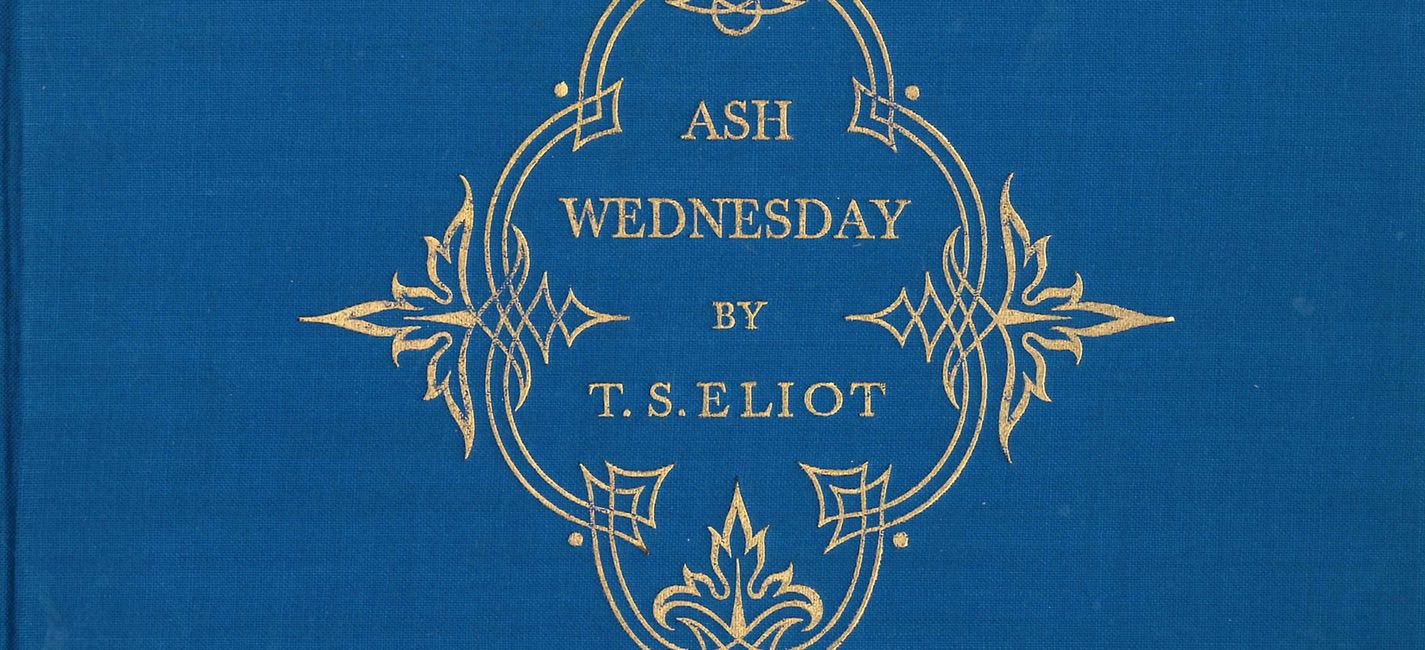
Poetry: “Ash Wednesday, Part V” by T. S. Eliot

Today is Ash Wednesday.  Over the years on Ash Wednesday I have highlight a particular part of T. S. Eliot’s poem, “Ash Wednesday.”  So far I have highlighted the first four of the six parts of the poem.  Let me link you to the posts on the first four parts:

Part 1 (Posted on February 22, 2023) here.  

Part II (Posted on February 13, 2013) here.  

Part III (Posted on February 18, 2015) here  and again (Posted February 14, 2024) here.  

Part IV (Posted on March 5, 2025) here.


If Part I can be summarized as an acknowledgement of personal sin and the turn for repentance, Part II as the suffering of penance and the request of prayer from a lady of silence, Part III as a passing through of Purgatory, and Part IV as the transcendence of sin, we come to Part V. 


V

If the lost word is lost, if the spent word is spent

If the unheard, unspoken

Word is unspoken, unheard;

Still is the unspoken word, the Word unheard,

The Word without a word, the Word within

The world and for the world;

And the light shone in darkness and

Against the Word the unstilled world still whirled

About the centre of the silent Word.


O my people, what have I done unto thee.


Where shall the word be found, where will the word

Resound? Not here, there is not enough silence

Not on the sea or on the islands, not

On the mainland, in the desert or the rain land,

For those who walk in darkness

Both in the day time and in the night time

The right time and the right place are not here

No place of grace for those who avoid the face

No time to rejoice for those who walk among noise and deny the voice


Will the veiled sister pray for

Those who walk in darkness, who chose thee and oppose thee,

Those who are torn on the horn between season and season, time and time, between

Hour and hour, word and word, power and power, those who wait

In darkness? Will the veiled sister pray

For children at the gate

Who will not go away and cannot pray:

Pray for those who chose and oppose


O my people, what have I done unto thee.


Will the veiled sister between the slender

Yew trees pray for those who offend her

And are terrified and cannot surrender

And affirm before the world and deny between the rocks

In the last desert before the last blue rocks

The desert in the garden the garden in the desert

Of drouth, spitting from the mouth the withered apple-seed.


O my people.


There are four stanzas with a refrain.  The refrain comes between stanzas one and two, between three and four, and clipped at the end as a coda.  Why isn’t there a refrain between stanzas two and three?  I don’t know. Perhaps just to make Part V asymmetric. 

How does one read the refrain, “O my people, what have I done unto thee?”  One might read it with a sense of remorse with a tone of guilt.  However, the refrain is an actual quote from the Book of the Prophet Micah 6:3.  Here is the quote in context:


Hear what the Lord says:

Arise, plead your case before the mountains,

    and let the hills hear your voice.

2 Hear, you mountains, the controversy of the Lord,

    and you enduring foundations of the earth;

for the Lord has a controversy with his people,

    and he will contend with Israel.


3 “O my people, what have I done to you?

    In what have I wearied you? Answer me!

4 For I brought you up from the land of Egypt,

    and redeemed you from the house of bondage;

and I sent before you Moses,

    Aaron, and Miriam.

5 O my people, remember what Balak king of Moab devised,

    and what Balaam the son of Be′or answered him,

and what happened from Shittim to Gilgal,

    that you may know the saving acts of the Lord.” (Mic 6:1-5)

As you can see, the verse that Eliot uses as a refrain is spoken by God in Micah with a tone of anger and indignation, as if God is saying, “what have I done to deserve this?”  Let’s check Eliot’s tone reading the poem.  Part V starts at 8:05 and ends at 10:12.


It sounds like indignation to me.  Eliot is channeling God’s indignant voice at least for the refrain.  But is he then channeling God’s voice throughout the poem?  Is that God speaking in indignation in all of Part V?  It is interesting that Part V is the only section of the entire poem that does not appear to be in first person.  It is possible that Part V is the voice of God entering the poem.

It is interesting that stanzas one is framed in the conditional case: “If the lost world is lost,” Stanzas two, three, and four are framed in the interrogative case: “Where shall the word be found,” “Will the veiled sister pray,” and again “Will the veiled sister…pray.”  Framing in a conditional and interrogative cases creates an imagery less specific, more amorphous, and less incorporeal.  That might also suggest a more spiritual or God voice.

The first stanza, except for the images of light and darkness, is built around abstractions.  “Word” and “word,” “spoken,” “unspoken,” “still,” “unstill,” lost, and “spent.”  Of all the nouns to identify Christ, Eliot chooses the most abstract here, “the Word .”  Significantly, the “Word is unheard.”  I suspect this is the voice of God condemning a sinful people. 

The second stanza asks ““Where shall the word be found”?  Not here, and Eliot provides a sequence of very specific nouns of the earth.  The earth is too noisy.  “There is not enough silence.”  It is too busy for holiness and repentance.

The third and fourth stanzas, the voice of—and I think it is God—asks the “veiled sister” to pray for those who cannot.  He asks her to pray for “those who walk in darkness.”  The veiled sister comes up several times in the overarching poem, and in Part VI we see the veiled sister is the “holy mother.”  Humanity is identified as having spit “from the mouth the withered apple-seed,” the image of man tainted with original sin.

The first two stanzas signal the need for Christ (the Word) for acceptance  and redemption in this “noisy” world.  Stanzas three and four asks whether the Blessed Virgin (the veiled sister) will pray as intercessor for our redemption.  The answer theologically of course is yes, she will intercede for us; the real question for me is whether we will accept the grace that comes from her intercession. 

In Part V of “Ash Wednesday,” then, we see God in judgement of man, but offering the possibility through the intercession of the Blessed Mother the means of redemption.

Next year we will read and analyze the final section.  Have a holy Ash Wednesday and blessed season of Lent.


Wednesday, March 5, 2025

Poetry: “Ash Wednesday, Part IV” by T. S. Eliot

Today is Ash Wednesday.  Over the years on Ash Wednesday I have highlight a particular part of T. S. Eliot’s poem, “Ash Wednesday.”  So far I have highlighted the first three of the six parts of the poem.  Let me link you to the posts on the first three parts:

Part 1 (Posted on February 22, 2023) here.  

Part II (Posted on February 13, 2013) here.  

Part III (Posted on February 18, 2015) here and again (Posted February 14, 2024) here.  

If Part I can be summarized as an acknowledgement of sin and the turn for repentance, and Part II as the suffering of penance and the request of prayer from a lady of silence, and Part III as a passing through of Purgatory, we come to Part IV. 


IV

Who walked between the violet and the violet

Who walked between

The various ranks of varied green

Going in white and blue, in Mary's colour,

Talking of trivial things

In ignorance and knowledge of eternal dolour

Who moved among the others as they walked,

Who then made strong the fountains and made fresh the springs


Made cool the dry rock and made firm the sand

In blue of larkspur, blue of Mary's colour,

Sovegna vos


Here are the years that walk between, bearing

Away the fiddles and the flutes, restoring

One who moves in the time between sleep and waking, wearing


White light folded, sheathing about her, folded.

The new years walk, restoring

Through a bright cloud of tears, the years, restoring

With a new verse the ancient rhyme. Redeem

The time. Redeem

The unread vision in the higher dream

While jewelled unicorns draw by the gilded hearse.


The silent sister veiled in white and blue

Between the yews, behind the garden god,

Whose flute is breathless, bent her head and signed but spoke no word


But the fountain sprang up and the bird sang down

Redeem the time, redeem the dream

The token of the word unheard, unspoken


Till the wind shake a thousand whispers from the yew


And after this our exile


If you want to read the entire poem, you can do so here.  


How can we summarize Part IV?  Is the penitent still undergoing purgation?  Or has he let out of purgation?  In Dante’s Divine Comedy on which this poem uses greatly, when Dante the character passes through the final purgatorial cleansing, he comes to an earthly paradise, the paradise of Adam and Eve.  Is this what Eliot is describing here?  Perhaps.  What the character of the poem is aware of is the color blue, the color of the Blessed Virgin Mary.  What is redeemed here above all is time: “Redeem/The Time.”  That is quite profound actually.  All our sins are committed in time, and therefore time itself has been violated.  Our redemption includes the redemption of the time and place.  The narrator goes on to redeem all in a magnificent vision:


,,,Redeem

The unread vision in the higher dream

While jewelled unicorns draw by the gilded hearse.

That is a difficult passage to untangle, but what I think Eliot is getting at is that redemption what was muddied by sin will be transformed into something transcendent.  “Hearse” suggests a death—perhaps the death of his sin or sinful nature—but now driven away by “jeweled unicorns”!  What vision or dream is he referring to?  My guess is that in Part II of his scattered bones and his body being fed upon by a leopard.  That image being drawn away in a gilded hearse by unicorns is a magnificent image of redemption. 

And to conclude the passage Eliot has the Blessed Virgin praying from which a fountain emerges spouting water.  This is a symbol of redemption through baptism. 


Sunday, January 5, 2025

Solemnity Meditation: The Magi

On this second Sunday of Christmas, we celebrate the Solemnity of the Epiphany of the Lord.  Who were these strange men—the Gospel does not say they were kings—who followed a star to baby Jesus?  Well I had four blog posts on the reading of Fr. Dwight Longenecker’s book, The Mystery of the Magi.  If you really want to know who these mysterious men were—not the fable of Balthazar, Caspar, and Melchior—but the real history, read my posts.  Here is blog post #4 on Fr. Longenecker’s book, and from there are links to Posts one, two, and three.  The real history is more astonishing than the legend. 

However, Matthew’s spiritual significance is just what epiphany means.   Epiphany is a revelation of God, a theophany, and here the Magi reveal to the world that baby Jesus is the Christ, King of the Jews.


When Jesus was born in Bethlehem of Judea,

in the days of King Herod,

behold, magi from the east arrived in Jerusalem, saying,

“Where is the newborn king of the Jews?

We saw his star at its rising

and have come to do him homage.”

When King Herod heard this,

he was greatly troubled,

and all Jerusalem with him.

Assembling all the chief priests and the scribes of the people,

he inquired of them where the Christ was to be born.

They said to him, “In Bethlehem of Judea,

for thus it has been written through the prophet:

And you, Bethlehem, land of Judah,

are by no means least among the rulers of Judah;

since from you shall come a ruler,

who is to shepherd my people Israel.”

Then Herod called the magi secretly

and ascertained from them the time of the star’s appearance.

He sent them to Bethlehem and said,

“Go and search diligently for the child.

When you have found him, bring me word,

that I too may go and do him homage.”

After their audience with the king they set out.

And behold, the star that they had seen at its rising preceded them,

until it came and stopped over the place where the child was.

They were overjoyed at seeing the star,

and on entering the house

they saw the child with Mary his mother.

They prostrated themselves and did him homage.

Then they opened their treasures

and offered him gifts of gold, frankincense, and myrrh.

And having been warned in a dream not to return to Herod,

they departed for their country by another way.

~Mt 2:1-12


Fr. Geoffrey Plant as usual does a thorough of explaining the historical and biblical significance of the Epiphany.


Fr. Geoffrey gives a handful of theories of where the Magi came from but none of them agree with Fr. Longenecker’s research.  I would go with Fr. Longenecker. 

Now for a sermon on the spiritual significance of the epiphany, let’s turn to Jeff Cavins.


It occurs to me that the light given off by Christ shines through the Magi.  Let the light of Christ shine through you.  Let your person be a manifestation of Christ, an epiphany to the world.

We don’t see much of how the Magi are transformed by their visit, but the poet T.S. Eliot speculates on how one particular Magus (singular for Magi) is transformed in his great poem “The Journey of the Magi.”  I provided a detailedanalysis of the poem here if you wish to read and understand this great work of poetry.    


Solemnity Meditation: “Where is the newborn king of the Jews?  We saw his star at its rising and have come to do him homage.”


Instead of a hymn this week, I am going to provide a reading by someone named Arthur L. Wood of T.S. Eliot’s he Journey of the Magi.” 


I selected this clip since it provided the words, but that is also an excellent reading.

Wednesday, February 14, 2024

Poetry: Part III of T.S. Eliot’s Ash Wednesday

In the past I have posted Part I and Part II of T.S. Eliot’s magnificent poem Ash Wednesday.  You can read the entire poem here.    

Today is Ash Wednesday, a day of penance, fasting, and meditation on one’s sins and mortality and the four last things: death, judgement, heaven, and hell.  

Eliot’s poem Ash Wednesday really captures this well.  The poem is comprised of six parts, and I’ve already gone through the first two.  Each year I’ll give you another part to meditate on on this solemn day.  Here is Part III.


III


At the first turning of the second stair

I turned and saw below

The same shape twisted on the banister

Under the vapour in the fetid air

Struggling with the devil of the stairs who wears

The deceitful face of hope and of despair.


At the second turning of the second stair

I left them twisting, turning below;

There were no more faces and the stair was dark,

Damp, jaggèd, like an old man's mouth drivelling, beyond repair,

Or the toothed gullet of an agèd shark.


At the first turning of the third stair

Was a slotted window bellied like the figs's fruit

And beyond the hawthorn blossom and a pasture scene

The broadbacked figure drest in blue and green

Enchanted the maytime with an antique flute.

Blown hair is sweet, brown hair over the mouth blown,

Lilac and brown hair;

Distraction, music of the flute, stops and steps of the mind

over the third stair,

Fading, fading; strength beyond hope and despair

Climbing the third stair.


Lord, I am not worthy

Lord, I am not worthy


              but speak the word only.

In Part III the narrator is climbing a spiral staircase and at each of the first three turns he looks down.  Is the climbing of the stairwell an allusion to a journey through life to salvation?  Or is it a journey through Purgatory as a purgative journey to heaven?  Or something else?  I don’t really know.  My intuition leads me to think he is climbing the Purgatorial Mountain akin to Dante’s Purgatorio in the Divine Comedy.  Dante Purgatorial Mountain requires also spiral climb.  But there are no devils in Purgatory, neither in Dante’s Purgatory or in the Catholic doctrine of Purgatory.  Could Eliot have been mistaken or is he suggesting one of the other possibilities?

Nonetheless, go the Church and receive your ashes.  Make time to go before the Blessed Sacrament and meditate on your life and death and your journey hopefully to God.


Wednesday, February 22, 2023

Poetry: Part I of T.S. Eliot’s Ash Wednesday

I adore this blessed day, Ash Wednesday, and the beginning of Lent.  Time for penance is so critical to the Christian life.  T.S. Eliot knew this.  His poem Ash Wednesday is his first major poem after his religious conversion captures the penitential need.  Indeed, Brad Birzer at The Imaginative Conservative in his essay, “T.S. Eliot’s “Ash Wednesday,” considers the poem to be Eliot’s ‘the Purgatorio between the Inferno of “The Waste-land” and the Paradiso of the “Four Quartets”’.  That is an interesting analogy and mostly accurate I would say.  Birzer’s essay is worth reading.

I’m not going to get into any analysis, and I am not posting the entire poem here.  I have written on it in the past.  In 2013 I posted on Part II.  There are six parts to the poem.  It’s too lengthy to explicate the entire poem in a post, and I’m not really going to explicate even Part I which I am posting here.  You can read it in its entirety at All Poetry here.     

I am going to post Part I, and I will say a few words on it.


Ash Wednesday

By T. S. Eliot


I

Because I do not hope to turn again

Because I do not hope

Because I do not hope to turn

Desiring this man's gift and that man's scope

I no longer strive to strive towards such things

(Why should the agèd eagle stretch its wings?)

Why should I mourn

The vanished power of the usual reign?


Because I do not hope to know

The infirm glory of the positive hour

Because I do not think

Because I know I shall not know

The one veritable transitory power

Because I cannot drink

There, where trees flower, and springs flow, for there is nothing again


Because I know that time is always time

And place is always and only place

And what is actual is actual only for one time

And only for one place

I rejoice that things are as they are and

I renounce the blessèd face

And renounce the voice

Because I cannot hope to turn again

Consequently I rejoice, having to construct something

Upon which to rejoice


And pray to God to have mercy upon us

And pray that I may forget

These matters that with myself I too much discuss

Too much explain

Because I do not hope to turn again

Let these words answer

For what is done, not to be done again

May the judgement not be too heavy upon us


Because these wings are no longer wings to fly

But merely vans to beat the air

The air which is now thoroughly small and dry

Smaller and dryer than the will

Teach us to care and not to care Teach us to sit still.


Pray for us sinners now and at the hour of our death

Pray for us now and at the hour of our death.

So what we see in Part 1 is a man caught in despair (“I do not hope” of the first three lines and beyond) who is reaching out for mercy.  It does echo the Purgatorio of Dante’s Divine Comedy.  Purgatory in Dante is constructed as a mountain which you corkscrew around to the top.  And so Eliot provides allusion to turning, and the eagle alludes to Dante the character being carried up by an eagle from the lower section of Purgatory to the start of the terraces (Pur. IX). And the Eliot central character is trying to expunge his sin of envy: “Desiring this man's gift and that man's scope,” an allusion to a line from Shakespeare’s sonnet 29, envying another writer’s talent.  Now that I’ve oriented you, I think the rest follows.  He ends Part I with the closing lines of the Hail Mary prayer.

Remember, unto dust you shall return. 

I hope you had a blessed Ash Wednesday.