"Love follows knowledge."
"Beauty above all beauty!"
– St. Catherine of Siena

Showing posts with label St. Bernard. Show all posts

Friday, July 19, 2019

Comments to Dante’s Paradiso, Cantos XXXI thru XXXIII, Part 2


St. Bernard’s prayer to Mary in the last canto is of such beauty it should be quoted in its entirety and have its own post. 

'Virgin Mother, daughter of your Son,
more humble and exalted than any other creature,
fixed goal of the eternal plan,

'you are the one who so ennobled human nature
that He, who made it first, did not disdain
to make Himself of its own making.

'Your womb relit the flame of love --
its heat has made this blossom seed
and flower in eternal peace.

'To us you are a noonday torch of charity,
while down below, among those still in flesh,
you are the living fountainhead of hope.

'Lady, you are so great and so prevail above,
should he who longs for grace not turn to you,
his longing would be doomed to wingless flight.

'Your loving kindness does not only aid
whoever seeks it, but many times
gives freely what has yet to be implored.

'In you clemency, in you compassion,
in you munificence, in you are joined
all virtues found in any creature.

'This man who, from within the deepest pit
the universe contains up to these heights
has seen the disembodied spirits, one by one,

'now begs you, by your grace, to grant such power
that, by lifting up his eyes,
he may rise higher toward his ultimate salvation.

'And I, who never burned for my own seeing
more than now I burn for his, offer all my prayers,
and pray that they may not fall short,

'so that your prayers disperse on his behalf
all clouds of his mortality and let
the highest beauty be displayed to him.

'This too, my Queen, I ask of you, who can achieve
            whatever you desire, that you help him preserve,
after such vision, the purity of his affections.

'Let your protection rule his mortal passions.
See Beatrice, with so many of the blessed,
palms pressed together, joining me in prayer.'  (XXXIII. 1-39)


###

Two points can be made about St. Bernard’s prayer. 

(1) He captures the paradoxical mysteries on which Christianity rests:  Virgin/Mother, daughter/of your son, humble/exalted, fixed/eternal.  These paradoxes all lead to most paradoxical mystery of them all, of three yet one.

(2) The prayer follows the Salve Regina. 

Hail, Holy Queen, Mother of Mercy, our life, our sweetness and our hope! To thee do we cry, poor banished children of Eve. To thee do we send up our sighs, mourning and weeping in this valley of tears! Turn, then, most gracious advocate, thine eyes of mercy toward us, and after this, our exile, show unto us the blessed fruit of thy womb, Jesus. O clement, O loving, O sweet Virgin Mary.

Pray for us, O holy Mother of God.
That we may be made worthy of the promises of Christ.

Bernard’s prayer is an appeal to her as “most gracious advocate” for her Son, just as we ask for advocacy in the Salve Regina.  Bernard in his prayer appeals for her to turn her eyes on this poor sinner (Dante), just as we appeal in the Salve, and, as we appeal in the prayer to be made worthy, Bernard appeals for her to pray to make Dante worthy of the blessed vision.


Friday, July 12, 2019

Comments to Dante’s Paradiso, Cantos XXXI thru XXXIII, Part 1

It’s been really hard to pick a starting point for commentary on these last three cantos.  One could start with the centrality of the Blessed Virgin in the conclusion.  One could start with the climatic mystical vision of the Trinity—the theophany—and back the steps to there.  One could start with the surprise transition to a new guide for just a mere three cantos.  But I’ll start as Dante (the author) with the beauty and strange imagery the mystical Rose, referred to as the Empyrean, which constitutes the City of God.

As Dante’s (the character) vision clears after immersing his eyes into the river of light, he finds himself in a remarkable place, almost like a sudden transition from one scene to another in a movie.  He uses three sparkling similes in Canto XXXI as an attempt to approximate the wonder.  These are the pilgrim similes.  Here’s the first.

 If the barbarians, coming from that region
which Helice covers every day,
wheeling with her son, in whom she takes delight,

were dumbstruck at the sight of Rome
and her majestic monuments,
when the Lateran surpassed all other works of man,

I, who had come to things divine from man's estate,
to eternity from time,
from Florence to a people just and sane,

with what amazement must I have been filled!
Indeed, between the wonder and my joy, I was content
neither to hear nor speak a word. (XXXI. 31-42)

Just like barbarians, who have probably lived in thatched huts all their lives, are filled with wonder when they first enter Rome and see the immense architecture and vast city, so Dante is taken aback with the wonder of Empyrean.  The second (lines 43-48) describe that same pilgrim wondering in such a spectacular city planning to tell his tale to those back home when he returns. And finally the third pilgrim simile foreshadows the climax:

As the man who, perhaps from Croatia, has come
to set his gaze on our Veronica,
his ancient craving still not satisfied,

            and who thinks to himself while it is shown:
'My Lord Jesus Christ, God Himself,
was this then how You really looked?',

just so was I, gazing on the living love
of him who, still within the confines of this world,
in contemplation tasted of that peace.  (XXXI. 103-111)

Just like a man from Croatia—that is a country bumpkin—comes to Rome to see Veronica’s relic, the face of Christ on a towel and wonders if this is how Christ truly looked, so too Dante -feels like a country bumpkin, and remember Dante is a pretty sophisticated guy.  Notice, that face is what Dante will actually see at the theophany in a few moments.

The image of angels as bees interacting with the human souls, who are as flowers is stunning.  The bees gather the “pollen” of God’s love and pollinate the followers.  We are indeed in a new world charged with God’s grace.  As the Israelites crossed the desert to a land of milk and honey, Dante has arrived at his journey’s end.

This city of God is in the shape of a white rose.  In each petal of the rose resides a sanctified soul.  Is this rose a corresponding and contrasting image to the inner city of hell, Cocytus?   One would have to surmise so, and then a comparison could not be avoided.  Cocytus is a frozen lake with souls stuck in the frozen ice, cold, sterile, and bleak.  The rose, on the other hand, suggests beauty, life affirming, fertility, warmth.  In Canto XXXIII, an allusion is made that Mother Mary’s womb is a flower: “'Your womb relit the flame of love --/its heat has made this blossom seed/and flower in eternal peace” (7-9).  The rose is a womb which is a tabernacle.

Just as Dante (the character) was frozen from fear to find Virgil disappeared toward the end of Purgatorio, so he is frozen from fear to find Beatrice gone at the end of Paradisio.  And both times a new guide replaces the old.

Dante’s prayer to Beatrice (XXXI. 79-90) pays tribute to the woman who saved his soul and led him “from servitude to freedom.”  In that respect Beatrice is an analogue for Moses who in turn is an analogue for Christ. 

But why introduce a new guide here with only three cantos to the end?  At the end of Purgatorio it made sense a new guide would be needed since Virgil, a pagan, could not enter heaven.  There is nothing obstructing Beatrice from continuing into the heart of Empyrean.  In fact we see her seated in her place in the Rose.  Bernard seems unnecessary.

But by having Bernard complete Dante’s journey, Dante (the author) accomplishes two vital points.  First it highlights the centrality of the Blessed Virgin’s position in these latter cantos.  St. Bernard is one of history’s greatest devotees of the Blessed Mother, and so he is most fitting as a guide here.  More on that centrality in a bit.

Second, Dante (the author) creates a web of intercessors from which Dante’s (the character) salvation rests.  Recall that in the first two cantos of Inferno, when Dante was in a midlife crises and lost in the wood, it was the Blessed Mother’s compassion that dispatched St. Lucy to dispatch Beatrice who dispatched Virgil to guide Dante.  But why were all those links needed?  Why couldn’t the Blessed Mother come herself to Dante and lead him through?  Indeed, why couldn’t Christ Himself appear to Dante and guide him?  Perhaps a Protestant author would have done it that way.

But it would have been so much a lesser work.  Besides the rich narrative complexity that would have been lost, it would also have lacked showing the communion of saints that work for our intercession.  While we face God alone in our judgement, our journeys are not solitary.  We have many earthly and spiritual people who come to our aid.  The Blessed Mother, St. Lucy, Beatrice, Virgil form a web of spiritual intercessors.  We have such a web at our disposal too. 

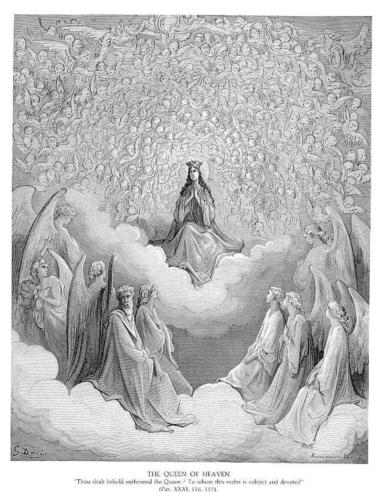
With this understanding we see that the Virgin Mary’s quiet centrality has been throughout the Divine Comedy.  She’s the one who set in motion the means for Dante’s (the character’s) salvation.  Her centrality is evident within the Empyrean.  When Bernard points up to the top of the Rose, it is the Queen Mother who stands out brightest.

Once Mary is identified as the central locus in the Rose, Bernard then points out various saints relative to her position.  Notice the pattern that Bernard creates as he identifies blessed souls.  He follows a line down from Mary, and then to the left of her, and then to the right.  This forms the shape of a cross.  On the mirror opposite side from Mary, he forms another cross, this time with John the Baptist at the top.  Indeed, the divisions of the Empyrean can be seen as sectors formed by the lines of cross.  The left-right divide formed by the shaft (stipes) divides the worthy Hebrews from the Christian saved.  The top-bottom divide formed by the crossbar divides adult saved from the infants saved.

Finally Bernard tells Dante if he wants to be worthy of the ultimate vision, he must refocus on the Blessed Mother.  Notice how he phrases this:

'Look now on the face that most resembles Christ,
for nothing but its brightness
can make you fit to look on Christ.' (XXXII. 85-87)


“The face that most resembles Christ” is pregnant (pun intended!) with meaning.  The Blessed Mother most resembles Christ in that (1) she is sinless, (2) she has an equal heart of compassion, and (3) she was His physical mother.  Dante (the author) could not have known about genetics but certainly it was evident that children resembled their parents.  One should never minimize the importance of the corporeal nature of the incarnation.


Wednesday, July 10, 2019

Dante's Paradiso Cantos XXXI thru XXXIII, Summary

Canto XXXI

In the Empyrean, Dante (the character) surveys what is around him now that his eyes have been fully opened.  He sees the heavenly structure before him that is in the shape of a white rose.  This is the Empyrean and it is filled with all the blessed souls in paradise.  He sees angels flying around, going back and forth from the center point, which is God, to the flowers, who are the souls sitting inside the white rose.  He is so awestruck he feels like a barbarian who has lived in huts stepping into the glory of the city of Rome for the first time.  He stares into the rose and for the first time since coming to paradise can see clear faces, other than that of Beatrice.  He turns to ask Beatrice some questions but finds that she is gone and in her place is a kindly, old man who later we learn is St. Bernard of Clairvaux.  Bernard tells Dante to look at the third to last row of the rose and there he can see the beautiful face of Beatrice who has taken her assigned heavenly seat.  Though the distance may be hundreds of miles away, Dante can clearly see her face as if it were close by.  Realizing that his time with Beatrice is over, he says a prayer of homage and gratitude to her for saving his soul.  She smiles back in acknowledgement that she has heard his prayer.  Bernard instructs Dante to now focus on the Queen of heaven if he wishes to experience the complete divine vision.  Looking up Dante sees the brightest face of the Empyrean, the Blessed Virgin, shining like the sun and with a host of angels dancing about her, bringing pleasure to all the other souls.  Dante and Bernard stare at the Virgin Mother in fixed mystical gaze.


Canto XXXII

At the Empyrean, St. Bernard describes to Dante the structure of the rose and points out several of the inhabitants, using Mary as the frame of reference.  Sitting below the Blessed Mother is Eve, and below Eve is Rachel.  To Rachel's right across the dividing line that separates the pre-Christian and post-Christian souls is Beatrice.  Below Rachel in successive rows are Sarah, Rebecca, and Ruth.  These women form a wall that separates those that believed in the coming messiah (the Old Testament Jews) from those that believed in Christ that is the messiah.  Bernard points out that the Old Testament half is filled while the Christian half, which has the same number of seating, is unfilled and to be filled.  Directly across the Virgin Mother on the Christian side is St. John the Baptist.  In subsequent rows below him are Francis, Benedict, and Augustine.  This is the upper half of the rose.  In the lower half reside a multitude of saved babies, children that were too young to commit willful sins.  These children are divided into three categories:  the Jewish infants before circumcision was instituted, the Jewish infants who are circumcised, and the Christian infants that are baptized.  Unbaptized children who don't fit these categories are in Limbo.  Bernard redirects Dante's gaze back "to the face that most resembles Christ," Mary.  The angel Gabriel has come singing the Ave Maria to her.  Bernard continues to point out more of the blessed: Adam, St. Peter, St. John the Evangelist, Moses, St. Anne, and St. Lucy.  Finally Bernard tells Dante it is time to seek the complete vision of God and the only way to do it is to pray to Mary for such a grace.  Bernard will start the prayer but asks Dante to join his heart to it.


Canto XXXIII


Continuing from where the previous canto ended, St. Bernard offers a prayer to the Virgin Mother to grant Dante the complete vision of God.  He starts by paying homage to the Blessed Mother, a lady both humble and exalted who through her acceptance of God's will changed human history.  Bernard continues by citing her virtues, kindness, compassionate, munificent.  He appeals to her on Dante's behalf to grant him the most blessed theophany which no living person has ever seen.  He begs her to use her prayers for him, not only to see God but to preserve his purity after the vision and protect him from his mortal inclinations.  He further implores that Beatrice and other souls in the rose are joining him in this prayer.  Mary's eyes, which are fixed on Bernard, signal her appreciation, and then turn toward the center light.  Dante, staring upward, feels his sight grow purer and sharper, penetrating the exalted light of God.  What he sees he cannot now articulate, and stepping out of the narrative appeals to God to recall what he saw so that now he can express it.  He now recalls that his sight merged with the "goodness that is infinite" and felt the love that unifies the differed elements of the universe.  At that moment, in a flash, Dante understands "the universal form" that unites all disparate, knotted things.  What he sees are three overlaying circles of different colors, yet fused into one.  As if from the colors themselves and within the circles, the face of Christ suddenly appears, and in a moment as instant as lightning, the vision disappears.