The fourth and final Sunday of Advent is
reserved for the honor of the Blessed Virgin Mary, and in Year C we read of
Mary’s visitation to her kinswoman Elizabeth.Here Mary has just been given this startling news of her supernatural
conception, which undoubtedly is going to put her life at risk since it is a
pregnancy without a human father, and the first thing she does is “in haste”
rush to care for her elderly cousin who is also pregnant. I find this one of the most touching scenes in
all the New Testament.
Mary set out
and traveled to the hill country in
haste
to a town of Judah,
where she entered the house of
Zechariah
and greeted Elizabeth.
When Elizabeth heard Mary’s
greeting,
the infant leaped in her womb,
and Elizabeth, filled with the Holy
Spirit,
cried out in a loud voice and said,
“Blessed are you among women,
and blessed is the fruit of your
womb.
And how does this happen to me,
that the mother of my Lord should
come to me?
For at the moment the sound of your
greeting reached my ears,
the infant in my womb leaped for
joy.
Blessed are you who believed
that what was spoken to you by the
Lord
would be fulfilled.”
~Lk 1:39-45
First, Kimberly Hahn, Scott’s wife, provides
a detailed exegesis of this passage.
Fabulous sermon.Kimberly is a better preacher than her
husband!
Next Bishop Barron provides a wonderful
homily on the importance of the Blessed Mother in our spiritual life.
Next I am going to
give you a third clip, a homily from a Fr. Anthony Craig that takes the meaning
of the passage and the significance of the Blessed Mother as we have heard in
the first two clips, and provides the moral on which we can be transformed.
Did you catch that at
the beginning?Check the 40 second
mark.Christ’s first action incarnate in
the world while still in the womb is an act propelling the bearer to service
and charity.How important is that to
contemplate?I don’t think I have ever
heard that before.
Finally if you still
have the energy, a couple of months ago I provided an analysis of Thomas Merton’s poem, “The Quickening of John the Baptist” which is a meditation on the Visitation and St.
John’s the Baptist’s leap for joy.It’s
a wonderful poem well worth reading and very fitting for today's Gospel passage.l
Sunday Meditation: “And how does
this happen to me that the mother of my Lord should come to me?”
John Michael Talbot put the “Hail Mary” to
music and it’s outstanding.
I had never heard it before.My goodness, that is just so lovely.It should be more widely played.
As with last week, John the Baptist has a
starring role in the Third Sunday of Advent again.But does he?Yes, John has the speaking part.Yes, the crowd comes to him to ask how they can be saved.And yes they come to John filled with
expectation of the coming messiah.But
this Gospel passage is divided into two movements.The first is the coming to John.The second is John pointing them to
Jesus.Jesus is the real star here.
The crowds asked John the Baptist,
“What should we do?”
He said to them in reply,
“Whoever has two cloaks
should share with the person who has
none.
And whoever has food should do
likewise.”
Even tax collectors came to be
baptized and they said to him,
“Teacher, what should we do?”
He answered them,
“Stop collecting more than what is
prescribed.”
Soldiers also asked him,
“And what is it that we should do?”
He told them,
“Do not practice extortion,
do not falsely accuse anyone,
and be satisfied with your wages.”
Now the people were filled with
expectation,
and all were asking in their hearts
whether John might be the Christ.
John answered them all, saying,
“I am baptizing you with water,
but one mightier than I is coming.
I am not worthy to loosen the thongs
of his sandals.
He will baptize you with the Holy
Spirit and fire.
His winnowing fan is in his hand to
clear his threshing floor
and to gather the wheat into his
barn,
but the chaff he will burn with
unquenchable fire.”
Exhorting them in many other ways,
he preached good news to the people.
~Lk 3:10-18
First, let’s get introduced to the supporting
actor.Who is John the Baptist?Dr. John Bergsma from the St. Paul Institute
gives us a full understanding.
“I am an introduction incarnate, a preface in
a person, a forward in the flesh, I am the prelude to the Messianic age.”That is fantastic!I have considered John the Baptist the first
Dominican, the Order of Preachers, since he came to preach ahead of the
Lord.
Now, the best explanation of this Gospel
comes from Fr. Cajetan Cuddy, O.P.Watch
Fr. Cajetan divide the Gospel into its two parts.
He goes a little long
at the end but I don’t think anyone else’s homily quite shows the two parts so
starkly.
Sunday Meditation: “His winnowing
fan is in his hand to clear his threshing floor and to gather the wheat into
his barn”
Let’s return to John Michael Talbot with his “Surrender
to Jesus.”
Yesterday,
August 29th was the Memorial of the Passion of St. John the Baptist,
and you can read and pray more about it here at Catholic Culture.
In
my reading of the accolades to St. John the Baptist, I was also directed to a
poem Thomas Merton wrote on St. John, not on his beheading but on his leap in his mother's womb
when the Blessed Virgin arrived at her visitation to Elizabeth. I was
absolutely floored by the beauty of this poem, "The Quickening of John the
Baptist."I want to present it here
and provide a little analysis.First the
poem.
The
Quickening of John the Baptist
On the Contemplative
Vocation
By Thomas Merton
Why do you fly from the
drowned shores of Galilee,
From the sands and the
lavender water?
Why do you leave the
ordinary world, Virgin of Nazareth,
The yellow fishing boats,
the farms,
The winesmelling yards
and low cellars
Or the oilpress, and the
women by the well?
Why do you fly those
markets,
Those suburban gardens,
The trumpets of the
jealous lilies,
Leaving them all, lovely
among the lemon trees?
You have trusted no town
With the news behind your
eyes.
You have drowned
Gabriel’s word in thoughts like seas
And turned toward the
stone mountain
To the treeless places.
Virgin of God, why are
your clothes like sails?
The day Our Lady, full of
Christ,
Entered the dooryard of
her relative
Did not her steps, light
steps, lay on the paving leaves
like gold?
Did not her eyes as grey
as doves
Alight like the peace of
a new world upon that house, upon
miraculous Elizabeth?
Her salutation
Sings in the stone valley
like a Charterhouse bell:
And the unborn saint John
Wakes in his mother’s
body,
Bounds with the echoes of
discovery.
Sing in your cell, small
anchorite!
How did you see her in
the eyeless dark?
What secret syllable
Woke your young faith to
the mad truth
That an unborn baby could
be washed in the Spirit of God?
Oh burning joy!
What seas of life were
planted by that voice!
With what new sense
Did your wise heart
receive her Sacrament,
And know her cloistered
Christ?
You need no eloquence,
wild bairn,
Exulting in your
hermitage.
Your ecstasy is your
apostolate,
For whom to kick is contemplata tradere.
Your joy is the vocation
of Mother Church’s hidden children -
Those who by vow lie buried
in the cloister or the hermitage;
The speechless Trappist,
or the grey, granite Carthusian,
The quiet Carmelite, the
barefoot Clare, Planted in the night of
contemplation, Sealed in
the dark and waiting to be born.
Night is our diocese and
silence is our ministry
Poverty our charity and
helplessness our tongue-tied sermon.
Beyond the scope of sight
or sound we dwell upon the air
Seeking the world’s gain
in an unthinkable experience.
We are exiles in the far
end of solitude, living as listeners
With hearts attending to
the skies we cannot understand:
Waiting upon the first
far drums of Christ the Conqueror,
Planted like sentinels
upon the world’s frontier.
But in the days, rare
days, when our Theotokos
Flying the prosperous
world
Appears upon our mountain
with her clothes like sails,
Then, like the wise, wild
baby,
The unborn John who could
not see a thing
We wake and know the
Virgin Presence
Receive her Christ into
our night
With stabs of an
intelligence as white as lightning.
Cooled in the flame of
God’s dark fire
Washed in His gladness
like a vesture of new flame
We burn like eagles in
His invincible awareness
And bound and bounce with
happiness,
Leap in the womb, our
cloud, our faith, our element,
Our contemplation, our
anticipated heaven
Till Mother Church sings
like an Evangelist.
The
poem is in free verse with ten stanzas, or perhaps more accurately, ten sections
that are separated by a space since they are so irregular I’m not sure “stanza”
would apply.The poem starts with the
Virgin Mary off on her visitation to her cousin Elizabeth, who pregnant with
St. John the Baptist.If you number the
sections of the poem from one through ten, I can summarize the narrative flow
and gist of each.Here is my section by
section gist.
1
– Addressing the Blessed Virgin, the poet asks why are you traveling across the
country?
2
– Still addressing the Virgin, the poet highlights points on the journey and
asks her why her clothes are like sails?
3
– The poet narrates her arrival.
4
– The poet narrates Mary’s greeting and the awakening of St. John in the womb
at the sound of her voice.
5
– The poet addresses John and asks how in his enclosed space could he see and
hear the Blessed Mother?
6
– The poet still addressing John asks what her voice did to him, and to know
she was carrying Christ?
7
– Still addressing John, the poet acknowledges the child’s in ability to speak
except through the kick in the womb.
8
– Perhaps the key section of the poem where the poet contemplates John’s
silence and enclosure and identifies it with the plight of humanity.
9
– The poet continuing his contemplation connects John’s pre-birth existence with
the existential nature of humanity.
10
– The poet concludes his contemplation with a final identification of John, the
poet, and the reader before Christ.
“The Quickening” in the title refers to the
moment St. John in the womb is enlivened by the presence and voice of the
Virgin carrying her own child, the Christ.So much of the poem is about contemplation.The subtitle of the poem is “On the Contemplative
Vocation,” which identifies John as fetus, in a contemplative vocation.Perhaps all fetuses have the vocation—at least
for those “cloistered” nine months—of a contemplative.Indeed, in section seven, Merton identifies contemplative
and cloistered religious orders: Trappists, Carthusians, Carmelites, and Poor
Clares.We know that Merton himself was
a Trappist monk bound to the Abbey of Our Lady of Gethsemani in Kentucky.And while it is not true that Trappists are
never allowed to speak, they are required to limit their speech to only what is
necessary.So you can see how Merton as
poet connects with John in the womb, the “small anchorite.”An anchorite (or anchoress for feminine) is
someone who is locked in a cell for the rest of their lives to pray and
contemplate.
There
is also the contemplation identified with the Blessed Mother of God.“But Mary kept all these things and pondered
them in her heart” (Lk 2:19).The
Blessed Mother was witness to most of Christ’s life and His death, and so
contemplated much.Contemplation for Catholics
starts with Mary.In the poem she is
identified with the sea—which connects with her title as Stella Maris, Our Lady of the Sea.The vast sea has often through the ages been seen as an instrument that
inspires contemplation.To be on the sea
and on a boat is to be isolated from society, and of course being submerged or
drowned is a metaphor for the act of contemplation or being lost in thought.(See the poem, “The Love Song of J. AlfredPrufrock” by T. S. Eliot and how he associates drowning with
contemplation.)When in section two Merton addresses Mary as having
“drowned Gabriel’s word in thoughts like seas,” he is referring the Archangel’s
words to Mary at the Annunciation.She
hasn’t discarded Gabriel’s words, but submerged them in her consciousness for
later meditation.Why are her clothes
like sails?Because she is navigating an
ocean of introspective thought.
###
The
first seven sections of the poem establishes the context for the last three sections as they
culminate to a thesis.Let’s look at the
last three more closely.
“Night
is our diocese and silence is our ministry/Poverty our charity and helplessness
our tongue-tied sermon.”
Who
is “our” referring to?The poet as he
identifies with St. John in the womb, and I would venture all of us reading who
can similarly identify.The darkness constitutes
their church, and silence the ministry, that is the administering of a religious
action.“Poverty” and “helplessness”
convey a beatitude in the limitations of transmitting the message, almost an
echo of “Blessed are the poor in spirit” (Mt5:3).
“Beyond
the scope of sight or sound we dwell upon the air/Seeking the world’s gain in
an unthinkable experience.”
Again,
the “we” unifies the poet, St. John, and the reader, caught in a moment of
anticipation, waiting for what I would guess is the incarnation of the second
Person of the Trinity, building to the last four lines which need to be quoted
together:
We are exiles in the far
end of solitude, living as listeners
With hearts attending to
the skies we cannot understand:
Waiting upon the first
far drums of Christ the Conqueror,
Planted like sentinels
upon the world’s frontier.
Absolutely
breath-taking lines.The reference to
exiles is twofold at least.Not only are
they exiles because they are contemplatives in a world that is hardly
contemplative—or perhaps even anti contemplative—they are exiles from their
true home of heaven where the first parents were cast out to be exiles.They (and we) are the “poor banished children
of Eve,” but now “sentinels” on the “frontier” waiting for Christ to come and conquer
death.That moment of anticipation has
now come, as we see in the ninth section.
But in the days, rare
days, when our Theotokos
Flying the prosperous
world
Appears upon our mountain
with her clothes like sails,
Then, like the wise, wild
baby,
The unborn John who could
not see a thing
We wake and know the
Virgin Presence
Receive her Christ into
our night
With stabs of an
intelligence as white as lightning.
Perhaps
that is the poem’s climax; “We wake and know the Virgin Presence/Receive her
Christ into our night.”The statement is
not just referring to the contemporaneous moment for St. John in the womb, but
for all of us when every moment we realize and contemplate the incarnation,
when in prayer the Blessed Mother visits us to bring Christ to us.
Finally
in the tenth section we have a denouement.
Cooled in the flame of
God’s dark fire
Washed in His gladness
like a vesture of new flame
We burn like eagles…
Purified
in fire and water presumably from contemplation, we now become like eagles, a
symbol of transformed strength.
…in His invincible
awareness
And bound and bounce with
happiness,
Leap in the womb, our
cloud, our faith, our element,
Our contemplation, our
anticipated heaven
Till Mother Church sings
like an Evangelist.
We
too in Christ’s awareness leap with joy at our now knowledge of our anticipated
return to “home.”
What
a brilliant poem.I have to admit I
laughed out loud to this line in section seven: “Your ecstasy is your
apostolate,/For whom to kick is contemplata
tradere.”As a Lay Dominican, I
particularly understand the reference.One of the Dominican Order’s mottos is Contemplata aliis trader, which translates into English as "to
hand down to others the fruits of contemplation."A Dominican is not supposed to just contemplate, but the fruits of that
contemplation are supposed to be passed on to others.So Merton refers to St. John’s kick in the
womb as a passing on the fruit of the fetus’s contemplation.I thought that was funny.
Finally
John Michael Talbot turned that extraordinary eighth section into a song, “We
Are the Exiles.”
John
Michael must have found that passage breathtaking as well.It's a beautiful song but he did take some liberties with the lyrics to
fit it better into song form.I did find
this blog post by an unfamiliar blog called Peaceable Wisdom where he posted the lyrics as sung as sung by JMT.If you’re interested in the lyrics, you can
check it out.
This is the second Sunday in a row the Gospel
focuses on St. John the Baptist.Last
Sunday we looked at him through Mark’s Gospel.Today we get an even fuller characterization through John’s Gospel.
A man
named John was sent from God.
He
came for testimony, to testify to the light,
so
that all might believe through him.
He
was not the light,
but
came to testify to the light.
And
this is the testimony of John.
When
the Jews from Jerusalem sent priests
and
Levites to him
to
ask him, “Who are you?”
He
admitted and did not deny it,
but
admitted, “I am not the Christ.”
So
they asked him,
“What
are you then? Are you Elijah?”
And
he said, “I am not.”
“Are
you the Prophet?”
He
answered, “No.”
So
they said to him,
“Who
are you, so we can give an answer to those who sent us?
What
do you have to say for yourself?”
He
said:
“I am
the voice of one crying out in the desert,
‘make
straight the way of the Lord,’”
as
Isaiah the prophet said.”
Some
Pharisees were also sent.
They
asked him,
“Why
then do you baptize
if
you are not the Christ or Elijah or the Prophet?”
John
answered them,
“I
baptize with water;
but
there is one among you whom you do not recognize,
the
one who is coming after me,
whose
sandal strap I am not worthy to untie.”
This
happened in Bethany across the Jordan,
where
John was baptizing.
~Jn
1:6-8, 19-28
Bishop Robert Barron’s sermon on John the
Baptist is the absolute best understanding of the saint that I have come
across.This is a must listen and
perhaps a must bookmark.
Did you get that?John the Baptist is the summation of every
religious figure.Here is the sculpture Bishop Barron alludes to of John the Baptist at the Cathedral of Chartres.
Doesn’t he look a little like John Michael Talbot?Here is a lovely song by John Michael, "Worship and Bow Down."
Meditation: “Who are you?” He
admitted and did not deny it, but admitted, “I am not the Christ.”
I love this passage.I always think of it when at Mass the priest
after the Agnus Dei holds up the
transubstantiated host and chalice and says, “Behold the Lamb of God.”I envision John the Baptist pointing to Jesus
walking toward him
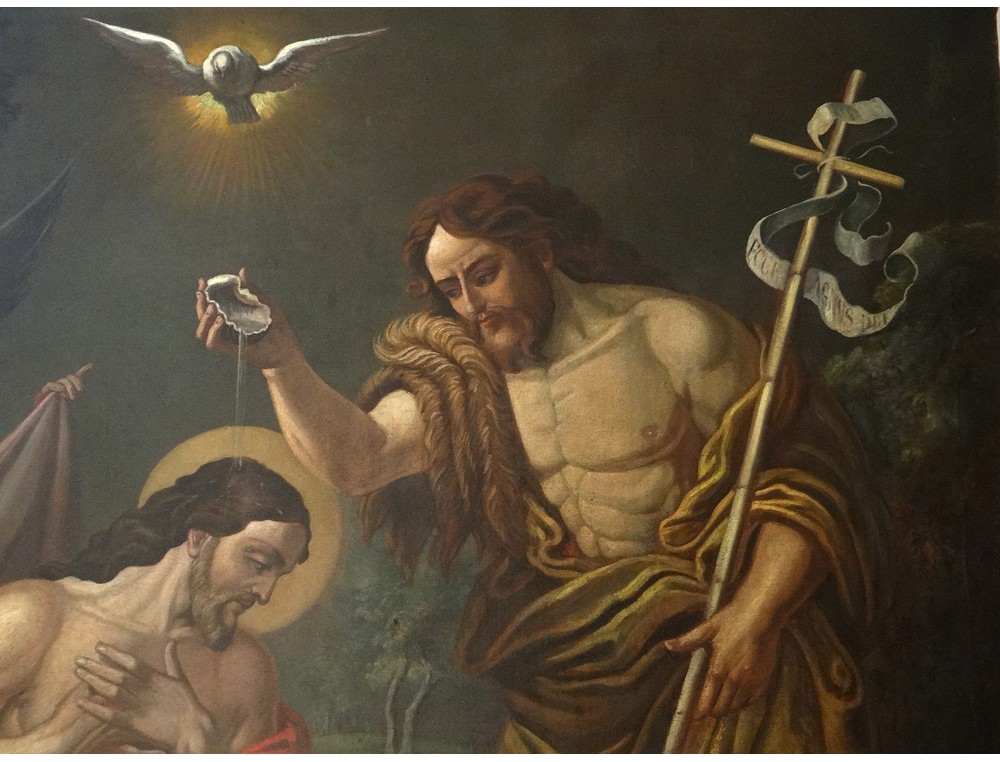
John
the Baptist saw Jesus coming toward him and said,
"Behold,
the Lamb of God, who takes away the sin of the world.
He is
the one of whom I said,
'A
man is coming after me who ranks ahead of me
because
he existed before me.'
I did
not know him,
but
the reason why I came baptizing with water
was
that he might be made known to Israel."
John
testified further, saying,
"I
saw the Spirit come down like a dove from heaven
and
remain upon him.
I did
not know him,
but
the one who sent me to baptize with water told me,
'On
whomever you see the Spirit come down and remain,
he is
the one who will baptize with the Holy Spirit.'
Now I
have seen and testified that he is the Son of God."
~Jn
1:29-34
Dr. Brant Pitre explains it thoroughly.It takes two videos.
"Behold,
the Lamb of God, who takes away the sin of the world.”