"Love follows knowledge."
"Beauty above all beauty!"
– St. Catherine of Siena

Showing posts with label Spring. Show all posts

Tuesday, March 24, 2026

Photos: Yellow and Purple Crocuses

I have had these crocuses for over twenty, maybe twenty-five years!  Or should I say croci for plural—but I have never heard anyone say “croci.”  I have had them so long I cannot remember when I planted them.  Every year, they come up at the end of February to the beginning of March, and they come up faithfully.  I take them as a sign that winter is over, and though spring may not be fully here yet, it is a sign that it is within spitting distance. 

This year they came out late.  They popped up just about the middle of last week, which was past the midpoint of March.  This is the latest they have sprung that I can remember.  But guided by God’s diurnal hand, they arrived.  Their tardiness is understandable this year.  We had one of the coldest winters in memory and two big snowfalls.  The last one was at the end of February, a twenty-four inch pile of flakes that transformed Staten Island into a tundra.  I was worried the crocuses would never make it with all that snow.  I did try to remove the snow from their ground, but I didn’t know if the snow had aborted their resurrection.  But God is in control, and here they are.


They are only about three inches high.  Cute little things.  The flowers last two to three weeks.


The yellows always seem to come up a few days earlier than the purples.  I’m going to look for more and plant them for next year.

Thursday, March 20, 2014

Poetry Analysis: Spring by Gerard Manly Hopkins

My poet to read and absorb this year is Gerard Manly Hopkins, an English, Victorian poet.  Hopkins was a Catholic convert and a Jesuit priest, and was among the most original of poets.  I’ll go into the nuances of his style in a later post, but let’s get a feel for his poetry. 

To commemorate spring, that most wonderful of seasons, here is his poem titled, simply. 

Spring
by Gerard Manly Hopkins 

Nothing is so beautiful as spring—
  When weeds, in wheels, shoot long and lovely and lush;
  Thrush’s eggs look little low heavens, and thrush
Through the echoing timber does so rinse and wring
The ear, it strikes like lightnings to hear him sing;
  The glassy peartree leaves and blooms, they brush
  The descending blue; that blue is all in a rush
With richness; the racing lambs too have fair their fling.

What is all this juice and all this joy?
  A strain of the earth’s sweet being in the beginning
In Eden garden.—Have, get, before it cloy,
  Before it cloud, Christ, lord, and sour with sinning,
Innocent mind and Mayday in girl and boy,
  Most, O maid’s child, thy choice and worthy the winning.

 
First, it’s an Italian sonnet, and the first two quatrains (the first eight lines) describe a beautiful pastoral scene at the start of the season.  Thrush’s eggs are near hatching, but what’s interesting is that the blue of the eggs reflect the blue of the sky, suggesting a relationship between the pastoral scene and paradise.  The “descending blue” of line seven is sort of a blessing coming down from God.


In the sestet (the final six lines) Hopkins asks in his inventive way (“What is all this juice and all this joy?”), what’s this all about?  His answer is that the beauty of spring is a remnant of earth’s original state, the “cloy” of nature, before sin entered the world and Christ and innocence was the state of things.
 
But notice Hopkins style.  He loves the Anglo-Saxon-esk alliteration: weeds/wheels, long/lovely/lush, richness/racing, flair/fling, and so on.  And he loves rhythmic phrasing, even if it awkward on the tongue.  Notice the jumbled syntax of the last four lines to alter the rhythm to emphasize Christ: “Have, get, before it cloy,/Before it cloud, Christ, lord…”  Look at the symmetry of that phrase: “Have, get” balances with “Chrst, lord” while “before it cloy” echoes with “Before it cloud.”  That is so excellent.


Here’s a really nice reading of the poem.
 
 
Hope you enjoyed it, and hopefully spring is here to stay

Tuesday, March 18, 2014

Music Tuesday: Spring from the Four Seasons by Vivaldi

It’s been such a hard winter around here.  I don’t know if this makes it as the coldest on record, but if it isn’t it’s close.  I know it’s not the snowiest on record, but we’ve had a good share of that too.  Every time we think spring is finally here, the weather regresses back.  Most people are begging for spring to come.

Well, if you’re begging, here it is, the “Spring” Concerto from the set of concertos by Antonio Vivaldi named The Four Seasons. 

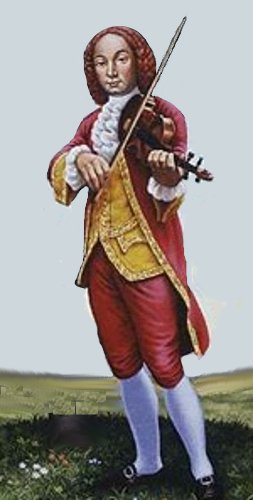
Here’s some background information.  Vivaldi is considered one of the great composers of the Baroque era, a favorite of Johann Sebastian Bach.  His nickname was the il Prete Rosso, “the red priest” because he was a priest and had red hair.  A Venetian and the the musical director of at an woman’s orphanage where many women went on to be musicians, he reached notariety from his violin virtuosity and then as a composer. 

Vivaldi wrote many violin concerti, and one factoid that surprised me in my research was that Vivaldi in his conceretos established the fast/slow/fast tempos of a concerto’s three movements.  This became a general rule, and not just for concertos.  So many pieces of music are set to a fast/slow/fast pattern, down to our very day. 

The Four Seasons (Le quattro stagioni) are a set of concerti where each of the seasons are an individual concerto.  Each concerto is rendered to reflect a sense of its respective season.  It has been claimed that each season was based on a series of sonnets, also respective to a season, but the sonnets are so dreadful as literary works, a counter claim has been made that the sonnets were backformed from the musical work.  Nonetheless whether the music was based on the sonnet or on elements of the season, it does make the concerti program music.  

Here is the Spring Sonnet from which the composition was supposedly based on. 

Allegro
Springtime is upon us.
The birds celebrate her return with festive song,
and murmuring streams are softly caressed by the breezes.
Thunderstorms, those heralds of Spring, roar, casting their dark mantle over heaven,
Then they die away to silence, and the birds take up their charming songs once more.

Largo
On the flower-strewn meadow, with leafy branches rustling overhead, the goat-herd sleeps, his faithful dog beside him.

Allegro
Led by the festive sound of rustic bagpipes, nymphs and shepherds lightly dance beneath the brilliant canopy of spring.

So in the first Allegro movement, which is in ritornello form, birds singing make up the theme while stream and thunder motifs offer a contrast.  In the slow Largo we have a picture-scape with goats and dogs.  And in the final Allegro we have a folk spring time dance.  I’ve never been a fan of program music.  I hardly ever see the pictures or drama they are supposed to be represent. 
 
But this is such a joyful work.  Here is the great Itzhak Perlman with the israel Philharmonic.


So did you catch the birds singing, the thunder resonating, and the dogs barking?