For the Eighteenth Sunday of Ordinary Time, Year A, we have concluded Matthew’s Discourse of the Parables, and now we continue on with Jesus’s Galilean ministry. Today we are presented with Matthew’s version of the Feeding of the Five Thousand. This passage has a lot more depth than a simple miracle that Jesus performs. The homilies I will embed go into them in depth but let me point out a few details and thoughts that are either too briefly touched on or not touched on at all.
As we see, Jesus’ multiplication of the loaves alludes to a number of other feasts, both before Jesus on that deserted hill or after. Let me just numerically list a few. I don’t think this is comprehensive but it’s probably more than pointed out in any homily.
1.
The offering of bread and wine by Melchizedek upon
Abraham’s victory following the Battle of Siddim.
2.
The manna in the desert during the Exodus.
3.
All the Jewish feasts of the Old Testament:
Passover, Unleavened Bread, First Fruits, Rosh Hashanah, Pentecost, Atonement, Sukkot.
4.
Elijah’s miracle of the unending supply of flour
and oil for the widow of Zarephath.
5.
The banquet of Herod where he decapitates John the
Baptist. (Notice that this precedes Jesus’s
feeding in Matthew’s Gospel and is in stark contrast. Herod’s is the banquet leading to death,
Jesus’s leading to life.
6.
The Wedding Feast at Cana.
7.
The Last Supper and the Institution of the
Eucharist.
8.
The heavenly Marriage of the Supper of the Lamb in Revelations
19.
9. The Eschatological Banquet, prophesied in Isaiah 25:6-8, and described in Luke 14 (Parable of the Great Banquet), Matthew 22 (the Parable of the Marriage Feast), and elsewhere.
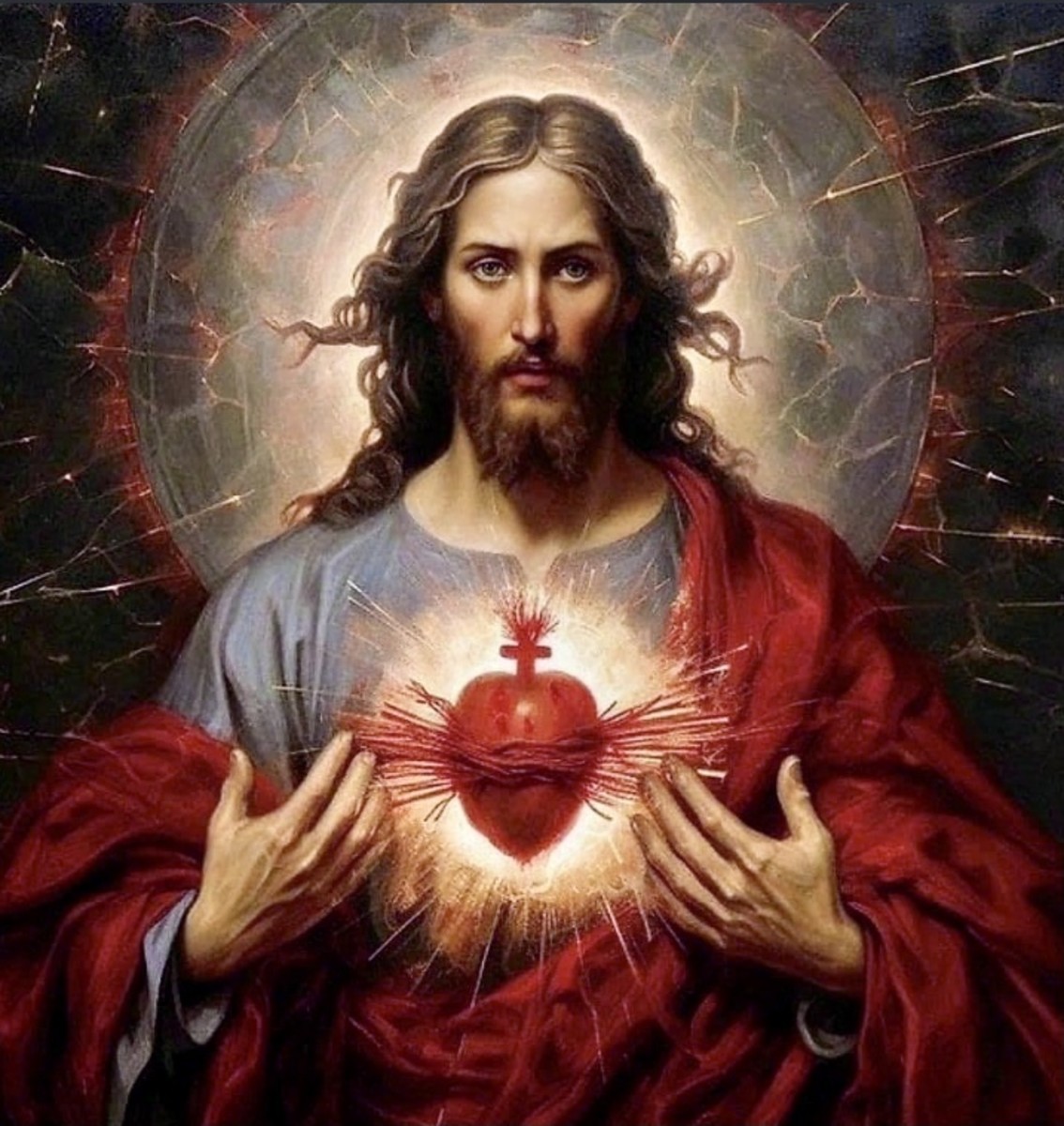
We can see the connections of Jesus’s feeding as it echoes across the scriptures. You will hear both homilists today connect this passage with compassion, and I don’t think that can be emphasized enough. Jesus is moved in His Sacred Heart to pity. Consider, He has just heard the news of His cousin’s death. He goes away to meditate and pray. The first thing He does when He sees the multitude is have pity. He heals, and then He wants to feed them.

Today’s Gospel:
When Jesus heard of the death of John the Baptist,
he withdrew in a boat to a deserted place by himself.
The crowds heard of this and followed him on foot from their towns.
When he disembarked and saw the vast crowd,
his heart was moved with pity for them, and he cured their sick.
When it was evening, the disciples approached him and said,
“This is a deserted place and it is already late;
dismiss the crowds so that they can go to the villages
and buy food for themselves.”
Jesus said to them, “There is no need for them to go away;
give them some food yourselves.”
But they said to him,
“Five loaves and two fish are all we have here.”
Then he said, “Bring them here to me,”
and he ordered the crowds to sit down on the grass.
Taking the five loaves and the two fish, and looking up to heaven,
he said the blessing, broke the loaves,
and gave them to the disciples,
who in turn gave them to the crowds.
They all ate and were satisfied,
and they picked up the fragments left over—
twelve wicker baskets full.
Those who ate were about five thousand men,
not counting women and children.
~Mt: 14:13-21
Both homilies today could serve as both exegetical and pastoral
homilies. I wasn’t sure which I should
put in which slot, but I go with that of Archbishop of Detroit, Edward J. Weisenburger
for the exegetical.
Archbishop Weisenburger:
Brothers and sisters,
this is Archbishop Weisenburger, and this weekend is the 18th Sunday in
Ordinary Time. And our Gospel passage is the miracle of the multiplication of
loaves and fishes. You may not know it, but it's the only miracle in all four
gospels. That's how intensely embedded
it was in the minds and hearts of the faithful. Now, to break open the inner meaning of this
text, my remarks today are in two parts, which are simply: the context then and
the context now. First, the context
then. The Gospel says that Jesus had just learned of the beheading of St. John
the Baptist, which was no doubt a great blow to him. He likewise was exhausted and trying to
escape the crowds for a little rest and renewal. And even though it's late in
the day, the crowds follow him. His disciples note that due to the late hour and
the fact the crowds are hungry and without food, they urge Jesus to just send
them away. But instead, as we all know
the story, Jesus multiplies those loaves and fishes, more like little crackers
and some sardines for a child's lunch. And with what little he has, she creates
a banquet. But please stop to think, the beheading of John the Baptist also
took place at a banquet, Herod's banquet. The "feeding of the 5000"
is meant to be seen in stark contrast to the banquet of Herod. Herod's feast
was a celebration of arrogance, conspiracy, and murder. Jesus' banquet was a celebration of healing, faithful
obedience, and caring for others through the sharing of food and compassion.
Moreover, Jesus' banquet is foreshadowing of the Eucharistic banquet. In this way, it reveals that the celebration
of the Mass is always meant to be a
countercultural sign of the Kingdom of God dawning in our midst.
Okay, that was the context then. But the words from today's Gospel that haunt me are Jesus' rebuke to his own followers who want to send the hungry, weary crowds away. It's Jesus line, "No, you give them something to eat!" It's that line that gets me every time…. Brothers and sisters, I would be the first to tell you, yes, the Church needs your financial commitment. I'm not against anyone's support. But what both Jesus and a crotchety, but perhaps holy priest teach us is that there's something sacred, something life-changing, something humanizing, and something that helps fashion us into the divine when we encounter in a direct, immediate way our Christ in the poor. No one in the end really can do it for me. And in the end, you really shouldn't try to do it for anyone else. It's a redemptive experience, an experience each of us needs, and an experience that can make all the difference in our own faith journey.
The ellipsis leaves off the story the Archbishop tells about the retired priest who feeds the homeless. It would make the quote too long, but make sure you listen to it. Feeding the hungry in person instead of just writing a check is a “redemptive experience” each of us needs.
Here is another new find as a homilist, this time from The Catholic
University of the Philippines, the University of Santo Tomas run by friars of the
Dominican Order. Here is Fr. Christian
Dale Dakila offering an insightful homily.
Fr. Christian:
One of the most beautiful lines in today's gospel is not the multiplication of the loaves. It is not even the miracle itself. The most beautiful line comes before the miracle. When Jesus disembarked and saw the vast crowd, his heart was moved with pity for them. Before Jesus fed the crowd, he first saw them. Before he performed a miracle, he first noticed their suffering. Before he gave them bread, he first gave them attention. The miracle of the loaves began not with power but with compassion. The gospel tells us that Jesus had withdrawn to a deserted place. He himself was grieving the death of John the Baptist. He wanted solitude and silence. Yet when he saw the people, he did not see an interruption. He saw wounded sheep longing for a shepherd. His heart was moved with pity. Splagchnizomai (σπλαγχνίζομαι). The original gospel word speaks of a compassion so deep that it comes from the very depths of one's being. It was literally moved to the gut. And it is not simply feeling sorry for someone but it is allowing another person's pain to enter your own heart and perhaps that is what many people hunger for today. Not only bread or only money but only success. Many people are hungry for someone who will truly listen.
Splagchnizomai is a movement of compassion inside the very core of our beings. Today We might consider Splagchnizomai as being in the Sacred Heart of Jesus. But you can see that the Gospel is referring to more than just a simple pity.
Fr. Christian:
The hunger of the human heart is deeper than physical hunger. This is why today's gospel remains relevant. The crowd was hungry for bread. But before Jesus multiplied the loaves, he spent the day healing them, teaching them, and accompanying them. He listened to their deeds, to their pain, to their hopes. The miracle started because Jesus paid attention. Brothers and sisters, listening is becoming a lost art. Today we have more ways of communicating than ever before. Yet many people feel more unheard than ever before. We send messages instantly. We can contact anyone in seconds. We can speak to thousands through social media. Yet many cannot find one person willing to listen deeply. Sometimes we are physically present but emotionally absent. We hear words but do not hear hearts. We listen only long enough to prepare our reply. But Jesus teaches us another way. The Lord listens first and he acts. Perhaps this is why he tells his disciples something surprising. The disciples say, "Send them away." Jesus says, "Give them some food yourselves." The disciples only see the problem. Jesus sees the possibility. The disciples see scarcity. Jesus sees generosity. The disciples count five loaves and two fish. Jesus counts willing hearts. And perhaps that command remains for us today. Give them some food yourselves. Feed those who are hungry, lonely, grieving, confused. Feed those who are losing hope. And sometimes the first food we can offer is not advice. It is our listening. Sometimes people do not need answers, they need presence.
It’s not just physical hunger we are called to heal. Listening is a form of care taking,
especially for those lonely, those grieving, and those losing hope. Lord, make me an instrument of your peace;
where there is despair, let me bring hope.
Sunday Meditation: When
he disembarked and saw the vast crowd,
his heart was moved
with pity for them, and he cured their sick.
I love this hymn, “Come to the Water.”
O let all who thirst,
let them come to the water.
And let all who have nothing,
let them come to the Lord:
without money, without price.
Why should you pay the price,
except for the Lord?
And let all who seek,
let them come to the water.
And let all who have nothing,
let them come to the Lord:
without money, without strife.
Why should you spend your life,
except for the Lord?
Let all who have nothing, let them come to the Lord, without price.