"Love follows knowledge."
"Beauty above all beauty!"
– St. Catherine of Siena

Showing posts with label Holy Week. Show all posts

Sunday, March 29, 2026

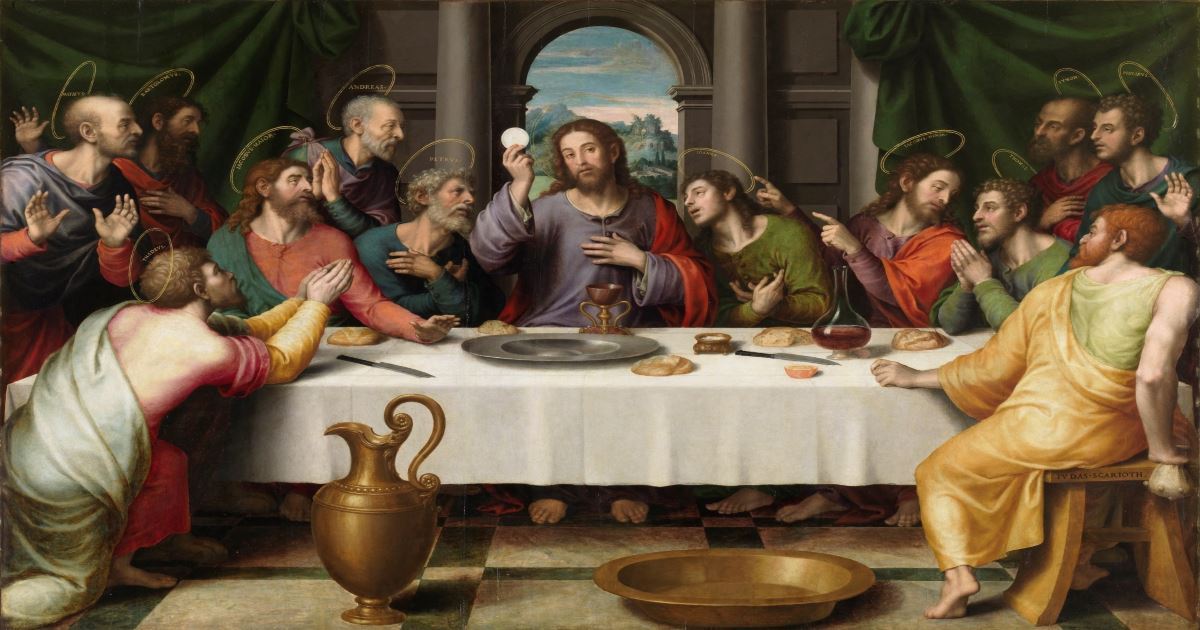
Sunday Meditation: Holy Week and the Institution of the Eucharist

I’ve had several posts on Palm Sunday over the years.  The latest from Year A was three years ago where you could hear Dr. Brant Pitre explain Jesus’ entrance into Jerusalem and about the two donkeys of Matthew’s version.  Or you can hear Fr. Geoffrey Plant explain Palm Sunday on a Year C Gospel reading.  Or you can just search all my “Palm Sunday” blog posts to pull them all up. 

Today I want to focus on Holy Week and the Institution of the Eucharist.  The Passion reading stretches across the week and includes Matthew’s version of the Institution narrative.  But I want also post a summary of the Holy Week Gospel events.  This is a simplified listing of the salient events.  It is not comprehensive.


Jesus Raises Lazerus

Week Prior to Palm Sunday

Jesus Retreats to Ephriam

Week Prior to Palm Sunday

Jesus Travels Back to Bethany

Week Prior to Palm Sunday

Mary Anoints Jesus

Saturday Before Palm Sunday

Jesus Enters Jerusalem

Palm Sunday

Jesus Cleans the Temple

Holy Monday

Jesus Sermon on the End of Times

Holy Tuesday

Judas Agrees to Betray Jesus

Holy Wednesday/Spy Wednesday

The Last Supper

Holy Thursday

Jesus’s Anguish in the Garden of Gethsemane

Holy Thursday Evening

Jesus is Apprehended

Holy Thursday Evening

Jesus’s Trial Before the Sanhedrin

Holy Thursday Evening

Jesus’s Trial Before Pilate

Early Good Friday Morning

Jesus is Scourged, Crucified, Dies, and Buried

Good Friday

Jesus’s Harrowing of Hell

Holy Saturday

Jesus’s Resurrection

Easter Sunday


Here is the Institution Narrative from Matthew’s Passion.


While they were eating,

Jesus took bread, said the blessing,

broke it, and giving it to his disciples said,

"Take and eat; this is my body."

Then he took a cup, gave thanks, and gave it to them, saying,

"Drink from it, all of you,

for this is my blood of the covenant,

which will be shed on behalf of many

for the forgiveness of sins.

I tell you, from now on I shall not drink this fruit of the vine

until the day when I drink it with you new

in the kingdom of my Father."

Then, after singing a hymn,

they went out to the Mount of Olives.

~Mt:26:26-29


I will start with a pastoral homily first this Sunday.  Fr. Thomas McCarthy of the Order of St. Augustine—the same Order from which Pope Leo XIV heralds—explains Palm Sunday and the Institution of the Eucharist.


Fr. Thomas McCarthy:

It was at that meal that he instituted the priesthood and the Eucharist by taking bread and saying, "This is my body. Do this in memory of me." By taking the chalice filled with wine and saying, "This is my blood. Do this in memory of me. As Catholics, we say those words every time we go to mass. We are doing exactly what Jesus said. He did not say this is a symbol.  He did not say this is kind of almost/sort of/like/maybe. He said this is my body. This is my blood. Do it in memory of me. And so that's why as Catholics we believe in the real presence that the Eucharist is not a symbol. It is not a reenactment. is not a kind of sort of like almost maybe. And so it all happened at the last supper. And it was also at that last supper that Jesus humbled himself, took the form of a slave and washed his disciples feet.

So what are we to do this week?  Fr. Thomas says, “This holy week begins today and I hope that all of us will take time to truly celebrate and prayerfully be attentive to what's happening this week.  So my friends, how good it is that we are here. And I just want to encourage us all to really live out this this week.

To explain Holy Week, I found this new YouTube channel called Catholic Snack that explains Catholic theology and Catholic news of the day.  Here is the video on the Holy Week events.


Catholic Snack:

This is Holy Week. And if you've never understood what really happened during those eight days, stay with me because this story will change the way you see everything.  Every year, Christians around the world enter into a sacred season called Holy Week, the final week of Lent leading up to Easter Sunday. But for many people, sit can feel like a blur of church services, prayers, and traditions without fully grasping the weight of what actually happened. Holy Week is not just a religious calendar event. It is the story of God stepping fully into human suffering, betrayal, abandonment, agony, death, and then doing something no one expected. It is the greatest story ever told. And it happened in real time over eight unforgettable days. So, let's walk through it together, day by day, step by step.

That is pretty good for a “snack.”  I wonder why they named themselves that.  I have not found any background on this channel.  I found this part on Holy Saturday profound.

Catholic Snack:

We live so much of our lives on Holy Saturday, in the in between, after the loss, before the answer, in the silence where God seems absent, but is in fact working. The church's tradition tells us that on this day Christ descended to the dead, reaching even into the depths to bring light where there had only ever been darkness.  In the silence of Holy Saturday, God was not absent. He was at work in the places we couldn't see.  This is the day of waiting, of darkness before dawn, of faith without sight. And sit is one of the most important lessons of Holy Week. Because most of us know this place. Most of us have sat in this silence. And Holy Saturday tells us, "Hold on. Morning is coming, Sunday.

I loved this as a conclusion.

Catholic Snack:

Holy Week is not a story that happened 2,000 years ago and stayed there. It is a story that is still happening in every person who carries a cross they didn't choose.  In every moment of betrayal, grief, and silence, in every mourning that arrives when you thought the darkness would never end, Jesus walked through all of it. He didn't observe it from a safe distance. He entered it fully, flesh, blood, tears, nails, and all so that no human experience would ever be outside the reach of his presence. When you are in your Palm, Sunday, joyful, full of hope, he is there. When you are in your Gethsemane, afraid on your knees, asking God to take the cup away, he is there.  When you are in your Holy Saturday, silent, waiting, uncertain, he is there. And he is always, always moving toward Easter. This Holy Week, I invite you not just to observe the liturgy, but to enter the story, to let it find you where you are, to allow the passion of Christ to speak to your own.  Because that is what Holy Week is for.  Not to make us spectators, but to make us witnesses.


Sunday Meditation: “I tell you, from now on I shall not drink this fruit of the vine until the day when I drink it with you new in the kingdom of my Father."


This is supposed to be a traditional hymn for Palm Sunday, “All Glory, Laud, and Honor.”


All glory, laud, and honour

to you, Redeemer, King!

To whom the lips of children

made sweet hosannas ring.


You are the King of Israel

and David's royal Son,

now in the Lord's name coming,

the King and Blessed One.


ll glory, laud, and honour

to you, Redeemer, King!

To whom the lips of children

made sweet hosannas ring.


The company of angels

are praising you on high;

and mortals joined with all things

created make reply.


All glory, laud, and honour

to you, Redeemer, King!

To whom the lips of children

made sweet hosannas ring.


Friday, April 18, 2025

Triduum Meditation: The Friday We Call Good

Last year I started the Triduum Mediation, and I and I started with Holy Thursday.  I intended to post on one day of the Triduum each year.  This year I will post a meditation on Good Friday.

As I said last year, the Pascal Triduum are the three days that lead to the Resurrection on Easter Sunday. 

The Gospel reading for Good Friday is the entire Passion Narrative from the Gospel according to St. John, Jn 18:1-19:42.  I can’t post the entire two chapters, so I’ll take a portion that will have the most resonance to the embedded homilies.


So they took Jesus, and, carrying the cross himself, he went out to what is called the Place of the Skull, in Hebrew, Golgotha.

There they crucified him, and with him two others, one on either side, with Jesus in the middle.

Pilate also had an inscription written and put on the cross.

It read,

“Jesus the Nazorean, the King of the Jews.”

Now many of the Jews read this inscription, because the place where Jesus was crucified was near the city; and it was written in Hebrew, Latin, and Greek.

So the chief priests of the Jews said to Pilate,

 “Do not write ‘The King of the Jews,’ but that he said, ‘I am the King of the Jews’.”

Pilate answered,

“What I have written, I have written.”


When the soldiers had crucified Jesus, they took his clothes and divided them into four shares, a share for each soldier.

They also took his tunic, but the tunic was seamless, woven in one piece from the top down.

So they said to one another,

“Let’s not tear it, but cast lots for it to see whose it will be, “ in order that the passage of Scripture might be fulfilled that says:

            They divided my garments among them,

                        and for my vesture they cast lots.

This is what the soldiers did.

Standing by the cross of Jesus were his mother and his mother’s sister, Mary the wife of Clopas, and Mary of Magdala.

When Jesus saw his mother and the disciple there whom he loved he said to his mother, “Woman, behold, your son.”

Then he said to the disciple,

“Behold, your mother.”

And from that hour the disciple took her into his home.


After this, aware that everything was now finished, in order that the Scripture might be fulfilled,

Jesus said, “I thirst.”

There was a vessel filled with common wine.

So they put a sponge soaked in wine on a sprig of hyssop and put it up to his mouth.

When Jesus had taken the wine, he said,

“It is finished.”

And bowing his head, he handed over the spirit.


Here all kneel and pause for a short time.


Now since it was preparation day, in order that the bodies might not remain on the cross on the sabbath, for the sabbath day of that week was a solemn one, the Jews asked Pilate that their legs be broken and that they be taken down.

So the soldiers came and broke the legs of the first and then of the other one who was crucified with Jesus.

But when they came to Jesus and saw that he was already dead, they did not break his legs, but one soldier thrust his lance into his side, and immediately blood and water flowed out.

An eyewitness has testified, and his testimony is true; he knows that he is speaking the truth, so that you also may come to believe.  For this happened so that the Scripture passage might be fulfilled:

            Not a bone of it will be broken.

And again another passage says:

            They will look upon him whom they have pierced.

~Jn 19:17-37


I will go with Fr. Geoffrey Plant again because he offers so much information.  After he explains Good Friday, Fr. Geoffrey takes us through Jesus last seven words on the cross.  


It is with the fourth cup of the Passover and the death of the Lamb of God that completes the atonement.    I loved that ending from Fr. Geoffrey: “The Evangelists remind us that the life of a Christian is lived in the tension between ‘My God, my God, why have you forsaken me” and “Father, into your hands I commend my spirit.”


Bishop Barron tells us on the horrific nature of the crucifixion.


And despite the horror of the cross, Christians embraced it!


Sunday Meditation: "When Jesus had taken the wine, he said,

“It is finished.” And bowing his head, he handed over the spirit."


This is too solemn a day for a hymn.  Indeed there was no music at Good Friday Mass today, just a Capella.  So another reflection is in due order, this time by two Dominican friars from Our Sunday Visitor, Frs. Patrick Briscoe and Vincent Bernhard O.P. who reflect on Good Friday traditions.


If you’re wondering what a “double genuflection” is, it’s not very mysterious.  I had just never heard it was called anything.  Here is a clip to demonstrate it.


So at Good Friday adoration of the wood of the cross, I had to try a double genuflection after hearing the friars talk about it.  Geez, I almost couldn’t get up with my aging knees.

Thursday, March 28, 2024

Triduum Meditation: Holy Thursday Washing of the Feet

So we come to the Paschal Triduum—the three days that leads to the Resurrection on Easter Sunday.  I’m not going to have a meditation for every day of the Triduum in one year, but I thought I could do one of the days every year for the next three years.  I’ll do them in order, so today, this year, I will provide a meditation on Holy Thursday.

Holy Thursday—also called Maundy Thursday—commemorates the Last Supper but we celebrate it in a liturgy composed from Gospel of John’s version of the Last Supper.  More specifically we highlight Jesus’s washing of the Apostles’ feet.  The Gospel reading describes the action.


Before the feast of Passover, Jesus knew that his hour had come

to pass from this world to the Father.

He loved his own in the world and he loved them to the end.

The devil had already induced Judas, son of Simon the Iscariot, to hand him over.

So, during supper,

fully aware that the Father had put everything into his power

and that he had come from God and was returning to God,

he rose from supper and took off his outer garments.

He took a towel and tied it around his waist.

Then he poured water into a basin

and began to wash the disciples’ feet

and dry them with the towel around his waist.

He came to Simon Peter, who said to him,

“Master, are you going to wash my feet?”

Jesus answered and said to him,

“What I am doing, you do not understand now,

but you will understand later.”

Peter said to him, “You will never wash my feet.”

Jesus answered him,

“Unless I wash you, you will have no inheritance with me.”

Simon Peter said to him,

“Master, then not only my feet, but my hands and head as well.”

Jesus said to him,

“Whoever has bathed has no need except to have his feet washed,

            for he is clean all over;

so you are clean, but not all.”

For he knew who would betray him;

for this reason, he said, “Not all of you are clean.”


So when he had washed their feet

and put his garments back on and reclined at table again,

he said to them, “Do you realize what I have done for you?

You call me ‘teacher’ and ‘master,’ and rightly so, for indeed I am.

If I, therefore, the master and teacher, have washed your feet,

you ought to wash one another’s feet.

I have given you a model to follow,

so that as I have done for you, you should also do.”

~Jn 13:1-15


Fr. Geoffrey Plant explains the historical and Biblical contexts of Maundy Thursday. 


There is one interesting fact that Fr. Geoffrey cites that was startling to me.  He cites Fleming Rutledge’s observation (starting at the 27:00 min mark) that Christ washing his feet in His loin cloth is a corresponding image to Christ in His loin cloth on the cross.  This is not just a foreshadowing but an amplification of the action Christ’s self-sacrificing love teaches from the cross.  I also love the quote Fr. Geoffrey takes from Pope Benedict XVI, from I think Pope Benedict XVI’s Jesus of Nazareth: Holy Week.  Speaking of the foot washing, Pope BXVI says,


Jesus represents the whole of his saving ministry in one symbolic act.  He divests himself of his divine splendor; he, as it were, kneels down before us; he washes and dries our soiled feet, in order to make us fit at the table for God’s wedding feast.

There is one observation on the washing of feet that no one in any of the homilies I sampled across the internet makes, and so this perhaps is a peculiar observation to me.  So if I’m wrong, you can blame me.  So the connection to the washing of feet, or more specifically the lowering of a king to a servant for the sake of his subject can be found with King Rehoboam in First Kings, Chapter 12.  King Rehoboam is the son of King Solomon and the successor to the throne, but King Rehoboam faces a crises.  Jeroboam from the northern Israel is threatening to divide the kingdom by rebelling Israel against Judah.  Why, Jeroboam asks, should Israel subject herself to his authority when Rehoboam and his father have been so tyrannical over Israel?  King Rehoboam seeked advice for an answer.  Jeroboam, confronts him.


(4) “Your father put a heavy yoke on us. If you now lighten the harsh servitude and the heavy yoke your father imposed on us, we will be your servants.”

(5) He [King Rehoboam] answered them, “Come back to me in three days,” and the people went away.

(6) King Rehoboam asked advice of the elders who had been in his father Solomon’s service while he was alive, and asked, “How do you advise me to answer this people?”

(7) They replied, “If today you become the servant of this people and serve them, and give them a favorable answer, they will be your servants forever.”

(8) But he ignored the advice the elders had given him, and asked advice of the young men who had grown up with him and were in his service.

(9) He said to them, “What answer do you advise that we should give this people, who have told me, ‘Lighten the yoke your father imposed on us’?”

(10) The young men who had grown up with him replied, “This is what you must say to this people who have told you, ‘Your father made our yoke heavy; you lighten it for us.’ You must say, ‘My little finger is thicker than my father’s loins.

(11) My father put a heavy yoke on you, but I will make it heavier. My father beat you with whips, but I will beat you with scorpions.’”

(12) Jeroboam and the whole people came back to King Rehoboam on the third day, as the king had instructed them: “Come back to me in three days.”

(13) Ignoring the advice the elders had given him, the king gave the people a harsh answer.

(14) He spoke to them as the young men had advised: “My father made your yoke heavy, but I will make it heavier. My father beat you with whips, but I will beat you with scorpions.”

(15) The king did not listen to the people, for this turn of events was from the LORD: he fulfilled the word the LORD had spoken through Ahijah the Shilonite to Jeroboam, son of Nebat.

(16) When all Israel saw that the king did not listen to them, the people answered the king:

“What share have we in David?*

We have no heritage in the son of Jesse.

To your tents, Israel!

Now look to your own house, David.”


So Israel went off to their tents. (1 Kings 12:4-16)

Notice the King Rehoboam’s receives two sets of advice.  From the elders he is advised: “If today you become the servant of this people and serve them, and give them a favorable answer, they will be your servants forever” (7).  He is first advised to be a servant king.  Who today on Maundy Thursday do we celebrate in a liturgy replicating His actions as a servant King?  Jesus Christ in the washing of the feet.  Does King Rehoboam take this advice to be a servant king?  No as we see in the very next line (8).  He goes on to ask advice from his childhood buddies, and they advise him to put on an even heavier yoke than the heavy yoke his father had put on Israel (10-11).  And this is what he tells Jeroboam (14) and Jeroboam and Israel break away and divide the kingdom (16).  So King Rehoboam is an anti-archetype to King Jesus, negatively foreshadowing Christ’s foot washing.  Notice to the language of “heavy yoke” Rehoboam uses.  Notice how that contrasts with Jesus speaking about His yoke in Matthew eleven:

o

(28) “Come to me, all you who labor and are burdened,* and I will give you rest.

(29) Take my yoke upon you and learn from me, for I am meek and humble of heart; and you will find rest for yourselves.

(30) For my yoke is easy, and my burden light.” (Mt 11:28-30)


Meditation: “Do you realize what I have done for you?”