"Love follows knowledge."
"Beauty above all beauty!"
– St. Catherine of Siena

Showing posts with label Silence. Show all posts

Friday, April 3, 2026

Triduum Meditation: The Silence of Holy Saturday

Two years ago I initiated a meditation for the holy three days before Easter Sunday referred to as the Pascal Tridium.  Each year I would highlight one of the three days.  I started with Holy Thursday, and last year was Good Friday.  This year I will offer a meditation on Holy Saturday.

There is no Mass celebrated on Holy Saturday, nor as in Good Friday an opportunity for a recital of the Passion and Adoration of the Wood of the Cross.  There are no readings nor homilies.

Perhaps the best place to start for Holy Saturday is at the thirteenth and fourteenth stations of the Stations of the Cross: Jesus taken down from the cross and placed in a tomb. 
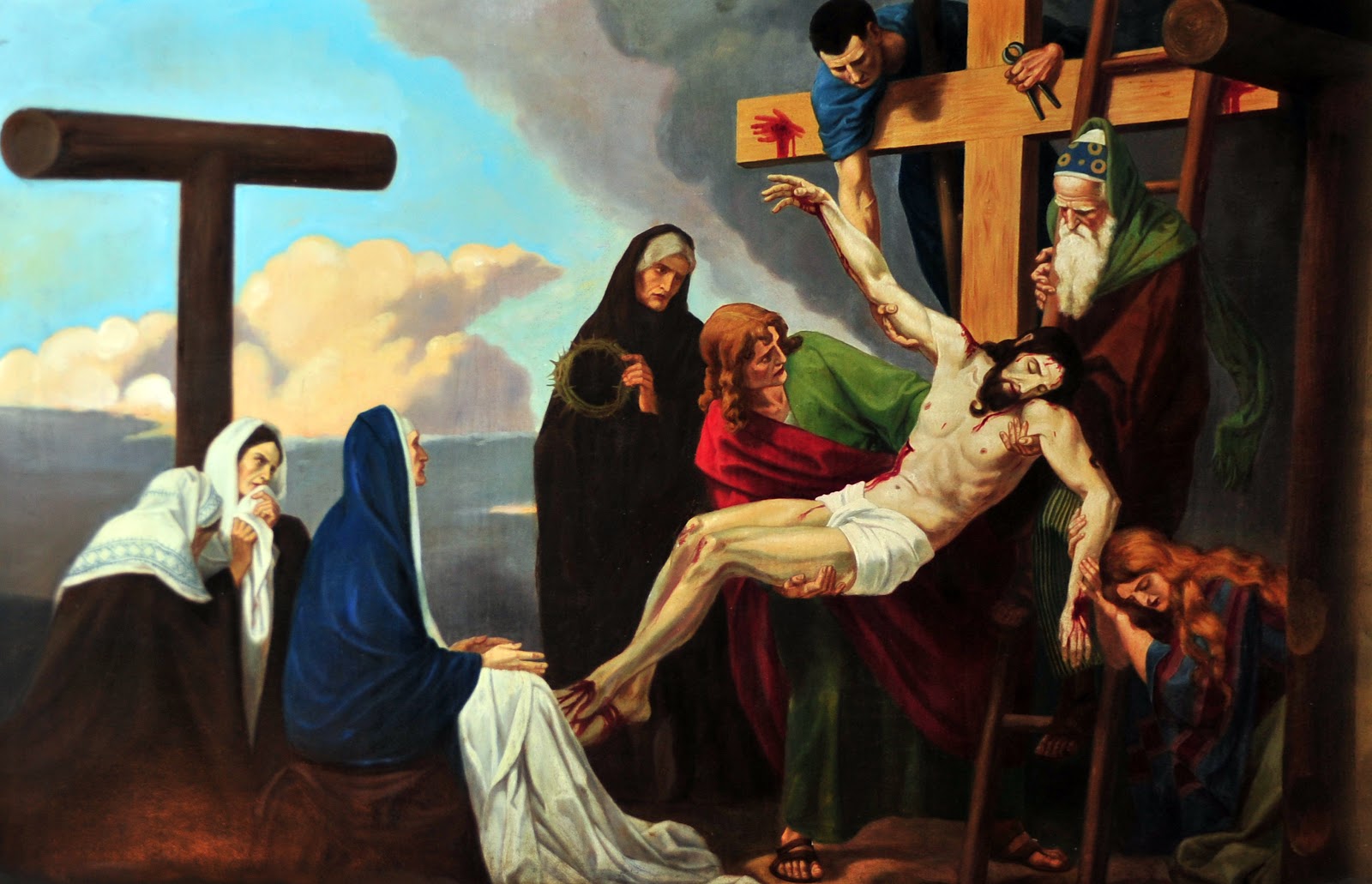


This comes from the last paragraph of the nineteenth chapter of John’s Gospel.


After this, Joseph of Arimathea,

secretly a disciple of Jesus for fear of the Jews,

asked Pilate if he could remove the body of Jesus.

And Pilate permitted it.

So he came and took his body.

Nicodemus, the one who had first come to him at night,

also came bringing a mixture of myrrh and aloes

weighing about one hundred pounds.

They took the body of Jesus

and bound it with burial cloths along with the spices,

according to the Jewish burial custom.

Now in the place where he had been crucified there was a garden, and in the garden a new tomb, in which no one had yet been buried.  So they laid Jesus there because of the Jewish preparation day; for the tomb was close by.

~Jn 19:38-42


We adore you, O Christ, and we praise you, because by your Holy Cross you have redeemed the world.


The distinguishing feature of Holy Saturday is silence and waiting.  There is no liturgy, no celebration, no homilies, no Eucharist.  Jesus’s body is motionless, indeed, lifeless in tomb while His soul travels down to the abode of the dead to raise up all the righteous dead. 


Dominican Fr. Jonah Teller O.P. reflects on the wait.


Fr. Teller:

God sleeps the sleep of death but only for a time.  Hope in him, hope in Christ. So what do we do on this day, this strange day when the stone is still rolled in front of the tomb and we can't see Jesus? What do we do?  I think we just wait.  We just wait there close to Jesus. He's still there. And we hope. And hope is for what you can't see.  But the one who has promised is trustworthy and he will do it. And so whatever it is that we're waiting for, whatever it is we're hoping for, whatever it is we're suffering, any stone rolled in front of any tomb in our lives, any death that we fear, any suffering we experience, we can know confidently that Jesus Christ has already stepped into the middle of it, taken it upon himself, and conquered it. And we can hope that he will share the victory over it with us.  All we have to do is wait.
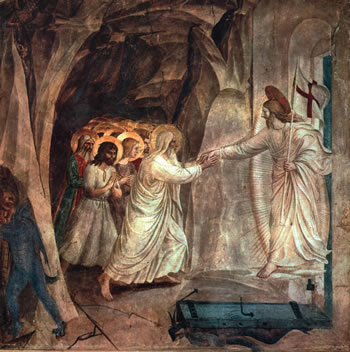


Fra Angelico's The Harrowing of Hell

The Office of Readings of the Liturgy of the Hours has a reading attributed to an ancient unknown writer but sometimes, though questionably, attributed to St. Melito of Sardis.  It is sometimes referred to as “An Ancient Homily on Holy Saturday.”  Whoever wrote it, it was probably written during the second century.

Something strange is happening—there is a great silence on earth today, a great silence and stillness. The whole earth keeps silence because the King is asleep. The earth trembled and is still because God has fallen asleep in the flesh and he has raised up all who have slept ever since the world began. God has died in the flesh and hell trembles with fear.

He has gone to search for our first parent, as for a lost sheep. Greatly desiring to visit those who live in darkness and in the shadow of death, he has gone to free from sorrow the captives Adam and Eve, he who is both God and the son of Eve. The Lord approached them bearing the cross, the weapon that had won him the victory. At the sight of him Adam, the first man he had created, struck his breast in terror and cried out to everyone: “My Lord be with you all.” Christ answered him: “And with your spirit.” He took him by the hand and raised him up, saying: “Awake, O sleeper, and rise from the dead, and Christ will give you light.”

I am your God, who for your sake have become your son. Out of love for you and for your descendants I now by my own authority command all who are held in bondage to come forth, all who are in darkness to be enlightened, all who are sleeping to arise. I order you, O sleeper, to awake. I did not create you to be held a prisoner in hell. Rise from the dead, for I am the life of the dead. Rise up, work of my hands, you who were created in my image. Rise, let us leave this place, for you are in me and I am in you; together we form only one person and we cannot be separated.

For your sake I, your God, became your son; I, the Lord, took the form of a slave; I, whose home is above the heavens, descended to the earth and beneath the earth. For your sake, for the sake of man, I became like a man without help, free among the dead. For the sake of you, who left a garden, I was betrayed to the Jews in a garden, and I was crucified in a garden.

See on my face the spittle I received in order to restore to you the life I once breathed into you. See there the marks of the blows I received in order to refashion your warped nature in my image. On my back see the marks of the scourging I endured to remove the burden of sin that weighs upon your back. See my hands, nailed firmly to a tree, for you who once wickedly stretched out your hand to a tree.

I slept on the cross and a sword pierced my side for you who slept in paradise and brought forth Eve from your side. My side has healed the pain in yours. My sleep will rouse you from your sleep in hell. The sword that pierced me has sheathed the sword that was turned against you.

Rise, let us leave this place. The enemy led you out of the earthly paradise. I will not restore you to that paradise, but I will enthrone you in heaven. I forbade you the tree that was only a symbol of life, but see, I who am life itself am now one with you. I appointed cherubim to guard you as slaves are guarded, but now I make them worship you as God. The throne formed by cherubim awaits you, its bearers swift and eager. The bridal chamber is adorned, the banquet is ready, the eternal dwelling places are prepared, the treasure houses of all good things lie open. The kingdom of heaven has been prepared for you from all eternity.

“I order you, O sleeper, to awake.”  “My side has healed the pain in yours.”  I find that beautiful.  You can hear it being read along with some gorgeous imagery from this video produced by St. Catherine Labouré Church in Wheaton, Maryland.


Sunday Meditation: "They took the body of Jesus and bound it with burial cloths along with the spices, according to the Jewish burial custom.  Now in the place where he had been crucified there was a garden, and in the garden a new tomb…"


Any hymn on such a solemn day must be acapella.  Appropriate I think would be “Go to Dark Gethsemane” here performed by the Lux Choral Society.


Go to dark Gethsemane,

Ye who feel the tempter's pow'r;

Your Redeemer's conflict see;

Watch with Him one bitter hour;

Turn not from His griefs away;

Learn of Jesus Christ to pray.


Follow to the judgment hall;

View the Lord of life arraigned;

O the worm-wood and the gall!

O the pangs His soul sustained!

Shun not suff'ring, shame, or loss;

Learn of Him to bear the cross.


Calv'ry's mournful mountain climb;

There, adoring at His feet,

Mark the miracle of time,

God's own sacrifice complete:

""It is finished!"" Hear Him cry;

Learn of Jesus Christ to die;


Blessed Savior, now in love

Send thy Spirit from above;

Come and dwell with us, we pray;

Amen.

Saturday, May 29, 2021

List of Books I Wish I Had Read Earlier

I recently came across a book list where the creator of the list opined on wishing he had read those books earlier.  I thought that an interesting list.  So I decided to create my own. 

Now the first thing to decide was at what point would I consider as the dividing line as earlier?  I could say of any novel I really enjoyed and thought of highly should have been read earlier.  But “earlier” could be as early as a child.  No, the list had to be after a significant moment of my reading life.  Notice I said, “reading life.” 

I would say that the moment I got my Master’s Degree in English Literature to be such a dividing moment in my reading life.  Anything I read after would have been out of my mature years and from my free will.  Such books I read beyond that moment could have shaped my younger self, either as a person or as a lover of literature.

So finally, these books will be novels—I limit it to novels since novels are the art form I most enjoy—that I read since my 39th birthday that I wish I had read prior.  I’ll limit it to ten novels I have read in these past twenty years.  They are not necessarily the greatest novels I wished I had read earlier, but the most potentially impactful.  I’ll list them backwards, least wished to most wished.

10.  The Hobbit, by J.R.R. Tolkien. 

I was never a big Lord of the Rings fan, but I do acknowledge its greatness.  I read Lord of the Rings for the first time as a teenager, and then read it again in my twenties.  It’s a fun read, but I never saw the literary significance of it.  I know there is a core of Tolkien readers of good literary taste who rate it very high as a literary work.  I was never that passionate about it.  So I never read The Hobbit, the predecessor of LOTR, thinking it was along the same lines.  I finally read The Hobbit in 2012 and found it superb!  I think it’s a greater work than LOTR, perfectly written and not weighed down with stray adventures and characters.  It is a much more focused work, and so its moral is clearer and more direct.


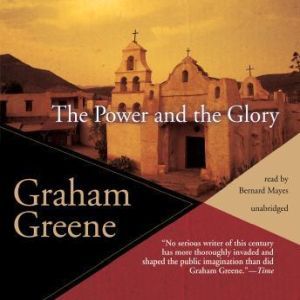
9. The Power and the Glory by Graham Greene.

It is possibly the greatest overtly Catholic novel ever written.  It is perfection in structure and storytelling.  It is powerful in its moral conception, capturing the weakness of man and man’s strength given a dedication to a higher cause.  The character of the “whiskey priest” is Everyman who feels caught between faith and doubt, between perseverance and cowardice.  It is tragic and heroic and will make you yearn for a life dedicated to a higher cause. 


8. Lord of the World by Robert Hugh Benson.

Famous Catholic convert, Catholic priest, and son of an Anglican Archbishop, Robert Hugh Benson was a gifted writer and wrote in different modes at the beginning of the twentieth century.  He wrote several novels, and this one praised by Popes Benedict XVI and Francis.  It’s an apocalyptic novel where a government of Freemasons have conquered the world and extinguished all religions except Catholicism.  The novel climaxes in a battle of Armageddon.  This is truly an underrated novel that should get more readership.  I read it last year and wished I read it as a young man.


7. Mariette in Ecstasy by Ron Hansen

This is another perfect gem of a novel by a writer who attempts various genres.  This novel is of a young lady entering a closed religious order as a novice at the turn of the 20th century and who experiences several ecstatic experiences.  The other sisters in the order divide between those who believe her and those who think she is faking them.  The novel brings into question the inability of science to understand religious experiences.  I read this novel in 2019 and was overwhelmed by the beauty of the writing, the psychological depth of the characters, and the profound modernist themes.


6. My Ántonia by Willa Cather.

This was my first Willa Cather novel, and it blew me away.  The depth of character, the beautiful prose, and perfect story structure should make this one of the great modernist novels.  My hunch is that Cather’s more traditional views holds this novel back from being more situated in the 20th century canon, but I would rank it with any American novel.  I don’t have a record of when I read it, but it should have been assigned in college.


5. Silence by Shūsaku Endō.

This too rivals for the greatest Catholic novel ever written.  A historical novel set in 16th century Japan where a Portuguese Jesuit priest sneaks into Japan to find out about an apostate priest and to serve the secret Catholic community.  He is captured and put into an existential situation where has to apostatize himself or have innocent peasants tortured and killed.  I read this in 2016, the year the movie version came out. 


4. Les Misérables by Victor Hugo.

My wife and I saw the musical many years ago on Broadway and loved it.  We’ve watched the PBS singing of the songs, and watched the movie.  I have the CD.  It’s been a particular favorite.  But I had not read the novel.  The novel is great!  Yes, it’s a tome of a book, and I read it over five years, one of the five parts of the novel in each year.  Yes, there is some expository digressions that interrupts the narrative.  That’s Victor Hugo.  But the narrative is fantastic.  The character of Jean Valjean captures my heart.  There are so many great moments.  The novel turns out to be much more religious than the modern adaptations.  I read Les Misérables from 2014 to 2019.  I wish I had read it earlier.


3. Crime and Punishment by Fyodor Dostoevsky.

I thought that The Brothers Karamazov was Dostoevsky’s great novel, and it is, but Crime and Punishment is its equal.  What a powerful all comprehensive work of art.  No one can better capture the psychological depth of characters than Dostoevsky.  And not just a momentary psychology but a psychology in development and transition.  This story is powerful for its Christian world view, its superb characters (I love Sonya!), and its intricate plot.  You know Raskolnikov is the killer.  It’s a question of whether he gets caught, and if you the reader want him to get caught.  I won’t spoil it.  For a novel that was written in 1866, it is so current today.  I read it in 2015. 


2. To Kill a Mockingbird by Harper Lee.

Another great novel.  You, dear reader, probably read this in high school.  For some reason I never was assigned this novel.  It’s also not one you would get assigned in college, and that is a pity.  I love the telling of the story from the point of view of a pre-teen girl, with all its implications of oncoming puberty.  I love the character of Atticus Finch, the heroic father and lawyer, and the implications of a little girl’s admiration for a moral and duty-bound hero.  I love the way Lee captures the South, both in its positive and negative attributes.  I read this in 2016 at the age of 54.  I should have read it forty years earlier.


1. The Chronicles of Narnia by C. S. Lewis.

The number one book I wish I had read earlier is not a single book but a series, C. S. Lewis’ great interlocking series of novels affectionately just referred to as Narnia.  Actually I haven’t even finished the whole series of seven.  I have been reading one per year and have completed the first four.  The main characters in each of the novels are children, and there is a strong Christian themes and symbolism.  I have been reading this with my son, who claims he doesn’t like it, but seems interested every time we get into it.  On one hand, Narnia is a set of children’s or young adults’ novels, but really anyone of any age can and should read them.  I should have read it as a pre-teen.  I’m joyfully reading them now!


I’ve have posts on most of these ten novels.  Just do a search in that little box at the upper left of the blog page.

What novels do you wish you had read earlier?

Friday, September 7, 2018

Notable Quotes/Faith Filled Friday: Quotes from The Power of Silence

This is a combination “Notable Quotes” and “Faith Filled Friday.”

 A few months ago I had several posts from The Power of Silence by Robert Cardinal Sarah.  You can find those posts here:
Part 1 here: 
Part 2 here: 
Part 3 here:

Cardinal Sarah was just so quotable I started jotting down some of the really great quotes out of his book.  I present them here for your enjoyment and moment of prayer.  Yes, reading spiritual quotes is a form of prayer.  At least I think so.


From Introduction:

This friendship was born in silence, it grew in silence, and continues to exist in silence.

Silence was the salt that seasoned this story.  Silence had the last word.  Silence was the elevator to heaven.

The silence of night is the most capable of crushing all the dictatorships of noise.

Silence is more important than any other human work.  For it expresses God.

From Chapter One:

There is one great question: how can man really be made in the image of God?  He must enter into silence.

At the heart of man is an innate silence, for God abides in the innermost part of every person.  God is silence, and this divine silence dwells in man.

If we observe the great works, the most powerful acts, the most extraordinary and striking interior transformations that God carries out in man, we are forced to admit that he works in silence. 

We listen in silence; man enters into a silence that is God.

Silence is not an absence.  On the contrary, it is the manifestation of a presence, the most intense of all presences.  


In silence man conquers his nobility and grandeur only if he is on his knees in order to hear and adore God.  It is in the silence of humiliation and self-mortification, by quieting the turmoil of the flesh, by successfully taming the noisy images, by keeping at a distance the dreams, imaginations, and roaring of the world that is always in a whirl, in order to purify himself of all that ruins the soul and separates it from contemplation, that man makes himself capable of looking at God and loving him.

God’s silence is a consuming fire for the man who approaches him.

This age detests the things that silence brings us to: encounter, wonder, and kneeling before God.

In silence there is a collaboration between man and God.

Persons who live in noise are like dust swept along by the wind.

Man must make a choice: God or nothing, silence or noise.

Lack of respect for silence is a form of blasphemy against the Holy Spirit.


From Chapter Two:

Creation itself is a silent word of God.

In heaven, speech does not exist.  There on high, the blessed communicate with each other without any words.  There is a great silence of contemplation, communion, and love.

The silence of Jesus’ death transforms, purifies, and appeases man.  It causes him to be in communion with the sufferings and death of Christ, to come back fully into the divine life.


From Chapter Three:

Sacred silence is therefore the only truly human and Christian reaction to God when he breaks into our lives.

Sacred silence, laden with the adored presence, opens the way to mystical silence, full of loving intimacy. 

Words bring with them the temptation of the golden calf!  Only silence leads man beyond words, to the mystery, to worship in spirit and in truth.

And how small would God be if we understood him.


From Chapter Four:

There is a time for human action, which is often uncertain, and a time for silence in God, which is truly victorious.  Far from vengeful, noisy, ideological rebellion, I believe in the fruitfulness of silence.  Prayer and silence will save the world.

Unless we seek to suppress all the superficial aspects of our lives, we will never be united with God.  By detaching ourselves from everything superfluous, we enter little by little into a form of silence.

 Modern existence is a propped-up life built entirely on noise, artificiality, and the tragic rejection of God.  From revolutions to conquests, from ideologies to political battles, from the frantic quest for equality to the obsessive cult of progress, silence is impossible.  What is worse: transparent societies are sworn to an implacable hatred of silence, which they regard as contemptible, backward defeat.

A man without silence is a stranger to God, exiled in a distant land that remains at the surface of the mystery of man and the world; but God is at the deepest part of man, in the silent regions his being.

When the soul is detached from the body of the departing person, it rises in an incomparable silence.  The great silence of death is the silence of the soul that travels toward another homeland: the land of eternal life.

All that is from God makes no noise.  Nothing is sudden, everything is delicate, pure, and silent.


From Chapter Five:

Silence is an extremely necessary element in the life of every man.  It enables the soul to be recollected.  It protects the soul against the loss of its identity.  It predisposes the soul to resist the temptation to turn away from itself to attend to things outside, far from God.

Man does not seek silence for the sake of silence.  The desire for silence for its own sake would be a sterile venture, a particularly exhausting aesthetic experience.  In the depths of his soul, man wants the presence and company of God, in the same way that Christ sought his Father in the desert, far from the cries and passions of the crowd. 

A Christian cannot fear silence because he is never alone.  He is with God.  He is in God.  He is for God.  In the silence, God gives me his eyes so as to contemplate him better.  Christian hope is the foundation of the true silent search of the believer.  Silence is not frightening; on the contrary, it is the assurance of meeting God.


Of course these are not all, and they may not even be the best quotes.  These are just some that caught my eye.  Try to set aside some silent time this weekend, and see if it moves you.

Wednesday, July 11, 2018

The Power of Silence by Robert Cardinal Sarah, Part 3

You can find Part 1 post here: 
And Part 2 here: 

The following is my Goodreads review of Robert Cardinal Sarah’s The Power of Silence: Against the Dictatorship of Noise and some discussion from the board which I participated in. 


The Power of Silence is an important book for our age.  T.S. Eliot in is his masterpiece work, The Four Quartets summarized the state of humanity in the modern world as “Distracted from distraction by distraction.”  Cardinal Sarah has a variation on this theme: that in the modern world a dictatorship of noise has descended upon mankind and, indeed, has enslaved mankind.  This noise has altered our fundamental relationship with God and has led to the pernicious condition of our souls.   Eliot looks at the symptom, distraction; Sarah identifies the infecting virus, noise. 

There is something to be said of this.  I remember many years ago reading about the Native American’s first reaction to the sound of a firearm when first encountering Europeans.  They had never heard a sound so loud that it disturbed to their core.  It was a sound that felt like a cleaving slice.  Nature does not provide any such sound, at least not on a routine basis.  And the modern world is full of such sounds.  We are rarely without sound, rarely allowed to have a wholesome composed time to commute with the divine, and rarely allowed to hear the silence that is God Himself.  Sarah is most eloquent in his metaphors.  “Silence is this powerful dike that controls the tumultuous waters of the world and protects from noises and distractions of all sorts. Silence is a dam that restores a kind of dignity to mankind.”


That dignity is an integrity of being, a wholeness that resists the fragmenting jolts of contemporary life.  In the book, Cardinal Sarah takes us through the dictatorship of noise of our lives, through what it has done to us and to society, and what we can achieve by seeking silence. It is a little haphazardly written—or perhaps more accurately, not written in a linear fashion—and at times it feels he over stretches the argument.  It is not a perfectly written book, and so it may frustrate the reader at times.  But it does not diminish the book’s importance.  It makes a monumental argument against the dissipation of our times.


Some excerpts from our discussion board at Catholic Thought Book Club:

Galicus:
I thought I would hear something about the active and growing Catholic Church in Africa, as described by John Allen in “The Future Church” which we read here not long ago, as this is a book by an African prelate but alas this book sounds entirely European—a compendium of writings by mostly European and Bible land mystics and saints on escaping the world into contemplation and silence. Is it true that Cardinal Sarah left Africa in 2001 and is out of touch with what goes on in the active and growing Catholic Church in Africa?

Me:
Galicius, what made you think this would be about Africa? None of the book descriptions even remotely suggested it. Cardinal Sarah is way more than just an African Cardinal. He was on the short list for the Papacy, and I hold out hope that he may be the next Pope, though he is already 72. Cardinal Sarah has obviously absorbed the entire Catholic tradition.

Is the book European? The book is Catholic, and I don't think African Catholicism is any different, especially in its intellectual foundation. If anything African Catholicism is more traditional Catholic than what European Catholicism has evolved to. This book is of the contemplative tradition, which goes back to the Desert Fathers. However, the book it reminds me the most is Thomas a Kempis, The Imitation of Christ. If you get a chance, compare the two. I should dig out my copy and compare as well.


Br. Stabin:
This book is really a challenge to me. To create a silence of the heart. We in the community keep the silence at certain times but how to shut the heart it is really challenging. I know unless keeping the heart and mind in silence we cannot be a prayerful person. We will be like chatterboxes in our prayers and masses.

Me:
I found what you were referring to, paragraphs 48 through 52.

Silence of the heart consists of quieting little by little our miserable human sentiments so as to become capable of having the same sentiments as those of Jesus. (P. 52)

I see what you mean. That is a challenge that I can't imagine I could do.

Kerstin:
"163. I am certain that God gives to each believer a heart capable of hearing the language of creation."

This is a surprising and yet very profound insight:

"166...I am convinced that the problem of contemporary atheism lies first of all in a wrong interpretation of God’s silence about catastrophes and human sufferings. If man sees in the divine silence only a form of God’s abandonment, indifference, or powerlessness, it will be difficult to enter into his ineffable and inaccessible mystery. The more man rejects the silence of God, the more he will rebel against him."

Isn't this the age-old demand of "showing one more sign"; if only "one more sign" is miraculously produced, then I am willing the believe...

Me:
I agree with your comment on 163. I have no doubt on that either. However, given that God doesn't stand in front of us and declare Himself and given that science has developed theories of how the universe came into being, then I can understand how the atheists come to their conclusion. Those theories depend on huge, astronomical probabilities, which in my opinion aren't very likely. But the atheists go in with an outlook of skepticism, and so only weigh the probability based theories rather than a God who guided those probabilities to come to be.

Irene:
In Sarah's section on silence in the liturgy, I appreciated how he pointed out the places in the rubric that calls for silence. My parish has tried to be more aware of keeping silence at various points such as after each reading or after "Let us pray: to encourage more reflection.

He also writes of wanting a reform of the liturgical reform. From some of his comments in this section, I get the impression that he wants to return to the style of liturgy prior to Vatican II. That would not be my hope. He wrote of the Eucharistic Prayer being prayed in silence by the presider. That would not enhance the liturgical experience for me. My mind wonders too easily. I need to hear the prayers to feel engaged.

Me:
While we can all use more silence in our contemplative moments, I can’t help feel that at times Cardinal Sarah is stretching the argument too far. How can you have liturgical service in total silence? And what’s wrong with music to accompany. Beauty is as important as silence and singing is praying twice as St. Augustine said. Yes I agree dancing down the aisle is not appropriate but even Cardinal Sarah acknowledges older people who are lonely should be able to converse after Mass. We are communicative beings. Expressing ourselves, with limitations of course, is not only necessary but human.

Sunday, June 24, 2018

The Power of Silence by Robert Cardinal Sarah, Part 2

Having taken you through the Introduction and Chapters I, II, and III in my first post on Robert Cardinal Sarah’s The Power of Silence: Against the Dictatorship of Noise, I continue here with Chapters IV, V, the Conclusion, and the Afterward.

The fourth chapter, titled “God’s Silence in the Face of Evil Unleashed” furthers the understanding of silence as it pertains to evil in the world.  It examines why God is silent in the face of evil, silence as a proper reaction toward evil, and silence in understanding sickness and death. 

Christ alone can give man the strength to confront evil and come to terms with it.  He offers himself as the only power of helping mankind to conquer suffering.  “Apart frpm me you can do nothing” (Jn 15:5).  By the strength of his Cross, he has the power to save mankind.  The most beautiful cry possible is an outburst of love for God.  Suffering is often the expression of immense love.  It is redemptive.  Suffering and sorrow show that we are alive, guiding the physician more precisely in his diagnosis.  It is necessary to accept suffering and to cope with it in silence.  There is no injustice in the world that does not find a prayerful response to God.  (P. 283)

But Sarah emphasizes that silence “is not a form of passivity.”  To fight injustice, man must turn to God and His love.

We must involve God in our combat against injustice.  I like to keep saying that are true weapons are love and prayer.  The silence of prayer is our only equipment for combat.  The silence of invocation, the silence of adoration, the silence of waiting: these are the most effective weapons.  Love alone is capable of putting out the flames of injustice, because God is love.  Loving God is everything.  All the rest has not the slightest value to the extent that it is not transformed and elevated by Christ’s love.  The choice is simple: God or nothing… (P. 292)

While Cardinal Sarah understands man’s rebellion in the face of injustice, he does not support many of the modern approaches to combat such injustice.  In what I find to be one of the most insightful paragraphs summarizing the modern condition, Sarah is repulsed by the noisy struggles from all sides.

Modern existence is a propped-up life built entirely on noise, artificiality, and the tragic rejection of God.  From revolutions to conquests, from ideologies to political battles, from the frantic quest for equality to the obsessive cult of progress, silence is impossible.  What is worse: transparent societies are sworn to an implacable hatred of silence, which they regard as contemptible, backward defeat.  (P. 336)

That paragraph is at the center of the book’s theme. 


The fifth chapter, “Like a Voice Crying Out in the Desert: The Meeting at the Grand Chartreuse” pulls together the various threads that Cardinal Sarah has been developing and comes to answer why search for silence.  Though the themes seem a bit redundant at this point—I think he has answered the same question in every chapter—there is a change in presentation.  A new voice enters the discussion, Dom Dysmas de Lassus, the Prior General of the Carthusians.  Nicholas Diat is still asking questions, but now the two religious answer in a sort of duet.  As the chapter title suggests, the meeting of the three take place at the Grand Chartreuse, the head monastery of the Carthusian religious order.

In an answer to why seek silence, Cardinal Sarah answers bluntly: “The authentic search for silence is the quest for a silent God and for the interior life.  It is the quest for a God who reveals himself in the depths of our being (p. 191).  He continues:

Silence is an extremely necessary element in the life of every man.  It enables the soul to be recollected.  It protects the soul against the loss of its identity.  It predisposes the soul to resist the temptations to turn away from itself to attend to things outside, far from God.

If man wants to become entrenched in the depths of his heart, in that beautiful interior sanctuary, in order to examine himself and to verify the Presence of God within him, if he wants to know and understand his identity, he needs to be silent and to win his interiority.  (p, 192)

Dom Dysmas amplifies this by explaining the Carthusian rule of silence: “In a charterhouse [Carthusian monastery], we seek, not silence, but, rather, intimacy with God by means of silence.  It is the privileged space that will allow for communion; it is on the order of language, but a different language (p. 199).  Cardinal Sarah then cautions that seeking silence has to have meaning.

Man does not seek silence for the sake of silence.  The desire for silence for its own sake would be a sterile venture, a particularly exhausting aesthetic experience.  In the depths of his soul, man wants the presence and company of God, in the same way that Christ sought his Father in the desert, far from the cries and passions of the crowd.  (p. 201)

Cardinal Sarah goes on to assure us not to fear the silence.

A Christian cannot fear silence because he is never alone.  He is with God.  He is in God.  He is for God.  In the silence, God gives me his eyes so as to contemplate him better.  Christian hope is the foundation of the true silent search of the believer.  Silence is not frightening; on the contrary, it is the assurance of meeting God.  (p. 230)


In the formal “Conclusion,” Sarah encourages us “to revolt against the dictatorship of noise, that seeks to break our hearts and our intellect” (p. 240). 

Finally in a short “Afterward,” Pope Emeritus Benedict XVI praises Cardinal Sarah as a spiritual teacher, one “who speaks out of the depths of silence with the Lord, out of his interior union with him, and thus really has something to say to each one of us” (p. 244).


This book does have something to say that is very important to the modern—or shall I call it, postmodern—world.  But will the world listen?  It would be wise if we each in our individual practices listened.