"Love follows knowledge."
"Beauty above all beauty!"
– St. Catherine of Siena

Showing posts with label Dante's 750th Birthday. Show all posts

Wednesday, June 10, 2015

Literature in the News: Dante Alighieri’s 750th Birthday

In my last post I mentioned I wanted to celebrate the 750th anniversary of Dante Alighieri’s birth.    I also mentioned there that the exact day of Dante’s birth is unknown, but from a reference in The Divine Comedy we know he was born under the sign of Gemini, and therefore we can bracket from May 11th to June 11th. 

The celebrations in Italy for the occasion must have been stunning.  Both a the actor Robert Begnini and an emissary for the Pope spoke in honor of the great Italian poet in the Italian parliament.  From the English version of the Italian news, ANSA. 

(ANSA) - Rome, May 4 - Oscar-winning actor Roberto Benigni received a standing ovation Monday as he read from Dante in the Italian Senate and Pope Francis praised the medieval poet as a "prophet of hope" as the nation marked the 750th anniversary of his birth.
    Benigni received a standing ovation after his reading from Dante's Divine Comedy in the Upper House of parliament, which was attended by President Sergio Mattarella and broadcast live to the nation by state-run RAI radio.
    The program also included a new musical homage to the poet by renowned composer Nicola Piovani.
    The pope's message said that Dante's works announced the "possibility of redemption and liberation" for humanity with his works that affirmed the love of God and the hope for a new life.
    Cardinal Gianfranco Ravasi delivered the pope's message that described Dante as "one of the most illustrious figures of all humanity".
    The pope's message added the Florentine was an "artist of the highest universal values who still has much to say and to give through his works (to those who are) willing to follow the way of true knowledge, the discovery of self and the world".
    Benigni, who read from the XXIII canto of Dante's Paradiso, said: "The Divine Comedy is a miracle, a work whose beauty takes your breath away".

The article goes on to say that 187 events will occur across Italy in commemoration of his birth, and another 173 outside of Italy by Italian cultural institutes.  I wonder if any will occur here in New York City since we have such a large Italian-American population. 

So how should I commemorate the occasion?  Let’s start with the first 39 lines of that Paradisio Canto XXIII that Benigni read.  This is the spectacular moment that Dante the character sees Christ, the light of the world.  I’ll copy over from the Princeton Dante Project  which includes the Hollander and Hollander translation.  I’ll post the Italian and the English side by side.

Come l'augello, intra l'amate fronde,  1          As the bird among the leafy branches that she loves,
                                                                         
posato al nido de' suoi dolci nati        2          perched on the nest with her sweet brood
                                                                         
la notte che le cose ci nasconde,         3          all through the night, which keeps things veiled from us,
                                                                         
    che, per veder li aspetti disïati        4          who in her longing to look upon their eyes and beaks
                                                                         
e per trovar lo cibo onde li pasca,       5          and to find the food to nourish them --
                                                                         
in che gravi labor li sono aggrati,        6          a task, though difficult, that gives her joy --
                                                                         
    previene il tempo in su aperta frasca,          7          now, on an open bough, anticipates that time
                                                                         
e con ardente affetto il sole aspetta,   8          and, in her ardent expectation of the sun,
                                                                         
fiso guardando pur che l'alba nasca;   9          watches intently for the dawn to break,
                                                                         
    così la donna mïa stava eretta         10        so was my lady, erect and vigilant,
                                                                         
e attenta, rivolta inver' la plaga           11        seeking out the region of the sky
                                                                         
sotto la quale il sol mostra men fretta:            12        in which the sun reveals less haste.
                                                                         
    sì che, veggendola io sospesa e vaga,         13        I, therefore, seeing her suspended, wistful,
                                                                         
fecimi qual è quei che disïando           14        became as one who, filled with longing,
                                                                         
altro vorria, e sperando s'appaga.        15        finds satisfaction in his hope.
                                                                         
    Ma poco fu tra uno e altro quando, 16        But time was short between one moment and the next,
                                                                         
del mio attender, dico, e del vedere   17        I mean between my expectation and the sight
                                                                         
lo ciel venir più e più rischiarando;     18        of the sky turned more and more resplendent.
                                                                         
    e Bëatrice disse: "Ecco le schiere    19        And Beatrice said: 'Behold the hosts
                                                                         
del trïunfo di Cristo e tutto 'l frutto    20        of Christ in triumph and all the fruit
                                                                         
ricolto del girar di queste spere!"        21        gathered from the wheeling of these spheres!'
                                                                         
    Pariemi che 'l suo viso ardesse tutto,          22        It seemed to me her face was all aflame,
                                                                         
e li occhi avea di letizia sì pieni,          23        her eyes so full of gladness
                                                                         
che passarmen convien sanza costrutto.          24        that I must leave that moment undescribed.
                                                                         
    Quale ne' plenilunïi sereni   25        As, on clear nights when the moon is full,
                                                                         
Trivïa ride tra le ninfe etterne 26        Trivia smiles among the eternal nymphs
                                                                         
che dipingon lo ciel per tutti i seni,     27        that deck the sky through all its depths,
                                                                         
    vid' i' sopra migliaia di lucerne        28        I saw, above the many thousand lamps,
                                                                         
un sol che tutte quante l'accendea,     29        a Sun that kindled each and every one
                                                                         
come fa 'l nostro le viste superne;       30        as ours lights up the sights we see above us,
                                                                         
    e per la viva luce trasparea  31        and through that living light poured down
                                                                         
la lucente sustanza tanto chiara           32        a shining substance. It blazed so bright
                                                                         
nel viso mio, che non la sostenea.       33        into my eyes that I could not sustain it.
                                                                         
    Oh Bëatrice, dolce guida e cara!     34        O Beatrice, my sweet belovèd guide!
                                                                         
Ella mi disse: "Quel che ti sobranza    35        To me she said: 'What overwhelms you
                                                                         
è virtù da cui nulla si ripara.    36        is a force against which there is no defense.
                                                                         
    Quivi è la sapïenza e la possanza    37        'Here is the Wisdom and the Power that repaired
                                                                         
ch'aprì le strade tra 'l cielo e la terra,   38        the roads connecting Heaven and the earth
                                                                         
onde fu già sì lunga disïanza."            39        that had so long been yearned for and desired.'

How about a post some statues of Dante from across the world.  Here is the most famous I think, from the UffiziMuseum in Florence, Italy, the city that banished Dante during his lifetime.
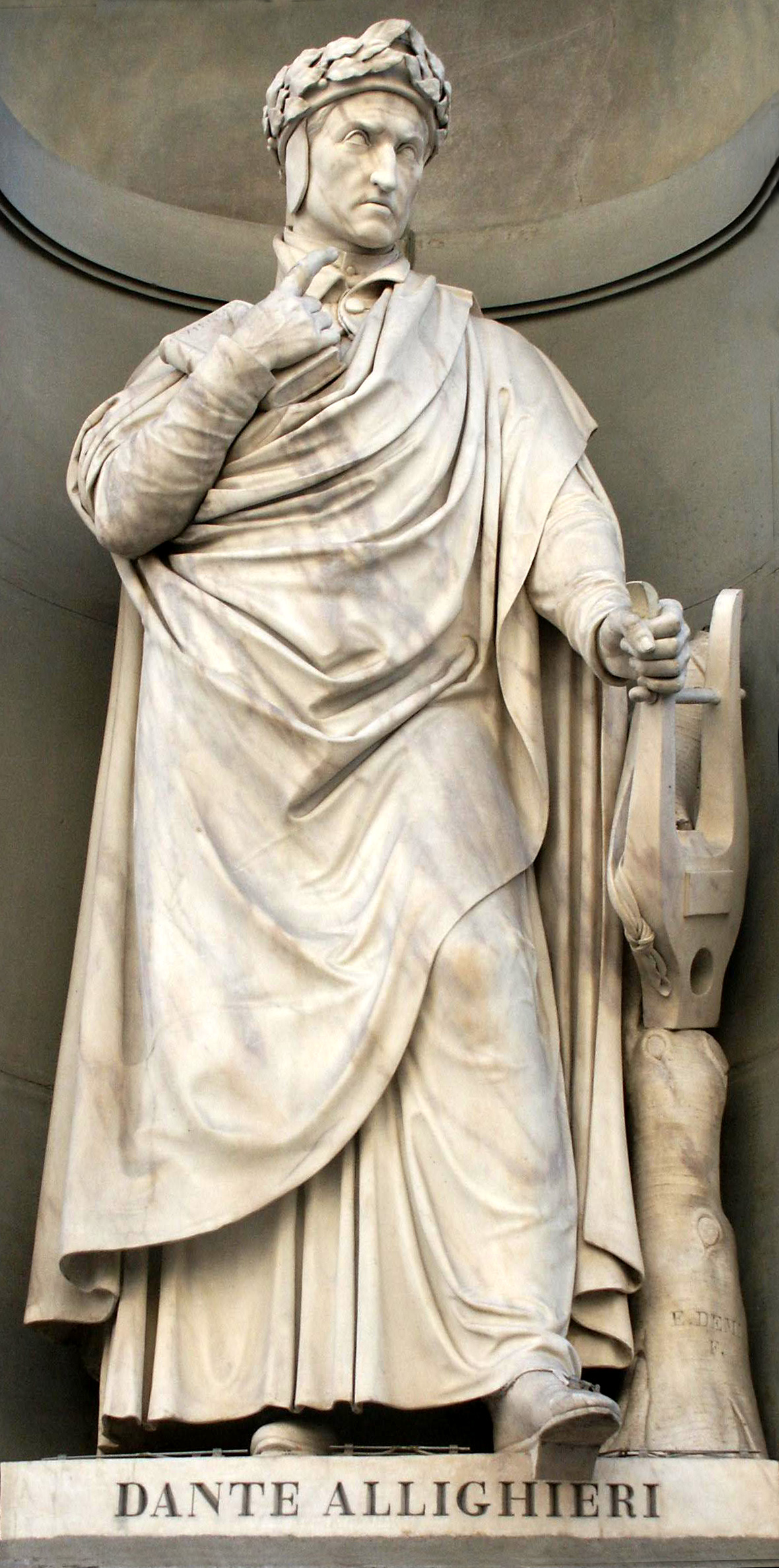


This also in Florence at the wonderful Santa Croce Basilica.  


I’ve been there but I can’t remember the statue.  I do remember the one at the Uffizi.

Here is one in Verona, Italy.


And then one in Naples, Italy. 
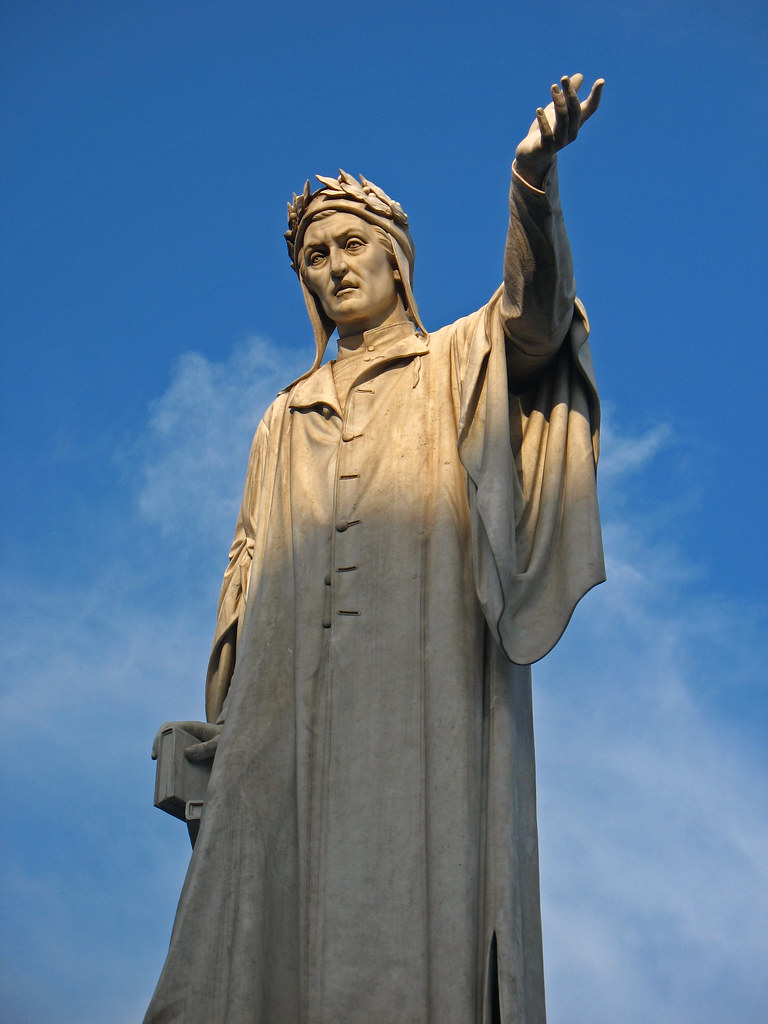


I wonder if every city in Italy has a statue of Dante.  Let’s come over to the United States and there is this one in Washington, DC.


And then there is this one in New York City.  This is off my personal camera.  I took it on Memorial Day when Matthew and I were on a bus.  Unfortunately I couldn’t get a good angle, and the bus was moving.


OK, that didn’t really capture it.  Sorry it was the best I could do from the bus.  Here’s an image of it off the internet.


Actually it looks exactly the same as the one in Washington.  So which do I like the best?  I’d go with the one at the Uffizi.

Happy Birthday Dante!


Sunday, June 7, 2015

Purgatorio by Dante Alighieri, Part 4

I wrote on my Purgatorio read last year, but I always meant to complete Purgatorio with a fourth part.  Now that we are in the midst of Dante’s approximate 750th birthday, I want to complete my posts on Purgatorio with the culmination of the second Cantica and a detailed look at one of the greatest moments in all of literature, the moment that Dante the character finally meets Beatrice.

First, here are links from last year to my first three posts on Purgatorio:

Part 1.  
Part 2.  
Part 3.  

Second, let me quickly explain why I said “the approximate” birthdate.  We know the year that Dante Alighieri was born but we don’t have a date.  We only know under what zodiac sign he was born under, which narrows his birthdate to a month’s span.  From Famous People bio site: 

Dante was born on May/June c.1265 in Florence. The actual birth date of Dante is still unknown. His year of birth is analyzed from the autobiographic allusions in La Divina Commedia. Also as the sun was in Gemini so he must be born around the period of 11th May to 11th June.

So in commemoration, I will post a conclusion to my Purgatorio read and before June 11th I will have a smashing 750th birthday post for the greatest poet of all time.

Third, let me conclude a summary from where I left off.  At the end of the seventh terrace, where I had left off in Part 3 of my Purgatorio posts, the pilgrims (Dante, Virgil, and Statius) reach a wall of fire (Canto 27), a refining purgation that allows souls into heaven.  This might be the only element of the Purgatorio which is actually biblically supported (see 1 Cor 15).  Frozen with fear to pass through the flames, Dante is finally lured by Virgil with the thought that this is the only way to reach Beatrice.  Passing through the wall of flame, the pilgrims reach Earthly Paradise—a lush place of pastures, woods, streams, and a gentle breeze—the actual location of Eden (Canto 28), where they meet a new guide, a young lady named Matelda.  The lady shows the travelers about when a great procession comes out of the woods (Canto 29), a procession of Biblical figures, climaxed by a chariot drawn by a gryphon, a creature that is half eagle and half lion.  The procession is actually a grand entrance for Beatrice, upon which Virgil disappears and Dante and Beatrice have that great reunion (Cantos 30 & 31).  More on this below.  Finally with Dante repented and purged of all sin and in essence baptized anew, the journey with Beatrice as his new guide to the heavens begin (Cantos 32 &33).  And so Purgatorio ends with, “I retuned from the most holy wave refreshed, as/new plants are renewed with new leaves,/pure and made ready to rise to the stars” (XXXIII, 142-145). 

Last, let me go through what I think is one of the most amazing scenes in all of literature, the rendezvous between Dante and Beatrice.  From the Durling translation, Canto 30:

   I have sometimes seen, at the beginning of the
day, the eastern sky all rosy, and the rest adorned
with cloudless blue,
   and the face of the sun rising shadowed, so that
by the tempering of vapors the eye endured it for a
long while:
   so, within a cloud of flowers that from the
hands of the angels was rising and falling back
within and without,
   her white veil girt with olive, a lady appeared to
me, clothed, beneath a green mantle, in the color
of living flame.  (ll 22-33)

Here’s the scene.  A great procession of Biblical characters has just paraded from the woods (Canto 29) in front of Dante, who is separated by a stream, and suddenly from the sky through the clouds, Beatrice drifts down, angels about her tossing flowers as if it were confetti.  Now that is Hollywood-esk grand entrance.  She is dressed in three colors, representing faith (white), hope (green), and love (red).  It continues with Dante relating what he’s feeling.

   And my spirit, which already for so long a time
had not known in her presence the awe that
overcame it with trembling,
   without having more knowledge through the
eyes, because of hidden power that moved from
her, felt the great force of ancient love.  (ll 34-39)

By his “spirit” he means the emotions inside of him are recalling “the awe” of her being, which comes from her “hidden power” that one feels through her eyes.  He cannot see her face—she is veiled—but he is sure it is her because of “the force of the ancient love,” ancient being when they last separated ten years before.  Ancient is a strange word (Italian, d’antico) when it is only ten years before, but it will get repeated further down.
   As soon as my sight was struck by that high
power that had transfixed me before I was out of
boyhood,
   I turned to the left with the appeal with which a
little boy runs to his mama when he is afraid or
when he is hurt,
   to say to Virgil: “Less than a dram of blood is left
me that is not trembling: I recognize the signs of
the ancient flame!”  (ll 35-48)

The shock and awe from Beatrice coming down regresses his adult control back to boyhood, and he turns to his guide, Virgil, like “a little boy” who “runs to his mama when he is afraid or when he is hurt.”  This will not be the last time his manhood regresses in the scene.  In his excitement he screams out, “I recognize the signs of the ancient flame!”  There’s that word “ancient” again.  That line he screams out is a loaded line; it’s the very line that Dido says in Virgil’s epic, The Aeneid, when she falls in love with Aeneas, feeling the emotions she once felt for her departed husband.  Here’s the significance.  Dido feels a love that should not have taken place; for Dante, he feels a love that was abandoned and betrayed.  But even more importantly, Virgil the character is about to disappear, and Dante the poet uses one of Virgil’s most famous lines as a tributary send off.  So Dante the character turns only to find Virgil gone.

   But Virgil had left us deprived of himself—
Virgil, most sweet father, Virgil, to whom I gave
myself for my salvation—,
   nor did anything our ancient mother lost
suffice to prevent my cheeks, though cleansed with
dew, from turning dark again with tears.  (ll 48-54)

And Dante, seeing that his second father, the poet he most admires, the guide who has brught him safely through hell and purgatory, has vanished, he breaks down into tears. But then the most startling thing of all happens.  Beatrice speaks.

   “Dante, though Virgil depart, do not weep yet,
do not weep yet, for you must weep for another
sword.”  (ll 55-57)

First, this is the only time in all of The Divine Comedy, the entire epic of a 100 Cantos averaging about 160 lines each, that Dante’s name is actually uttered, and it’s spoken by Beatrice at the moment of their reunion.  Of course that is no coincidence.  But look at what she says.  Just when Dante is expecting some sort of consolation, Beatrice tells him, repeating twice, “do not weep yet” (and the repetition suggesting it’s said sternly) because if you think Virgil’s disappearance is a pang, you’re going to be weeping from another stab. 

   Like an admiral who comes to stern and prow to
see the people who serve on the other ships, and
heartens them to do so well:
   on the left side of the chariot, when I turned at
the sound of my name, which of necessity is here
set down,
   I saw the lady who had just appeared to me
veiled beneath the angelic welcome, directing her
eyes toward me across the stream,
   although the veil that came down from her
head, circled with Minerva’s foliage, did not permit
her to appear openly.
   Still regal and haughty in bearing, she continued
like one who speaks but holds in reserve the hotter
speech:
   “Look at us well!  Truly I am, truly I am
Beatrice.  How have you deigned to approach the
mountain?  Did you not know that here mankind is
happy?”  (ll 58-75)

Notice she projects power and control: She stands “like an admiral” who faces his crew.  Dante highlights that his name was uttered, if readers didn’t catch its significance.  “Regal and haughty” she speaks with a sternness that is holding back anger.  In essence, what she says is how do you dare approach this holy mountain.  What gives you the right?  She is poking at his sinfulness.  And he falls in shame.  We don’t exactly know what the sin was, but Dante had turned away from her and been diverted. He failed to be faithful, though most scholars don’t believe it was a failing due to lust, but a spiritual failing. 

   My eyes fell down to the clear spring, but,
seeing myself there, I turned them to the grass,
such shame weighed down my brow:
   so a mother seems severe to her son as she
seemed to me, for bitter is the flavor of
compassion still unripe.  (ll 76-81)

Again his manhood regresses, and he feels the guilt of a boy who is being berated by his mother.

   She fell silent, and the angels sang suddenly: “In
te, Domine, speravi,” but beyond “pedes meos” they
did not pass.  (ll 82-84)

She goes silent, a stern silence, but the angels around her sing from Psalm 30 (“In

te, Domine, speravi”), which is an appeal to be delivered in justice.  In his guilt, “the ice that had tightened around [his] heart/became spirit and water” (97-98), melting and alluding to the ice that Satan in Inferno was frozen in.  What a powerful scene.