My
friend Kelly, who has commented on this blog, and, actually as I think on it,
was one of the people who inspired me to start this blog many years ago, sent
me an email concerning this lovely hymn.Kelly is the music director at
her parish—I think that’s her title but actually I’m not a hundred percent
sure.Nonetheless she is involved in the
music at her parish.She sent me an
email of a hymn that she came across, Adoro
te devote, translated into English as “I Devoutly Adore You.”
No,
she wasn’t sending me a note of adoration—hahaha—but telling me about the
translator into English of this hymn which was originally composed in Latin by
St. Thomas Aquinas as a prayer.Most
people know about St. Thomas’s philosophic and theological gifts, but less
known is his gift for composing poetry in Latin, and his poetry was prayer.According to Wikipedia, https://en.wikipedia.org/wiki/Adoro_te_devote
this prayer was not part of the liturgical works Aquinas had composed for the Solemnity
of Corpus Christi https://en.wikipedia.org/wiki/Feast_of_Corpus_Christi
but for his own private use before the Blessed Sacrament.Here is a rendition of the hymn in Latin, followed
by the Latin text.
Adoro te devote
By St. Thomas Aquinas
Adoro te devote, latens
deitas,
Quæ sub his figuris vere
latitas;
Tibi se cor meum totum
subicit,
Quia te contemplans totum
deficit.
Visus, tactus, gustus in
te fallitur,
Sed auditu solo tuto
creditur.
Credo quidquid dixit Dei
Filius;
Nil hoc verbo Veritátis
verius.
In Cruce latebat sola
Deitas,
At hic latet simul et
Humanitas,
Ambo tamen credens atque
confitens,
Peto quod petivit latro
pœnitens.
Plagas, sicut Thomas, non
intueor:
Deum tamen meum te
confiteor.
Fac me tibi semper magis
credere,
In te spem habere, te
diligere.
O memoriale mortis
Domini,
Panis vivus, vitam
præstans homini,
Præsta meæ menti de te
vívere,
Et te illi semper dulce
sapere.
Pie Pelicane, Jesu
Domine,
Me immundum munda tuo Sanguine:
Cujus una stilla salvum
facere
Totum mundum quit ab omni
scelere.
Jesu, quem velatum nunc
aspicio,
Oro, fiat illud quod tam
sitio:
Ut te revelata cernens
facie,
Visu sim beátus tuæ
gloriæ. Amen.
Now
that is very beautiful.What Kelly had
sent me was a link to an English translation of the hymn posted at the website,
Hymnary.Hymnary by its own identification, is a “comprehensive index of hymns and
hymnals.”I believe you can think of it
as a library of hymns, and I’ve actually come across it before but I can’t
remember why.I must have done a search
for a hymn and Hymnary popped
up.Kelly’s surprise when she looked at
the Adoro te devote page, and why she
thought of me, was the translator of the Latin hymn into English.If you look at the bottom of the page the
English translator is listed as “G. Manly Hopkins,” that is the great English
poet and Catholic convert, Gerard Manly Hopkins.I have posted often on Hopkins, and you can find those posts here.
What
is funny about that Hymnary page is
that below the translator’s name is this about him: “no biographical
information available about G. Manley Hopkins.”Hahaha, that is very funny.They
could just have looked in Wikipedia or Norton’s Anthology of English Literature.I suspect that the people who run Hymnary are mostly Protestant musicians,
and so don’t know very much of poets nor of famous Catholic converts.Hopkins is a great modernist poet who
converted to Catholicism and became a Jesuit priest.Like Thomas Aquinas, Hopkins’ poems are
prayers as well.Here is the Hopkins
translation of the Adore te devote.
Adoro te devote
By St. Thomas Aquinas
Translated by Gerard
Manly Hopkins
Godhead here in hiding
whom I do adore
Masked by these bare
shadows, shape and nothing more.
See, Lord, at thy service
low lies here a heart
Lost, all lost in wonder
at the God thou art.
Seeing, touching, tasting
are in thee deceived;
How says trusty hearing?
that shall be believed;
What God's Son has told
me, take for truth I do;
Truth himself speaks
truly or there's nothing true.
On the cross thy godhead
made no sign to men;
Here thy very manhood
steals from human ken:
Both are my confession,
both are my belief,
And I pray the prayer
made by the dying thief.
I am not like Thomas,
wounds I cannot see,
But I plainly call thee
Lord and God as he:
This faith each day
deeper be my holding of,
Daily make me harder hope
and dearer love.
O thou, our reminder of
the Crucified,
Living Bread, the life of
us for whom he died,
Lend this life to me,
then; feed and feast my mind,
There be thou the
sweetness man was meant to find.
Like what tender tales
tell of the Pelican,
Bathe me, Jesus Lord, in
what thy bosom ran--
Blood that but one drop
of has the pow'r to win
All the world forgiveness
of its world of sin.
Jesus whom I look at
shrouded here below,
I beseech thee, send me
what I thirst for so,
Some day to gaze on thee
face to face in light
And be blest forever with
thy glory's sight.
What
is amazing is that Hopkins keeps Thomas’s eleven syllable line (called the hendecasyllabicline) and the coupling rhyme scheme.The hendecasyllabic line is much more common
in Latin and not very common in English.
First
let’s listen to it read as a poem, read here by Jonathan Roumie.
Notice
Hopkins also keeps the caesura—the pause in the middle of most lines—that forms
the heart of the melody.Listen to the
Latin again and hear how Aquinas composes a pause at the end of each line but
also a subtle, shorter pause in the middle of each line, the caesura.Hopkins is very conscious of the caesura and
incorporates it into the English translation as well.
It’s
not a complicated poem thematically.The
poem is about being and praying before the Blessed Sacrament—that which we
Catholics consider to be the real presence of Jesus—that which looks like bread
but has through transubstantiation become the Body of Christ.The Thomas in the fourth stanza is a
reference to Thomas the Apostle—the doubting Thomas of the Gospels.Thomas Aquinas is saying that though he may
be a “Thomas,” he is not the doubting one.The allusion to the Pelican in the sixth stanza is a reference to the
pelican being a symbol for Christ.It
was legendary that the pelican poked her chest until it bled to feed her chicks
the blood which poured out.From
Wikipedia:
In a newer, also medieval
version of the European myth, the pelican was thought to be particularly
attentive to her young, to the point of providing them with blood by wounding
her own breast when no other food was available. As a result, the pelican came
to symbolize the Passion of Jesus and the Eucharist, supplementing the image of
the lamb and the flag. This mythical characteristic is referenced in the hymn
"Adoro te devote" ("Humbly We Adore Thee"), where in the
penultimate verse, Saint Thomas Aquinas describes Christ as the loving divine
pelican, one drop of whose blood can save the world. Similarly, the 1678
Christian allegorical novel The Pilgrim’s Progress describes how “the pelican
pierce[s] her own breast with her bill … to nourish her young ones with her
blood, and thereby to show that Christ the blessed so loveth his young, his
people, as to save them from death by his blood.”
Now
here is a musical version of the hymn with the Gerard Manly Hopkins
translation. Note, the English version goes by the name "Godhead Here in Hiding: from the first words of the opening lines.
I
picked this version because it sings all seven stanzas.I think it important that one hear all seven
stanzas to get the full insight of Thomas’s prayer.
Now
if you want to hear a more modernized, ballad shaped rendition, the wonderful
Matt Maher arranged this version.He
does take liberties with the stanza order and does not sing them all.
That
is beautiful too.And the guitar instrumentation
doesn’t take away from the reverence.
This
reminds me of my post from earlier this month on the 750th anniversary
of the death of St. Thomas Aquinas.I also noted there how Pope Francis has authorized a plenary indulgence for all
those who visit a Dominican church, shrine, or chapel.You can get the details of the indulgence
here.
I
just want to end with emphasizing how St. Thomas Aquinas was so much more than
a theologian.Philosopher, theologian, scholar, ethicist,
mystic, poet, friend.In this 750th
year, discover a good biography and learn about his life and work.
Last week we heard Jesus telling us that He
must be lifted up to bring eternal life.He said this in the third chapter of John in a conversation to
Nicodemus, the elder at the Temple.It
was a mysterious comment that is picked up again and elaborated on nine
chapters later, this time to a crowd in Jerusalem who had come for Passover.But as a lead in to that, Jesus first speaks
of life and death as a grain of wheat.
Some Greeks who had come to
worship at the Passover Feast
came to Philip, who was from
Bethsaida in Galilee,
and asked him, “Sir, we would like
to see Jesus.”
Philip went and told Andrew;
then Andrew and Philip went and
told Jesus.
Jesus answered them,
“The hour has come for the Son of
Man to be glorified.
Amen, amen, I say to you,
unless a grain of wheat falls to
the ground and dies,
it remains just a grain of wheat;
but if it dies, it produces much
fruit.
Whoever loves his life loses it,
and whoever hates his life in this
world
will preserve it for eternal life.
Whoever serves me must follow me,
and where I am, there also will my
servant be.
The Father will honor whoever
serves me.
“I am troubled now.Yet what should I say?
‘Father, save me from this hour’?
But it was for this purpose that I
came to this hour.
Father, glorify your name.”
Then a voice came from heaven,
“I have glorified it and will
glorify it again.”
The crowd there heard it and said
it was thunder;
but others said, “An angel has
spoken to him.”
Jesus answered and said,
“This voice did not come for my
sake but for yours.
Now is the time of judgment on
this world;
now the ruler of this world will
be driven out.
And when I am lifted up from the
earth,
I will draw everyone to myself.”
He said this indicating the kind
of death he would die.
~Jn
12:20-33
This is a complicated passage.There is much going on.First the Greeks coming to Philip, and him
and Andrew taking them to Jesus; then the grain of wheat metaphor; then the
embracing of death; then the glorification and the voice of the Father; then announcing
the time of judgement; and finally the lifting up description.This will require more than one exegesis to
grasp it all.
First let’s listen to Brant Pitre to get the
gist of the Gospel reading.
Second, Bishop Robert Barron provides the
more theological implications of the passage.
Finally Jeff Cavens provides a connection to
our personal lives.
Gosh, I think I have in the past missed the
voice of God the Father, “I have glorified it and will glorify it again.”There is so much in this passage that it must
have never sunk in that the Father actually speaks.The voice of God enters here to verify His
approval of the glorification.
Another striking element to the passage is
that Jesus seems to ignore the Greeks.They come to greet Him and what does He say?Tangentially He announces the hour has come
for Him to be glorified.Does the crowd
now understand the lifting up image?I
don’t think so.I think one can only
understand that after one sees His crucifixion.
So this week I gave you a triple play, but if
you want a grand slam search out Fr. Geoffrey Plant’s homily on this passage.That’s worth watching as well.
Meditation: “Now is the time of judgment on
this world.”
Petronius writes another letter to Vinicuis.He is shocked about the recent happenings with
Vinicius, especially of the ability of Ursus to so easily defeat Croton.But he cannot understand the Christians and
their religion.He asks Vinicius to meet
him in Beneventum with the rest of Nero’s entourage.Vinicius, now back to his home, feels no
desire to reply.He is torn about
staying in his home or going back to that Christian abode he was nursed.He rejects going to Beneventum entirely and
writes to tell Petronius that Christian kindness and forgiveness has moved him,
and this has increased his love for Lygia.He tells Petronius that Lygia has run off again because of the
impossibility of their relationship.He
tells him also of meeting another leader of the Christians, Paul of
Tarsus.He tells Petronius that he is
thinking of embracing Christianity but there is something in him that revolts
at the idea.He tells him of the little
crosses Lygia has left for him made out of twigs.He concludes with a confession that the
Christians have changed his soul.
Vinicius now lives in his house shut off thinking only
of Lygia and the Christians.He senses
that Lygia loves him in return, and contemplates receiving baptism to join
their community.At home, his soul
struggles between his life as a Roman and his potential life as a
Christian.In an excursion into the
countryside he meets Chrysothemis, a loose upper class Roman woman, who tries
to seduce him but which he rejects.In
time Petronius returns to Rome and tries to get Vincius to travel abroad to
break these doldrums he is in.But Vinicius
has no desire.Petronius gets angry at
what the Christians have done to him.Petronius, as an Epicurean, tries to entice him with other women.He even shows him the pleasure he receives
from his woman slave Eunice.But all
this just deepens Vinicius’ desire for Lygia, and he rejects all of Petronius’s
enticements and tells Petroinus they no longer understand each other.
Nero, upon returning back to Rome, wants to travel
again and yet can’t, wants to change the buildings of Rome and yet can’t.He has become even more of a
megalomaniac.He is now infatuated with
Rubria, the young Vestal Virgin.A
conversation ensues where Vinicius tells Nero of how Ursus killed Croton, and
Nero wants to see this barbarian.He
asks of Lygia, and Vinicius does not respond.But he invites Vinicius to another of his feasts.
At this feast, held at the pond of Agrippa, on a raft
in the pond, all sorts of entertainment was provided: music and song, dancers,
mock naval battles on the pond, exotic foods, and wines.Poppea seemed to be infatuated with Vinicius,
who was seated next to her.At dusk the
raft touched land and all the entourage scattered into the woods where tents
were arranged for illicit wanton liaisons.Vinicius too was stirred into lust and ran into the woods, but his
recall of Lygia held him back, and when he was about to get away a masked woman
approached him.She pushed herself on
him and he rejected her.At that moment Petronius
approached and the veiled woman ran off.When the two could speak privately, Petronius tells him that Nero has
committed the grave sin of having sex with the Vestal Virgin Rubria.Vinicius wondering who that veiled woman
could be is told it was Poppaea.Filled
with disgust, Vinicius wishes to leave Rome.
Afterward, Petronius contemplates the trouble Vinicius
is in.If Vinicius succumbs to Poppaea’s
advances, Vinicius will be under Nero’s wrath.If he continues to resist Poppaea, he will be under Poppaea’s
wrath.It would be safer for Vinicius to
leave Rome altogether.In addition he
plans to suggest to Nero that he expel all the Christians from Rome, and so
Lygia would be away from Vinicius.Hoping to meet again with Lygia, Vinicius rejects leaving Rome.Despite Petroius explaining all the dangers
around him, Vinicius can only think of finding Lygia.As it turns out, Chilo returns to Vinicius’
house and informs him he knows where Lygia is now.He could take her to this new house where she
was staying with a priest named Linus.Passion
took Vinicius again.He realized he
could go to this house and seize her.But this would never allow Lygia to love him.He felt the tension again between his Roman
consciousness and a Christian one.At
that moment, Chilo standing before him disgusted him.He ordered that he be whipped with three
hundred lashes.Begging, Chilo
pleaded.But Vinicius’s Roman heart was
unmoved and his slaves pulled Chilo away to be whipped.Chilo begged “in the name of Christ.” And
while Chilo was being flogged, Vinicius repented, also “in the name of
Christ.”When Chilo revived, Vinicius
had him lead to the house where Lygia was staying.
At the house, Vinicius finds Miriam, her son, Peter,
Glaucus, Crispus, and Paul.He greets
them in the name of Christ.He explains
to them that his love for Lygia has been a suffering, and that he cannot take
her by force but through Christianity must have her love him.Christianity he explains has changed
him.Though it be unnecessary to ask, he
requests her hand in marriage through them.He acknowledges he has an incomplete understanding of the faith but is
predisposed to accept it.He even sees thorough
the misconception of Christianity bringing no joy of life.Peter especially is pleased and welcomes
him.Lygia then arrives and is surprised
to find Vinicius.Peter asks her if she
loves Vinicius, and she says she does.
Together in a garden, Vinicius and Lygia express their
love for each other and plan to marry.As they go over the events that led to their initial meeting and their
final betrothal, Lygia points out it was the hand of Christ that had shaped the
circumstances, and Vinicius agrees.He
envisions them in the future living at his home in Rome.They plan the wedding and sit to eat with the
others.
###
My
Comment:
I think Chapter 33 is
just about the midpoint of the novel, and there the conversion of Vinicius is
completed.So the main thrust of the
first half is to bring Vinicius from a young, Roman aristocrat and soldier to
his conversion to Christianity.He is
clearly the hero and central character of the novel.I am surprised to find that we see the
Christianity from an outsider’s perspective.Sienkiewicz has done a superb job of credibly creating the ancient Roman
consciousness and worldview and then looking at Christianity through that
worldview, capturing both what would repulse the Romans about the Christians
and what would make the pagan world attracted.And also he’s created a credible love story of what would seemingly be
impossible two to bring together.
Michelle’s
Comment:
Vinicius' conversion was
so wonderfully written. It wasn't an instantaneous light switch, but an ongoing
struggle with him toggling back and forth between the two sides of himself.
I also started to like
Petronius more by this point. He was genuinely upset about the effect of
Christianity on his nephew's state of mind.
Kerstin’s
Reply and Comment:
Manny wrote: "I am
surprised to find that we see the Christianity from an outsider’s perspective.”
Isn’t this the way most people encountered Christianity at the time? Very few
at the time were born into the Christian faith. We get to discover and explore
what is so special about the faith from the perspective of someone who truly
has never encountered the Christian world view. That’s no small feat, since
we’ve been so inculturated over the millennia we often no longer recognize many
aspects of Western Culture originating in Christianity.
My
Reply to Kerstin:
Yes, that is true and
perhaps that is why Sienkiewicz wrote it that way. I was pondering if my
approach to the subject would have gone that way. If I had sat down to write a
novel where the early Christians are the subject I might have written it from
the perspective of a Christian. The novel Ben-Hur is written from the
perspective of a Jew who becomes Christian in Roman times. Sienkiewicz makes it
work because Vinicius is so integrated into both worlds and converts over. If
Sienkiewicz had written this from the perspective of say Petronius, for
instance, I think it would have faced a lot of obstacles. I don't know if it
then could have worked. You would not get a sympathetic view of the Christians.
Kerstin’s
Reply:
Manny wrote: " If
Sienkiewicz had written this from the perspective of say Petronius, for
instance, I think it would have faced a lot of obstacles. I don't know if it
then could have worked. You would not get a sympathetic view of the
Christians."
I agree. Petronius has no reason to look at the Christians in any other way but
as a group of people with strange and questionable beliefs. With Vinicius we
have a young man in love who wants to know everything he can about Lygia and
who she is. His heart is already open. When he finds out that the rumors
peddled about the Christians are not true he is liberated to see and learn what
this religion is all about.
Kerstin’s
Comment:
The decadence at the
feast at the pond of Agrippa was masterfully done. The whole affair is so over
the top that one gets repulsed by it, and that is long before the lascivious
events of the evening.
###
Excerpt
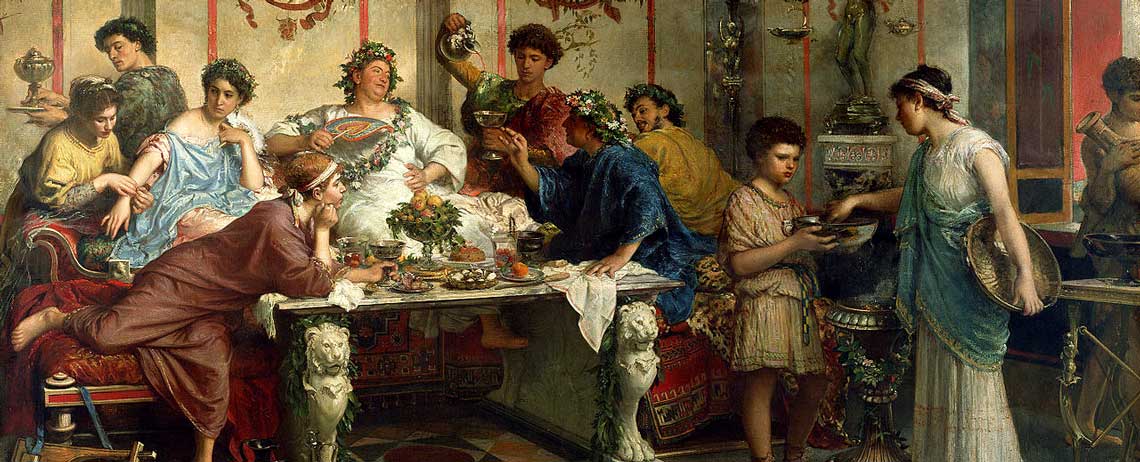
from Chapter 31, Nero’s floating feast on the Pond of Agrippa:
But the "floating
feast" pleased Cæsar, for it was something new. Besides, such exquisite
dishes were served that the imagination of Apicius would have failed at sight
of them, and wines of so many kinds that Otho, who used to serve eighty, would
have hidden under water with shame, could he have witnessed the luxury of that
feast. Besides women, the Augustians sat down at the table, among whom Vinicius
excelled all with his beauty. Formerly his figure and face indicated too
clearly the soldier by profession; now mental suffering and the physical pain
through which he had passed had chiselled his features, as if the delicate hand
of a master had passed over them. His complexion had lost its former
swarthiness, but the yellowish gleam of Numidian marble remained on it. His
eyes had grown larger and more pensive. His body had retained its former
powerful outlines, as if created for armor; but above the body of a legionary
was seen the head of a Grecian god, or at least of a refined patrician, at once
subtle and splendid. Petronius, in saying that none of the ladies of Cæsar's
court would be able or willing to resist Vinicius, spoke like a man of
experience. All gazed at him now, not excepting Poppæa, or the vestal virgin
Rubria, whom Cæsar wished to see at the feast.
Wines, cooled in mountain
snow, soon warmed the hearts and heads of the guests. Boats shaped as
grasshoppers or butterflies shot forth from the bushes at the shore every
moment. The blue surface of the pond seemed occupied by butterflies. Above the
boats here and there flew doves, and other birds from India and Africa,
fastened with silver and blue threads or strings. The sun had passed the
greater part of the sky, but the day was warm and even hot, though in the
beginning of May. The pond heaved from the strokes of oars, which beat the
water in time with music; but in the air there was not the least breath of
wind; the groves were motionless, as if lost in listening and in gazing at that
which was happening on the water. The raft circled continually on the pond,
bearing guests who were increasingly drunk and boisterous.
The feast had not run
half its course yet, when the order in which all sat at the table was observed
no longer. Cæsar gave the example, for, rising himself, he commanded Vinicius,
who sat next to Rubria the vestal, to move. Nero occupied the place, and began
to whisper something in Rubria's ear. Vinicius found himself next to Poppæa,
who extended her arm and begged him to fasten her loosened bracelet. When he
did so, with hands trembling somewhat, she cast at him from beneath her long
lashes a glance as it were of modesty, and shook her golden head as if in
resistance.
Meanwhile the sun, growing
larger, ruddier, sank slowly behind the tops of the grove; the guests were for
the greater part thoroughly intoxicated. The raft circled now nearer the shore,
on which, among bunches of trees and flowers, were seen groups of people,
disguised as fauns or satyrs, playing on flutes, bagpipes, and drums, with
groups of maidens representing nymphs, dryads, and hamadryads. Darkness fell at
last amid drunken shouts from the tent, shouts raised in honor of Luna.
Meanwhile the groves were lighted with a thousand lamps. From the lupanaria on
the shores shone swarms of lights; on the terraces appeared new naked groups,
formed of the wives and daughters of the first Roman houses. These with voice
and unrestrained manner began to lure partners. The raft touched the shore at
last. Cæsar and the Augustians vanished in the groves, scattered in lupanaria,
in tents hidden in thickets, in grottos artificially arranged among fountains
and springs. Madness seized all; no one knew whither Cæsar had gone; no one
knew who was a senator, who a knight, who a dancer, who a musician. Satyrs and
fauns fell to chasing nymphs with shouting. They struck lamps with thyrses to
quench them. Darkness covered certain parts of the grove. Everywhere, however,
laughter and shouts were heard, and whispers, and panting breaths. In fact Rome
had not seen anything like that before.
A
second excerpt from Chapter 33.Vinicuis
professes before Peter and Paul that he loves Lygia and is moved to the faith
of Christ.Vinicuis first speaks of his
difficulties with Christianity.
He spoke with head erect
and decisively; but still he was moved, and his legs trembled beneath his
mantle. When silence followed his words, he continued, as if wishing to
anticipate an unfavorable answer,—
"I know what
obstacles exist, but I love her as my own eyes; and though I am not a Christian
yet, I am neither your enemy nor Christ's. I wish to be sincere, so that you
may trust me. At this moment it is a question of life with me, still I tell you
the truth. Another might say, Baptize me; I say, Enlighten me. I believe that
Christ rose from the dead, for people say so who love the truth, and who saw
Him after death. I believe, for I have seen myself, that your religion produces
virtue, justice, and mercy,—not crime, which is laid to your charge. I have not
known your religion much so far. A little from you, a little from your works, a
little from Lygia, a little from conversations with you. Still I repeat that it
has made some change in me. Formerly I held my servants with an iron hand; I
cannot do so now. I knew no pity; I know it now. I was fond of pleasure; the
other night I fled from the pond of Agrippa, for the breath was taken from me
through disgust. Formerly I believed in superior force; now I have abandoned
it. Know ye that I do not recognize myself. I am disgusted by feasts, wine,
singing, citharæ, garlands, the court of Cæsar, naked bodies, and every crime.
When I think that Lygia is like snow in the mountains, I love her the more; and
when I think that she is what she is through your religion, I love and desire
that religion. But since I understand it not, since I know not whether I shall
be able to live according to it, nor whether my nature can endure it, I am in
uncertainty and suffering, as if I were in prison."
Here his brows met in
wrinkle of pain, and a flush appeared on his cheeks; after that he spoke on
with growing haste and greater emotion,—
"As ye see, I am
tortured from love and uncertainty. Men tell me that in your religion there is
no place for life, or human joy, or happiness, or law, or order, or authority,
or Roman dominion. Is this true? Men tell me that ye are madmen; but tell me
yourselves what ye bring. Is it a sin to love, a sin to feel joy, a sin to want
happiness? Are ye enemies of life? Must a Christian be wretched? Must I
renounce Lygia? What is truth in your view? Your deeds and words are like
transparent water, but what is under that water? Ye see that I am sincere.
Scatter the darkness. Men say this to me also: Greece created beauty and
wisdom, Rome created power; but they—what do they bring? Tell, then, what ye
bring. If there is brightness beyond your doors, open them."
"We bring
love," said Peter.
And Paul of Tarsus
added,—"If I speak with the tongues of men and of angels, but have not
love, I am become sounding brass."
But the heart of the old
Apostle was stirred by that soul in suffering, which, like a bird in a cage,
was struggling toward air and the sun; hence, stretching his hand to Vinicius,
he said,—"Whoso knocketh, to him will be opened. The favor and grace of
God is upon thee; for this reason I bless thee, thy soul and thy love, in the
name of the Redeemer of mankind."
Vinicius, who had spoken
with enthusiasm already, sprang toward Peter on hearing this blessing, and an
uncommon thing happened. That descendant of Quirites, who till recently had not
recognized humanity in a foreigner, seized the hand of the old Galilean, and
pressed it in gratitude to his lips.
Peter was pleased; for he
understood that his sowing had fallen on an additional field, that his
fishing-net had gathered in a new soul.
Those present, not less
pleased by that evident expression of honor for the Apostle of God, exclaimed
in one voice,—"Praise to the Lord in the highest!"
This week’s Gospel takes a turn from where to
meet God (the desert, the mountain, the temple) to preparing us for the
crucifixion and Holy Week events.Today
we have the famous conversation between Jesus and Nicodemus, the elder Pharisee
at the Temple. The Gospel passage comes in mid conversation,
but it would behoove you to read the previous thirteen lines of John, Chapter
3.Here is only the Gospel reading.
Jesus said to Nicodemus:
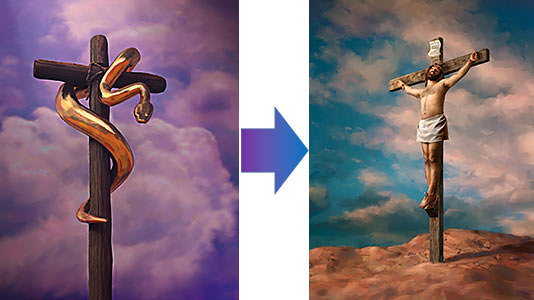
“Just as Moses lifted up the
serpent in the desert,
so must the Son of Man be lifted
up,
so that everyone who believes in
him may have eternal life.”
For God so loved the world that he
gave his only Son,
so that everyone who believes in
him might not perish
but might have eternal life.
For God did not send his Son into
the world to condemn the world,
but that the world might be saved
through him.
Whoever believes in him will not
be condemned,
but whoever does not believe has
already been condemned,
because he has not believed in the
name of the only Son of God.
And this is the verdict,
that the light came into the
world,
but people preferred darkness to
light,
because their works were evil.
For everyone who does wicked
things hates the light
and does not come toward the
light,
so that his works might not be
exposed.
But whoever lives the truth comes
to the light,
so that his works may be clearly
seen as done in God.
~Jn
3:14-21
This week, Bishop Barron has the best
homily.
In listening to Bishop Barron, it dawned on
me why we Catholics put a crucifix up in the sanctuary of every church, and why
we put crucifixes in our homes.I
remember a Protestant woman asking this once.She said Protestants emphasize the Resurrection, and so the cross should
not have the corpus on it.I responded
that the crucifixion shows our redemption and the love Christ showed for us,
and that is true.In the future I think
I should add to this analogy that Christ makes Himself, that is, just as the
bronze serpent was raised in desert that saved the Jews, Christ raised on the cross
saves us!
Meditation: “Just as Moses lifted up the
serpent in the desert, so must the Son of Man be lifted up, so that everyone
who believes in him may have eternal life.”


.jpg)