
For the Fifteen Sunday of Ordinary Time in Year A, Jesus begins His Parables Discourse, the third of five discourses in Matthew’s Gospel. He begins the discourse with the Parable of the Sower.
In the July 2026 (Vol 28, No. 5) issue of the
magazine Magnificat, Fr. Philip Nolan, O.P. in his editorial has
this to say about this parable:
The sower, says Jesus, is the Son of Man (Mt 13:37). In the beginning of time, the Son of Man the Word of the Father, brought life not merely to a barren landscape, but to a void of absolute nothingness. All things came to be through him, and without him nothing came to be (Jn 1:3). Then, after the influence of evil stunted the growth of that first gift of life, in the fullness of time the Son of Man, the Incarnate Word of the Father, graced with his footsteps the hills of Galilee and the streets of Jerusalem, scattering with abandon his words of new life for the people of his time and the people of every time.
This puts the Word that is being sown into
perspective. He is the Word that brought
forth life in abundance from the beginning, and is the Word which saves life
now. What is being scattered is the Word
and words are the communicative constituents that are transmitted and received. As Jesus says in this passage, “Whoever has
ears ought to hear.”
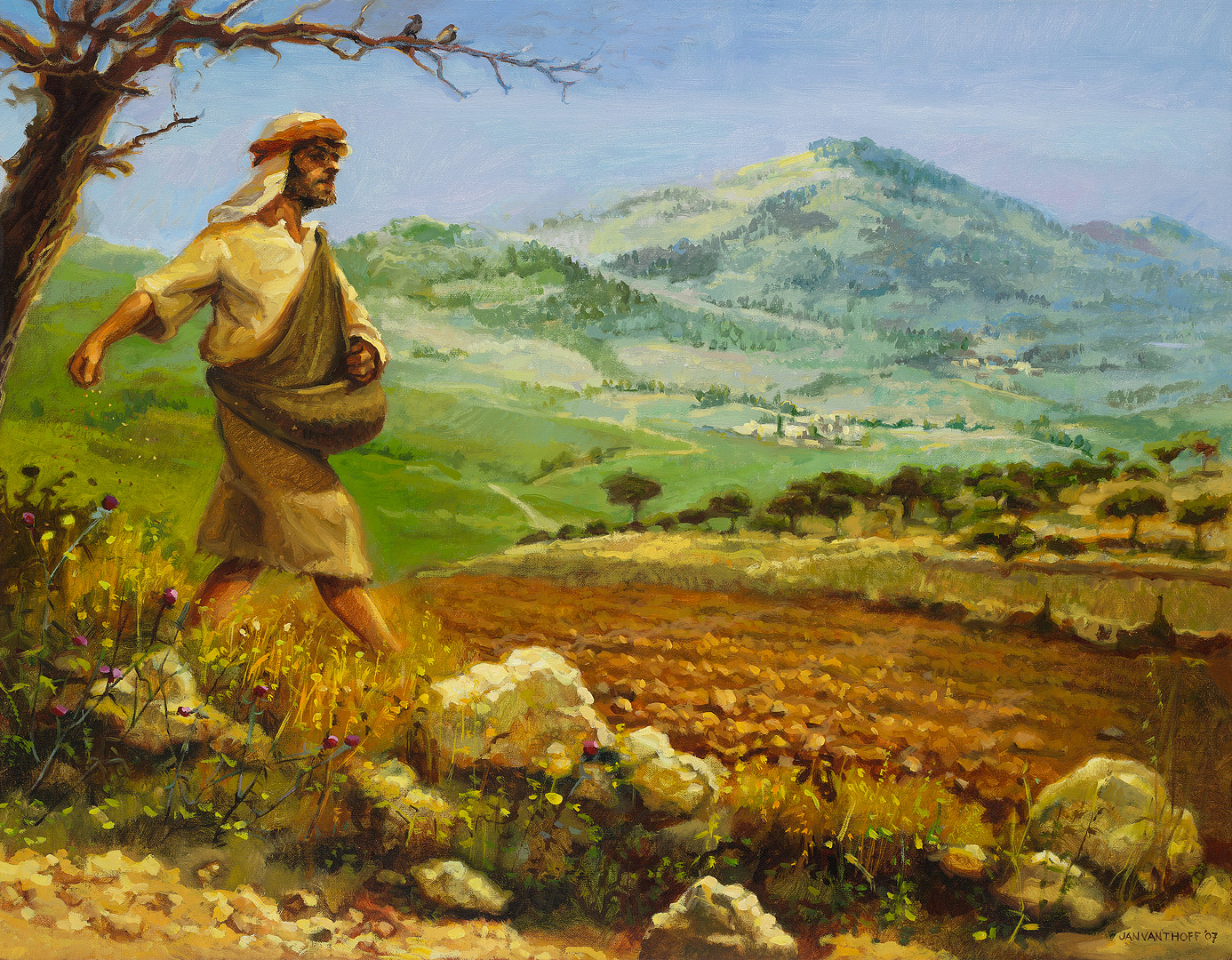
Today’s Gospel:
On that day, Jesus went out of the house and sat down by the sea. Such large crowds gathered around him that he
got into a boat and sat down, and the whole crowd stood along the shore.
And he spoke to them at length in
parables, saying:
“A sower went out to sow.
And as he sowed, some seed fell on
the path,
and birds came and ate it up.
Some fell on rocky ground, where it
had little soil.
It sprang up at once because the
soil was not deep,
and when the sun rose it was
scorched,
and it withered for lack of roots.
Some seed fell among thorns, and the thorns grew up and choked it.
But some seed fell on rich soil, and
produced fruit,
a hundred or sixty or thirtyfold.
Whoever has ears ought to hear.”
The disciples approached him and
said,
“Why do you speak to them in
parables?”
He said to them in reply,
“Because knowledge of the mysteries
of the kingdom of heaven
has been granted to you, but to them
it has not been granted.
To anyone who has, more will be
given and he will grow rich;
from anyone who has not, even what
he has will be taken away.
This is why I speak to them in
parables, because
they look but do not see and hear but do not listen or understand.
Isaiah's prophecy is fulfilled in
them, which says:
You shall indeed hear but not
understand,
you shall indeed look but never see.
Gross is the heart of this people,
they will hardly hear with their
ears,
they have closed their eyes,
lest they see with their eyes
and hear with their ears
and understand with their hearts and
be converted,
and I heal them.
“But blessed are your eyes, because
they see,
and your ears, because they hear.
Amen, I say to you, many prophets
and righteous people
longed to see what you see but did
not see it,
and to hear what you hear but did
not hear it.
"Hear then the parable of the
sower.
The seed sown on the path is the one
who hears the word of the kingdom
without understanding it,
and the evil one comes and steals
away
what was sown in his heart.
The seed sown on rocky ground
is the one who hears the word and
receives it at once with joy.
But he has no root and lasts only
for a time.
When some tribulation or persecution comes because of the word he immediately falls away.
The seed sown among thorns is the
one who hears the word,
but then worldly anxiety and the
lure of riches choke the word
and it bears no fruit.
But the seed sown on rich soil
is the one who hears the word and
understands it,
who indeed bears fruit and yields a
hundred or sixty or thirtyfold.”
~Mt: 13:1-23
I found Fr. Cajetan Cuddy’s explanation of this passage to be most
insightful. Other homilies focus on the sowing
and the four soils, but Fr. Cajetan explores the element of hearing involved in
the four types of reception.
Fr. Cajetan:
The Gospel's opening
line reads Jesus said to his disciples hear, hear the parable of the sower. This parable and this dynamic of hearing
serves as the gospel's meta context. The disciples hear Jesus. And what do they hear? They hear a command to
hear. Jesus commands them to hear the parable of the sower. Our Lord then exposits, he explains, he
unpacks the dynamics of hearing the word in each of the four disciplines.
Thus, if we were to
diagram, to frame, to outline this gospel, we could say that today's gospel
comprises three degrees of hearing. The
disciples hear from Jesus, a command to hear, a parable, about hearing the
word. Hearing, hearing, hearing. This is
the dynamic of today's gospel. And each
of the four seeds in the parable found in today's gospel, each of the four
seeds hears the word. We note, however, what also attends or doesn't attend
their hearing of the word. The
evangelical prepositions with and without With and without these prepositions,
these words, play critical roles in today's gospel. And perhaps most interestingly, the seed
that's most significant is the second seed, the one, quote, sown on rocky
ground. Each of the other three seeds
here's the word either with or without something else. The first without understanding. The third
with worldly preoccupations, the fourth with understanding. Notice the withouts and the withs that
punctuate these different scenarios vis-a-vis the seeds.
But it's the second scenario. The second is the only seed framed in terms of both a with and a without. The one who hears the word and receives it at once with joy, but he has no root. In other words, he is without root and lasts only for a short time, with joy, but without root, the paradoxical and distinguishing complexity of the second seed. So evidently this second seed understands something. Of the word it hears. If it lacked all understanding, there would be no basis for its initial joy. The seed rejoices precisely because it does understand to a degree. What it lacks, however, is root. And thus the joy of its, the seeds, the second seeds, limit under understanding, limited understanding is short-lived. In contrast, the fourth seed. Who hears the word and understands it, bears fruit and yields a hundred or sixty or thirty fold. This final seed who hears and understands is rooted. So now we see as we progress through the gospel, in addition to the theme, the dynamic of hearing, we also have the theme and dynamic of understanding. And the theme and the dynamic of rootedness. Understanding and rootedness are essential attributes in the contemplative life in the theologian's contemplation. As we know, understanding implies a certain intimate knowledge.
Notice what Fr. Cajetan points out.
In the first soil, “the seed sown on the path is the one
who hears the word of the kingdom without understanding it.” In the second soil, “the seed sown on rocky ground is the one who hears the word and receives it at once with joy. But he has no root [without] and lasts only for a time.” In the third soil. “the seed sown among thorns is the one who hears the word, but then [with] worldly anxiety and the lure of riches choke the word and it bears no fruit.” In the fourth soil, “the seed sown on rich soil is the one who hears the word and understands it.” The soil metaphor is related to the dynamic of hearing.
For the pastoral homily I’m going to turn to a Franciscan Friar, Fr.
Jonathan St. André, TOR of Franciscan University of Steubenville.
Fr. Jonathan:
In the gospel for the
15th Sunday in ordinary time, we hear the marvelous parable of the sower and
the seed. It's a beautiful parable that I think uh has so much to instruct us
in in our tradition and spirituality. And actually, it's a parable that was
close to St. Francis of Assi's heart. I've got my writings of St. Francis here,
which are dogeared and beat up because I love reading them. And in his early
rule chapter 22 in a section in admonition to the brothers he actually includes
this parable in its entirety and gives some commentary on it. St. Francis
writes, "We have nothing else to do but to follow the will of the Lord and
to please him. Let us be careful that we are not earth along the wayside or
that which is rocky or full of thorns." In keeping with what the Lord says
in the gospel, the word of God is a seed.
So Francis of Assi is really imploring us, cautioning us, asking us,
what kind of earth are you? How are you going to be receiving the seed of the
word of God?
And I think if you're like me and you're honest and you look at your own heart, you look at your own soul, you look at your own spiritual life, that you are all of those different kinds of earth in the parable. Sometimes parts of our heart are the wayside and the seed, the word of God, the message that we hear hits our heart, but it's too shallow. It can't really take root. Sometimes it's the rocky ground and we're all gung-ho and we're excited to move forward in faith and follow Jesus and then the trials come and it's like okay things slip away, slide away, we pull back. Sometimes it's the ground where the thorns have grown alongside the word and they choke out the word and the thorns in the scripture passage really relate to the allure of the world the temptations also anxieties for many of us we're just we get so anxious about many things that it can choke out the truth of God's word in our life so the constant pursuit of the spiritual life is to ask what kind of earth am I for the word for the seed that is the word?
So, at different moments in our lives we can be any of the four soils. The Word of God as seed is constantly being sown,
and our hearts have the capacity to plant the seed in any of the four
ways. May our hearts be of rich soil
more often than not.
Sunday Meditation: “But
blessed are your eyes, because they see,
and your ears, because
they hear.”
This is a lovely hymn that matches today’s Gospel perfectly, “Seed,
Scattered and Sown.”
Seed, scattered and
sown,
wheat, gathered and
grown,
bread, broken and
shared as one,
the living bread of
God.
Vine, fruit of the
land,
wine, work of our
hands,
one cup that is
shared by all;
the Living Cup, the
Living Bread of God.
Is not the bread we
break,
A sharing in our
Lord?
Is not the cup we
bless,
The blood of Christ
outpoured?
Lovely.

No comments:
Post a Comment