What
is it about six year old boys that love April Fools? Matthew has been playing April Fools jokes on
me since the first.
“I
have a present for you Daddy.”
“What
is it?
“April
Fools.”
It’s
raining outside, Daddy.”
“It
is?”
“April
Fools.”
Then
he tried to tell jokes in the form of his math homework.
“If
there are fifteen ice cream cones on an airplane and the airplane lands in
Chicago, how many ice cream cones are left?”
Of
course there’s no logic to that, and after trying to argue with him over it, I
gave up and said, “Five.”
“No,”
he said after pondering for a reply. “Four.”
Finally
in bed, while in his pajamas and I’m reading him a bedtime story, a childhood
version of Last of the Mohicans, he
tapped me on the arm. I’m at the point in
the story that has a lot of anticipation—the party on the side of the good guys
has been captured and are being led to the enemy camp for who knows what—so I
expected a story question from Matthew.
He did ask a question, though it had nothing to do with the story.
“If
you stick up you middle toe, is that a curse?”
“What?”
“Like
a middle finger. If you stick up your
middle toe, is that a curse?”
I
couldn’t answer because I was laughing..
“Like
this.” He sat up and with one hand held
down the two most left toes on one foot and with the other hand held down the
two most right toes. The middle toe was
sticking up.
I
couldn’t stop from laughing. “No, it’s
not. Now stop that.”
Today
is Divine Mercy Sunday, the Sunday so instituted by St. Pope John
Paul II. The idea traces back to a young
Polish woman who has become one of the great saints of the 20th
century, St. Maria Faustina Kowalska. In honor of this occasion I would like to present
and examine the great painting that St. Faustina commissioned to have painted
based on her visions of Christ coming to her.
There are many versions which have cropped up since the original was
painted back in 1934, but it is the original painting, painted by Eugeniusz Kazimirowski, that transcends.
Last
Thursday I had the great privilege to attend at my Church a private screening
of a documentary on the making of the painting (“The Original Image of Divine
Mercy: A Documentary”) and its convoluted history afterwards. The death of St. Faustina in 1938, the death
of the painter in 1939, the Nazi invasion, World War II, the Soviet occupation,
and the communist repression of religion all caused the painting to be forgotten,
abandoned, and then stored in an attic exposed to outdoor temperatures. It is a remarkable history, which you can
read here, but if you have the chance to see this wonderful documentary, do so. Here is a movie trailer of it.
So
while the original painting fell into obscurity, other painters tried their
hand at St. Faustina’s description in her diary of the Christ of her visions,
and their paintings took root in the culture.
That is why there are so many versions.
Of particular note is the 1943 version by Adolf Hyla, which you can see
on the Wikipedia entry for the Divine Mercy image. For me the Hyla version is most definitely
inferior. It’s less iconography and more
like a cover art for a pop culture magazine.
The right hand is raised less in blessing and more in salutation; Christ’s
face is Hollywoodish, the eyes don’t seem to convey mercy, and the head tilt makes
Christ seem more like a buddy than God.
The more I look at the Hyla version, the more I’m turned off.
So
why am I so attracted to the original Kazimirowski version?
First,
it’s restrained. The simplicity of every
element accentuates the message. There
is very little implied motion. The right
hand is fixed in position of blessing; the feet have come to a stop, though the
position suggests that Christ has come forward.
The tunic hangs still, suggesting stasis. The only motion is reserved for the left hand
peeling open the lip on the tunic at the heart, letting forth divine
light.
Second,
the right arm is in a position of balance and blessing. It is directly level with the left arm, with
the hand up in blessing. Balance seems
so important to the structure of the painting.
The light from the half opened lap reflects off the right hand, glowing
in benediction.
Third,
the dark background from which Christ comes forth is so suggestive. One can read it as the darkness of evil and sin,
or perhaps the darkness of pre-creation, or perhaps the darkness of everlasting
damnation. If the darkness contrasts
behind Christ, then the bright figure of Jesus is the light of the world, the
light of salvation, the light of mercy.
Fourth,
the eye of the viewer is drawn in toward the light from the heart. The lines all lead one to Christ’s heart. The light is bright, natural, and mixed with
red, suggesting the blood and water that flowed from Christ’s side. It is not over done and completely realistic
in the way it points downward as the opening from the garment flap lifts from
the bottom.
Fifth,
Christ’s face is perfection. It is His
face that captures me. It is a
remarkable work of realism. The hair and
the beard are so humble. Hair can
suggest ego and preening. Not here. The beard is scraggly, the hair thin and
modestly placed. It is a peasant’s face, not one of royalty. The eyes are looking down.This might be the most remarkable feature of
the painting.The eyes are not looking
into the viewer’s eyes.They are not
probing you.It is not a moment of
judgement.It is a moment of mercy, of
understanding.Here is a detail of the
head to mid body.
The
documentary said that when Kazimirowski completed the painting, St. Faustina
cried, not because he had captured her vision, but because she realized it was
impossible to capture it.In a way, the
painting was a collaboration between Kazimirowski, St. Faustina, and St.
Faustina’s spiritual director who modeled for the Christ, Fr. Michał Sopoćko.Every week Faustina would come to the studio
and have Kazimirowski rearrange in an effort to capture her visions. It must have been difficult for the painter to have this intense young woman stipulating her vision and forcing change upon change. However, the final product is a masterpiece.
Jesus,
I trust in you. Update April 5th, 8:09 AM: Great article by Paul Jaskunas in First Things Magazine on St. Faustina, the documentary, and the painting, here.
For
Easter Sunday, by the great seventeenth century poet, George Herbert.
Easter
Wings
by George Herbert
Lord,
who createdst man in wealth and store,
Though foolishly he lost the same,
Decaying more and more,
Till he became
Most poore:
With
thee
Oh let me rise
As larks, harmoniously,
And sing this day thy victories:
Then
shall the fall further the flight in me.
My tender
age in sorrow
did beginne:
And still with sicknesses and shame
Thou
didst so punish
sinne,
That
I became
Most thinne.
With
thee
Let me combine
And feel this day thy victorie:
For,
if I imp
my wing on
thine
Affliction
shall advance the flight in
me.
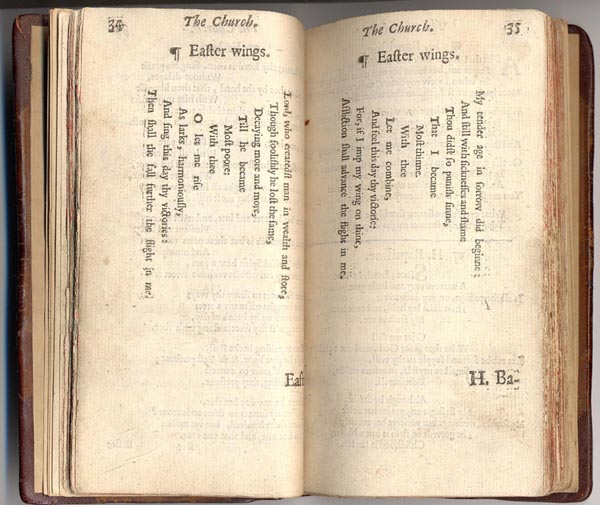
Notice
how the poem is shaped in the form of wings.
This is an example of Shape Poetry.
The poem’s typography form the shape of a
dove with wings. Notice also how the
skinny sections are about poor and thin.
That’s no coincidence. Here
is an image of the poem in its actual printing.
UPDATE (27 Mar, 2016 9:40 PM):
Great minds think alike. Fr. Dwight
Longenecker posted on this same poem for Easter Sunday reading over at
Imaginative Conservative. His essay goes
into more depth and well worth the read, here.
I
know the Brussels terror attack is very much in the news today, but I assume
most have heard about the ISIS attack in Yemen on a retirement home a few weeks
ago (March 4th) run by the Sisters of Charity, part of the late
Mother Theresa's ministry. If you haven't you can get filled in by this news
clip.
Five
Nuns ran the retirement home, one survived, a Sister Sally and she recounted
the events. The following are a second hand retelling from a Sister Rio,
written down by a Sister Adriana. Sister Sally is apparently in shock and has
not come out in public yet.
This Yemen massacre was what I think finally pushed the
Obama administration to agree that the slaughter of Christians and other
minorities in the Middle East to be classified as genocide. I don't know why it
took the Obama administration this long - it's been evident for a long time -
but at least we should be grateful they finally did.
So for Good Friday, here is the second hand retelling of
what happened that morning. The
description is gruesome and brought me to tears. You might want to pass on it.
It's a little disjointed, as you can imagine something like this might be.
SISTER
RIO’S WORDS TO SISTER ADRIANA, MC: Friday, midday, March 4, 2016
Sisters
had Mass, breakfast as usual. As usual, Father stays back in chapel to say
prayers, then to fix things around the compound.
8:00am:
Said apostolate prayer and all 5 went to home.
8:30am:
ISIS dressed in blue came in, killed guard and driver.
5 young
Ethiopian men (Christian) began running to tell the sisters ISIS was here to
kill them. They were killed one by one. They tied them to trees, shot them in
the head and smashed their heads.
The
sisters ran 2 by 2 in different directions, as they have mens and ladies home.
4 working women were screaming, “Don’t kill the sisters! Don’t kill the
sisters!” One was the cook for 15 years. They killed them as well.
They
caught Sr. Judith and Sr. Reginette first, tied them up, shot them in the head
and smashed their heads. When the sisters ran in different directions, the
Superior ran to the convent to try to warn Father Tom.
They
caught Sr. Anselm and Sr. Marguerite, tied them, shot them in the head and
smashed their heads in the sand.
Meanwhile,
the Superior could not get to the convent. It is not clear how many ISIS men
were there.
She saw
all the sisters and helpers killed. The ISIS men were already getting to the
convent so she went into the refridgerator room, since the door was open. These
ISIS men were everywhere, searching for her, as they knew there were 5. At
least three times they came into the fridgerator room. She did not hide, but
remained standing behind the door – they never saw her. This is miraculous.
Meanwhile,
at the convent, Father had heard the screaming and consumed all the Hosts. He
had no time to consume the large Host, so he threw the oil out of the sanctuary
lamp and dissolved it in the water.
A
neighbor saw them put Father Tom in their car. They did not find any trace of
Father anywhere. All the religious articles were smashed and destroyed – Our
Lady, crucifix, altar, tabernacle, lectionary stand – even their prayer books
and Bibles.
10:00 or
10:15am: The ISIS men finished and left.
Sr. Sally
came to get the bodies of the sisters. She got them all. She went to the
patients to each one individually to see if they were OK. All were OK. Not one
was hurt.
The son
of the woman who was the cook (who was killed) was calling her on her
cellphone. Since she was not answering, he called the police, and he went with
the police there and found this great massacre. The police and the son arrived
at about 10:30am.
The
police tried to take Sr. Sally out of there — she refused to leave the people
who were crying, “Don’t leave us; stay with us.” But the police forced her to
go with them because the ISIS knew there were 5 sisters, and they were
convinced they will not stop until they kill her too. So finally she had to
leave. She took one set of clothes and the sisters’ bodies, and the police
brought them to an international hospital called “Doctors Without Borders” for
protection. As there was not enough room in the mortuary of that hospital for
the sisters’ bodies, the police brought their bodies to a bigger hospital
mortuary.
Sr. Sally
told Sr. Rio she is so sad because she is alone and did not die with her
sisters. Sr. Rio told her God wanted a witness and told her, “Who would have
found the sisters’ bodies and who would ever tell us what happened? God wants
us to know.”
Pope
Francis had his secretary contact the Yemen Secretary of State very often –
about once a week to check up on the sisters and reassure them of his
closeness. Today, the Pope’s secretary sent the message: “I thank them — Little
M.C. martyrs.” He said he is offering the 40-hour First Friday devotion for
them.
Sr. Sally
told Sr. Rio that Fr. Tom tells them every day, “Let us be ready for
martyrdom.”
Sr.
Judith — they were trying so hard to take her for senior course, but they were
not able to get her out.
Sr.
Reginette — they were trying to send her for junior course but could not get
her out.
God
wanted them there.
Aden is
rich city – a port city. Aden wanted to be its own state, so they got ISIS in
to help them fight against Yemen. So ISIS won for Aden. That was the war last
year, with all the bombing. They won, so that is over, but ISIS won’t leave.
They want to take over and exterminate any Christian presence. They did not
kill the sisters in the war because they had no political reason to waste time
on them. But now, they are the only Christian presence, and ISIS wants to get
rid of all Christianity. So they are real martyrs — died because they are
Christians. They could have died so many times in the war, but God wanted it to
be clear they are martyrs for the faith.
Sr. Rio
said Sr. Sally is fully surrendered. The police are trying to get her out
because they will just keep after her until they kill her. She is fully
surrendered and told Sr. Rio – whatever God wants. She said the other Muslims
are so respectful of them. She said to pray that their blood will be the seeds
for peace in the Middle East and to stop the ISIS.
She said
that if they kidnapped Father Tom most probably they will wait 2 days, then ask
in exchange for Father Tom either money or the release of their members held in
prison.
Sr. Rio
said they were so faithful – ISIS knew exactly when they leave and when to
break in. And because of their faithfulness, they were in the right place at
the right time and were ready when the Bridegroom came.
Sr.
Adriana said she thinks the crushing of the heads has some evil connection with
“She will crush head of the serpent,” some kind of mockery or evil meaning.
I thought that after the Holocaust, the world promised
never again would we be idle in the face of genocide. But as you can readhere, there has
been a long string of genocides across the world since WWII. I don't know why
humanity succumbs to such evil, but here it is again. On this Good Friday, give
a special prayer or two for the innocent people massacred here and across the
Middle East, especially for these modern day Holy Martyrs who have died simply
for being Christian. May they rest in peace.
This
was on TV Sunday night, Palm Sunday, and I missed it. I didn’t know about it, but I did see the
blog posts Monday Morning. It’s a
musical narrative of Christ’s last week leading to the Resurrection. Kathy Schiffer, the producer of the show,
writes about it on Aleteia.
“I didn’t want to create
a show just for believers. I wanted to reach those who know nothing!”
Adam Anders is talking
about his latest project, The Passion, a creative and contemporary retelling of
the Gospel narrative which will be broadcast live from New Orleans on Palm
Sunday. Anders is executive producer and executive music producer for The Passion.
At Fox’s New Orleans studio, he talked to reporters about the project.
Here
is the trailer:
Kathy
continues on how the idea came about:
Anders first got the idea
for The Passion after he was invited to attend a similar large-scale production
in Holland. In that country, he reported, only 7 percent of the population goes
to church. In contrast, since the musical production of The Passion was
introduced there in 2011, it has been viewed by more than 50 percent of
Holland’s populace. Anders was excited to realize that this performance could
bring the Gospel to people who might otherwise know nothing about it.
“The Catholic Church [in
the Netherlands] got behind it, helping to fund and promote it,” Anders told
me. “It just took the country by storm. So when I saw that response in a
country that’s largely atheist, I thought This is perfect! We’ve got to get it
here!”
What
a fantastic idea, and New Orleans is a great selection for the host city. Kathy continues:
The procession will
originate at New Orleans’ iconic Superdome, where thousands of displaced
persons took refuge during Hurricane Katrina. The relevance of New Orleans as a
“resurrected city” is not lost on Anders. “Tyler Perry, who grew up in New
Orleans, will talk about it,” he told me. “The Superdome, where this starts,
has become a symbol of suffering. There is, in people’s minds, that powerful
visual of people trapped by the swirling floodwaters. So many lives have been
changed — for better and worse. The city lost thousands of people, some who
died and some who left and never came back. My own brother lived here and never
returned after Katrina. Now he’s back here for the first time — he’ll be
playing in the band.”
So who is in it?
The Passion features a
star-studded cast from a wide range of musical genres. Tyler Perry is the host
and narrator. Cuban American singer/songwriter/actor Jencarlos Canela will play
Jesus, clad in a beige trenchcoat. Chris Daughtry stars as Judas, and Trisha
Yearwood portrays Jesus’ mother, Mary. British singer/songwriter Seal steps
into the role of Pontius Pilate. Christian artist Michael W. Smith plays a
disciple. And Nischelle Turner, entertainment correspondent for CNN and
anchor/correspondent for Entertainment Tonight in effect plays herself — as a
reporter on the streets of New Orleans, interviewing people from the crowd
during the live procession. Three musical groups — a band from Los Angeles, a
New Orleans jazz band and a choir of voices from local churches — will perform,
and there will be an appearance by New Orleans’ famed Preservation Hall Jazz
Band.
To be honest, other than
Seal, I don’t know any of them, but don’t go by me. I’m pop culture illiterate. Christopher Rossi gave it a fine review on
his blog, Christopher Closeup: /
The use of modern songs
as the heart of the production showed that God (or at least a spiritual
subtext) can be found in popular culture if we open our eyes and ears.
Jencarlos Canela as Jesus singing “Calling All Angels” in the Garden of
Gethsemane was especially fitting. (“When there is no place safe and no safe
place to put my head / When you feel the world shake from the words that are
said / And I’m calling all angels / I’m calling all you angels.”). And his duet
with Prince Royce as Peter on the Phillip Phillips hit “Home,” brought a new
dimension to the song when thought of from the point of view of how Peter felt
when Jesus told him he would be the head of His church. (“Settle down, it’ll
all be clear / Don’t pay no mind to the demons / They fill you with fear / The
trouble—it might drag you down / If you get lost, you can always be found /
Just know you’re not alone / ‘Cause I’m gonna make this place your home.”)
Now if you missed it like
I did, you can still watch it on streamed at Fox.com, here.
I’ve been watching it and
I love it. It’s gospel and very American
music. I also love the scenes of New
Orleans French Quarter. I’ve only been
there once (actually a few months before Hurricane Katrina) and I recognize a
number of the wonderful city visuals.
Here
were my observations for the second and third mansions from the Goodreads Catholic
Thought book club discussions on St. Theresa of Avila's Interior Castle.
Susan Margaret wrote: "In the first
paragraph on the Second Mansions, Teresa mentions something that I think all of
us on Goodreads – Catholic Thought have in common and that is, “…most of us
never get tired of the multitude of
books that deal with matters of the soul” (pg 55, Mirabai Starr edition). I
really like the fact that Teresa is such an avid reader; it gives me something
I can easily relate to."
Manny in repsnse: I'm amazed at how learned she
is. I don't know the details of her biography; how did she become so well read
and a fine writer for a woman of her age. It's a rare woman in her times that
even got to go to school, let alone be so exceptional.
Kerstin wrote: "I find her writing style a
little rambling. It almost seems as if one has to make a synopsis of every
paragraph to extract what the essence is."
Manny in repsonse: Kerstin, if I may speculate,
I think what you're having trouble with is St. Theresa's poeticism. She writes
like a poet. So much of what she says is in analogies, similes, and metaphors,
and therefore it's not direct. And to be fair to St. Theresa, the subject
matter doesn't lend itself to direct speech. Such spirituality is difficult to
express, and one has to grasp for comparisons. I could be wrong. I could also
be the translation.
For me, I had similar issues at the beginning.
But over time her style has worked its way into my head. I'm fifteen pages from
the end, and her writing seems quite logical and conversive.
Matthew in the
Introduction section mentioned he felt he was mostly in the first mansion. I would have to say for me—and I bet most of
us here—are in the second mansion. In
the 2nd paragraph is where she describes those people:
“In this part of the
castle are found souls which. have begun to practise prayer; they realize the
importance of their not remaining in the first mansions, yet often lack
determination to quit their present condition by avoiding occasions of sin,
which is a very perilous state to be in.
However, it is a great grace that they should sometimes make good their
escape from the vipers and poisonous creatures around them and should
understand the need of avoiding them. In some way these souls suffer a great
deal more than those in the first mansions, although not in such danger, as
they begin to understand their peril and there are great hopes of their
entering farther into the castle. I say that they suffer a great deal more, for
those in an earlier stage are like deaf-mutes and are not so distressed at
being unable to speak, while the others, who can hear but cannot talk, find it
much harder. At the same time, it is better not to be deaf, and a decided advantage
to hear what is said to us.”
Yes
that probably describes me. I pray and
understand the condition of my sins, and understand the need to avoid them, but
I can’t say I break free of them often.
She goes on in the next paragraph to understand the psychology of me and
those like me:
“These souls hear our
Lord calling them, for as they approach nearer to where His Majesty dwells He
proves a loving Neighbour, though they may still be engaged in the amusements
and business, the pleasures and vanities of this world. While in this state we
continually fall into sin and rise again, for the creatures amongst whom we
dwell are so venomous, so vicious, and so dangerous, that it is almost
impossible to avoid being tripped up by them. Yet such are the pity and
compassion of this Lord of ours, so desirous is He that we should seek Him and
enjoy His company, that in one way or another He never ceases calling us to
Him. So sweet is His voice, that the poor soul is disconsolate at being unable
to follow His bidding at once, and therefore, as I said, suffers more than if
it could not hear Him.”
Though
I hear our Lord, we are just too wrapped up in the business and amusements of
this world, like the Super Bowl. You
would think that watching the Super Bowl would be relatively innocuous but it
would amaze how many little sins will happen during the course of a Super Bowl
party: the language, the bad thoughts, the gambling, the pleasure of watching
someone lose, etc. All venial sins, I’m
sure, but sins nonetheless sins which pull you away from elevating the
soul.
Third
Mansion
Along
the line of needing a trusted spiritual adviser, this paragraph from the first
chapter of the third mansion suggests that it would be helpful and that it
might not:
"Still I must give
you one warning: be not too confident because you are nuns and the daughters of
such a Mother. David was very holy, yet you know what Solomon became. Therefore do not rely on your enclosure, on
your penitential life, nor on your continual exercise of prayer and constant
communion with God, nor trust in having left the world or in the idea that you
hold its ways in horror. All this is good, but is not enough, as I have already
said, to remove all fear; therefore meditate on this text and often recall it:
'Blessed is the man that feareth the Lord.' "
You
could look at that paragraph and conclude you can't do it on your own, Even Solomon failed. But it also warns that just because you have
Theresa of Avila as a spiritual mother, it doesn't mean that you will
progress. I've never had a spiritual
director, and it would have to be someone I really felt comfortable with if I
were to take one on, but I don't know how much it helps. I guess it can't hurt.
In
reply to Andy above, I found this somewhere in the middle in the second chapter
to be significant:
“Believe me, the question
is not whether we wear the religious habit or not, but whether we practise the
virtues and submit our will in all things to the will of God. The object of our
life must be to do what He requires of us: let us not ask that our will may be
done, but His. If we have not yet attained to this, let us be humble, as I said
above. Humility is the ointment for our wounds; if we have it, although perhaps
He may defer His coming for a time, God, Who is our Physician, will come and
heal us.”
Humility
and submission to the will of God in all things—which is the same thing—is how
one makes it to the third mansion.
Pvt. Robert N. Jabo, of the 8th New
Hampshire infantry, was dying of tuberculosis in Washington’s Harewood Hospital
and needed to write to his family.
The Civil War had been
over for months. Most soldiers had gone home. And Jabo’s wife and six children
were no doubt wondering where he was.
But he was sick and
illiterate. So a cheerful, bearded man who regularly visited hospitalized
soldiers offered to write a letter for him.
The
cheerful bearded man turned out to be Walt Whitman. Whitman wrote many letters for the wounded
and ill of the Civil War. During the war
Whitman helped in the hospitals in Washington D.C. where many of the Union
wounded were brought.
The letter was written on
both sides of a plain sheet of lined paper, which was probably Whitman’s. It
was written with a pen in neat, legible script, probably on Jan. 21, 1866.
“I am mustered out of the
service but am not at present well enough to come home,” it says on the front
side. “My complaint is an affection of the lungs. . . . I hope you will try to
write back as soon as you receive this and let me know how you all are.”
Wilson, of Arlington,
turned the letter over.
“Well I send you all my
love, and must now close,” it ends. “Your affectionate husband . . . ”
Two lines down, came the
surprise: “Written by Walt Whitman, a friend.”
It’s
an amazing find. I’m not sure if I’ve
said this before on a Whitman post of mine, but I’ll say it again. Whitman was an incredibly compassionate man
and a truly good soul.
Here’s
an image of the actual letter, with Whitman’s signature prominent.


.jpg)