
For the Twelfth Sunday in Ordinary Time for
Year A, Jesus continues His Missionary Discourse in chapter ten of Matthew’s
Gospel. Gina Hens-Piazza summarizes the
gist of the passage in her Scripture
Reflections.
In the Gospel passage from Matthew, Jesus urges his disciples three times to be unafraid. As he continues the missionary discourse begun in last week’s Gospel passage, Jesus now warns his disciples about the opposition they will encounter, an opposition that can dissuade them from carrying out his mission. These hostilities not only can destroy the body, but they can also do far worse; they can destroy the soul, which can discourage and eventually cut off one’s will and desire to follow Jesus.
With the three times Jesus tells us to not be afraid, He provides assurances to strengthen us: Mysteries will be revealed; God will protect the soul; God knows all about you. The verse that most stands out is how the Father knows even the number of hairs on one’s head. Who can know how many hairs are on one’s head? It’s impossible to count, though I suppose we see that the number decreases with age. But our Father knows.
Today’s Gospel:
Jesus said to the Twelve:
"Fear no one.
Nothing is concealed that will not
be revealed,
nor secret that will not be known.
What I say to you in the darkness,
speak in the light;
what you hear whispered, proclaim on
the housetops.
And do not be afraid of those who kill the body but cannot kill the soul;
rather, be afraid of the one who can
destroy
both soul and body in Gehenna.
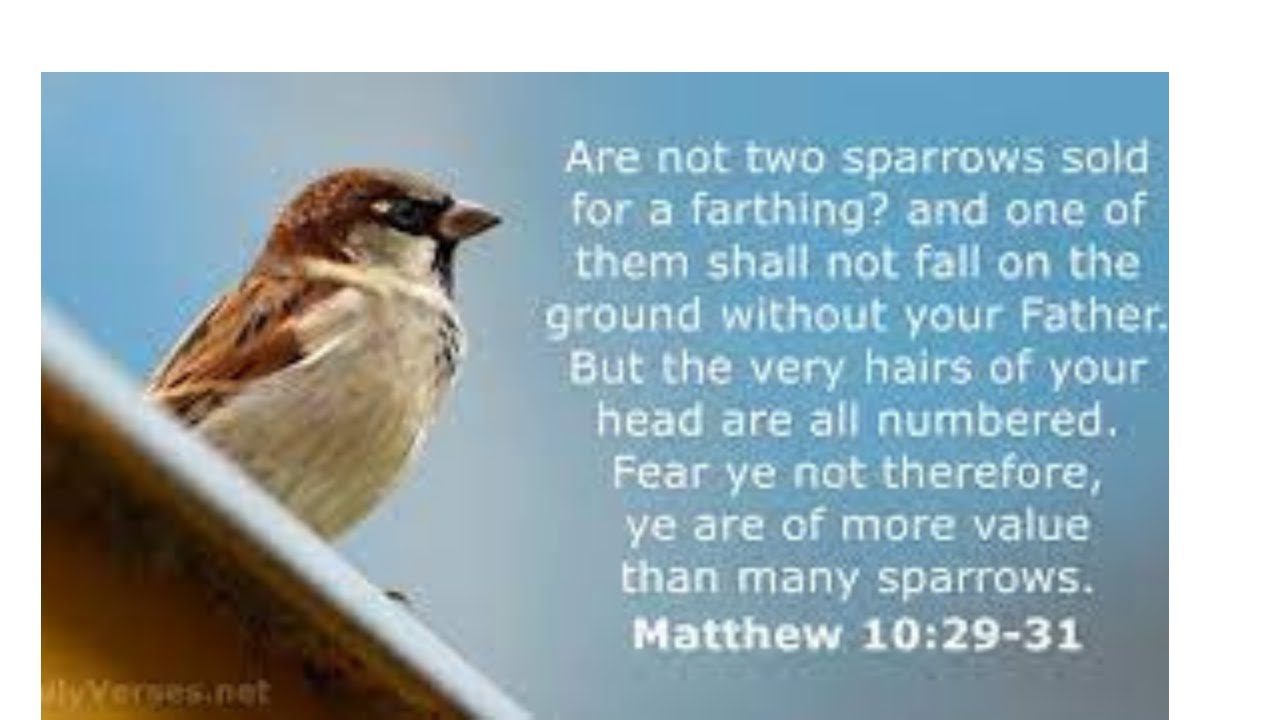
Are not two sparrows sold for a
small coin?
Yet not one of them falls to the ground without your Father's knowledge.
Even all the hairs of your head are
counted.
So do not be afraid; you are worth more than many sparrows.
Everyone who acknowledges me before
others
I will acknowledge before my
heavenly Father.
But whoever denies me before others,
I will deny before my heavenly
Father."
~Mt: 10:26-33
For the exegetical homily, I’m going to go to Catholic Bible
Studies. Unfortunately the priest here
doesn’t give his name. He must
somewhere, but I can’t find it. The
priest here summarizes the Missionary Discourse and dives right into the Gospel
passage.
Catholic Bible Studies:
So, if you remember
last week, we finished the ninth chapter and started into the 10th chapter
of Matthew's gospel. So, the at the very end of chapter 9 …Jesus talks about
the harvest being plentiful. There's so many souls to harvest. We need a
harvest of souls, and we need harvesters to gather the souls. We need out we
need the Lord to send out workers, laborers for his vineyard. And so ask the
master of the harvest to send out those laborers. Okay? And then at the very
beginning of chapter 10, he calls his 12 apostles and then he sends them out.
So in in other words, like he's speaking to his disciples and then the very
ones that he calls are like an answer to the prayer that he just commanded to
be prayed ultimately. So it's kind of an interesting thing. But then but then
from there he gives them a mission and in giving them a mission he gives them
authority his own authority.
He calls them to
share in his mission. That's such an important thing. And again I mentioned
this last week that he doesn't give this authority to everybody but he does
give it to these 12. Okay. Then he goes on what's called a missionary discourse
or a missionary sermon. That is to say that he's he speaks to them. He preaches
to them about what they're going to encounter in the mission. And surprisingly
enough, what he has to say is mostly unpleasant. So it's obviously really cool
that that he talks about like, okay, you're going to go and you're going to
cast out demons and you're going to forgive sins and you're going to heal
people and all that that really cool stuff. You're going to do everything that
he's been doing. But the part that we missed it's kind of an interesting thing
that we we skipped over a whole bunch of it. Um is is basically him saying like
look I send you out as sheep in the midst of wolves…And so what would what
would sheep do in the midst of wolves? Well the wolves would attack and eat the
sheep ultimately. That's what they would do.
And so for Jesus to
say that to his apostles, he's like look I'm giving you this authority and
you're going to do incredible things. You're going to save souls for the
kingdom and yet you're going into the midst of wolves and you're just sheep.
You're not like another wolf to fight against the wolves, but you're going to
be a sheep. And that's it seems strange
and it seems counterintuitive. Like, why
would he send sheep into the midst of wolves?
Okay, so then then he gets into this part. He's like, "Okay, well, fear no one." So you can imagine like you're hearing this this whole discourse and it's like this is going to be really hard and you're going to be rejected and people are going to drag you and they're going to flog you and they're going to persecute you and they're ultimately going to malign you because they malign me. So it's like you hear that and you're like, "Oh gosh, what a gift that Jesus you're sending us out on this this mission. What can can you find someone else?" And nonetheless, he says, "Fear no one. Nothing is concealed that will not be revealed, nor secret that will not be known." This is kind of has echoes of when Jeremiah says this, "But the Lord is with me like a mighty champion. My persecutors will stumble. They will not triumph. In their failure, they will be put to utter shame to lasting unforgettable confusion." So there's something here where the Lord in his wisdom, he says, "Look, I've seen it all. I've seen it all happen and it's going to happen again. But nonetheless, those things that are secret, there are little secret deceptions, there secret lies, there are secret rejection of you, it's all going to be made known. And so what I say to you in the darkness, speak in the light. Bring it all to the light so that so that people can hear and see that you are one of my disciples and that you are here to proclaim the kingdom of God. Do not be afraid of those who kill the body but cannot kill the soul. That's such an important point that you have you have you have a part of you, your soul that is that is made for immortality and so yes, people are going to persecute you. They can they can even harm you through the flogging through perhaps even your own martyrdom but they cannot harm your soul. So here he's laying out the relative value of earthly life compared to the absolute good of eternal life with God in heaven. And so he's saying cling to that absolute good as opposed to clinging to the relative good of earthly life as good as it is. Cling instead to the thing that is absolutely good. Uh rather be afraid of the one who can destroy both soul and body in Gehenna.
So given this discourse, do you think it would have made the apostles any less afraid? I don’t know. If I were an apostle listening to this, I would stick with Jesus but I would probably still be afraid. I think it’s sticking with Jesus that is most important.
For the pastoral homily, I turn to Fr. Mike Schmitz, who gives a super
one here. I’m only going to quote a
little bit to get the gist, but you must listen to the entire homily.
Fr. Mike:
So um I was thinking
about fear recently. I think fear is funny. Um not fear isn't funny. I think
what we are afraid of is sometimes funny because you ask someone like okay what
are some of your fears? The list is quite diverse. The list goes from spiders
to dying alone. … The thing the span of things that we can be afraid of things
like abandonment or rejection or famine or snakes like the vast amount of
things that we can be afraid of are remarkable. In fact, there was a study and then someone Jerry Seinfeld made
a joke about it that he said that they came out with this survey and they said
that the top two fears people have are uh are public speaking number one and
dying number two. So he made that joke that said so basically at a funeral most
people would rather be in the casket than giving the eulogy because the things
that we're afraid of right so and one of those things we're afraid of is death and
I think both of them are mentioned in both things are mentioned in the in in
the gospel today. So fear is mentioned in the gospel today and death is
mentioned in the gospel today.
Of course for
Christians we recognize that we're called to never ever fear the end of our
lives. And yet as Christians I think a lot of us a lot of us are afraid of
death. Maybe we're not necessarily afraid of death. We're afraid of what will
happen immediately after death because we know that immediately after at the
moment of our death, we know that there is the judgment. I think that's what makes us afraid. And that
and that then it makes sense. Of course, I mean I pause on this. Have you ever
imagined what it would be or what it will be like to stand before God at the
moment of your death? to stand before
God in that moment of judgment. To stand before God in the moment of moments
because that's for all of our lives. That is going to be it. That is going to be in all of our lives. That is going to be the moment of moments.
Have you ever imagined that moment? I I I do a lot actually. What will it be like to stand before God who
is goodness himself? To stand before God
who is truth himself. You know in the
gospel remember Jesus says, "Do not fear. do not be afraid. But he says, I will tell you who to fear. He
says, "Fear the one who can cast both body and soul into Gehenna." Who Jesus is talking about. He's talking
about God.
I want to invite you to do this. I think we all need to do this to do this exercise to do the exercise where you put yourself in that situation where the moment of moments has arrived and in that moment in that moment you are totally helpless, totally defenseless in that moment. There's no escaping goodness in that moment. There's no avoiding truth and there's no argument. There's no excuses. There's no but but but no, there's none of that. There's no defense and there's no time, right? There's no opportunity to change. There's no opportunity to say, "Well, God, I'll be better in the future." Because there is no future in that moment of moments. There will be only one thing left. That one thing left will be the truth of what I've become. The one thing left will be who I've chosen to be. That will be the one thing left in the moment of moments. who you and I have chosen to become and Jesus. That's all. That's all in the end. It'll be who you and I have chosen to become and Jesus because that that's so important for us to understand.
I think that is such an incredible thing to do, to imagine yourself
before God on that moment of moments. Do
it. Do it often. I will.
Sunday Meditation: “So
do not be afraid; you are worth more than many sparrows.”
Let’s listen to “Faith of Our Fathers.”
Faith of our fathers,
living still
In spite of dungeon,
fire and sword
O how our hearts beat
high with joy
Whene’er we hear that
glorious word
Faith of our fathers,
holy faith
We will be true to
thee till death
Faith of our fathers,
we will strive
To win all nations
unto thee
And through the truth
that comes from God
Mankind shall then
indeed be free
Faith of our fathers,
holy faith
We will be true to
thee till death
Faith of our fathers,
we will love
Both friend and foe
in all our strife
And preach thee, too,
as love knows how
By kindly words and
virtuous life
Faith of our fathers,
holy faith
We will be true to
thee till death
Faith of our fathers,
holy faith
We will be true to
thee till death
To be true to thee!

No comments:
Post a Comment