"Love follows knowledge."
"Beauty above all beauty!"
– St. Catherine of Siena

Friday, July 10, 2015

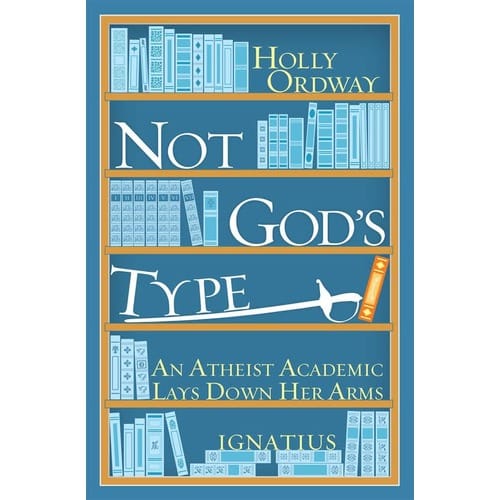
Not God’s Type by Holly Ordway

At my last quarterly update of my annual reads, I mentioned I read Holly Ordway’s Not God’s Type, a memoir of her conversion story, and low and behold she turns up as a guest on the EWTN TV show, The Journey Home with Marcus Grodi.

For those that aren’t familiar, The Journey Home is an interview show where the guest provides their conversion story to the Catholic faith.  Holly Ordway was an atheist University professor of English Literature, and her memoir took the reader through the process of overcoming her strong atheism, compelled ultimately to believe in Christianity, and then after a few years as an Anglican/Episcopalian converted to Roman Catholicism.  Literature and philosophic reasoning was at the heart of her conversion. 


Here is the episode with Holly on The Journey Home.  Be aware, there lots of literature mentioned.


But do read the book.  It’s even better than the interview.  Here is an excerpt, this from Chapter 3, “Alone in the Fortress of Atheism.”

Behind all of my consciously articulated views was the same premise: there is no God, no ultimate meaning beyond ourselves.
 
If there is no real meaning to our lives, what is the point of living?  As early as high school, I had recognized the problem.  I remember in my junior-year Latin class reading some of the more philosophical despairing poets, and asking my teacher why, if they felt life was meaningless, didn’t they just kill themselves?  My teacher replied, “A lot of them did.”
…Atheism when consistently lived out, leads to self-deception or despair.  Self-constructed meaning is only a stop-gap: it is real only in the sense that a stage set of Elsinore Castle is a real place.  One can suspend disbelief while Hamlet is being performed, but at some point, the curtain falls and one must leave the theater.  What’s to be done when Helping Others, Doing Good Work, and Having Friends are recognized as paint and canvs and trick lighting?

But it was through reading high literature that opened her to exploring faith.  Here’s another excerpt (from Chapter 6, “Winter and Spring”) on how literature opened her to faith.

The greatest works of English literature spring from Christian roots.  And so, atheist though I was, when I turned back to literature I found myself rereading poems of explicit and profound Christain faith.  I rediscovered the work of T. S. Eliot, George Herbert, John Donne, Gerard Manly Hopkins, and the Anglo-Saxon poets whose names are lost to history.  Consciously, I dismissed their faith as antiquated, or subjective, or irrelevant; I took the condescending view that their work was worth teaching in spite of this irritating fascination with God.  But knowing a poem is experiential, like knowing a person.  In order to teach a poem you must know it inside and out: its nuances, its shifts of tone, its images and their play upon the imagination.  A great poem speaks more fully and deeply upon each reading of it.  And something happened as I read.

John Keats, in “Ode to a Grecian Urn,” closes with these words: “ ‘Beauty is truth, truth beauty,’—that is all/Ye know on earth, and all ye need to know.”  Beauty: I had admired it, appreciated it, been moved by it, but until now had not thought deeply about why I responded as I did.  Something had changed.  I could feel power thrumming in the lines of the poems, an electricity of meaning, drawing from some source beyond my reach, and I began to wonder what that source was.


Now that was not her conversion moment.  Just a seed that would blossom later.  It took a lot of philosophic jousting to reach her faith, and Ordway takes the reader through it.  The book is on Amazon for those interested.


Wednesday, July 8, 2015

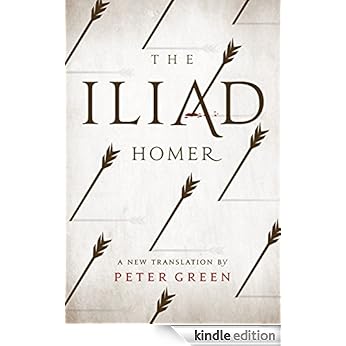
Literature in the News: New Translation of Homer’s The Iliad

I came across a book review of a new translation of Homer’s The Iliad by Peter Green in Washington Free Beacon.  

When it comes to picking a translation of the Iliad or the Odyssey, readers of Homer sometimes feel as if they are being forced to choose between the beautiful and the good. The most popular translations of Homer are either praised for their poetry or for their accuracy, but not for both.

Robert Fitzgerald and Robert Fagles’ translations are known for their lovely verses, but also for taking liberties with the text. Meanwhile, Richard Lattimore’s translation is known for being line-by-line accurate to the Greek, but also for being convoluted and difficult to read. However, his fidelity to the text makes him the standard translation for purists.

Now that is an interesting observation on the various translations around.  I have read both the Robert Fitzgerald and Robert Fagles translations and think highly of them.  Now I can’t read the original Greek, so I can’t speak to their accuracy.  I have not read the Richard Lattimore translation but I have heard of it and I did not realize it was closer to the original translation.  Kate havard at the Free Beacon goes on:

In his new version of the Iliad, Peter Green, a professor emeritus of classics at the University of Texas at Austin, attempts to give us a translation that is as faithful to the Greek as the Lattimore while being easier to read, and, more important, easier to hear. Green believes that a poem “so oral in its essence … should be naturally declaimable.”

Because Green’s Iliad is written to be read aloud, the language is much simpler and less lofty than the Lattimore. Yet like Lattimore, Green insists on “preserving the strangeness” of Homer, the aspects of his poetry that strike the modern ear so oddly—the repeated formulaic phrases, the consistent use of epithets (Achilles is always “swift-footed,” even when he is merely sitting around) and the long, long, similes.

To my recollection both Fitzgerald and Fagles’ translayions keep Homer’s long winding epithets and similes.  So it’s hard to say what the distinction she is making with the Lattimore translation.  She goes on, however, to point out that the Green translation goes even further than the Lattimore’s close translation:

The virtue in Green’s translation comes from its meter. Homer’s poetry is written in dactylic hexameter, six sets of dactyls, a poetic foot consisting of one long sound and two shorts. It sounds something like this: DAH-didi DAH-didi DAH-didi DAH-didi DAH-didi DAH-didi (the dactyl can also consist of two longs, a DAH-DAH). It beats forward, like the drummer keeping time for rowers on a galley ship.

This meter is very difficult to render into English: Greek poetry relies on vowel lengths, but in English, vowel sounds have no fixed quantity. For this reason, Fitzgerald and Fagles abandon the hexameter.

But throwing out Homer’s meter, Green says, robs the reader of Homer’s stately and majestic rhythms, which contribute greatly to his momentum and power. However, he adds that when a strict dactylic hexamter is rendered into English, it results in over-long lines that drag lugubriously.

Wow, so Green uses Homer’s dactylic hexameter in English.  Yes, a volume as long as The Iliad would drag the reader down over such a span.  I couldn’t imagine enjoying that read.  And neither could Green:

Green’s solution is to use a loose approximation of Homer’s meter (“a variable 6/5 stress line ranging from 12 to 17 syllables”). This meter echoes the Homeric meter without trying too hard to force the English language to take on unnatural, ancient characteristics. Green’s approach results in passages that are deceptively simple and highly musical.
For example, in this passage, Homer describes Achilles’ inability to sleep due to the grief he suffers from losing his dear friend Patroklus to his great enemy, Hektor. The last line is particularly lovely:

…sleep the all subduing
got no hold on him: he kept tossing this way and that
missing Patroklus—his manhood, his splendid strength,
all he’d been through with him, the hardships he’d suffered,
facing men in battle and the waves of the cruel sea.

The pace of this passage seems to build and build until Achilles can no longer contain his heartache:

Recalling these things he shed large tears, lying now,
Stretched out on his side, but, restless, sometimes again
on his back, or prone. Then again he’d rise to his feet
and wander, distraught, by the seashore…

The description is uncomplicated but the movement here is rapid, and the pacing is as restless and as agitated as Achilles. The symmetry in the line “stretched out on his side, restless, sometimes again,” coveys something of the obsessive, circular thoughts and shifting around that define a sleepless night.


Fascinating.  I do like the metric solution that Green employs in that passage.  There are more examples at the Free Beacon article.  It’s a translation that’s worth considering, though I already have two translations.  


Monday, July 6, 2015

Music Tuesday: John Wayne's God Bless America

I know how a lot of people are feeling about this country.  Where has the country we knew and loved gone?  Here's a time when the people in the media were unabashedly patriotic.  This was the America we knew.


With hard work and perseverance, we can bring back that nation.  Have hope and love.

Matthew Monday: Disney World Vacation, Part 1


The other week, right after Matthew had completed his Kindergarten school year, we went on a vacation down to Orlando, Florida for mostly Disney World.  Matthew had a great time.  My wife and I had a good time.  It was good to be away, but I think the whole Disney World thing is for kids.  I do know adults that go almost every year, but I fail to see what makes it so interesting for adults. 

We picked a great week.  I think it was a week where a good number of schools around the country were still in session.  I’ve heard of lines for the rides being an hour plus long.  I don’t think we had any line over thirty minutes.   So if you making plans, aim for that third week in June, if you can. 

I said it was mostly Disney World.  We kind of broke it up.  We had a day in Legoland, then a pool day at the hotel, then Magic Kingdom day, then a day for Epcot, another hotel pool day, a day at Animal Kingdom, and finally a half day at Downtown Disney for shopping before an afternoon flight home.  We hit the major highlights, but there are a few other theme parks we could have tried.  There’s a ton of things to do, but it’s all rather child oriented if you ask me.  I’m not big on these theme parks.


So here are some pictures.

Matthew and Mom on some sort of mini train coaster.


Matthew as a knight on a Legoland horse.


Matthew beside a Lego wolf.  They had some really cool Lego built up items.


Matthew racing in his Lego police car.


Mathew and mom on Main street in Magic Kingdom.


Matthew and Dad somewhere in Magic Kingdom.


That's quite a few pictures already.  I'll have to break this up into more than one Matthew Monday post.  Stay tuned for next week.

Saturday, July 4, 2015

Great Speeches: Henry Lee Eulogizes George Washington

In my Plans for 2015 Reads, I mentioned I would start a new feature this year where I would present a great speech from history and perform a little analysis on it.  Well, I’ve been trying to find the time to start that off.  So here’s an ideal moment, the fourth of July.

I’m going to start with Henry Lee III’s famous eulogy of George Washington.  Lee, a fellow Virginian, serve with Washington in the Revolutionary War, and at one time was Governor of Virginia.  He was also the father of the Civil War General, Robert E. Lee.

Amazingly I could not find the entire speech on the internet.  You can find that famous first paragraph that is often quoted, but I was at a loss to get a hold of the entire thing.  So, I had to type it out myself.  It’s not a very long speech.  My copy comes from William Safire’s collection, Lend Me Your Ears: Great Speeches in History. 

First in war—first in peace—and first in the hearts of his countrymen, he was second to none in the humble and endearing scenes of private life; pious, humane, temperate, and sincere; uniform, dignified, and commanding, his example was as edifying to all around him as were the effects of that example lasting.

To his equals he was condescending, to his inferiors kind, and to the dear object of his affections exemplarily tender; correct throughout, vice shuddered in his presence, and virtue always felt his fostering hand; the purity of his private character gave effulgence to his public virtues. 

His last scene comported with the whole tenor of his life—although in extreme pain, not a sigh, not a groan escaped him; and with undisturbed serenity he closed his well spent life.  Such was the man America has lost—such was the man for whom our nation mourns.

Methinks I see his august image, and I hear falling from his venerable lips these deep-sinking words:

“Cease, sons of America, lamenting our separation; go on, and confirm by your wisdom the fruits of our joint councils, joint efforts, and common dangers; reverence religion, diffuse knowledge throughout your land, patronize the arts and sciences; let liberty and order be inseparable companions.  Control party spirit, the bane of free governments; observe good faith to, and cultivate peace with, all nations, shut up every avenue to foreign influence, contract rather than extend national connection, rely on ourselves only: be Americans in thought, word, and deed—thus will you give immortality to that union which was the constant object of my terrestrial labors; thus will you preserve undisturbed to the latest posterity the felicity of a people to me most dear, and thus will you supply (if my happiness is now aught to you) the only vacancy in the round of pure bliss high heaven bestows.”

Certainly that is such a memorable beginning using the rhetorical device called anaphora (the sequence of a repeated first word), here constructed in a sequence of three components: “First in war—first in peace—and first in the hearts of his countrymen.”  Writing in elements of threes creates a sense of completeness that twos lack, and greater than threes suggest you can’t fully pin down.  You should try to construct many sentences in elements of threes in writing, but in a speech you should always construct in threes.  The ear picks up on the threes even more so than in writing.  Even as Lee goes on to list an abundance of Washington’s attributes, he divides them into groups of threes.

I also found the conclusion fascinating.  Lee almost brings Washington to life by calling forth “his august image,” and then does something that is brilliant: he allows the image of Washington to speak from the dead in that last paragraph.  Notice also the tone shift (it heightens into a more formal tone) when he has Washington “speak.” 


I hope that brought you back to our founding fathers.  I revere George Washington above all our other founders.  Pious, dignified, ascetic, noble in a natural sense.  Virtue I think is the most precise adjective.


Happy Fourth of July!


Thursday, July 2, 2015

Literature in the News: Flannery O’Connor and the Public Square

I came across this article in First Things on Flannery O’Connor and her relationship with the secular society.  The article starts with the recently commemorative stamp the US Post Office recently put out of O’Connor.  I posted on it a few weeks ago, here.  

The author of the article, Ralph C. Wood, notes there is a fair amount of irony in the stamp because he claims O’Connor refused to “assimilate her fiction to the national consensus” of the “American Project.”  There was a theory in the 1950s which continues to today that religion and the secular polis at large needed to remain separate, though respectful.  Wood claims that O’Connor rejected this theory on the basis it would lead to a society without religion, which would amount to idolatry.  From Wood’s article:

Flannery O’Connor resisted such idolatry. She would not be honored with a commemorative stamp if she had attuned her faith and her fiction to the national consensus. Her achievements would have been significant but not drastically important. Setting her loves in proper order, O’Connor gave her first and final loyalty, not to the United States of America, but to the incarnate and living God, the God under and to whom this nation putatively pledges its allegiance. She became the most important Christian author this nation has yet produced—T. S. Eliot the Christian poet being not an American but a British citizen—by becoming a radically unaccommodating Catholic writer.

For O’Connor, there was something ajar almost from the beginning of the American experiment. She famously complained that, in his 1832 refusal to celebrate communion at First Church Boston, without first removing the bread and wine, Emerson began the vaporization of religion in America. The anti-sacramental becomes the spiritual, the discarnate.

How interesting that this article came out a few weeks before this horrendous Supreme Court decision legalizing same sex marriage for the entire country,  It is without question that the separation of religion from the polis has led to an idolatry of the secular.  But what makes this article particularly interesting is that it explores the rich integration of the sacred with society in O’Connor’s fiction. 

…she sought an alternative to the vaporizing spirituality of her age. She found it chiefly in her own region. She both loved and criticized her native South, praising its transcendent virtues while lamenting its temporal evils. Chief among the Southern virtues that made O’Connor the Roman Catholic thoroughly at home among the folk Christians of the Protestant South was their saturation in Scripture. She shared their conviction that the biblical Story of the world’s creation and salvation is meant to master us rather than for us to master it. We have engaged Scripture aright, O’Connor declared, when, “like Jacob, we are marked.”

O’Connor admired the backwoods believers of the American South because they were thus “mastered,” thus “marked.” She was drawn to their self-blinding street prophets and baptizing river preachers. Despite their awful failings, they spoke the language and declared the message of Scripture. These economically poor and educationally uncouth believers possessed no cultural standing or political power; indeed, polite society had passed them by on the other side. Yet she makes them the focus of her fiction, not in scorn but sympathy. Their fierce and sweated Faith enabled them to feel “the hand of God and its descent,” she confessed. “We have trembled with Abraham as he held the knife over Isaac.”

In O’Connor’s world view Wood finds a Christian response to what will certainly be the coming religious ostracism.

When God dies, as O’Connor learned from Nietzsche, “the last man” arrives. “‘We have invented happiness,’ say the last men, and they blink.” They blink because they no longer question or probe, because they refuse to take courageous risks or venture untrodden paths. The last men are shrunken creatures who make everything small, who live longest because they hop like fleas from one warm host to another, who no longer shoot the arrow of their longing beyond man, who want the same things as everyone else because everyone is the same. Unable even to despise themselves, they blink because they are satisfied with happiness as small-minded as themselves.

Wood sees O’Connor advocating courage, resistance, and fight instead of what some have called the Benedict option, a Christian retreat to a self-regulating society removed from the secular world.  (The Benedict option was first proposed by Rod Dreher in The American Conservative.)  Now to be fair to Mr. Dreher, I don’t think he means that the Benedict Option requires religious to be flee-like, but nonetheless it does suggest a lack of courage to stand for your beliefs.

Finally this is a must read article if you wish to have an insight into O’Connor’s work.  For instance,

O’Connor’s work answers these seemingly legitimate protests. Her characters learn to “see” by discerning the invisible realities that are both the cause and the cure of the world’s misery. They discover that, as O’Connor herself declared, evil is not a problem to be fixed but a mystery to be endured. Our great temptation, in an age of “antireligious religion,” is to believe that, because we can repair much of human pain by human measures, we can also mend the human soul. Thus do we also blink. We benignly yield to feelings that, at whatever cost, must not be “hurt.” We cancel our very humanity in conforming ourselves to a happiness that denies both our moral perversions and bodily limitations.

Flannery O’Connor’s characters do not blink. Like many biblical figures, her central characters are not good country people or just plain folks. They believe and they behave strangely. They often find what they are not looking for. They are put on the path toward something infinitely more important than social acceptance and cultural conformity. They are being burned clean and made whole—not by a soft-centered tenderness but by the purifying fire of divine mercy.


I found Wood’s article to be fascinating and rich on many levels, especially when you consider we are in our annual Fortnight for Freedom prayer.  If you’re interested in O’Connor’s work or just in religious liberty, you should read it.

Wednesday, July 1, 2015

Word of the Day: Eucatastrophe

In the June 2015 edition of the Magnificat Magazine, a devotional monthly, the editorial from Editor-in-Chief Father Peter Cameron, O.P. starts with a J. R. R. Tolkien  coined word, “eucatastrophe.” From the editorial:  

What is “eucatastrophe”?

In one of his letters, Tolkien writes:

I coined the word “eucatastrophe”: the sudden happy turn in a story which pierces you with a joy that brings tears….It produces its peculiar effect because it is a sudden glimpse of Truth, your whole nature chained in material cause and effect, the chain of death, feels a sudden relief as if a major limb out of joint had suddenly snapped back.  It perceives…that this is indeed how things really do work in the Great World for which nature is made.

That is quite fascinating, both as a theological argument (which I’m not going to get into here) but as an element of story craft.  Happenstance, a chance event that turns a plot, may if the author integrates it correctly be an integral part of worldview and not just a convenient way of turning a plot.  The happenstance carries meaning, Tolkien calling that eucatastrophe.  Fr. Cameron goes on to explain:

Just as the hero of a mythical tale is on the verge of a disastrous dead ends, with his demise looming before him, terrible and inevitable, the eucatastrophe happens:

The good catastrophe, the sudden joyous “turn”….this joy is a sudden and miraculous grace….It denies (in the face of much evidence, if you will) universal final defeat…, giving a fleeting glimpse of joy.  Joy beyond the walls of the world, poignant as grief.

Tolkien considered the Incarnation as the eucatastrophe of human history, and the resurrection the eucatastrophe of the Incarnation.

And then Fr. Cameron goes on to develop the theology. 

One can see how Tolkien employed this in his fiction.  But let’s explore the etymology of the coinage since Tolkien was a philologist by training.  The word can be broken down to eu, which comes from the Greek (through Latin) word for well or good, and catastrophe.  From the Online Etymology Dictionary:  

catastrophe (n.) 1530s, "reversal of what is expected" (especially a fatal turning point in a drama), from Latin catastropha, from Greek katastrophe "an overturning; a sudden end," from katastrephein "to overturn, turn down, trample on; to come to an end," from kata "down" (see cata-) + strephein "turn" (see strophe). Extension to "sudden disaster" is first recorded 1748.


So there you have it, eucatastrophe, a good fatal turning point.  That is a great word to know and keep in mind as one reads stories.