We
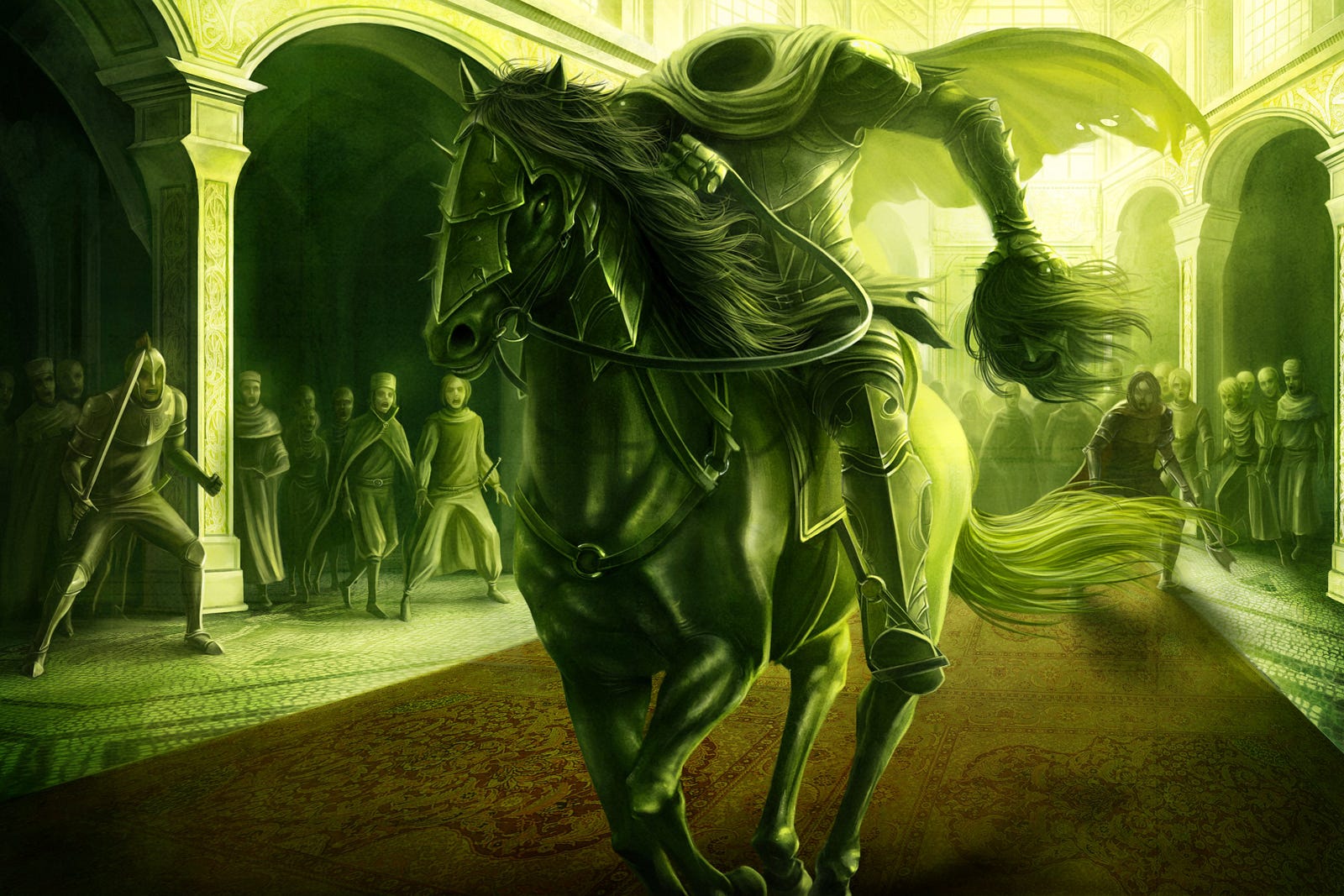
read Sir Gawain and the Green Knight, the great medieval English classic as our Christmas read over at the Catholic Thought Book Club. These are my comments and thoughts.
I’ve
completed Part 1.What a joy of a
read!I’m starting with the Marie
Borroff translation since that is what I have as a hardcopy.It was included in the Norton’s Anthology of
English Literature, Part 1, which I’ve had since undergrad, going back to the
late 1980s!I keep my books and I try to
keep them in good shape.If I read this
fast enough I may try the Tolkein translation. I’m also listening to the Simon
Armitage audiobook of his translation.It’s read by Bill Wallis, and I love the reading and sound of it.I’m considering getting Armitage’s
translation itself.[Note: I did not read
the Tolkein translation, but I get the Armitage translation to go along with
the audiobook.]
###
I
should describe the poetic form of Sir
Gawain for those that might be interested.It’s not that complicated.First,
it’s a narrative poem, so there is a story and narrative progression.It’s told in stanzas, and there are 101
stanzas to the poem.The stanzas are of
varying lengths of at least a dozen lines (I didn’t actually count) to as any
as two dozen.Each line, called the
alliterative line, is also of varying syllabic length.What controls each line are a regular number
of stressed syllables, four stressed syllables to each line but there is a
pause at the center of each line called a caesura.Caesura translates to cutting in Latin, and
so the pause creates a cut in the line.Of the four stressed syllables, two come before the caesura and two
after.Let’s take an example.Here’s the eighth stanza from the Tolkein
translation.
All of green were they
made, both garments and man:
a coat tight and close
that clung to his sides;
a rich robe above it all
arrayed within
with fur finely trimmed,
showing fair fringes
of handsome ermine gay,
as his hood was also,
that was lifted from his
locks and laid on his shoulders;
and trim hose tight-drawn
of tincture alike
that clung to his calves;
and clear spurs below
of bright gold on silk
broideries banded most richly,
though unshod were his shanks,
for shoeless he rode.
And verily all this
vesture was of verdure clear,
both the bars on his
belt, and bright stones besides
that were richly arranged
in his array so fair,
set on himself and on his
saddle upon silk fabrics:
it would be too hard to
rehearse one half of the trifles
that were embroidered
upon them, what with birds and with flies
in a gay glory of green,
and ever gold in the midst.
The pendants of his
poitrel, his proud crupper,
his molains, and all the
metal to say more, were enameled,
even the stirrups that he
stood in were stained of the same;
and his saddlebows in
suit, and their sumptuous skirts,
which ever glimmered and
glinted all with green jewels;
even the horse that
upheld him in hue was the same,
I
tell:
a green horse great and thick,
a stallion stiff to
quell,
in broidered bridle
quick:
he matched his master
well.(ll. 151-178)
Let’s
look at the first line: “All of green were they made, both garments and
man.”The two stressed syllables before
the caesura are “green” and “made.”The
caesura comes right after the “made” actually punctuated with a comma, though
caesuras are not necessarily at a punctuated pause.The two stresses after the caesura are “gar”
from garment and “man.”Now we are
dealing with a translation and the four stresses and caesura may not be as
clear in the modern English as it would have been poet’s actual language.
There
is an interesting little technique at the end of each stanza.The poetic line suddenly shortens into an
appendage of five lines.The first of
the five is only two syllables, and in this stanza is “I tell.”The four last lines form a rhyming
quatrain.While the alliterative line
goes back to Old English, this appendage, called the “Bob and Wheel” is
something that came out of the late Middle Ages and out of hymns.The two syllable line is the “Bob” and the
quatrain is the wheel.I really like the
concept.It allows the reader to take a
breath every so often, slowing the pace down, and providing a summary of what
went before it.
The
alliterative form was throw back by the time this poet was writing in around
1400.Since he did not come from the
London area, the poet probably was more Anglo-Saxon or Welch, and perhaps felt
this form was closer to his speech.Geoffrey Chaucer died in 1400, so he was writing before the Gawain poet,
and you can see Chaucer’s poetic form is much more Romance language
derived.So the Gawain poet is looking
backward, reviving a previous form.
###
My
Reply to Joseph:
Joseph wrote:
"Kerstin, I read the Middle-English text and it's very alliterative. John
Ciardi's translator's note on Dante's Divine Comedy points out that,
"English is a rhyme poor language,"
I'm probably going to disagree with Ciardi here. Of course English is not a
rhyme rich language but many a poet through the ages have been using rhyme. It
hasn't stopped them. In my opinion, it's just natural for English to write in
alliteration. The language is just made for it, especially early and middle
English. So it's not because it's rhyme poor but because it's more natural to
the language. I think poets in English force themselves to rhyme.
My
Reply to Galicius:
Galicius wrote: "My
humble/honest input on this reading:
The rendering description in Chapter 2 will sound abominable to any vegetarian.
We have a member of the immediate family and have a few vegan and
vegetarian..."
I'm not a vegetarian, but even for me it was a bit revolting. Hunting and
butchering of animals is brutal, and I'm squeamish. You reminded me of a scene
in Tomas Hardy's novel Tess of the d'Urbervilles (if I'm remembering correctly)
where they slaughter a pig. It was Hardy's way of bringing in hard realities.
My
further comment on the hunting:
As I said, I'm
squeamish...lol. But I do eat meat and I'm aware of how it comes to the
supermarket and eating meat is human. Sometimes I feel like St. Francis of
Assisi with love for all animals. I have a little vocal prayer when I do see an
animal. I say, "Lord have mercy on all your creatures. They are also of
your heart."
By the way, as it happens
my dear cat has had to undergo a major procedure these last couple of days for
a blocked urethra. He had not urinated for around four days, and he was
probably close to kidney failure. He's currently recovering at the vet
hospital.
By the way, I should say,
there is nothing wrong with hunting. It's a necessary activity and hopefully
done for need rather than human glory.
My
Reply to Kerstin who pointed out the alternating of the
hunting and seduction scenes:
Good observation on the
intertwining of the hunting and seduction scenes. I wonder if there is some
metaphorical or symbolic connection? I guess Gawain is being
"hunted." ;)
So is Gawain the hunted
or the hunter? If he's the hunted, then he's able to survive the hunt. If he's
the hunter, I can see he killed off the animal lust of the seduction. LOL. OK,
so what's the metaphor? I don't see one. There may not be one. Perhaps it's
just a neat dramatic device to intertwine the hunt and the seduction. However
it still feels like there's a significance I'm missing.
###
Some
lovely quotes to sample the poetry.First here are descriptions of the beautiful Bertilak’s wife and the old
crone beside her.These quotes will all
come from the Armitage translation.
She was fairest amongst
them—her face, her flesh,
her complexion, her
quality, her bearing, her body,
more glorious than
Guinevere, or so Gawain thought,
and in the chancel of the
church they exchanged courtesies.
She was hand in hand with
a lady to her left,
someone altered by age, an
ancient dame,
well respected, it
seemed, by the servants at her side.
Those ladies were not the
least bit alike:
one woman was young, one
withered by years.
The body of the beauty
seemed to bloom with blood,
the cheeks of the crone
were wattled and slack.(943-53)
“The
body of the beauty seemed to bloom with blood,/the cheeks of the crone were
wattled and slack”
Here
the Green knight’s court off on their first hunt.
On the bugles they blew
three bellowing notes
to a din of baying and
barking, and the dogs which
chased or wandered were
chastened by whip.
As I heard it, we’re
talking a hundred top hunters
at least.
The handlers hold their
hounds,
the huntsmen’s hounds run
free.
Each bugle blast rebounds
between the trunks of
trees.(1141-9)
Here
in one of the attempts by Bertilak’s wife to seduce Gawain, and Gawian
resisting.
For that noble princess pushed
him and pressed him,
nudged him ever nearer to
a limit where he needed
to allow her love or
impolitely reject it.
He was careful to be
courteous and avoid uncouthness,
cautious that his conduct
might be classed as sinful
and counted as betrayal
by the keeper of the castle.
“I shall not succumb,” he
swore to himself.(1170-6)
Here
where a servant leading Gawain through a forest points to the chapel where the
Green knight resides.
“I have accompanied you
across this countryside, my lord,
and now we are nearing
the site you have named
and have steered and
searched for with such singleness of mind.
But there’s something I
should like to share with you, sir,
because upon my life,
you’re a lord that I love,
so if you value your
health you’ll hear my advice:
the place you head for
holds a hidden peril.
In that wilderness lives
a wildman, the worst in the world,
he is brooding and brutal
and loves bludgeoning humans.
He’s more powerful than
any person alive on this planet
and four times the figure
of any fighting knight
in King Arthur’s castle,
Hector included.
And it’s at the green
chapel where this grizzliness goes on,
and to pass through that
place unscathed is impossible,
for he deals out death
blows by dint of his hands,
a man without measure who
shows no mercy.(2091-106)
Another
transition in her life now occurs, going from corporal works of mercy to
spiritual works of mercy.This chapter
outlines Catherine’s conversions of men who go from lives of sin and lack of
faith, to repentance, conversion, and a death that is in a state of grace.Her extended spiritual family—her devoted
followers—continued to grow as she becomes an important part of Sienese life.
Chapter
10
Undset
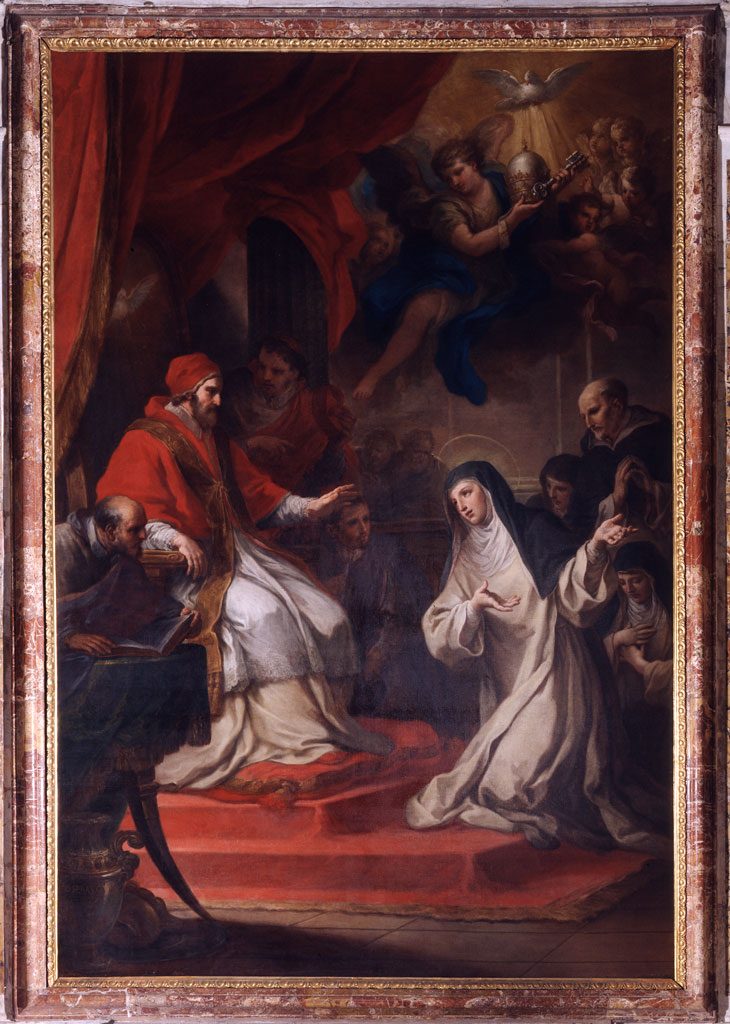
provides the historical background as to why the Popes had moved to Avignon,
and the attempts to persuade the Pope to return to Rome by St. Catherine’s
predecessor, St. Bridget of Sweden.
Chapter
11
As
Catherine’s growing influence makes her more sought after, her band of
followers, the “Caterinati” also grows, attracting educated and nobility,
religious and secular, and most especially sinners, those who want to be
converted and those who convert against their initial wishes.Her charismatic personality and her powerful
spiritual insight convert many a sinner.
Chapter
12
By
1372, Catherine’s influence had grown across Italy.Her letters now went to Cardinals and princes
of city-states concerning major political issues of the day, including wars
between states.And these heads of
states sought her advice, not just through letters but by sending ambassadors
to Siena to reach her in person.The
Seraphic Virgin of Siena even endorsed global policies such as a crusade
against Islam, though it was never taken up.
Chapter
13
In
1374 Catherine and her followers went to Florence on one of her missions to
bring peace between warring families, and there met her future biographer and
most important confessor, Blessed Raimondo of Capua.That year the Bubonic Plague would return
with a vengeance and strike down a third of Siena.Catherine worked tirelessly to care for the
ill and bury the dead, including performing several miracles.After the plague had subsided, Catherine and
her band made a pilgrimage to Montepulciano to venerate the body and relics of
St. Agnes of Montepulciano.There a
miracle occurred where when Catherine went to kiss the foot of the dead woman,
Agnes lifted her foot for Catherine.
###
My
Comment:
This morning in my email
feed I got an inspirational quote that happened to be from St. Catherine. Let
me share it:
"We've had enough of
exhortations to be silent! Cry out with a hundred thousand tongues. I see that
the world is rotten because of silence."
-St. Catherine of Siena
With all the craziness
that is going on in the world, St. Catherine is so on the mark.
My
Reply to Irene:
Irene wrote: "This
section made me curious about St. Birgita. I find it fascinating how often the
lives of saints overlap."
I was thinking similar on Blessed Raimondo of Capua the other night. He’s not a
full saint (canonized) but still a blessed. Other than his relationship to St.
Catherine, I realized I know nothing about him.
My
Reply to Gerri:
Gerri wrote: "I also
like how Undset says the Caterinati were eager to give witness to not only
Catherine's power and piety, but also to her "holy gaiety." I love
that - holy gaiety.
Yes holy gaiety! This was my mission with this book, to get that across.
Because what people remember about Catherine's personality is her severe
asceticism, people assume she was stern and dour. She was stern but definitely
not dour. What people need to realize about her was her bubbly personality. She
was gay (in the old sense of the word) and joyful and playful. She attracted
the huge Caterinati because of her personality. There are lots of devout people
around, but there are few people where you want to be around them all the time.
She made being devout fun!
###
What
really puzzles me in these sections is how she went from an obscure little
religious woman who did good works about town to being sought after by the
highest nobility in Italy. Think about it. She comes out of her cell as a
complete unknown, starts doing good works of mercy about town, starts leading
people to repentance through spiritual acts of mercy, starts engaging in what
I’ll call conflict resolutions about Siena, is then sought after to resolve
more conflicts by powerful, and then ultimately goes to Siena’s rival city of
Florence to resolve a dispute between the heads of Florence, Siena, Milan,
Pisa, and I think the Papacy. That is quite a jump for an unknown woman who is
not part of the aristocracy. Here’s how I piece together the timeline for those
years.
1347
Birth, age 0
1363-66
Lives in her cell, age 16-19
1366
Becomes Third Order Dominican, age 19
1367
Exits her cell and starts good works, age 20
1368
Her father dies, age 21
1370
Starts Engaging in Conflict Resolution, age 23
1372
Is Sought By the Powerful for Resolutions, age 25
1374
Travels to Florence for a Peace Mission, age 27
How
does a young woman go from what we today might classify as a nurse’s aide (not
even a nurse) to resolving conflicts between Dukes and Cardinals in four to six
years? Undset does her best to show the leap, but details would be fascinating.
What were these Dukes and Cardinals thinking? Why her? What specifically did
she do to gain that trust? I guess that is lost to the silence of history. But
I find that astonishing.
My
Reply to Irene, who did not find it astonishing that
Catherine got so popular:
I can understand that
Irene. Yes, her miracles may have opened people's eyes, but I guess the main
part of my point was the connection between the dots, so to speak, has been
lost to the silence. Why did this particular ruler decide to trust in her over
this particular miracle. The connection between miracle or whatever it was that
was persuasive and powerful figure has been lost.
I did imply a certain
minimizing of her person in my comment. My exact words were "an obscure
little religious woman." I hope you didn't think me sexist for that. I was
merely placing her in the context of medieval society. She was not aristocratic
and she was not educated. She didn't even have a powerful husband. There would
be nothing about her for the powerful of her day to take note.
I'm also skeptical that
the miracles could have persuaded many. I'm afraid miracles don't persuade many
people. Look at it in our era. Take Padre Pio, a man who was known to
bi-locate, read people's souls, and have the visible stigmata. You would think
the whole world would be rushing to become Catholic. But even our own Church
doubted him for a long time. Blessed Solanus Casey (is he a saint now?) was
long associated with miracles, and has the United States rushed to become
Catholic? Who was it that said (Dostoyevsky? or is it in the New Testament?)
that despite the miracle of parting the Red Sea, the Israelites lost faith in
Moses? Anyway it's also in Psalm 106. People will have miracles performed right
in front of their eyes and they will not attribute to the divine. Actually look
at Fatima and the miracle of the sun. How many hundreds of people witnessed it?
You would think because of that the world would be rushing to become Catholic.
You would think Catholics would be rushing to be Catholic. No, I'm afraid
miracles don't necessarily lead to conversion and discipleship.
My
Reply to Irene who said people like Catherine were the
superstars of the Middle Ages:
Well argued Irene. Yes,
it's possible. It's still over a very short time, only four years. Her fame
really exploded for her to be sought outside of Siena. And there was no mass
communication for word to get around. Perhaps it was through her letters. I'm
not sure Undset makes enough of her letters. They span all levels of society.
If I remember correctly 380-ish letters survive, which I think she wrote over
ten years. They are really remarkable and lend real insight into her person and
thought. You can find free editions on the internet, though they were
translated over 100 years ago. Perhaps if I can identify the ten or so most
interesting we can do them as a short read at some point.
Gerri
Reply to those previous comments:
One more thing that may
have contributed to Catherine's reputation: the political activity of her
brothers. They were highly active and right in the thick of the region's
political feuds. Word of Catherine may have spread via both their supporters
and detractors.
I, too, was surprised at
first when I read that highly placed figures were seeking her out. On page 158:
".. when Bernabo
Visconti sent ambassadors to Siena to see if he could win the goodwill of the
Republic in his dispute with the Pope, he gave them orders to make contact with
the dyer's daughter, and if possible to get her support."
Could a saintly and
beloved Sienese's support influence the local power brokers and her own
immediate family? Something to think about. I think her reputation grew from a
combination of what you both said, Manny and Irene, with perhaps some help from
Italian family culture.
Side note: I'd love to
read some of Catherine's letters. I never know where to start, though. Manny,
I'd welcome your input but no rush. I've still got half of our book to read.
My
Reply to Gerri:
That is a very good point
Gerri. It's quite possible and as I was saying again lost to history I'm
afraid.
I will pick a couple of
Catherine's letters Gerri and link them here.
Also if you get
Magnificat magazine, almost every month they include an excerpt from one of her
letters as a meditation on a Gospel reading.
###
Oh!
I as just looking ahead to EWTN's upcoming programing, and as part of their All
Saints Day lineup, they will have an hour long show on St. Catherine of Siena.
Here's the brief show description:
"Take
a tour through 14th century Italy to experience the life and writings of St.
Catherine of Siena in this EWTN original docudrama, filled with incredible
interviews and dramatic reenactments."
It's
at 2 PM and for 60 minutes. Check your local time. It doesn't mention time
zone. So Sunday, November 1st
###
Chapter
14
Catherine
is now engaged in diplomatic efforts of a number of Italian City-States,
advocating peace among themselves and the papacy and joining together for
another crusade against Islam.While in
the city of Pisa, where she stayed for quite a while, Catherine experiences the
full stigmata.It is at this time in
1374 that Catherine’s letter writing dramatically increases, and while returning
home from Pisa she writes her first letter to Pope Gregory XI.As she returned home, Catherine found out
that most of the Tuscan City-States aligned together against the papacy.
Chapter
15
Much
to Catherine’s dismay, Pope Gregory in his obstinacy entrenches himself further
against the Tuscan City-States.Catherine writes several letters to the Holy Father imploring mercy
toward the towns, but in his petulancy the Pope sent an army to capture Bologna
and Casena, where men were massacred and women raped.In the meanwhile, Catherine resolved a local
Sienese conflict where a young man, Stefano Maconi, would become her most
devoted “son.”The Florentines, now
under a humiliating interdict from the Pope, agreed to Catherine’s offer to act
as a mediator in this dispute.
Chapter
16
Catherine
arrives in Avignon in mid-June and will spend the entire summer there, leaving
in mid-September.While there, the Holy
Father she has several conversations with the Holy Father, meets the vast papal
court and entourage, and wins over most, including the Holy Father
himself.The Pope agrees to a peace with
Florence, but the Florentines actually reject the offer.By the end of the summer, Pope Gregory XI, so
smitten with her holiness, decides to follow Catherine’s advice and return the
papacy back to Rome.He takes up the
court and moves leaves for Rome two days after Catherine departed.
Chapter
17
On
the journey back home, Catherine was bombarded with admirers.It took longer than expected because of the
plague encountered, both to her entourage and in the various cities they
stopped.Catherine’s letter writing,
however, continued on a remarkable pace.During her stay in Genoa, the Pope, masquerading as an ordinary priest
surprised her by stopping at her dwelling.On his way to Rome, Gregory XI was weakening from his decision and
needed Catherine’s support.Catherine
once again inspired the Pope to make the courageous and historic decision.
Chapter
18
As
the Pope in 1377 arrives in Rome, Catherine finally arrives home to Siena.She continues her letter writing especially
one imploring prisoners to come to the faith.She meets a particular young man, Niccolò di Toldo who was bitter and
unforgiving over his sentence of death.Catherine through her personality go him to repent, take communion, and
bravely walk to his execution with her by his side.She knelt by him and caught his head when it
was severed.
###
One
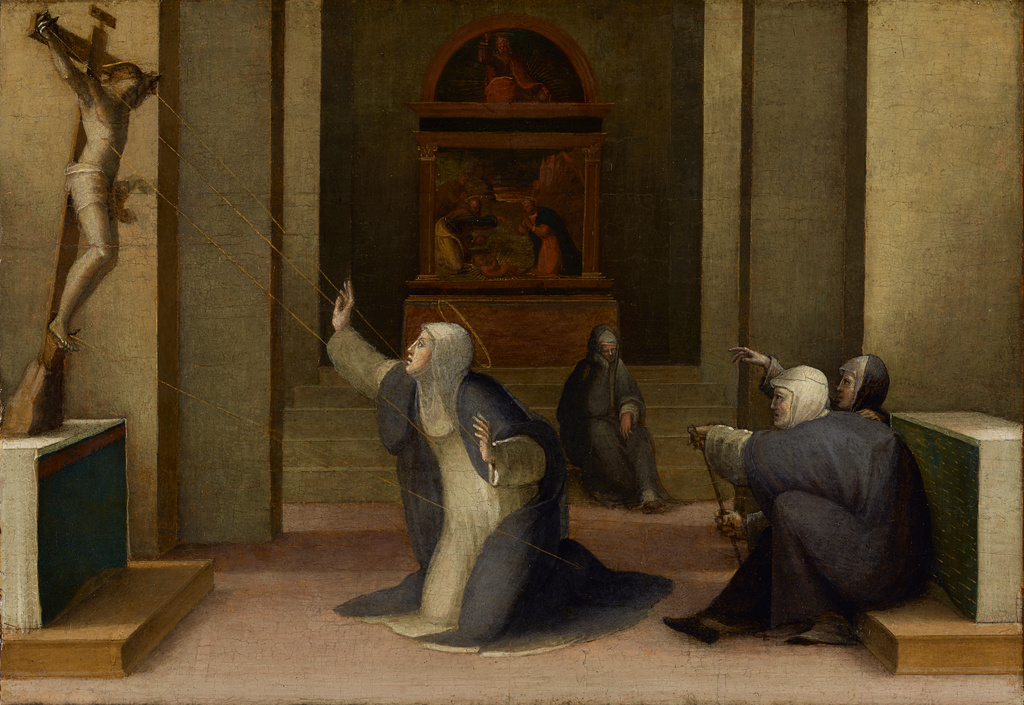
of those incredible passages is the moment she receives the stigmata.It’s worth transcribing.
But the most overwhelming
event in Catherine’s life while she was in Pisa was that she was marked with
Christ’s stigmata.Raimondo describes
the event as he saw it.
On Laetare
Sunday—mid-Lent Sunday—he celebrated Mass in the church of St. Christina and
had given Catherine Holy Communion.She
lay on her face for a long while afterwards without moving.Raimondo and her friends waited
patiently—they hoped that when she awoke from her ecstasy she would have a
message for them from the lips of her Bridegroom.Suddenly it was as though the outstretched
figure was lifted up; she knelt with closed eyes and her face shining with
supernatural bliss.She stretched out
her arms, with the palms of her hands outward, stiff and still: then she fell
suddenly to the ground as though mortally wounded.A little while after, she recovered
consciousness.
Some time later she
called Raimondo to her and whispered: “Father, know that by the grace of our
lord Jesus I now bear His stigmata in my body.”Raimondo had guessed by her movements what had happened, but he asked
her to describe the manner in which the gift of grace had been given her.“I saw Our Savior on the cross lean down
toward me in a bright light.And when my
soul tried to hasten to meet its creator, it forced my body to rise.Then I saw how five jets of blood came from
the five wounds and streamed toward my miserable body.I cried out, ‘O my Lord and Savior.I beg You, do not let the wounds on my body be
visible outwardly’—and while I spoke the jets of blood changed to shining
light, and as the rays of light they struck my hands, feet, and heart.” (p.
180)
It
is amazing there was a witness at the time and recorded what happened and her
understanding of it.
###
My
Reply to Joseph:
Joseph wrote: "It's
also pretty amazing just how active her contemplative life became. We had a
retreat master a couple of years ago emphasize that our work is not our prayer,
our prayer is our work. There's a pretty strong emphasis among our faculty that
we need to be rooted in prayer before we can effectively carry out the active
ministries of priesthood and I think in these chapters St. Catherine models
that relationship brilliantly."
Well, she's Dominican you know.
My Reply to Gerri:
Gerri wrote: "Manny,
I remember you mentioned in an earlier comment about Catherine's support of a
Crusade. Her strong belief in that cause came through clearly to me in these
chapters and surprised me a little. Then I realized how she saw a crusade as a
means to unify the warring Christian factions against a common foe."
Yes, that was the immediate need for the crusade but she also said it would
convert the Muslims for God. I think that was rather naïve on her part.
My
Reply to Gerri:
Gerri wrote: "To
everyone interested in Catherine of Siena: Learn25.com is having a sale on
certain items, including a course on Catherine of Siena. I just ordered the
Audio CD for $6.95. Of course, they got me ..."
Gerri, I have that course. It's presented by Sr. Suzanne Noffke who is probably
the world's leading scholar on St. Catherine of Siena. She has written and
edited many books on St. Catherine. Here is her Goodreads page: https://www.goodreads.com/author/show...
When I first listened to the course, I didn't at first particularly fall in
love with it. It took several listens over a span of time to warm up to them.
It seemed like Noffke brought in too much of her own life to the lectures for
my taste and it didn't seem like she got to the heart of Catherine's ideas.
This would not be a starter course on St. Catherine, but now that you will have
read this biography I think you might not feel lost.
My
Reply to Gerri:
Gerri wrote: "Oh,
boy, thanks for that insight, Manny. I'm not a big fan of authors bringing
their own life into lectures/biographies. I'm there to learn about the subject,
not the author. Especially with a pers..."
Yes, I know what you mean. Some of those Lear25 courses are disappointing. I
don't want to give the impression that the St. Catherine of Siena course is one
of those disappointing ones. It's not. It's just organized in a manner I did
not expect, and so was a little disconcerting. And Sr. Suzanne is not a dynamic
speaker. But in time I grew to understand her and appreciate her course. I
recommend it. Let me know what you think.
My Comment:
Also, the EWTN
documentary of St. Catherine today was excellent! I enjoyed it and they got to
the heart of her life and thought. The visual images of the locale was great. I
think for those that are mid way through the book, you know enough about her
for the documentary to resonate, I think the book enriched the documentary and the
documentary enriched the book.
###
One
of the often cited instances of Catherine’s life is her giving comfort to
Niccolò di Toldo as he went to his execution.I had forgotten some of the details.I had forgotten that Catherine actually narrated this event to Raimondo,
so we have Catherine’s actual take on the whole incident.First I was shocked he was condemned to death
because he had spoken derisively of Siena.He came from a rival town and was of the nobility of that rival
town.I guess that must have all added
up to a death penalty in those days.And
he was bitter, and refused to reconcile himself with God: “He was wild with
rage and despair over the crazy justice of this wretched government who want to
take his life over such a trifle” (p. 224).She describes the meeting:
You know I went to visit
him, and he gained such great strength and power that he made his confession in
the right state of mind.He made me
promise for the sake of God’s love I would be with him when the day of execution
came, and I promised.The next day
before the bells rang for the first time, I went to him, and that consoled him
greatly.I went with him to Mass, and he
received Holy Communion, which he had always avoided.His will was one with God’s holy will and submitted
to it.He was only afraid of one
thing—that his courage would fail in the crucial moment.But God’s immeasurable goodness fired such
love and longing in him that he could not have enough of God’s presence.He said, Say with me, do not go from me and I
will be good, I will die happy.And he
leaned his head against my breast.I was
filled with joy, for it seemed to me that the perfume of his blood mixed itself
with mine which I long to be able to pour out for my beloved Bridegroom
Jesus.(p. 225-6)
Three
things I would like to highlight in that passage.Catherine’s power to charm is noticeable in
all her encounters with people, be they religious people, regular people,
Popes, or a young man who is facing execution.We don’t get the details of what she said that caused him to go from a
wild and bitter man to one who was willing to “die happy.”This is one of the things that is so
memorable about Catherine, her charisma, her charm.
Second,
her amazing poetic descriptions: “it seemed to methat
the perfume of his blood mixed itself with mine which I long to be able to pour
out for my beloved Bridegroom Jesus.”Notice the compact series of images in that one sentence.Blood has a perfumed aroma?What a leap that is.And she envisions the aroma (as a sort of
ether) of Niccolò’s blood somehow mixing with the ether of her blood, and the
two bloods mixed into one is poured out for Christ.I haven’t been able to highlight much of her
language, but this sort of intense imagery runs throughout her writing.She really was a natural poet.
Third,
the blood.Blood is one of her central
symbols: the blood of Christ that washes away sin, and the blood of our
humanity, which is somehow supernaturally connected with the divine.I can’t pin it down—it would take a
systematic study—but for Catherine it’s as if our human blood is our link to
God.And why not?Christ in His incarnation had blood in His
veins, blood that would be shed.That
image of mixing of blood looks ahead to Niccolò’s execution.
Niccolò came, peaceful as
a lamb, and he smiled when he saw that Catherine stood there waiting for
him.He asked her to make the sign of
the cross over him, and she whispered to him: “My dear brother, let us go to
the eternal marriage feast, to enjoy life which shall never end.”She bared his throat, and when he laid his
head on the block she knelt beside him.He said nothing but “Jesus, Catherine,” and then his head fell into her
hands.
Then I fastened my eyes
upon the Divine Goodness and said: I will.Immediately I saw, as clearly as one sees the sunshine, Him who is God
and Man.He was there, He received the
blood.In this blood was the fire of
holy desire which grace had put into his soul, and this fire was swallowed up
in the fire of God’s mercy.”She saw
that Niccolò was as though drawn into the treasure chamber of mercy, his
pierced heart into Christ’s breast, so the great truth was made clearly
apparent—that Christ receives a soul entirely because of His mercy, and not
because of any merits of the soul itself.But as the soul of Niccolò entered the mystery of the Holy Trinity it
turned and looked at her, as the bride does when she has come to the house of
her bridegroom and with bowed head acknowledges those who have accompanied her,
as a last sign of gratitude.(226-7)
Can
you imagine the amount of blood that must have splattered on her?And as she held on to the dripping head?What a mess, but that blood is so significant
to her.Blood and fire and holy desire
and treasure chamber of mercy—there’s a lot of theology there.Too much for here, and I’m not sure I can tie
it all up together.But this is why she
was made a Doctor of the Church.She
connects Catholic doctrine—she never creates or distorts doctrine as some
modern theologians—in a way that is original to her and is meaningful to
us.I would love to have listened to her
preach.
And
kudos to Sigrid Undset for a beautiful description and integration of
Catherine’s words.
###
My
Reply to Several on Gender Restrictions that St. Catherine
may have faced:
I'm sure there were many
gender restrictions but why would there be one on speaking with a prisoner? I
don't follow that. Plus she may have had one or more of her followers alongside,
so she wouldn't have been alone with him.
As I think of it, I'm surprised they let her stay beside him as the decapitated
him, and not because of her gender. I can't imagine that being common.
My
Reply to Kerstin:
Kerstin wrote: "I
tend to think that women in the Middle Ages had far more freedoms then we give
them credit for. According to history-Prof. Christopher Bellito, who did a few
lecture series on Learn 25/Now You Kn..."
I suspect that is true. The thought has crossed my mind, but I don't have any
expertise to know.
Our
little cat Tiger had to have emergency surgery this week.I wrote about how we found him as a kitten beside
our house almost five years ago and took him in.About a week ago we noticed he was acting
strange.He was hiding and not eating
much.Then I noticed his litter box did
not have the usual clumps that would indicate he peed.Finally after about four days and watching
him struggle in the litter box, on Monday we got him to a veterinarian.They said his urethra was blocked from
crystals and grit coming from his bladder.Apparently this is a not an unusual problem for male cats, especially if
they have been neutered.
The
vet put a catheter in to relieve the bladder.Any longer he might have died from kidney failure.They cleaned the urethra and assessed to see
him urinate.The ultrasound showed a lot
of grit still in his bladder.Within a
day his urethra was blocked again, and the only alternative was surgery.He was then transported to an animal hospital
where this would be done.(Don’t ask
what this all cost.)
I’m
not exactly sure what the surgery specifically did but as I understand it they
opened up his urethra and reconstructed it so it’s wider.Sounds painful!My friend and I joked he was getting a sex
change.;)No, that’s mean.
Today
we got him back home.He has been so
affectionate.He’s purring and constantly
rubbing up against us.He is so happy to
be home.I’m sure he didn’t know what
was happening nor where he was.Here are
some pictures.He has to wear a cone so
he doesn’t disturb the area of concern.
He
peed right away as soon as he got home.He must have been holding it in from the one hour ride back from the
hospital.
He hasn't gotten used to the cone. He's been bumping up against everything with it. He will have to wear it for three weeks.
He’s
definitely lost a little weight but he’s been eating and he even took his pain
med.We’re happy to have him home.
As
I look at More’s key life experiences prior to the writing Utopia, you can connect a number of the subjects he brings up in
the book to his life.He brings up the Utopians’
religion and rituals; he lived a good deal of his life with religious clerics
and even at a monastery.He brings up
the Utopians’ organization of towns and population; he was a member of
parliament and presumably charged with the responsibility of civil
management.He speaks of the Utopians’
sense of justice and jurisprudence; well, he was both a lawyer and a
sheriff.He speaks of the Utopians’
trade policies, and he was a legal representative for merchants across international
barriers.He speaks of the Utopian’s
household arrangements, and marital and social conventions; he was a man in
midlife, having married and fathered four children, and by the writing of the
work a widower.He speaks of the Utopians’
high level of education and value in philosophy, and More himself was a well-educated
man in classical philosophy. The one aspect of the work where the connection
back to his life is tenuous, if actually nonexistent, is with that of the Utopians’
military organization and war-fighting doctrines.There doesn’t seem to be any military service
in More’s life.But nonetheless as a
parliamentarian and servant to the King he must have come into contact with
issues of warfare.
Now
when I say in the paragraph above that More “writes” of these aspects of Utopians’
life, he puts those words in a character’s mouth.There are several characters in Utopia and
one of them is Thomas More himself as a fictional character.It should be noted that More the author does
not put those words in Thomas More the character’s mouth.It is not More the character who is speaking
of and praising the Utopians; it is a character named Raphael Hythloday.And this is where I think the difficulty lies
in understanding the intent of Utopia.Do Raphael Hythloday’s opinions and values
represent the author’s?Or is Raphael
Hythloday just a foil for More the author to knock down and satirize?Clearly there are passages that could not rationally
be supported by More, but then there are passages that might.
Even
the name Raphael Hythloday is ambiguous.Raphael alludes to the archangel, and so on one hand his name may be suggesting
the bringing forth of divine wisdom.But
Hytholday means (I am told) “speaker of nonsense.”So which is it, wisdom or nonsense?
More
the author makes Hythloday a strange character.He’s a bearded old man, a Portuguese sailor, and explorer who traveled
with Amerigo Vespucci where he learned of many cultures and where he found the
perfect in the Utopians.He is certainly
an eccentric in that he prizes the strange aspects of Utopian life.Perhaps “eccentric” is putting it too
mildly.Perhaps we, the reader, are to
look at him as an oddball or a kook.He
speaks at length in what must have been several hours of rambling.I found his support for the marriage customs
hilarious:
Before marriage some
grave matron presents the bride, naked, whether she is a virgin or a widow, to
the bridegroom, and after that some grave man presents the bridegroom, naked,
to the bride. We, indeed, both laughed at this, and condemned it as very
indecent. But they, on the other hand, wondered at the folly of the men of all
other nations, who, if they are but to buy a horse of a small value, are so
cautious that they will see every part of him, and take off both his saddle and
all his other tackle, that there may be no secret ulcer hid under any of them,
and that yet in the choice of a wife, on which depends the happiness or
unhappiness of the rest of his life, a man should venture upon trust, and only
see about a handsbreadth of the face, all the rest of the body being covered,
under which may lie hid what may be contagious as well as loathsome.(p. 94, Kypros Press. Kindle Edition.)
Now
that is an example of Hythloday as a kook, and More the author lampooning the
values of the Utopians.In other places
it’s not so clear.For instance, here
Hythloday explains the nature of the Utopians’ laws.
“They have but few laws,
and such is their constitution that they need not many. They very much condemn
other nations whose laws, together with the commentaries on them, swell up to
so many volumes; for they think it an unreasonable thing to oblige men to obey
a body of laws that are both of such a bulk, and so dark as not to be read and
understood by every one of the subjects. (p. 98)
Well,
that sounds rather practical, a body of laws that are short and to the point.Who could be against that?All in all, it’s not always clear whether
More is satirizing or conceptualizing an ideal.
Perhaps
the one notion that is a sticking point to modern day readers is what appears
to be Hythloday’s endorsement of communism, and, because in this case it
doesn’t appear to be satire, coming as an endorsement from More the
author.More the character himself at
the end leaves open the possibility of such an endorsement.
When Raphael had thus
made an end of speaking, though many things occurred to me, both concerning the
manners and laws of that people, that seemed very absurd, as well in their way
of making war, as in their notions of religion and divine matters—together with
several other particulars, but chiefly what seemed the foundation of all the
rest, their living in common, without the use of money, by which all nobility,
magnificence, splendour, and majesty, which, according to the common opinion,
are the true ornaments of a nation… (p. 133)
So
“many things” of the Utopians seemed rather absurd but not the living in common
and the elimination of money.Is More really
endorsing that?Is More the character in
lock step with More the author?On the
one hand, what is being conceptualized is the Benedictine rule of living in
common.On the other hand, the Utopians
apply it not to a monastery, where individual bachelors of a single gender
choose such a life, but across a nation where families form the basic unit of
society.More the author and married man
would realize that a monastic lifestyle could not work in a lay society because
the family would no longer be the basic unit.Indeed, I know of no example of one where it has.Unfortunately the tone of the writing is not
indicative of the author’s intent.
As
one thinks about it, however, the entire economic concept propounded in the
book through the Utopians is absurd.Families living together?The
majority of people idle, and yet agriculture being the primary means of
sustenance, where the few that do work only labor six hours a day?In what farming community could that possibly
be true?It’s impossible.It’s nowhere!
So
what are we to make the book?The book
fails for me because it is impossible to distinguish what are serious
propositions to improve society and what are “nonsense” ramblings of an
eccentric old man, and if all is to be taken as nonsense ramblings, to what
end?“Utopia” means “nowhere.”So why should we read about this nonexistent and
not even possible ideal?Ultimately then
it would be a farce, but the tone of the work doesn’t feel like a farce.Why should we go through a 134 pages of silly
notions?Is More satirizing the
Utopians?Is he satirizing the
exploration writings that was becoming a formal genre in his day?Or is he satirizing philosophic treatises
with kooky old Hythloday as a silly savant?Ultimately I can’t tell.
But
on a second read, I have to admit, I was entertained.Once I came to the conclusion that Hythloday
is just an oddball not to be taken seriously I enjoyed the zaniness of the
monologue.As a philosophic work, Utopia has its issues.As a tongue-in-cheek farce I found it a
worthwhile read.
I thought this was a very informative video on St. Thomas More and Utopia.
This Sunday will be my first time serving as
lector and do the first two readings! And what great readings this Sunday since it
will be the Feast of the Epiphany. What an honor, blessing, and a grace for me.
“Then you [Jerusalem] shall be
radiant at what you see,
your heart shall throb and overflow,
for the riches of the sea shall be emptied out before you,
the wealth of nations shall be brought to you.
Caravans of camels shall fill you,
dromedaries from Midian and Ephah;
all from Sheba shall come
bearing gold and frankincense,
and proclaiming the praises of the LORD.”
-Isaiah
60:5-6
Part of the beautiful readings from the Feast
of the Epiphany.