"Love follows knowledge."
"Beauty above all beauty!"
– St. Catherine of Siena

Sunday, March 12, 2017

Sunday Psalm: An Introduction and Psalm 1

Last year’s reading of the Book of Psalms inspired me create a new series of posts.  I’m going to call this series “Sunday Psalm,” where I’ll perform an analysis of a psalm.  I would love to write up a post for each of the 150 psalms, but that’s rather daunting.  If I posted one every week it would take me nearly three years, and I could never keep that pace.  More realistically at one per month it would take me twelve and a half years.  That’s forever!  So for now I’ll start in series and then we’ll see where it takes us.  I’ll probably will have to pick and choose and jump around.  This post, which is going to be longer than what I expect the others to be, includes an introduction to the Psalms and will start with the first Psalm.

The Psalms are extremely rich, and there’s a lot to say, but let’s say up front I’m not an expert.   But I will fall back on a few noteworthy books to bounce off the thoughts I have.  Nonetheless, take everything I say with a grain of salt; I’m not a Biblical scholar or a theologian.  I’m just someone that reads, and that can be very dangerous and very wrong.  But I will approach this as honestly as I can and with humility.

Perhaps the best way to start is to state what psalms are.  From Meriam-Webster’s Dictionary:

 Noun

Etymology:     Old English psealm "psalm," from Latin psalmus (same meaning), from Greek psalmos "psalm," literally, "twanging of a harp," from psallein "to pluck, play a stringed musical instrument"

1. a sacred song or poem

2 capitalized: one of the hymns that make up the Old Testament Book of Psalms
Word History The Greek word psallein originally meant "to pull" or "to pluck." It then came to be used with the meaning "to play a stringed musical instrument." From this verb came the noun psalmos, which literally meant "the twanging of a harp." Since harp music often accompanied singing, psalmos took on the meaning of "a song sung to harp music" and later simply "a song or poem." It was borrowed into Latin as psalmus and came into English as psalm.

Let’s get specific and go to the Hebrew understanding.  From Wikipedia:

The Book of Psalms, Tehillim in Hebrew (תְּהִלִּים or תהילים meaning "Praises"), commonly referred to simply as Psalms or "the Psalms", is the first book of the Ketuvim ("Writings"), the third section of the Hebrew Bible.

So in psalms we have the notions of a song, poem, and “praises,” and by praises I think it means to say prayer.

The authorship of the Psalms has been commonly attributed to the Old Testament King David, and while some of the psalms may been written by him, there is no evidence that he actually did, and it is clear that for many of them he could not have, since they refer to events after his death.  The psalms span a vast array of time.  Psalm 29 could have been written by the Canaanites who preceded the Israelites and later readapted by the Israelites for the Jewish God.  I find that rather interesting.  There are two possibilities that I see here in locating the cultural roots of the form of the psalms.  It’s possible the Israelites could have adapted the form from the Canaanites or it’s also possible that given the Canaanites were also a Semitic people the form could have been passed down from a proto-Semitic culture.  I don’t know if the scholars have an answer to provide, but it’s certainly a question I would have for them.

There are 150 psalms, and over the centuries the numbering has been in dispute.  The reasons for the numbering disputes are two fold from what I see.  It can be questionable where one psalm ends and another begins in the original sources.  They were not nicely laid out in a Bible text as they are now.  Second, when third century B.C. Jews had their scrolls translated into Greek for the widespread Jews who had migrated into the Greek world, that text came to be known as the Septuagint, and the numbering of the psalms for the Septuagint Bible were already muddled from their origin, and so subsequently various religious groups numbered their psalms differently.  Jews stuck with the original Hebrew scroll numbering, Catholics and Orthodox with the Septuagint numbering, and Protestants I think wanting to distance themselves from Catholics went with the Hebrew numbering.  I think today most religious groups have come to an agreement on the numbering and division of the psalms.  Ah, religious harmony. 

It’s quite clear than many if not all the psalms were originally used for Jewish Temple liturgical service.  Several of the psalms allude to a Jewish festival or a sacrifice.  It’s not known exactly how they were used in the Temple liturgies.  In today’s services, both Jewish and Christian, the psalms are either read or sung.  But it’s possible that in the Temple they had some incantation type of function, a spoken prayer that effects the nature of a situation, sort of like the process of transubstantiating bread and wine into the body and blood of Christ in Catholic and Orthodox services. 

The arrangement of the collection of Psalms is not haphazard or in the sequence they were written.  While David certainly didn’t write all the psalms (it’s not even know definitively if he personally wrote any), David is a character that progresses through the psalms.  The Psalms traditionally seen to be divided into five parts, mirroring the five parts of the Pentateuch.  Each section ends with a doxology, calling to a close that section.  Scholars call the sections books, just like the books of the Torah.  Here are the traditional divisions between the psalms:

Book 1: 1-41
Book 2: 42-72
Book 3: 73-89
Book 4: 90-106
Book 5: 107-150 

Though I agree with the divisions, it’s not clear to me what the divisions signify.  Some have suggested a historical progression through the psalter.  The first two books span David’s Kingship, the third the fall of the two kingdoms (Judah and Israel), the fourth the Babylonian exile, and the fifth the return and the rebuilding of the temple.  As I read through it last year, I can’t say I was able to discern that narrative, but perhaps by going one by one I’ll be able to see it now.

What makes that or any narrative hard to discern is that none of the psalms are explicitly narrative.  They are lyrical in form, and so narrative needs to be deduced from jumps in situation from one psalm to another.   There seems to be many themes thorough out the psalms: the enthronement of God, the royalty of the king, the appeal for protection, the deliverance from enemies, the covenant with God, the wisdom of faith, thanksgiving for God’s bounty and creation, and Jewish peoples historical situation. 

Taking the psalms to a higher level of conceptualization we can classify the psalms into forms or genres.  Some simplify the psalter into two forms: psalms of praise and psalms of lament.  I think I saw somewhere that 60% of the psalms are of the praise form and 40% of the lament.  I can’t verify it but I don’t have anything to dispute it.  While psalms of praise and lament both run throughout the psalter, it is generally agreed that the psalms of lament tend to be denser at the beginning, while those of praise toward the end. 

I can’t say I fully agree with the classification of the forms to be only of praise and lament.  It seems to me that there are psalms that are neither, and it seems to me that there are psalms that carry both praise and lament.  I would classify the forms threefold: praise, lament, and theological.  By theological I mean psalms that preach a theological point or exhort a religious maxim. 

This introduction has gotten long.  I’ll have more to say as I post on them.  So let’s get to the first Psalm. I’m going to use the NAB translation


Psalm I

I
1 Blessed is the man who does not walk
in the counsel of the wicked,
Nor stand in the way of sinners, 
nor sit in company with scoffers.

2 Rather, the law of the LORD* is his joy;
and on his law he meditates day and night.

3 He is like a tree
planted near streams of water,
that yields its fruit in season;
Its leaves never wither;
whatever he does prospers.

II
4 But not so are the wicked, not so!
They are like chaff driven by the wind.

5 Therefore the wicked will not arise at the judgment,
nor will sinners in the assembly of the just.

6 Because the LORD knows the way of the just,
but the way of the wicked leads to ruin.


As you can see this is neither a praise nor a lament form.  This is exactly what I mean by a psalm that professes a theological maxim.  It’s only six lines long and has a theme—blessed is the man who follows the Torah’s law—and a contrasting theme, wicked are those that do not.  The psalm is actually a beatitude: “blessed is the man,” and you can see where Christ came up with his beatitude form (Matt 5).  At the heart of the psalm is a simile, the man who follows the Torah is like a tree, firmly rooted in the ground and delivering fruit, the fruit of God.  The wicked in contrast are like chaff, unrooted so they blow with the wind and produce nothing.  Robert Alter points out in his translation and commentary, The Book of Psalms, that in a desert climate trees only take root by water, so this image would be very familiar to one living in an arid land.  The water also connects to the significance of water as a blessing in Judaism (flood, Red Sea. Ablution ritual), which leads to Baptism in Christianity.  The tree and the fruit beside the stream can also be alluding to Eden. 

What is striking to me is that first sentence is phrased as a negation.  The psalmist could have said, “blessed is the man who does good or the man who keeps in the company of the good,” but he says “blessed is the man who does not walk in the counsel of the wicked… nor sit in company with scoffers.”  It’s as if the psalmist is warning his son about the influence of bad friends.  I just checked.  In none of Christ’s beatitudes does he phrase any of them in the negative.

Of all the translations, and I scanned a good dozen of the most prominent translations, the NAB is the only one that creates two stanzas.  I don’t know why they do that, and I wonder if the original does.  Several of the Revised Standard translations, including the Catholic Ignatius translation title this psalm “The Two Ways.”  While that may be an appropriate title, I don’t think it’s in the original. 

Charles Dollen, in his book, Prayerbook of the King: The Psalms,  also a commentary on each psalm, points out that the tree is an allusion to the cross.  I should point out here as part of the introduction that we Christians see in the Old Testament a prefiguring of the New, both in typology  and prophecy. 

So here’s a quick summary of Psalm 1:
Form: Theological
Theme: Follow God’s law
Length: six lines.
Key imagery: tree, fruit, stream, chaff.
Christian typology: cross. Baptism. 


Favorite lines: “He is like a tree planted near streams of water that yields its fruit in season.”

Sunday, March 5, 2017

Notable Quote: St. Isadore of Seville on Prayer and Reading

What a great quote from one of the great scholar saints of all time, St. Isadore of Seville.  St. Isadore’s great work was the encyclopedic Etymologiae, a summary of all the knowledge that was known to date, “ranging from grammar and rhetoric to the earth and the cosmos, buildings, metals, war, ships, humans, animals, medicine, law, religions and the hierarchies of angels and saints.”  He was extraordinarily well read.  He was also Archbishop of Seville, so he combined classical learning with Christian faith.  Here’s the quote:

"Prayer purifies us, reading instructs us. Both are good when both are possible. Otherwise, prayer is better than reading."
— St. Isidore of Seville

Now here’s a thought.  Isadore would have made a perfect Dominican, combining the contemplative life with that of active.  However, he lived a good 500 years before the order was founded. 

Wednesday, March 1, 2017

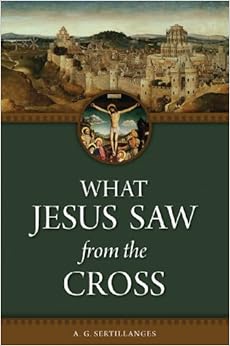
Lent and What Jesus Saw from the Cross

I want to introduce one of my Lenten reads for this year.  Today is Ash Wednesday, the beginning of Lent.  I hope you got your ashes across your forehead today.  You don’t have to be Catholic to receive ashes from a Catholic church.  Ashes are not a sacrament but a sacramental, and so anyone can receive them.  What’s a sacramental?  According to the Catechism of the Catholic Church, “sacramentals are sacred signs which bear a resemblance to the sacraments” but “do not confer the grace of the Holy Spirit” (CCC 1667-1670).  That’s rather theological, so let’s just summarize it as an action or outward sign that helps you get closer to God.  Ash Wednesday is a reminder that one is dust (“Remember that you are dust, and to dust you shall return") and a calling to repent (“Repent, and believe in the Gospel"). 

So this starts Lent where one is called to self-denial, penance, increased prayer, and alms giving.  This Lent I’m giving up the usual deserts and snacks and alcoholic beverages.  Someone also suggested one give up buying all “wants” and make purchases only of necessities.  I thought that was a brilliant self-denial, and so this year I will limit purchasing things only to things that are basic needs.  That’s going to be hard to do with limiting myself from buying books, but it will be a good test.

During Lent I increase devotional and spiritual reads, and a few weeks ago I mentioned I was going to read Compassionate Blood by Fr. Romanus Cessario, O.P. on meditations of Christ’s passion through the words of St. Catherine of Siena.  Now that’s a relatively short read.  A lengthier read is going to be What Jesus Saw from the Cross, published in 1930 by the French Dominican Antonin-Gilbert Sertillanges, O.P. 

The book is basically just what the title implies, a meditation on what Jesus saw looking out while hanging on the cross.  It’s objective is stated in the Prologue:

St. Paul exhorts us to “to on Jesus Christ, and in his words, understood in the spiritual sense in which he intended them, are of immeasurable importance.  However, there is perhaps another sense in which it is not impossible, nor without importance, to put on Jesus Christ.

We may put on Christ in imagination, placing ourselves not at the foot of the cross, nor before it, but upon it, with head bowed beneath the inscription, wearing the crown of thorns, pierced by the nails, feeling the cold, rough wood between our shoulders.  In short, we can make our own the sphere of vision and the emotions that were His, seeing with His eyes and feeling with His heart, remembering, judging, and foreseeing with Him so that, still in this same sense of imaging that we have changed places with Him, it is no longer we who live but Christ who lives in us.

It was in Jerusalem that this thought came to me, while I stood (as I frequently did) on a spot which is uniquely suggestive of such reflections.

Now that’s enticing.  Then I read the first chapter, “The View from the Cross,” and it blew me away.  Here’s a sample:

Having established the site of Calvary and described the Cross, the question still remains, in what direction was the Sufferer facing?  There are mystical authors who orient the Cross to the west—that is to say, they “disorient” it.  Their idea is that the look which regenerates is turned toward us, Israel and the Old Law being forsaken.  This theory, besides being a priori and not free from partiality, finds no confirmation in the situation of Calvary.

As you pass out of the Gate of Ephraim you are facing Mount Gareb, of which Calvary is a small foothill: to turn the gibbet to the west would be to make it face the hills and to hide it from the people.  The idlers of the gate and the loiterers of the esplanade, the passerby who met in great numbers at the crossroads, the folk that clustered everywhere about, the dwellers in the tents set up in the open air for the feast, all these would have been foiled.  The public example made of the victim would have been thwarted; furthermore, the erection of the gibbet and the management of the execution would have been made difficult.  In every way, it would have been a bad arrangement.

No, Jesus faced the gate by which He had come forth, through which came His insulters and those who were greedy for a spectacle.  He offered Himself to those who hated and mocked Him.  He lent Himself to the convenience of His executioners. 

And, if reasons of appropriateness must be added, the new Man looked toward the beginnings, toward the end of the earth from which came civilization together with the light.  He faced as the apse of a church faces, having before His eyes the rampart of a world beyond which He had passed, although He had not forsaken it.  His final glance saluted the Temple, His Father’s house, and the rising sun.


That is excellent prose.  I assume the original French was just as finely written.  For some reason the book doesn’t list the translator, but it does say it was translated in 1948.  A great subject, outstanding writing, intense spirituality, profound meditation, all through the thoughts of a Dominican friar—this is going to be a great read.  I’ll try to post again as I get deeper into the book.


Friday, February 24, 2017

Poem: “The Festubert Shrine” by Edmund Blunden

Continuing on with last year’s poetry read, Max Egremont’s Some Desperate Glory: The First World War the Poets Knew, I came upon this wonderful poem by Edmund Blunden.  I wrote about Egremont’s book last May while posting a on an Isaac Rosenberg poem.  I had never heard of Blunden, but apparently a poet of some renown both during and after the war.  He was a friend to the more well know Siegfried Sassoon. 

Blunden entered the front in 1916 shortly before a planned spring offensive.  Egremont describes Blunden’s arrival.

The western front was now full of rumours about the coming offensive.  Constant activity was thought to be vital and officers led parties to reconstruct damaged trenches, repair wire and bury the dead.  This was what Edmund Blunden found when he arrived in France in May.

Blunden was already a poet of immense fluency.  One long pre-trench poem, finished in March, was a disquieting account of cruelty’s consequences called “The Silver Bird of Herndyke Mill.”  A dark atmosphere threatens an English churchyard, stream and wood in the kind of Georgian scene that always inspired Blunden.  Early in 1916, with artillery rumbling from across the Channel, death must have seemed near, even in tranquil Kentish fields.

After some training in the camp at Etaples—where a sergeant major was killed by a faulty grenade—Blunden joined his battalion of the Royal Sussex regiment at La Touret, not far from Béthune.  It could seem idyllic until heavy guns and mines exploded, let off by both sides.  Festubert was within reach, where Sassoon and [Robert] Graves had been at the end of 1915, and Blunden looked for the local orchards, finding a chapel dedicated to the Virgin Mary, a peaceful place away from the guns.  Like Sassoon, he went off on a course; then saw the La Bassée canal, a Red Cross barge on it, the rich summer landscape and the now ruined village of Cuinchy, near the treacherous brickstacks.  He was close to Neuve Chapelle by the end of June.  (pp 113-4)

That chapel in Festubert became the subject to this poem.  Some more background before you get to the poem.  Festubert is a little town in northern France and was the focal point of The Battle of Festubert in 1915, the year before Blunden stumbled on the chapel.  The town was destroyed but the chapel, despite taking on projectile fragments, survived, and Blunden apparently taking a diversion looking for apple orchards stumbled upon it and found it would make a fine subject for a poem.  And so now you are ready to read the poem.

The Festubert Shrine
by Edmund Blunden

A sycamore on either side
In whose lovely leafage cried
Hushingly the little winds —
Thus was Mary’s shrine descried.

“Sixteen Hundred and Twenty-Four”
Legended above the door,
“Pray, sweet gracious Lady, pray
For our souls,” — and nothing more.

Builded of rude gray stones and these
Scarred and marred from base to frieze
With the shrapnel’s pounces — ah,
Fair she braved War’s gaunt disease:

Fair she pondered on the strange
Embitterments of latter change,
Looking fair towards Festubert,
Cloven roof and tortured grange.

Work of carving too there was,
(Once had been her reredos),
In this cool and peaceful cell
That the hoarse guns blared across.

Twisted oaken pillars graced
With oaken amaranths interlaced
In oaken garlandry, had borne
Her holy niche — and now laid waste.

Mary, pray for us? O pray!
In thy dwelling by this way
What poor folks have knelt to thee!
We are no less poor than they.

I doubt Blunden was Catholic—perhaps he was high Anglican—or if he was even religious, but the appeal to the Blessed Mother is moving: “Pray, sweet gracious Lady, pray/For our souls.”  I particularly like the image of the stone front scarred with shrapnel.  He refers to it as “War’s gaunt disease,” as if it were the remnants of a pox.  The final image of poor folks kneeling, and he and his fellow soldiers being just as poor reduces the gallantry of war to resignation.


I’m going to count this as a Faith Filled Friday post in addition to a poetry.  Blessed Mother pray for the war dead.


Sunday, February 19, 2017

Plans for 2017

Well this is certainly late, and frankly I’ve been wondering whether I should even bother providing reading plans for the year given I deviated dramatically last year from my beginning of the year plans.  But I will.  Two works in my annual goal were left unfinished: Adrian Goldsworthy’s Julius Caesar and Max Egremont collection of  WWI poetry in Some Desperate Glory: The First World War the Poets Knew.  I’m about two thirds deep in both books, but I’ve been reading the Julius Caesar biography for three years now. 


The planned reads I never got to start make quite a list: Herta Müller’s The Hunger Angel, Thomas Berger’s Crazy in Berlin, D. H. Lawrence’s novella, The Virgin and the Gypsy, Volume III of Victor Hugo’s, Les Misérables, titled “Marius,.” the third novel in Ford Madox Ford’s tetralogy under the heading Parade’s End, titled, A Man Could Stand Up, William Faulkner’s Old Man, Gertrude von Le Fort, The Wife of Pilate, Dante’s third part of The Divine Comedy, Paradisio, Pam Johnson-Bennett’s non-fiction Think Like a Cat, Thomas Cahill’s Sailing the Wine-Dark Sea: Why the Greeks Matter and Lawrence Rainey’s The Annotated Waste Land with Eliot’s Contemporary Prose, an annotation and commentary to T. S. Eliot’s great poem.  That amounts to four novels, three novellas, two works of non-fiction, and two works of book length poetry with commentary.  Add to the unfinished works and you’ve got an annual goal all in itself.

It’s not like I didn’t read enough last year.  I read nearly the amount I normally do.  The problem is I belong to a couple of book clubs now and the books selected come out of a vote, and what’s selected is usually out of my control.  And so I had to put off planned reads.

So here’s what I’m going to do.  I’m going to march down the list above, completing last year’s list.  I’ll have to add works that get chosen from the book clubs but I’m going to limit my participation to them and try to focus on what I want to read.

In addition to those listed above, I’m going to continue reading through the Bible.  On the Old Testament side, I’m up to Wisdom books: Proverbs, Ecclesiastes, Song of Songs, Wisdom, and Sirach.  On the New Testament I’ll be completing Paul’s Epistles.  In the past couple of years I’ve read Romans and the two Corinthians.  This year will be the Letter to the Galatians, Letter to the Ephesians, Letter to the Philippians, Letter to the Colossians, First and Second Letters to the Thessalonian, First and Second Letters to the Timothy, Letter to Titus, Letter to Philemon, and Letter to the Hebrews.  It sounds like a lot but many of those works are very short.

I’ll be aiming for two short stories a month as always, and I will also try to sneak in another play of Shakespeare I haven’t read yet.


Some of this I’ve already begun and even completed.  I’ll try to blog more on my readings.  I feel so guilty about dropping that.  I’d hate for my blog to disintegrate.  Well, here’s to another year of reading.


Sunday, February 12, 2017

My 2016 Reads

Completed: First Quarter

“Master and Man,” a short story by Leo Tolstoy.
Interior Castle, a non-fiction book on spirituality by St. Teresa of Avila.
“A Cup of Cold Water,” a short story by Edith Wharton.
Feline Catastrophes, a collection of humorous anecdotes by Victor S. E. Moubarak.
“In the Garden of the North American Martyrs,” a short story by Tobias Wolff.
To Kill a Mockingbird, a novel by Harper Lee.
Prayer for Beginners, a non-fiction book of devotion by Peter Kreeft.
“Saint Dymphna,” a short story by Mary O’Connell.

Completed 2nd Quarter:

“A House of Gentlefolks,” a short story by Evelyn Waugh. 
The Noonday Devil: Acedia, the Unnamed Evil of Our Times, a non-fiction book by Jean-Charles Nault, O.S.B.
White Fang, a novella by Jack London.
The Book of Psalms, (Psalms 51-100) KJV and Ignatius RSV Translations.
“Hallelujah, Family,” a short story by Ludmilla Petrushevkaya, translated by Anna Summers.
“Wingstroke,: a short story by Vladimir Nabokov. 
“A House of Gentlefolks,” a short story by Evelyn Waugh.
“Miles City, Montana,” a short story by Alice Munro. 
“The Cabuliwallah,” a short story by Rabindranath Tagore. 
“1933,” a short story by Mavis Gallant.
“The Man Born Blind,” a short story by C. S. Lewis. 
“After the Storm,” a short story by Earnest Hemingway.

Completed 3rd Quarter:

Saint Dominic, a biography by Sr. Mary Jean Dorcy, O.P.
“Clair de Lune,” a short story by Guy de Maupassant. 
“The Crucifix across the Mountains,” a personal essay by D. H. Lawrence.
“The Woman In White: Emily Dickinson and Friends,” an essay by Joyce Carol Oats.
“The State of Grace,” a short story by Harold Brodkey.
The Book of Psalms, (Psalms 101-150) KJV and Ignatius RSV Translations.
Learning the Virtues That Lead You to God, a non-fiction book of Christian devotion by Romano Guardini.

Completed 4th Quarter:

First Letter to the Corinthians, an epistle from the New Testament by St. Paul the Apostle in both the KJV and Ignatius RSV translations.
Silence, a novel by Shūsaku Endō. 
“Unzen,” a short story by Shūsaku Endō. 
“The Stampeding of Lady Bastable,” a short story by Saki (H. H. Munro).
“The Jesting of Arlington Stringham,” a short story by Saki (H. H. Munro).
Second Letter to the Corinthians, an epistle from the New Testament by St. Paul the Apostle in both the KJV and Ignatius RSV translations.
Buddenbrooks: The Decline of a Family, a novel by Thomas Mann.
“The Demilitarized Zone,” a short story by Anthony Doerr.
“The Flying Stars,” a Father Brown mystery short story by G. K. Chesterton.
 “The Red-Headed League,” a Sherlock Holmes short story by Sir Arthur Conan Doyle.
“In a Grove,” a short story by Ryūnosuke Akutagawa.
“Clay,” a short story by James Joyce.
Two Gentlemen from Verona, a play by William Shakespeare.
Artful Sentences: Syntax as Style, a non-fiction book on writing by Virginia Tufte.


Unfinished Reading:

Julius Caesar: Life of a Colossus, a biography by Adrian Goldsworthy.
Some Desperate Glory: The First World War the Poets Knew, a book of history and collected poetry by Max Egremont.


I’m late on summarizing last year’s reads.  Really late.  On balance I would say this was again not a great year for reading, perhaps just short of average.  But more importantly I was distracted from my plans.  I don’t think I read half of what I planned to read at the beginning of the year.  Two reasons I think.  First the Thomas Mann novel Buddenbrooks taken up in May but not completed until the end of summer was so long that I did not plan accordingly and once I fell behind it destroyed the pace and plan I envisioned.  Second belonging to Goodreads book clubs forces one to accommodate the poll winner for the reading selection,  I don’t get to decide all the time.  Before I summarize, if you wish to read my beginning-of-the-year plans and the quarterly updates for 2016 you can find them here:


As you break down my reads you will find twelve full length works, six books of non-fiction, five books of fiction, and one play, maintaining the one book per month goal I set out every year.  The fact that there were more works of non-fiction than fiction is not typical of my reading patterns, but I think this may have been a function of being part of a Catholic Book Club on Goodreads, where the book selections tend to be Catholic devotional works or about Catholic theology.  There were four such books on the list: St. Teresa of Avila’s Interior Castle, Peter Kreeft’s Prayer for Beginners, Jean-Charles Nault’s The Noonday Devil, and Romano Guardini’s Learning the Virtues that Lead You to God.  I have to say I thought the Kreeft book and the Guardini book were so-so.  I didn’t dislike them, but I didn’t think they were that insightful.  Interior Castle is a great classic and well worth the read, and Nault’s book on acedia—a complicated emotional state of boredom, sloth, and inertia—is fascinating and perceptive.  Nault makes the case that acedia is what drives people to lose devotion and perseverance, both in religious life and even every day activity, and Nault points out is particularly problematic in today’s hyper distracting world.  It’s a rather heavy read, but interesting.

Another non-fiction work, also with a Catholic subject was the biography of St. Dominic de Guzmán by Sr. Mary Jean Dorcy.  This read was not associated with the book club but was something I did to honor the 800th anniversary of the founding of the Order of Preachers.  And the last non-fiction book I read was my annual read on the art of writing, this year being Virginia Tufte’s Artful Sentences: Syntax as Style.  Tufte’s book is a magnificent work.  It goes through every possible sentence structure and their rhetorical implications.  I meant to post some of the grammatical points here, but unfortunately I haven’t been so consistent in my blogging.  Perhaps on occasion I still will post something from this wonderful book.

The four full length fiction works were all outstanding and all four classics.  Harper Lee’s To Kill A Mockingbird from mid-20th century American South dealt with issues of racism through the eyes of a young girl.  Jack London’s White Fang is an early 20th century American novel from the point of view of a wolf-dog as he goes from wild to domesticate.  Shūsaku Endō’s Silence is a 20th century Japanese historical novel set in the 16th century of Catholic persecution.  And Thomas Mann’s Buddenbrooks is an early 20th century German epic set in the 19th century of a family’s decline.  I immensely enjoyed all four novels.  The fifth fiction work, Feline Catastrophes, is Victor Moubarak’s humorous collection of anecdotes—somewhere between short stories and jokes—centered on the house cat and the trouble he causes.  Victor you may realize is a frequent reader of this blog.  As with his many other publications, Feline Catastrophes, was a fun read.

The one play I read was one of Shakespeare’s early comedies, Two Gentlemen from Verona.  While the plotting seemed a little awkward and the character’s conversions too convenient, the play was still enjoyable and worthwhile, least of all for Shakespeare’ language.   It was a play obviously where he was learning his craft, but his poetry had already developed into the Bard that he would be.  This play checks off another of the ones I’ve read from the Shakespeare opus.  That makes 28 plays read of Shakespeare’ 37 officially credited plays.  I’m getting there.

I also made headway on my track through the Bible.  From the Old Testament I read Psalms 50 through 150 both in the KJV an Ignatius RSV translations, and from the New Testament I read First and Second of Paul’s Letters to the Corinthians, also in both translations.  That puts me about half way on the Old Testament and significantly through the New.

I completed 22 short stories but if you add the two essays I’ve listed, which are about short story length, I read 24 short works this year.  That’s spot on the two per month I set as a goal.  I guess that’s not too bad.  Both essays were well worth reading, but Lawrence’s “The Crucifix Across the Mountains” is exceptional, a classic.  Not only was D. H. Lawrence a great novelist, great short story writer, and great poet, but he was a fine essayist as well.  “The Crucifix Across the Mountains” starts out as a travel essay where the author traverses across the Alps from Germany to Italy.  But near Innsbruck the author comes across a series of crucifixes, and as he goes from mountain to mountain he encounters more crucifixes.  The essay is a contemplation of art, Christ, and death.

This year I’ll rate the short stories as either exceptional, good, ordinary, or duds.  Of the duds there were two: “The Man Born Blind” by C. S. Lewis and “The State of Grace” by Harold Brodkey.  Lewis’s story was a posthumously published work and I suspect it was never refined, if it ever meant to be published.  It felt more like a sketch than a complete story.  Brodkey’s story was boring and depressing and was supposed to have all sorts of Freudian significance, which in today’s age is meaningless.  Six stories I considered ordinary: “Saint Dymphna” by Mary O’Connell, “Clare de Lune” by Guy de Maupassant, “The Jesting of Arlington Stringham” by Saki, “The Flying Stars” by G. K. Chesterton, “The Demilitarized Zone” by Anthony Doerr, and “Clay” by James Joyce.  The one surprise to some in those six I think would be Joyce’s “Clay.”  It’s about a spinster who going on a visit to the family of a man who she nursed when he was a child, forgets the cake she bought for the occasion on the train ride because she became flustered when a drunken man flirted with her.  It was well written but the lack of sympathy the author displays for the woman made it feel harsh and pitiless, and the theme wasn’t exactly profound.  I’m probably not with the majority, but I don’t find James Joyce that great a short story writer. 


Nine stories I’d rate in the good category:  Tobias Wolff’s “In the Garden of the North American Martyrs,” Ludmilla Petrushevkaya’s “Hallelujah, Family,” Vladimir Nabokov’s “Wingstroke,” Evelyn Waugh’s “A House of Gentlefolks,” Alice Munro’s “Miles City, Montana,” Rabindranath Tagore’s “The Cabuliwallah,” Mavis Gallant’s “1933,” Shūsaku Endō’s “Unzen,” Saki’s “The Stampeding of Lady Bastable,” I could probably distinguish a couple of those in a very good category (Gallant’s and Petrushevkaya’s ) since I had a hard time deciding if they were exceptional.  What’s notable about this group is just how international the group of writers are. 

Four stories I’d rate in the exceptional category: Leo Tolstoy’s “Master and Man,” Edith Wharton’s “A Cup of Cold Water,” Earnest Hemingway’s “After the Storm,” and Ryūnosuke Akutagawa’s “In a Grove.” “Master and Man” is a story of rich landlord and a peasant caught in a blizzard; “A Cup of Cold Water” is about a poor, young man in love with a rich lady but uses his last pocket money to save another lady.  “After the Storm” is about a scavenger who finds a sunken vessel after a hurricane and tries to steal the valuables.  “In a Grove” is a series of testimonies to the police about a murder, each account varying and telling us something about the witness.  When you add up the accounts you get to the heart of the murder.


As I do every year, I give a prize to the best short story read in that year.  First the honorable mention and runner up is…drum roll please… Ryūnosuke Akutagawa’s “In a Grove.”  Akutagawa is early 20th century Japanese writer known as the "Father of the Japanese short story.”  I had never read any of his stories, but was totally impressed with “In a Grove.”  The sequencing of accounts, varying and conflicting with each other, creates a complex situation where truth is distorted through perception.  Finally, the winner is…more drum roll…Tolstoy’s “Master and Man.”  This was an incredible story about a selfish landlord who faced with death of the peasant under him freezing to death saves him by using his body warmth.  While doing he has a mystical experience of meeting Christ, but while keeping the peasant warm he is exposed and dies.  The landlord maybe master over the peasant, but the Lord is master over him.  You can find both those stories on line if you want to read them.

Friday, February 10, 2017

Faith Filled Friday: Compassionate Blood by Fr. Romanus Cessario, O.P

For those looking for a devotional book to read for Lent, the monthly Catholic magazine, Magnificat, has put out a devotional this season, Compassionate Blood, written by Fr. Romanus Cessario, O.P. Fr. Romanus using the thoughts and words of my dear St. Catherine of Siena creates a meditation on Christ’s Passion.  Here’s what the ad blurb says:  

“What do we learn from this description of the suffering Christ? What does Catherine teach us about the transformation that brings the world stillness on Good Friday from noon until three o’clock?

“The answer is simple: We discover that because of his enormous love, Christ’s sufferings and death cause the transformation of all that exists, the transformation we call Christian salvation….
The transformation that Catherine announces is one that creates in those persons who remain united with Christ a new ground for love, a new sort of loving…. The transformation affects both our persons and our actions.”

Father Romanus Cessario, O.P.
Senior Editor of Magnificat

Of course given St. Catherine is my patroness, as soon as I saw the flyer in this month’s edition of Magnificat I went and ordered it right away.  It just came in the mail today.  Flipping through the pages, it looks like a great little read, especially if you’re looking to learn something about St. Catherine’s theology.  And remember St. Catherine of Siena is one of the doctors of thechurch.  It’s 86 pages not including the footnotes and about the size of a well-constructed paperback.  Here’s an image of the book.


You can order it here  for $9.95, three dollars off the regular price.  I don’t know when the sale ends, so hurry if you are interested.  March 1st is Ash Wednesday, and if you order now it should arrive before then.