"Love follows knowledge."
"Beauty above all beauty!"
– St. Catherine of Siena

Monday, January 13, 2014

Matthew Monday: Matthew the Superhero

Matthew has been playing superhero lately.  My goodness, he’s jumping like Spiderman, wrestling invisible bad guys like Batman, and powing invisible evil robots like Superman.  It’s been a bit exasperating as he leaps from the top of the bed, spontaneously runs from one end of the house to the other, or suddenly falls to the floor and does a roll, all with a sigh that “the Joker got" him. 

So Sunday I was driving him over to my mother, who is eighty years old, and as I unbuckle him from his car seat, he says, “Come on Robin let’s get out of the Bat mobile.” 

So in my stern voice, wondering how my mother is going to handle him, I said, “I don’t want you jumping around at Nonna’s.”

So he replies in a breathy, rebellious whisper, “OK.  I’m going to FLY around," with emphasis on "fly."

All I know is when I got back to pick him up he said he “scored ninety goals on Nonna.”  I can just imagine what went on. 


Friday, January 10, 2014

Literature in the News: 16 Movies in Theaters in 2014 Based on Books

Over at BuzzFeed Books, Arielle Calderon posted 16 Books ToRead Before They Hit The Theaters This Year.  I’ll just list the books and authors, but you can go over and read a short synopsis of each story line, the actors, and when the movie plans to release. 

 
1. Labor Day by Joyce Maynard

2. The Monuments Men by Robert M. Edsel and Bret Witter

3. Winter’s Tale by Mark Helprin

4. Vampire Academy by Richelle Mead

5. A Long Way Down by Nick Hornby

6. Divergent by Veronica Roth

7. The Fault in Our Stars by John Green

8. The Hundred-Foot Journey by Richard C. Morais

9. The Giver by Lois Lowry

10. Dark Places by Gillian Flynn

11. This Is Where I Leave You by Jonathan Tropper

12. The Maze Runner by James Dashner

13. Gone Girl by Gillian Flynn

14. Unbroken by Laura Hillenbrand

15. Wild by Cheryl Strayed

16. Serena by Ron Rash

Hat tip to Sister Rose at the Movies for leading me to the site.  I don’t frequent BuzzFeed.

I’ve never read any of them, nor even recognize any except Mark Helprin’s Winter’s Tale.  I read and reviewed Helprin’s A Soldier of the Great War on my blog here last year. 

To be up front, I probably won’t see any of them.  I don’t go to too many movies any more.  I don’t find the art form as interesting as reading the novel.  The only movie I might see—if I can convince my wife to go—is the new Captain America movie coming out in the spring. :) 

Wednesday, January 8, 2014

Plans for 2014 Reads

OK, I’m picking up where I left off on my 2013 reads.  I never did get to Mark Twain’s, Life on the Mississippi and Henry James’s Washington Square.  As I said in my summary of my 2013 reads, these will take priority.

Beyond that there are several novels that I really want to take up.  I really want to read Ford Maddox Ford’s epic novel of WWI and its aftermath, Parade’s End.  BBC I believe put out a TV series adaptation and I heard it received great reviews.  But I have to read the novel first.  It’s actually a tetralogy (four novels linked in series) so if I don’t get to finish all this year (it’s over 900 pages altogether) I can find a convenient break and pick it up next year.


The other novels I really want to get to is Dostoevsky’s Crime and Punishment (never read it and have wanted to for years) and I promised I would take up Stephen King’s The Shining.  I also never read Les Misarables, and at almost 1500 pages I know I can’t do it in one year.  So my thought was to divide it up into its parts.  Hugo sections the novel into five volumes, each volume about the length of an average novel.  So my thought was to do one volume each year for the next five years.  Volume 1 is titled, “Fantine.”

I will complete Dante and read the third cantica, Paradisio, and since I got so much out of reading two translations simultaneously of Purgatorio last year, I’ll do the same this year.

My poetry read is going to be Gerard Manley Hopkins: Poems and Prose, selected and edited by W. H. Gardner. 

My read on writing will be Style: an Anti-Textbook by Richard A. Lanham.  Other non-fiction will be a book of personal essays by Brian Doyle, The Thorny Grace of It: And Other Essays for Imperfect Catholics, a biography of Julius Caesar, Life of a Colossus by Adrian Goldsworthy, and my theology read, Orthodoxy by G. K. Chesterton.  Brian Doyle has the most wonderful writing style that ranks with the best, and he’s got wit to boot.  That’s going to be a fun read.  I debated with myself on a bio of Bach over Caesar, but I’ve had the Goldsworthy book longer on the waiting list.  And I just need to read more Chesterton. 

I’ll continue reading through the bible.  I’m up to Tobit, Judith, Esther, the two books of the Macabees, and depending how long that takes, Job as well.  That’s certainly a much more interesting read than the histories I was bogged down with last year.  On the New Testament I’ll be reading Paul’s epistle, Romans.

Then there are the short stories, and the only criteria there is that I make progress getting through Hemingway’s collection.  My objective remains 24 total stories for the year.  I did promise Jan I would do O. Henry’s, “The Ransom of Red Chief.” 

That’s quite a bit, but there might still might be room for a brisk novel or two.  I’ll assess as I go along.  I’ll also have to read at least one Shakespeare play.  Not sure which one yet.

I haven’t completed posting on last year’s reads.  I promised to post on Dante’s Purgatorio and I will.  And Alice Munro’s short story, “Fiction” was interesting enough for me to outline a post.  And I should have one post going through Steinbeck’s Cannery Row. 

As I’ve said before, if there is any work I read that someone wants to see my thoughts on it, please tell me.  I will accommodate if I can.  And that offer stands for anything I read last year and will read this year.  And if there is anything I listed that grabs your attention, perhaps we can read it at the same time and discuss it as we go along.  Just give me a heads up.


Tuesday, January 7, 2014

Music Tuesday: "In a Sentimental Mood" by Duke Ellington and John Coltrane

I don’t post enough jazz.  Perhaps it’s off-putting to people, but then so is classical.  If you give it a chance it can be so satisfying. 

My all time favorite jazz composer is DukeEllington He’s known mostly for Big Band compositions, but occasionally he recorded reduced the size of his band to a six to nine pieces.  Here he records his big band classic, “In a Sentimental Mood,” with a just quartet.  I’m no expert but I don’t recall Ellington ever recording with that small a group.  But this is not just any quartet.  This quartet features John Coltrane on saxophone.  The album from which this recording comes from, Duke Ellington and John Coltrane, has its own Wikipedia entry. 

On a small group arrangement you want to highlight the virtuoso and John Coltrane (“the Trane”)   is one of the greatest sax virtuosos ever.  The arrangement of piano and sax almost has the feel of a sonata in classical music.  [If you get a chance and are so interested compare this with Leonard Bernstein’s “Sonata for Clarinet and Piano.”   You can find it on youtube.]

 Here's Ellington and Coltrane in one of the most moving pieces I've ever heard.


Now that you’ve heard the quartet featuring Coltrane, here’s the Big Band version.  What I think I hear is alternative takes at the melody by a clarinet, sax, trombone, and trumpet.  And there is a lot more accompaniment by the rest of the orchestra. 


It is very lovely in its own way—it’s just a lovely composition—but either Coltrane is just so superior or it works so much better as a quartet.  What do you think?

Monday, January 6, 2014

Matthew Monday: Snow, Freezing Cold, Christmas, and the Croup

I haven’t had a Matthew Monday in a while, so here are a few items.

(1) Christmas.  Does Matthew love Christmas?  Does a bear discharge in the woods?  In addition to more toys (like he needed more die cast model cars) he got a three wheeled kid’s scooter from his Godmother.  It looks something like this except it doesn’t have the basket and those strips on the handle bars.  Basket looks geeky anyway.


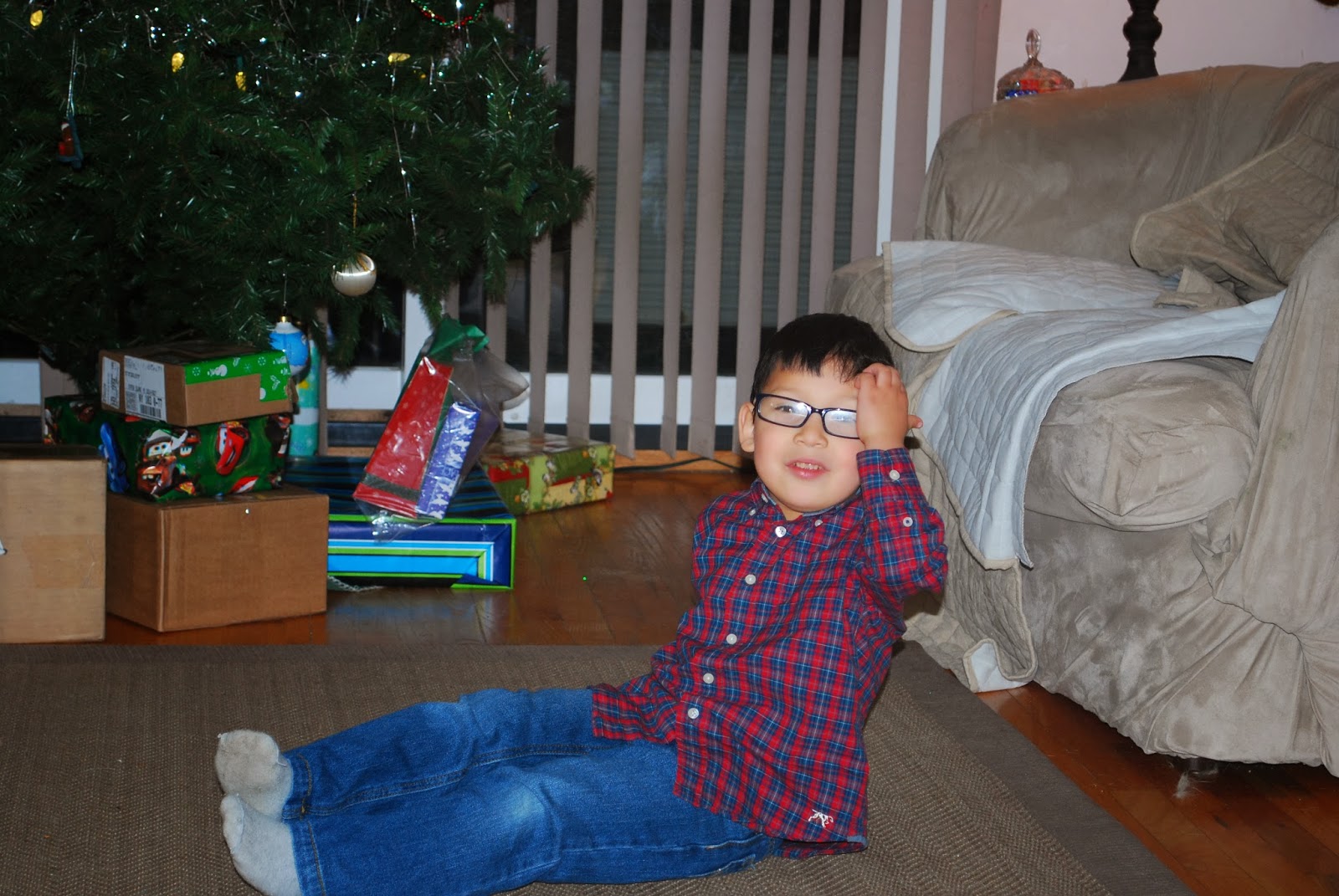
Since he can’t ride it outside yet because of the cold he’s been “practicing” (as he puts it) in his room and the upstairs hallway.  The noise listening to him from downstairs sounds like he’s running over speed bumps at Mach speed.  I may have to just let it vanish until springtime.  Here’s a picture of him in front of our Christmas tree.


And then opening a present with his elf hat on.


(2) A day or two after Christmas he woke up in the wee hours of the morning gasping.  My wife woke me up thinking he was choking.  She thought it sounded like he had something stuck in his throat.  I stuck my finger down his throat to make sure (I thought a spider might have crawled in) and there wasn’t anything.  Of course that caused him to start crying.  The wheezing really worried us.  So we got dressed and buttoned him up and we drove over to the Emergency Room.  Of course he didn’t want to go and was crying that he didn’t want any needles.  The triage nurse said he was like the third child in that night with the same symptoms.  Obviously something was going around.  She tried to take his blood pressure and that got him crying again...lol.  Once inside the doctor diagnosed it as “the croup.”  I said, “What?  What the heck is that?”  I had never heard of it and thought it might be something serious.  Not too serious.  A viral infection that causes coughing and wheezing.  He’s had a mild temperature (99F), runny nose, and a cough.  The ER gave him a steroid drink but nothing else.  He’s been out of school for a week but back on Monday. 
 

(3) Then we got nine inches (23 cm) of snow followed by arctic temperatures.  I think we actually got down to 1 degree F (-17C).  Matthew wanted to play in the snow.  We let him just once, after his temperature was normal and before the really bitter cold came in.   Some pictures in the snow.


The snowball was intended for me and he got me while I was shoveling.  The little devil.

Sunday, January 5, 2014

My 2013 Reads

“A Star Trap,” a short story by Bram Stoker.
“Grandfather and Grandson,” a short story by Isaac Bashevis Singer. 
The Man Who Was Thursday: A Nightmare, a novel by G.K. Chesterton.
“Feathers,” a short story by Raymond Carver.
The Cossacks, a novel by Leo Tolstoy.
“In Another Country,” a short story by Earnest Hemingway.
First Book of Chronicles, a book of the Old Testament, KJV.
Catherine of Siena, a biography by Sigrid Undset.
“The Masque of Red Death,” a short story by Edgar Allan Poe.
“William Wilson,” a short story by Edgar Allan Poe.
“A Descent into Maelstrom,” a short story by Edgar Allan Poe.
“The Lovely Lady,” a short story by D.H. Lawrence.
“Hills Like White Elephants,” a short story by Earnest Hemingway.
“The Killers,” a short story by Earnest Hemingway.
Second Book of Chronicles, a book of the Old Testament, KJV.
“The Fall of the House of Usher,” a short story by Edgar Allan Poe.
“The Waste Land,” a long poem by T.S. Eliot.
A Soldier of the Great War, a novel by Mark Helprin.
“The Shawl,” a short story by Cynthia Ozick.
ifferisms: An Anthology of Aphorisms That Begin With the Word if, a work of non-fiction by Dr. Mardy Grothe.
“Rip Van Winkle,” a short story by Washington Irving.
The Book of Ezra, a book of the Old Testament, KJV.
“Chi Ti Dice La Patria?” a short story by Earnest Hemingway.
Lumen Fidei, An Encyclical of the Roman Catholic Church.
The Book of Nehemiah, a book of the Old Testament, KJV.
“Pillar of Salt,” a short story by Shirley Jackson.
“The Shape of the Sword,” a short story by Jorge Luis Borges.
“The Body-Snatcher,” a short story by Robert Lewis Stevenson.
Pitching In A Pinch: Baseball From The Inside, a non-fiction book on baseball by Christy Mathewson.
“The Blue Cross,” a Father Brown mystery short story by G. K. Chesterton.
“Who Killed Bob Teal?” a short story by Dashiell Hammett. 
“The Man,” a short story by Ray Bradbury.
“Early Marvels,” a short story by Romulus Linney.
“Miriam,” a short story by Noni Tyent.
“Fiction,” a short story by Alice Munro.
Macbeth, a play by William Shakespeare.
“Purgatorio,” 2nd part of the epic poem of The Divine Comedy by Dante Alighieri, Translated by Anthony Esolen.
“Purgatorio,” 2nd part of the epic poem of The Divine Comedy by Dante Alighieri, Translated by Robert M. Durling.
"Esmé,” a short story by Saki (H.H. Munro)
Acts of the Apostles, a book of the New Testament, KJV & NAB.
Imagist Poetry: An Anthology, a collection of poetry edited by Bob Blaisdell.
Rome and Jerusalem: The Clash of Ancient Civilizations, a non-fiction history by Martin Goodman.
The Creed: What Christians Believe and Why it Matters, a non-fiction book of theology by Luke Timothy Johnson.
Cannery Row, a short novel by John Steinbeck.
 

As busy as I was this year, this might have been one of the most productive reading years I’ve had.  Four novels, the Helprin novel being over 800 pages; two separate translations of Purgatorio, Dante’s second cantica of The Divine Comedy; two works of poetry, “The Waste Land” for the umpteenth time, and a collection of imagist poets from the early part of the 20th century; one play, Shakespeare’s Macbeth, twenty-four short stories, achieving my goal of two per month; seven books from the bible, with Acts of the Apostles read twice in two separate translations; and six books of non-fiction.  All in all I estimate I read somewhere around 4000+ pages. 

 
Let’s start with the novels.  All four were very different from each other.  Tolstoy’s The Cossacks, while it’s not one of the great Tolstoy works (this was his first novel) is still a fine work, a work of picturesque beauty—set in the Caucus Mountains—of psychological probing (the central character is incredibly insecure and leaves the high Moscow society for the simplicity of Cossack life and still finds himself alienated), and rooted in 19th century Romanticism in a way that future Tolstoy works are less so.  Chesterton’s The Man Who was Thursday is a story of early 20th century anarchism but unlike Joseph Conrad’s The Secret Agent, a work of realism and tragedy and which I kept thinking of as I read Thursday, Chesterton’s novel is comic and absurdist.  I would say it is a forerunner to the absurdist movement later in the century.  However, we normally associate absurdist art with nihilism, but Chesterton turns nihilism on its head so that the novel is life and tradition affirming.  This novel should be ranked much higher on the Canon in literature departments, and frankly should be part of early 20th century literature curriculum.  And to boot, it’s absolutely hilarious, reminiscent of Voltaire’s Candide.  Mark Helprin’s A Soldier of the Great War is an epic that situates the problems of the 20th century there at the first big crises of the century, but through sequences of light and dark and through the life of a professor of aesthetics who served in the war, Helprin captures what is truly important in life, the love of family and friends and art in the midst of suffering and terror.  This work is a near masterpiece (a bit lengthy and verbose its only weakness, and perhaps on future readings I might be able to see why it had to be that long), and Helprin’s prose is a delight.  He is certainly one of the top prose stylists in English of the last fifty years.  Steinbeck’s Cannery Row is a ball of fun.  It’s a collage of vignettes around the lives of those in a seafood canning region in northern California.  The characters are so memorable, Lee Chong, Mack, Doc, Dora, Gay, Frankie, and the rest.  Most of them are a bunch of screw-ups.  But there is lots of drinking (of the alcoholic kind), fights, prostitution (a bit glorified), and friends helping friends through difficulties.  The vignettes are masterfully composed, vivid and concise and real; you get to feel like you live there, albeit it’s a bit more sentimentalized than life actually is.  But you can’t have a Steinbeck work without sentimentality.  While the vignettes are masterful, the novel’s shortcoming though is its lack of a strong central plot.  The only narrative development that moves the plot along and brings the work to a close is the effort and misfires to give Doc a party, which to me seems to lack the gravity of the situation.  But it’s still enjoyable.  As I look back on it now, all four novel reads are life affirming in their own way.  All four worth reading.

 
I read two different translations of Purgatorio because shortly before I started to read the Durling translation I discovered that Anthony Esolen, a scholar I hold in high regard, recently had come out with a translation of The Divine Comedy for Modern Library Classics.  I also found out Esolen was a poet as well as a medievalist scholar, which I hadn’t known before, and so I got his translation of Dante and decided to read two translations side by side.  Plus I realized that while I have read Dante’s Divine Comedy before, my readings of Purgatorio and Paradisio were cursory.  I had read Inferno several times, know it fairly well, but I had just blazed through the other two once, and mostly just to say I had read them.  One doesn’t typically read the other two unless one is majoring in medieval lit or Italian lit.  I want to understand and know Dante like I understand Shakespeare, Homer, and Virgil.  And it took me over three months to read them both.  I was saturated in Dante.  The differences between the two translations are noteworthy.  The Esolen is certainly more poetic and tries to hold to Dante’s form.  The Durling translation also in meter isn’t so concerned with maintaining Dante’s tercets and will spread out to four lines if needed for precision.  Also Durling’s translation provides extensive notes.  Esolen too provides notes, but I would say Esolen’s notes mostly focus on understanding the passage at hand while Durling’s notes crisscrosses the entire work to show the high integration of the Commedia, and once you appreciate that integration you can fully understand why I (and many others) consider it the greatest literary work.  I might characterize the differences in translations this way: Esolen’s is for the undergraduate student while Durling’s is for the graduate student.  But then Esolen’s poetry is excellent, about as good as any of the Dante translations I’ve ever perused.  I’m curious to see what his original poetry is like.

 
My poetry read of the year was a collection of poems from the Imagism movement at the early part of the 20th century.  I’m familiar with the imagist poets, especially Ezra Pound and D.H. Lawrence, but I wanted to sample a greater variety.  This was one of those inexpensive Dover Thrift Editions, and I don’t know if the selections were poor or the poems selected mediocre (probably both) but I bet one can do better with a collection.  There were a couple of oddities I found surprising.  First, the editor included Wallace Stevens, and Stevens is not an imagist poet.  He was friendly and traded letters with several of the imagists but he would not have included himself in their movement, at least that’s my memory of Stevens.  The collection also did not include Marianne Moore, and I would believe she fit into the imagist movement quite well, though I don’t know if she considered herself such.  But the intent of reading this was to broaden my reading of the imagists to those I had heard of but never read.  I have to say that D.H. Lawrence’s poems stood out.  If he weren’t already known for his fiction, which overshadows his poetry, I think Lawrence would be considered one of the top poets of the century.  I read “The Waste Land” again because I had found such a great audio version read by Jeremy Irons.  I don’t know if it’s still available for free.  I did at the time provide a link for my readers to download.  I read Macbeth again because I wanted to last year and never got to it.

 
I made my way through some of the hardest books (the dreaded histories) of the Old Testament in the King James translation as I make my way through the bible.  I say this every year, and I might as well say it again, I am not a fan of the King James translation, but because of its influence on the development of the English language I feel duty-bound as a student of English literature to read it through at least once.  I can’t wait until I’m done, but that’s going to be a few more years at this pace.  I did read Acts of the Apostles from the New Testament (in two translations, because I really want to understand the NT) and found it way more enjoyable than I expected.  St. Luke knows how to organize his material.

 
I read more non-fiction than I expected this year, six works in all.  One biography (of St. Catherine of Siena by the Nobel Prize winner, Sigrid Undset), one book on writing (I do one every year), an encyclical by the Pope which had come out and was about the length of a short novel, a book on baseball by a hall-of-fame old timer, a history of first century Rome and Jerusalem (I’m an ancient Roman history buff) leading to the destruction of the Temple in 70 AD, and a book of Christian theology on the formation of the Nicene Creed and what it actually means.  The book on writing, ifferisms is a book on the use of “if” in rhetorical phrasing and how it could improve one’s writing.  It was fun and I wish I could find more reasons to start sentences with “if” but the opportunities don’t seem to come up.  I had never read a papal encyclical before but I often have seen people quote them, so when this one came out in the spring I decided to pick I up.  Pope Francis is designated as author, but he had just been elected a short while before and it’s widely known that his predecessor, Benedict XVI had written a good 80 percent of it.  And I think I can identify who wrote what.  The Nicene Creed is the core of Christianity, and Johnson’s book is excellent in going through the history and breaking down each phrase to show its full meaning.  It’s also non-denominational; just about all Christian denominations profess the Nicene Creed.  The biography of St. Catherine touched me immensely, and I now consider her my patron saint.  The history and the baseball books reflect my interests, and were very good in their own way. 

 
I have to say my short story reads have become the joy throughout the year.  How else can one get such a diversity of writers, a diversity of subject matter, and diversity of style and form all within a day or two of completion?  I love the short story, and it serves as a pleasant diversion when bogged down with a long work.  I don’t really have a method to selecting the stories I read, except I’m slowly making my way a few stories per year through all of Hemingway’s.  I also had a few this year of Edgar Allen Poe, but that’s because I’ve been trying to round out my grasp of 19th century American literature, and one story from Poe wouldn’t be enough for a fair survey.  Other than that my choices are fairly random and impulsive.  I now have three shelves of a bookcase with short story collections, so I can choose almost any writer whim takes me to.  There were some duds in the reads.  The Stoker story (I had not read anything by Bram Stoker before and just wanted to sample), the Stevenson, and, two writers I had never heard of and probably will never read again, Linney and Tyent were disappointments.  All the rest were at least good, but I should highlight the cream of the crop.  The top tear stories here were “Grandfather and Grandson” by Singer, “Feathers” by Carver, “Hills Like White Elephants” and “The Killers” by Hemingway, “The Fall of the House of Usher” by Poe, “The Blue Cross” by Chesterton, “The Shape of the Sword” by Borges, “Fiction,” by Munro, and "Esmé” by Saki.  I have no problem considering any of those in the excellent category.  Though Cynthia Ozick’s “The Shawl” has the reputation of being one of the great contemporary short stories, I found it fell short.  So as I do every year, I will award the prize for the best short story read of the year, and this year it goes to…hold your breath…to Edgar Allen Poe, “The Fall of the House of Usher.”  This was a complete surprise for me.  Many times I have said I am not an Edgar Allen Poe fan.  I can’t help feeling that so much of his work is slapped together for quick sale using gratuitous sensationalism to hook the reader.  But there’s no question that he can be first rate.  The more I broke down “The Fall of the House of Usher.” the more I saw the subtle craft and integration.  I posted two whole blogs on this one short story.  If I were to put together a collection of the top twenty-five stories of all time, this one would be in it.  This year, I’ll give a runner-up prize and it goes to “Feathers” by Raymond Carver.

 
I didn’t get to Life on the Mississippi by Mark Twain and Washington Square by Henry James.  They’ll have priority in the New Year.

Wednesday, January 1, 2014

Literature in the News: Stephen King’s New Novels

Eve Tushnet, who blogs at Patheos and who also writes about culture and literature in several publications, reviewed for The American Spectator Stephen King’s latest two novels, Joyland and Doctor Sleep.  In doing so she really considers and assesses King’s entire body of work. 
 
Both of these novels feel like major departures for King. The psychological dynamics of each are essentially the reverse of those in King’s greatest work: An author who made his name chronicling his characters’ downward spirals is now trying to write upward.

Almost all of King’s greatest writing (the only exception I can think of is “The Body,” the novella that became Rob Reiner’s Stand By Me) follows the central character down into despair. While Stanley Kubrick’s film version of The Shining shows us Jack Torrance purely from the outside—it’s Wendy Torrance’s movie more than anybody else’s—the novel embeds the reader deep inside Jack’s disintegrating mind. Pet Sematary, Carrie, and Christine all star characters who are succumbing to horror. In Cujo King even manages to wring pathos out of a large family dog’s descent into madness. He’s adept at showing how we lose our integrity, hope, and sanity; hence one of his most recognizable tics, the italicized paragraph in which a monster’s thoughts suddenly surface within the mind of a man. I still shiver when I think about the bitter, hopeless anger of the old man who owned Christine: you shitters. That awful voice, the Screwtape voice we sometimes catch muttering around the corners of our minds: Stephen King shows us what would happen if that voice ruled the world.

It’s really a fine piece, and if you’re a Stephen King fan a really must read.  Tushnet zeros in to the specific King technique that characterizes his fiction: 

Stylistically, King has always relied on the Hitchcockian close-up, the sudden zoom of the narrative camera. He uses this trick in that glinting first sentence of IT: “The terror, which would not end for another twenty-eight years—if it ever did end—began, so far as I know or can tell, with a boat made from a sheet of newspaper floating down a gutter swollen with rain.” A thing which recurs, and gathers horror around itself with each recurrence, like a snowball. The Dead Zone has its refrain of the bad hot dog, the Wheel of Fortune: these little irrelevancies which create a moral catastrophe for the hero. The very littleness of the objects underlines our helplessness—it takes only a bad hot dog to bring us to anguish.
 
But what caught my eye was her assessment of King’s work. 

This writerly skill, plus King’s sheer tenacity, means that his more self-consciously literary readers are finally starting to throw around terms like Great American Novel. He deserves it; several of his novels are great in themselves, but especially great as portraits of a particular culture and time. It’s amazing that he’s managed to work so much Americana into his books with only an occasional lapse into hokeyness. Think of everything his cold fingers have touched: the prom, the classic car, the hot dog, The Wizard of Oz, the Winnebago, “Hey ho—let’s go!”

Now associating King’s work with the “Great American Novel” perked my ears.  In American literature, The Great American Novel is a very specific term for American novels that transcend to greatness while capturing a particular essence of American culture.  Herman Melville’s Moby Dick or F. Scott Fitzgerald’s The Great Gatsby are usually touted as being Great American Novels.  To say one has written the Great American Novel is to give that writer the highest honor possible.  I would never have conceived anything of Stephen King being the Great American Novel, not because I dislike his work but because (1) I’ve never read any of his work and (2) because he’s so popular with people—how should I put this?—who are sort of anti literary in their fiction taste.  Please don’t think I’m putting fans of that type of reading down; I’m not.  We all have different tastes and there’s nothing wrong with enjoying horror or mystery or romance or crime thrillers.

In fact, literary fiction can easily fall into any of those genres.  Jane Austin’s Pride and Prejudice is a romantic tale. Fyodor Dostoyevski’s The Brother’s Karamazov is a crime thriller.  Umberto Eco’s The Name of the Rose is a mystery.  What makes one work literary and another not may be reduced to opinion.  Still there are markers that would indicate a higher level of art that would signal literary to me.  No need to dwell on that here.  Perhaps that’s a discussion for another day. 

Ms. Tushnet also goes on to say 

The Shining is one of my candidates for Great American Novel. It’s a murder mystery in which the murder victim is, first and foremost, Jack Torrance’s conscience. It’s filled with scenes in which, as Torrance researches the Overlook Hotel’s bloody past, he finds himself confronting his own suppressed or hazy memories. He tells us the self-serving stories he’s told everyone else, in which he’s a fun guy who’s just the victim of other people’s misjudgment. These are stories even Torrance himself has begun to believe, because accepting the truth would destroy his sense of self. And then in the snowbound depths of the Overlook Hotel, the truth begins to come back to him, all the dead memories rising and buzzing around his skull like the wasps who mysteriously resurrected themselves in the bug-bombed nest. 

So there, she identifies King’s The Shining as a candidate for “the Great American Novel.”  Well that is actually amazing.  So I made this comment to the article’s comment section: 

I have never read a Stephan King novel, mostly because I can't get it out of my mind it's pop culture, genre schlock. I have to admit that's unfair. However, someone who's written 50 novels in 40 years as you say hardly substantiates that his work is literary. It smacks of dime novels. But based on this piece I realize I do need to at least sample his work. I'll check out The Shining. 

My comment spurred some reaction.  At this point one third of all the comments to the article were discussion off of my comment.  Some agreed with me and some didn’t.  Check out the comments section. 

So I imagine a number of readers on my blog have read Stephen King.  What do you think of his work?  Was I unfair?  Has he really written the Great American Novel?  Which of his novels would you recommend?

By the way, I found King’s The Shining on Amazon for Kindle on sale for $1.99.  So I grabbed it.