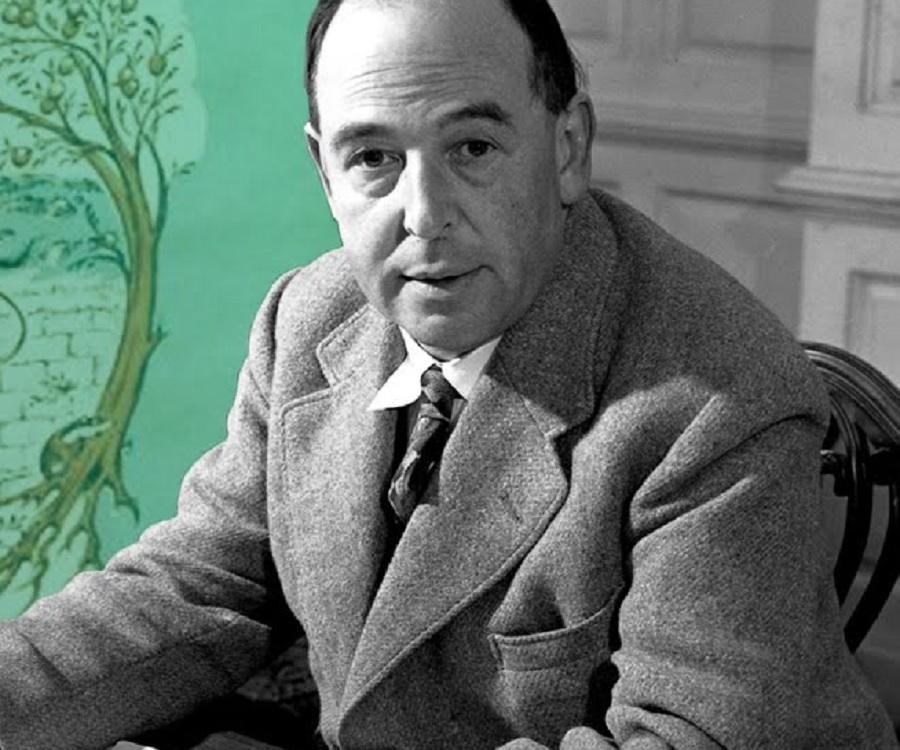
This
is the first of a series of posts on Mere
Christianity by C. S. Lewis.
Some
six months ago, the Catholic Thought Book Club read C. S. Lewis’s Mere Christianity. Clive Staples Lewis (1898 – 1963) was a novelist and Christian apologist from Oxford University and was highly
influential in the Catholic revival in England.
Now Lewis was not a Catholic but he must have been a High Church
Anglican because he shares close to a Catholic worldview. He was friends with J. R. R. Tolkien, who was
Catholic, and they were part of a group at Oxford made up of Catholics and
Protestants who called themselves the Inklings.
The Inklings shared their writings and critiqued each other. While Tolkien was known for his Lord of the Rings, Lewis was known for
his Chronicles of Narnia series, his
science fiction novels, and his works of apologetics.
Mere Christianity
was initially an explanation of the faith to the British public over a series of BBC radio
broadcasts during the World War II years of 1941 to 1944. The book does not delve into the areas where
Christian sects might disagree, but explain the fundamentals of why there is a
God and why the Christian understanding of that God makes the most sense. After the BBC broadcasts, Lewis compiled the
discussions and published it as a book after the war in 1953. The book is divided into four “Books,” each
having a number of chapters. The total
number of chapters add up to thirty-three.
Here is the table of contents.
Preface
BOOK I. RIGHT AND WRONG
AS A CLUE TO THE MEANING OF THE UNIVERSE
1.The Law of Human Nature
2.Some Objections
3.The Reality of the Law
4.What Lies Behind the
Law
5.We Have Cause to be
Uneasy
BOOK II. WHAT CHRISTIANS
BELIEVE
1.The Rival Conceptions
of God
2.The Invasion
3.The Shocking
Alternative
4.The Perfect Penitent
5.The Practical
Conclusion
BOOK III. CHRISTIAN
BEHAVIOUR
1.The Three Parts of
Morality
2.The “Cardinal Virtues”
3.Social Morality
4.Morality and
Psychoanalysis
5.Sexual Morality
6.Christian Marriage
7.Forgiveness
8.The Great Sin
9.Charity
10.Hope
11.Faith
12.Faith
BOOK IV. BEYOND
PERSONALITY: OR FIRST STEPS IN THE DOCTRINE OF THE TRINITY
1.Making and Begetting
2.The Three-personal God
3.Time and Beyond Time
4.Good Infection
5.The Obstinate Toy
Soldiers
6.Two Notes
7.Let’s Pretend
8.Is Christianity Hard or
Easy?
9.Counting the Cost
10.Nice People or New Men
11.The New Men
The
book is structured as (1) why there is a God, (2) what Christians believe about
that God, (3) moral behavior as a result of that God, and (4) the nature of
this God.
If
you wish to read Mere Christianity
online, you can access it for free in several different formats here.
I’m
going to summarize the major sections and highlights and present some of our
conversation it proves enlightening.
Summary
Book
I
Chapter
1: The Law of Human Nature
There is a universal law
of human nature—the law of right and wrong—and we intuitively know this law
even if we fail to follow it.
Chapter
2: Some Objections
Objections to this moral
law include the law as an innate instinct, and the law as a social convention;
neither are satisfactory explanations.
Chapter
3: The Reality of the Law
The law of right and
wrong is not a law we all follow, but a law we all know we ought to follow it.
Chapter
4: What Lies Behind the Law
Men find themselves under
this moral law, a law they did not make but know they ought to obey.
Chapter
5: We Have Cause to be Uneasy
The moral law could only
have been put in us by something outside of humanity, that is, God.
###
I
was impressed with how systematic Lewis was in Book 1. Each chapter built on
the previous. I could see it as stepping toward his conclusion. I put this
together as to what I thought the steps through Book 1 consisted. I think it could serve as a summary:
Steps through Book 1:
There is an inherent
human nature of the moral law.
This moral law cannot be
explained by the two objections of instinct and of social convention.
The law of human nature
is verified across humanity.
There are only two views
of understanding the universe, the materialist view—that is of chance—and the
religious view—that is of a creator God outside the universe.
The existence of the
moral law within man points to something beyond the materialist view of the
universe.
The existence of the
moral law within man points to a “Somebody or a Something behind the moral law.
That Something or
Somebody is the Christian concept of God in that it asks us to repent and
promises forgiveness.
###
My
Comment:
I just finished Book 1
and found this fascinating. Unlike Thomas Aquinas, CS Lewis does not start with
the first cause argument for God. He starts with the moral law written in human
nature argument, and I have to admit I found it powerful. There are so many
places I would like to highlight, but let me limit it to this paragraph from
chapter 4. I'll break up the paragraph because it's kind of large.
Ever since men were able
to think, they have been wondering what this universe really is and how it came
to be there. And, very roughly, two views have been held. First, there is what
is called the materialist view. People who take that view think that matter and
space just happen to exist, and always have existed, nobody knows why; and that
the matter, behaving in certain fixed ways, has just happened, by a sort of
fluke, to produce creatures like ourselves who are able to think. By one chance
in a thousand something hit our sun and made it produce the planets; and by
another thousandth chance the chemicals necessary for life, and the right
temperature, occurred on one of these planets, and so some of the matter on
this earth came alive; and then, by a very long series of chances, the living
creatures developed into things like us.
The other view is the
religious view. According to it, what is behind the universe is more like a
mind than it is like anything else we know. That is to say, it is conscious,
and has purposes, and prefers one thing to another. And on this view it made
the universe, partly for purposes we do not know, but partly, at any rate, in
order to produce creatures like itself—I mean, like itself to the extent of
having minds. Please do not think that one of these views was held a long time
ago and that the other has gradually taken its place. Wherever there have been
thinking men both views turn up.
It had never occurred to
that all views of the universe conflate to one of the two. It has always been
so. By the way, he shoots down the hybrid view pretty easily. Yes, that's silly
Casey
Replied:
A bit of a quibble,
Manny. Lewis doesn't shoot down the hybrid view exactly but shuts down those
who reject the implications. There's a sense in which the hybrid idea is
exactly right. Creation is always emerging, striving, evolving but it is truly
doing so, not randomly and conveniently so. It actually strives with purpose
and intent. Purpose and intent are sort of outside-in. They can't be explained
simply by atoms crashing into atoms. A turtle strives for the lettuce. Atoms
don't bump together in a way that appears to be a turtle striving for lettuce.
The idea that there's a
bunch of stuff randomly appearing to aim a single something which doesn't exist
is where it gets silly.
My
Reply to Casey:
Well, wait a second. This
is what Lewis says exactly:
People who hold this view
say that the small variations by which life on this planet “evolved” from the
lowest forms to Man were not due to chance but to the “striving” or
“purposiveness” of a Life-Force. When people say this we must ask them whether
by Life-Force they mean something with a mind or not. If they do, then “a mind
bringing life into existence and leading it to perfection” is really a God, and
their view is thus identical with the Religious. If they do not, then what is
the sense in saying that something without a mind “strives” or has “purposes”?
This seems to me fatal to their view.
It seems like he's
shooting it down to me. I think somewhere in Book I Lewis supported evolution,
so he's not against evolution per se.
Casey
Replied to Me:
Let me try this
analogy.... If an arrow is flying through the air toward a target this implies
a shooter. Let's say an "atheist" position would be 'not
necessarily.' The Life-Force position would be yes there is a force behind the
motion of the arrow that we might call a shooter but not necessarily a mind. A
"Theist" position would be that there must be a shooter with a mind
because it is the mind that creates the target.
Once you accept that the
arrow has a target (an aim, a purpose) then you must accept the implication of
a mind. If you reject the mind behind the motion then you must reject the idea
of the target.
The reason for my quibble
is that the Theist hybridizes by accepting both the mechanical, emergent
elements and the mindful elements simultaneously. The Life-Forcer is hybridizing
both to try to keep one foot in each camp but it doesn't work. You must accept
the implications in full. It is the rejection of the implications that's
problematic.
My
Reply to Casey:
Actually Casey, I think
we agree. I'm saying the hybrid is problematic too. And so is Lewis. Anyway, I
love your analogy with the arrow. That is a great visual to capture the
movement of life and the universe.
Casey’s
Reply to Me:
Oh yes, we agree but I
feel it is important to make the distinction about the implications because I
think for decades Christians have been so engaged with atheists they've
neglected the in-betweeners which is a category that has grown enormously.
Probably because the waters have been muddied so much by the Christian-atheist
jibber-jabber.
Madeleine’s
Comment:
For me the strongest
argument for God is that no one has ever been able to answer how it is possible
that anything, living or not, especially human beings with intellect and
abilities and a free will, is able to exist in the first place.
My
Reply to Madeleine:
That is also from
Aquinas. You can read about the five ways or proofs of God from Aquinas
here.
I agree with you
Madeleine. That is the argument that holds the most weight for me too. But I
can understand how Lewis starts with the innate moral law argument. Since
Aquinas science has been so far advanced that most people in the last 200 years
think science can answer everything. If they don't currently have an answer to
how something started from nothing, they expect that some day science will.
I've actually had this come up in a debate with atheists. They argue like this:
"Just because we currently don't know doesn't mean some magic God did it;
science will eventually figure it out."
The innate moral law I
think still has holes. I'm not sure he satisfactorily answered the objection to
social conventions. It does seem to me that various cultures have different
perspectives as to what is morally acceptable. Other cultures might not agree
on a Christian moral universe. But I don't know.
Kerstin
Replied to Me:
Manny wrote: " If
they don't currently have an answer to how something started from nothing, they
expect that some day science will.
That's scientism. I know they don't see it, but we're crossing the line between
the physical and metaphysical. The natural sciences, shortened today into
"science", can only show us what you can see and measure according
the the physical realities of this universe. If you take all matter away and
with it all laws governing matter, science becomes obsolete.
I've actually had this come up in a debate with atheists. They argue like
this: "Just because we currently don't know doesn't mean some magic God
did it; science will eventually figure it out."
The infamous "God of the gaps" argument. Once we find the "God
particle" science will explain everything. ;-)
Frances
Comment:
These thoughts of
Benedict XVI when he was the young theology professor Joseph Ratzinger expand
on the religious view: “Finite being, as we experience it, is marked, through
and through, by intelligibility, that is to say, by a formal structure that
makes it understandable to an inquiring mind. In point of fact, all of the
sciences rest on the assumption that at all levels, microscopic and
microcosmic, being can be known. . . The only finally satisfying explanation
for this universal objective intelligibility is a great Intelligence who has
thought the universe into being. Our language provides an intriguing clue in
this regard, for we speak of our acts of knowledge as moments of ‘recognition,’
literally a re-cognition, a thinking again what has already been thought. ‘’
(Bishop Robert Barron,
Catholicism, Image Books, pages 67-68)
Kerstin’s
Reply to Frances:
The argument of
intelligibility is simply brilliant.