This
is a remarkably engaging book of a conversion story from Islam to
Catholicism.Nikki—her birth name being
Naylah—was a believing Muslim who did not hate her religion but who found it
lacking and as she learned about Christianity began to have mystical
experiences.She tried to push the
mystical experiences away, but in their persistence she looked into what Christianity
was about and began to understand the fullness of truth, that God was not just
a master and she a servant but a loving Father.This is not an anti-Islam book but one of discovery and joy.
Nikki
takes you through her idyllic upbringing with a loving family, an arranged
marriage that turned out to be horrid, if not hellish, through her deepened
Islamic faith to find solace from the marriage, her escape to the United States
to get away from that marriage, a new marriage to a non-religious Christian,
which allowed her to keep her Islamic faith, but in that contact a discovery
which led her to Jesus Christ.It was
while visiting St. Patrick’s Cathedral as tourists that began her mystical
experience with Blessed Virgin Mary—Maryam as she is called in the Quran—which led
her to Jesus.
Some
quotes.
The rituals made me feel
that coming before Allah was no small matter, and He expected a reverence and
fear from me when I prayed.He was the
master to be feared for He was quick to punish.Allah had ninety-nine names that described his attributes, but there was
never any hint of a possibility to have a relationship with Him.Rather it seemed that having the audacity to
even desire a relationship with Allah showed arrogance and pride.(p. 39)
I had difficulty living
on the surface as a Muslim, but never looking beneath the crust that seemed to
be full of cracks.I continued to have
questions and thoughts about Allah, and an ache in my heart to know Him more
fully.I couldn’t understand why I was
not satisfied like them—there must be something I was missing.I knew that Islam was the only path to Allah,
so why wasn’t he answering me?I was not
satisfied with my prayers alone, as it seemed one-sided.I wanted a response from Him, and I believed
there was much more on the other side of the door.I knew the Truth was there, and I yearned for
it, so I did what I was trained to do and kept prostrating myself before Him,
begging Allah to reveal Himself.(p. 77)
I tried to find peace in
accepting this teaching of Islam and to forget the dream that had started this
discussion about Jesus.But my heart was
unsettled, and I could not stop thinking about this Jesus and who He was.I knew this was not just a dream.I was trying hard to accept the Quran’s
version of Jesus, but my heart kept rebelling.(91)
I am not sure when I came
to think of Jesus as God, but the Truth had quietly rooted itself in my
heart.I knew He was God, because only
God could love like He loved me, even after my rejection.Only God could touch my spirit and infuse the
Truth in such a gentle way, and fill me with such peace.Only God could have the magnanimous love to
suffer for even those who didn’t love Him, and open the door to Heaven for all
mankind!And finally, only God could
have turned me around from my faith in Islam to accept the very things that
were once blasphemous to me!(p. 116)
The immense richness of
the Catholic faith, and the treasures of its teachings overwhelmed me.I was like a starving person before an
unending buffet of rich food and drink.My soul was soaking up and taking its fill of riches of the faith that
brought me to a closer union with God.All of the Sacraments offered within the Church continued to work within
my soul and my openness to receive instruction and grow in my relationship set
the scene for the next amazing event to take place.(p. 138)
I have shared my journey
with the personal and mystical events to explain how I came into a relationship
with the Father.If some of you struggle
to understand or believe it, I hope you will at least consider the
possibility.My purpose is not to
convince you to believe it, but I hope to awaken a desire in your heart to
search deeper for the truth without giving God boundaries to respond
within.(p.176)
I
read this book on impulse and in only two days, which is incredibly fast for
me.It’s that engaging.I came across Nikki Kingsley as a guest on The Journey Home, a TV program where
guests are invited to tell their conversion stories to the Catholic
Church.You can watch that episode here.
Now
you can’t buy this book on Amazon, at least not yet as I’m currently writing,
but you can order it from Ms. Kingsely’s website.This book was a joy to read.It contains a lot more information than that
TV testimonial can provide.As Nikki
says in her prologue, “Walk with me through the darkness and into the Light.”
This
seems to be an annual event now in New York City with festivals in several parts
of the city.On Staten Island, it’s at
the Snug Harbor Cultural Center.Here’s
what it is according to News of America:
The annual event – which
officially opens at Snug Harbor Cultural Center and the South Meadow Botanical
Gardens on Friday – features an incredible selection of more than 1,000
individual lanterns of all sizes and shapes, and Advance / SILive.com was so
lucky to have an exclusive sneak peek of the mega-display of light.
We
had a couple of friends come over for a visit—one of them being Mary Sue who occasionally
comments on my blog—and on her recommendation decided to spend the evening at
the festival.
I
guess the only way to describe what it is that it’s a display of lanterns—internally
lit boxes—shaped into recognizable objects or characters and glow set against the
dark fall or winter night. Description doesn’t do it justice.You’ll just have to see some of the
pictures.
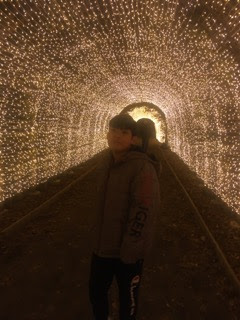
You
start going through a lit tunnel.
That’s
Matthew in the second picture.Here are
some sea creatures, a turtle, and a squirrel and mushrooms.
A
flower and Matthew beside an underwater creature/flower/mushroom (?).I forget what those are called, but you can
see they made it so it changed colors.
Next are some pictures
of Matthew in a framed setting.The
second is supposed to be a telephone booth.
How
many people even know what a telephone booth is today? Here are more pictures.You get the idea.
It
was really cool and really impressive, though it seemed a little short for $25 per person.Still I’d recommend it. Everything is expensive these days and I bet a lot of labor went into creating the entire set. If you’re in the area and wish to attend, you
can get information here.
This is one of the most touching moments in
the New Testament
Calling his disciples to himself, he said to them, “Amen, I say to you, this poor widow put in more than all the other contributors to the treasury. For they have all contributed from their surplus
wealth, but she, from her poverty, has contributed all she
had, her whole livelihood.”
Not
much to say this Halloween.Matthew
could not make up his mind what he wanted to go as, and so waited until two
days before and all the costumes were sold out.He did have a clown’s wig though, and so that was his costume.Just the wig.
At least it wasn't an evil looking character as has been the trend the last few years. I never liked that.
Actually
I didn’t even take him trick-or-treating.This was the first year.My wife
took him to meet up with some of his school friends.They went trick-or-treating and then had a
pizza party with the friends at one of their houses.Unfortunately I have no pictures.He didn’t even stop at my mother’s house.Oh well, but I had a nice few hours alone in
the house reading and watching football.
Perhaps
in my rush to get this discussion started, I incorrectly assumed everyone knew
the history of the novel’s setting.The
setting of the novel is during what has been called the Cristero War in Mexico.From Wikipedia:
The Cristero War, also
known as the Cristero Rebellion or La Cristiada [la kɾisˈtjaða], was a
widespread struggle in central and western Mexico in response to the imposition
of secularist and anticlerical articles of the 1917 Constitution of Mexico,
which were perceived by opponents as anti-Catholic measures aimed at imposing
state atheism. The rebellion was instigated as a response to an executive
decree by Mexican President Plutarco Elías Calles to enforce Articles 3, 5, 24,
27, and 130 of the Constitution, a move known as the Calles Law. Calles sought
to eliminate the power of the Catholic Church and all organizations which were
affiliated with it and to suppress popular religious celebrations in local
communities.
The massive popular rural
uprising in north-central Mexico was tacitly supported by the Church hierarchy,
and it was also aided by urban Catholic supporters. US Ambassador Dwight W.
Morrow brokered negotiations between the Calles government and the Church. The
government made some concessions, the Church withdrew its support for the
Cristero fighters, and the conflict ended in 1929. The rebellion has been
variously interpreted as a major event in the struggle between church and state
that dates back to the 19th century with the War of Reform, as the last major
peasant uprising in Mexico after the end of the military phase of the Mexican
Revolution in 1920, and as a counter-revolutionary uprising by prosperous
peasants and urban elites against the revolution's agrarian and rural reforms.
While
the war theoretically ended in 1929, there were localized persecutions all the
way into the thirties.I don’t think it
is clear what year the novel is set, but Greene traveled in Mexico in 1938 and
wrote a non-fiction book of his travels called The Lawless Roads, which he published in 1939.I haven’t read the book but Wikipedia does
not mention them.His experience from the trip and the writing
of the non-fiction book shaped his writing of The Power and the Glory.
Now
one other important fact from the Cristero War.There were many martyrs that took place.Priests were truly hunted down and shot.One important martyr that symbolizes the plight of Catholic priests is
that of Blessed Miguel Pro.You can read about Miguel at Wikipedia, but
one thing that is ingrained in Catholic imagination is that at the time of his
execution, Miguel spread out his arms so that his body became a cross, and just
before being shot yelled out in that position, “Viva Cristo Rey!"“Long live Christ the King.There are pictures of Miguel Pro’s last
moments at the Wikipedia entry.
The
novel is in some ways a contrast between the almost perfect faith of Miguel Pro
and the less than perfect faith of the whisky priest.There are many allusions to Miguel Pro in the
novel.The woman who speaks of the
martyrs to her children is undoubtedly referring to Miguel Pro.The whisky priest is shot like Miguel, though
he exhibits fear at his last moments.The whisky priest even gets a last request like Miguel.
I
assumed this was common knowledge among Catholics, but perhaps that is a bad
assumption.Plus there may be
non-Catholics who have not heard of Blessed Miguel Pro or the Cristero War.
###
Part
2, Chapters 1 & 2
Summary
Chapter
1
The
priest on the run now on a mule comes to a familiar village.There he meets Maria, the woman who he has
had a relationship with that has produced his illegitimate daughter Brigida.He learns that the police have enacted a
policy of executing a villager from every suspected place where the priest may
or may not be known to have visited.He
is pushed to leave as soon as possible and celebrate Mass in the morning and
then depart.But the police arrive
before the Mass is over, and so the villagers quickly break up the Mass.The lieutenant interrogates the villagers,
including the whisky priest himself.No
one turns the priest in and the priest evades the questions that would have
given him away, but the police decide to take a prisoner for execution.The priest offers himself in exchange but the
lieutenant turns him down.
After
coming to the conclusion that he can escape north where there is no Catholic
persecution, the whisky priest decides against it and travels south.On mule he meets a mestizo, who he lets know
he is heading to the town of Carmen.The
mestizo, suspecting he is a priest, follows him, and in conversation and action
intuits that he is a priest.The priest
tries to separate himself from the mestizo, fully realizing the man is after
the reward for turning in a priest, but cannot.When the mestizo gets seriously ill, and the priest has the chance to
abandon him, the priest decides to let the mestizo ride on his own mule while
they both journey to the town.Finally
on that journey the priest confirms for the mestizo he is a priest, despite
knowing full well the mestizo intends to turn him in.Just as he enters Carmen, the priest lets the
mestizo and mule go down one road while he escapes by another.
Chapter
2
In
Carmen, the priest is approached by a beggar, but the priest, pretending to be
an alcoholic, tells him he wants to buy alcohol, especially wine.He doesn’t let on that he wants the wine to
celebrate Mass, but that is his objective.The beggar brings him to the governor’s cousin, who secretly sells
confiscated liquor.The governor’s
cousin agrees to sell him a bottle of brandy and a large bottle of wine.The beggar tells the priest it would be
courteous to offer the governor’s cousin a drink, and he does offer him brandy,
but the governor’s cousin prefers to drink the wine.And so they open the bottle and the men drink
as the priest despondently watches as the quantity of wine is diminished.Along too comes the jefe, who also joins the
group drinking wine.Slowly despite the
priest’s objections the wine is finished, and even most of the brandy.Walking about the town he runs into some men
playing billiards where they learn he is carrying alcohol.They chase him and he runs to the home of
Padre Jose, who refuses to harbor him.Turned away, he is caught by the police as a drunk, and when he cannot
pay the fine for drinking alcohol is placed in jail.
###
There’s
a lot to be gained by a close examination of Part 2, chapter 1.It’s by far the longest chapter in the whole
novel, and I think it contains within it all the themes.In Part 1, Greene looks at the whisky priest
mostly from the outside.In Part 2, the
point of view shifts to the priest’s internal view.It’s interesting to note that both Parts 2
and 3 tell the story mostly from the priest’s internal point of view, while
Parts 1 and 4 are mostly from external to the priest.I’ll give my thoughts on that later when I
get to Part 4.
So
in the first chapter of Part 2 we see how complex the whisky priest character
is before us.By writing from the
priest’s internality, the novel enters what I’ll call the psychological phase
of the work.What we have is a
Dostoyevsky-esk drift into the heart of the character so that all his emotions,
his character makeup, and his contradictions form a three dimensional profile—a
psychological profile, if you will—of the central character.Let’s go through several passages in the
chapter to accumulate this character profile.
The
chapter opens with him riding through the woods with the police in search of
him.Instead of fear, which we will see
many times over, we has a strange thrill.
The priest scrambled off
and began to laugh. He was feeling happy. It is one of the strange discoveries
a man can make that life, however you lead it, contains moments of
exhilaration; there are always comparisons which can be made with worse times:
even in danger and misery the pendulum swings.(p. 59)
He
stops to wash his face in a pool of water and sees his reflection.
He knelt down in the late
sunlight and bathed his face in a brown pool which reflected back at him like a
piece of glazed pottery the round, stubbly and hollow features. They were so
unexpected that he grinned at them—with the shy evasive untrustworthy smile of
a man caught out. In the old days he often practised a gesture a long while in
front of a glass so that he had come to know his own face as well as an actor
does. It was a form of humility—his own natural face hadn’t seemed the right
one. It was a buffoon’s face, good enough for mild jokes to women, but
unsuitable at the altar-rail. He had tried to change it—and indeed, he thought,
indeed I have succeeded, they’ll never recognize me now, and the cause of his
happiness came back to him like the taste of brandy, promising temporary relief
from fear, loneliness, a lot of things. He was being driven by the presence of
soldiers to the very place where he most wanted to be. He had avoided it for
six years, but now it wasn’t his fault—it was his duty to go there—it couldn’t
count as sin. He went back to his mule and kicked it gently, ‘Up, mule, up,’ a
small gaunt man in torn peasant’s clothes going for the first time in many
years, like any ordinary man, to his home.(59-60)
The
earthy, brown reflection and the analogy of his face to pottery suggests a
primordial humanity, and one can’t help thinking of Isiah 64:8 where God is
referred to as a potter and humanity is the clay.So in one sense the whisky priest is Adam, or
Everyman, representative of the human condition.
Notice
how many adjectives and nouns he uses to describe himself: shy, evasive,
untrustworthy, humility, a buffoon.Notice the emotions: happy, exhilaration but those are temporarily
covering up fear and lowliness.It’s
almost if he’s experiencing a bi-polar range of emotions.And then there are the more complex feelings
of duty and sin.It was his duty to go
to his home, but endangering his fellow villagers was a sin.Implied there is guilt, which we will see
later.And so we see a paradox of
conflicting sensibilities: an obligation to do his duty, and the guilt that
results from doing it.These conflicting
emotions, the contradicting actions, the paradoxical motivations are at the core
of his character.
We
get more of his interiority as he contemplates his own decision.
In any case, even if he
could have gone south and avoided the village, it was only one more surrender.
The years behind him were littered with similar surrenders—feast days and fast
days and days of abstinence had been the first to go: then he had ceased to
trouble more than occasionally about his breviary—and finally he had left it
behind altogether at the port in one of his periodic attempts at escape. Then
the altar stone went—too dangerous to carry with him. He had no business to say
Mass without it; he was probably liable to suspension, but penalties of the
ecclesiastical kind began to seem unreal in a state where the only penalty was
the civil one of death. The routine of his life like a dam was cracked and
forgetfulness came dribbling through, wiping out this and that. Five years ago he
had given way to despair—the unforgivable sin—and he was going back now to the
scene of his despair with a curious lightening of the heart. For he had got
over despair too. He was a bad priest, he knew it. They had a word for his
kind—a whisky priest, but every failure dropped out of sight and mind:
somewhere they accumulated in secret—the rubble of his failures. One day they
would choke up, he supposed, altogether the source of grace. Until then he
carried on, with spells of fear, weariness, with a shamefaced lightness of
heart. (60)
More
emotions: surrender, loss, failure, despair, fear, weariness, shame.He carries on despite the fact that he isn’t
very good at his priestly obligations, that is, isn’t very good at his very
identity.“He was a bad priest, he knew
it.”And yet paradoxically he carries on
those duties despite the fear at being caught and killed.
When
he hears that the police are taking hostages and killing them if they don’t
over a priest,
‘They are taking hostages
now—from all the villages where they think you’ve been. And if people don’t
tell … somebody is shot … and then they take another hostage. It happened in
Concepción.’
‘Concepción?’ One of his
lids began to twitch up and down, up and down. He said, ‘Who?’ They looked at
him stupidly. He said furiously, ‘Who did they murder?’
‘Pedro Montez.’
He gave a little yapping
cry like a dog’s—the absurd shorthand of grief. The old-young child laughed. He
said, ‘Why don’t they catch me? The fools. Why don’t they catch me?’ The little
girl laughed again; he stared at her sightlessly, as if he could hear the sound
but couldn’t see the face. Happiness was dead again before it had had time to
breathe; he was like a woman with a stillborn child—bury it quickly and forget
and begin again. Perhaps the next would live.
‘You see, father,’ one of
the men said, ‘why …’
He felt as a guilty man
does before his judges. He said ‘Would you rather that I was like … like Padre
José in the capital … you have heard of him …?’
“He
felt like a guilty man before his judges.”And so one of his dominant emotions is a sense of guilt.There is the guilt of being a priest, which
causes the deaths of others.There is
the guilt of being an alcoholic.There
is the guilt of breaking his vow of celibacy.
I
find his exclamation there, “Why don’t they catch me?” insightful.Why is he there in the dangerous territory
pastoring, celebrating Mass, and issuing the sacraments?He has a chances to escape, and later
actually reaches safe territory.At
least twice he deliberately turns toward the very danger and though he doesn’t
want to be captured, fully expects to be captured and shot.Is he doing it out of priestly
obligation?Does he have a martyr
complex?Does he do it for the thrill of
the danger?Is he trying to expiate his
guilt?You might be able to find
justification for all those possibilities.
Which
brings me to what I think Greene is after in this psychological profile.I think he’s creating a character based on
what St. Paul says about himself in Romans 7:15-20.
What I do, I do not
understand. For I do not do what I want, but I do what I hate.Now if I do what I do not want, I concur that
the law is good.So now it is no longer
I who do it, but sin that dwells in me.For
I know that good does not dwell in me, that is, in my flesh. The willing is
ready at hand, but doing the good is not.For I do not do the good I want, but I do the evil I do not want.Now if [I] do what I do not want, it is no
longer I who do it, but sin that dwells in me.
“I
do not do what I want, but I do what I hate.”Why do we sin when we know better?It is a paradox.St. Paul is
suggesting that it is part of the flesh, the very fact of being human, and at
the very heart of being human is a paradox.And I think Greene is agreeing with him.Paradox is at the heart of this novel.In the whisky priest, Greene creates a character—an Adam type—that shows
the psychological complexity that is at the very heart of Catholic
anthropology.Adam sinned even though he
had no intention of doing it.We see in
the whisky priest the paradox of being human, wanting to be holy, wanting to
obey God’s commandments, and yet doing what we really don’t want to do.
###
To
speak of the whisky priest’s psychological complexity is ultimately to speak of
the priest’s flesh, but that would not be the complete picture.If the sins, the guilt, and the failures to
live up to his vocation are on the horizontal plane of his nature, there is
also a vertical plane, his transcendent plane.There is his capability to love.Christ commands us to love God and love one’s neighbor, and the priest
in various places in the novel shows his love for God, but what is central to
the novel is his love of neighbor.It
does strike me that his love of God in the novel is muted, but that is because
I think it is a given.In that wonderful
sermon he gives to his home town peasants in the only Mass we see him celebrate
in the novel we get this passage:
He kissed the top of the
packing-case and turned to bless. In the inadequate light he could just see two
men kneeling with their arms stretched out in the shape of a cross—they would
keep that position until the consecration was over, one more mortification
squeezed out of their harsh and painful lives. He felt humbled by the pain
ordinary men bore voluntarily; his pain was forced on him. ‘Oh Lord, I have
loved the beauty of thy house …’ The candles smoked and the people shifted on
their knees—an absurd happiness bobbed up in him again before anxiety returned:
it was as if he had been permitted to look in from the outside at the
population of heaven. (p.70-71)
If
you have time go back a read over the Mass in Part 2, chapter 1 (pp. 69-71).It has been six years since he last
celebrated.He performs it with such
reverence and love that one feels the priest’s love of God.“Oh Lord, I have loved the beauty of thy
house” (Ps 26:8).He feels exhilaration
again, performing the Mass, the “absurd happiness.”Why absurd?Because he is celebrating in a rundown hut with a chipped cup for a
chalice and homemade bread for the Eucharist.But yet, it is the miracle of the Mass.
But
passages where he is in direct contact with God are rare in the novel.The love of God seems muted because love of
neighbor dominates the novel.We see it
everywhere, with every relationship he has.We see it up front with Mr. Tench where the priest offers to share his
brandy.They are essentially strangers
but still have a heart to heart conversation.And Mr. Tench is later emotionally touched by the priest as he sees his
execution.He has a heart to heart
conversation with Coral Fellows, the girl who later will die and who sends out
Morse Code to priest from the beyond.He
has heart to heart conversations with the mestizo, who he knows will betray
him.He has a heart to heart
conversation with the people he meets in the jail cell and who do not betray
him.He has a heart to heart
conversation with the Indian woman whose child is killed.He even has a heart to heart conversation
with the lieutenant, who though he will have him executed, is actually moved by
his conversation with the priest.In
fact the novel’s narrative propels forward through a coupled pairing of the
priest and another character in dialogue.Let’s have a look at a couple of these conversations.
Let’s
look at the Tench/Whisky Priest interaction first.First, the two by chance meet out at the
port.The priest hears Tench exclaim
something to himself in English and out of his own initiative responds to him
in English.“You speak English,” Tench
asks him in surprise.The priest
responds he speaks a little English (p. 9).Why did the priest even respond?As it turns out it makes a huge difference to Tench.It will uplift him.
As
a habitual expression, Tench uses the Latin phrase Ora pro nobis, “pray for us” (10-11).It comes right out of the Hail Mary prayer,
the second half: “Sancta Maria mater Dei, ora pro nobis peccatoribus, nunc et
in hora mortis nostrae. Amen” (Holy Mary, Mother of God, pray for us sinners,
now and at the hour of our death. Amen.).As it turns out, the last words the priest says to Tench when he departs
is “I will pray for you” (17).It’s no
coincidence that after Tench for the second time says Ora pro nobis, the priest tells him he has brandy and is willing to
share it with him, answering Tench’s prayer (17).
When
the two go back to Tench’s apartment, Tench offers to show him his dentistry
equipment.The priest quietly is
attentive, though I can’t imagine he would have much interest.But he is gently receptive, and one can see
Tench uplifted.He is a lonely person in
a foreign country, and here is someone acknowledging his person.
The
priest notices that one of the apartment windows is actually a stained glass:
‘The window,’ the
stranger said, ‘is very beautiful.’
One pane of stained glass
had been let in: a Madonna gazed out through the mosquito wire at the turkeys
in the yard. ‘I got it,’ Mr Tench said, ‘when they sacked the church. It didn’t
feel right—a dentist’s room without some stained glass. Not civilized. At
home—I mean in England—it was generally the Laughing Cavalier—I don’t know
why—or else a Tudor rose. But one can’t pick and choose.’(13)
Again
the Blessed Virgin subversively enters between them.One should keep in mind that it is through
that window Tench watches the execution at the end of the novel.So he is either looking through the image of
the Madonna as he looks out or is by his head as he looks out the window.
When
the dentist explains his failures at making molds to the priest, he starts to
feel depressed.But the priest brings
him back to a shared love.
His mouth fell open: the
look of vacancy returned: the heat in the small room was overpowering. He stood
there like a man lost in a cavern among the fossils and instruments of an age
of which he knows very little. The stranger said, ‘If we could sit down …’
Mr Tench stared at him
blankly.
‘We could open the
brandy.’
‘Oh yes, the brandy.’(13)
It
is here then that they sit and their hearts open up.They have a conversation, and Tench shares
his private life.
Mr Tench poured himself
out another glass. He said, ‘It gets lonely here. It’s good to talk English,
even to a foreigner. I wonder if you’d like to see a picture of my kids.’ He
drew a yellow snapshot out of his note-case and handed it over. Two small
children struggled over the handle of a watering-can in a back garden. ‘Of
course,’ he said, ‘that was sixteen years ago.’
‘They are young men now.’
‘One died.’
‘Oh, well,’ the other
replied gently, ‘in a Christian country.’ He took a gulp of his brandy and
smiled at Mr Tench rather foolishly.
‘Yes, I suppose so,’ Mr
Tench said with surprise. He got rid of his phlegm and said, ‘It doesn’t seem
to me, of course, to matter much.’ He fell silent, his thoughts ambling away;
his mouth fell open, he looked grey and vacant, until he was recalled by a pain
in the stomach and helped himself to some more brandy. ‘Let me see. What was it
we were talking about? The kids … oh yes, the kids. It’s funny what a man
remembers. You know, I can remember that watering-can better than I can
remember the kids. It cost three and elevenpence three farthings, green; I
could lead you to the shop where I bought it. But as for the kids,’ he brooded
over his glass into the past, ‘I can’t remember much else but them crying.’
‘Do you get news?’
‘Oh, I gave up writing
before I came here. What was the use? I couldn’t send any money. It wouldn’t
surprise me if the wife had married again. Her mother would like it—the old
sour bitch: she never cared for me.’
The stranger said in a
low voice, ‘It is awful.’
Mr Tench examined his
companion again with surprise. He sat there like a black question mark, ready
to go, ready to stay, poised on his chair. He looked disreputable in his grey
three-days’ beard, and weak: somebody you could command to do anything. He
said, ‘I mean the world. The way things happen.’ (14-15)
They
speak of his children, one’s death, his wife and marital problems, and his
heart has opened up to the priest.The
priest was “somebody you could command to do anything.”He is receptive and understanding.One heart is speaking to another heart.
###
To
close this post, I’d like to embed the movie trailer to the novel.The movie was made in 1961 and stars Laurence
Olivier as the Whisky Priest and George C. Scott as the Lieutenant.
Despite
what is a superstar pairing of actors, the movie does not get great
reviews.I have not seen it.