Well
it’s not quite Friday yet, but it is October 7th 2021 and besides it
being the birthday of my beloved, departed father—he would have been 86
today—it is the anniversary of the Battle of Lepanto, the 450th
anniversary (1571) of perhaps the greatest naval battle in history and defeat
of the Ottoman Turks from overtaking Christian Europe.
So
why is today called the Feast of Our Lady of the Rosary? It wasn’t initially. Originally it was called the Feast of Our Lady
of Victory but within two years (1573) Pope Gregory XIII changed it to the
Rosary.
Christopher
Check at Catholic Answers has an excellent article, “The Battle that Saved the Christian West,” outlining the stakes.
During the five-decade
reign of Soleiman the Magnificent, the Ottoman Empire grew to its fullest
glory, encompassing the Caucuses, the Balkans, Anatolia, the Middle East, and
North Africa. Soleiman had conquered Aden, Algiers, Baghdad, Belgrade,
Budapest, Rhodes, and Temesvar. His war galleys terrorized not only the
Mediterranean Sea, but the Red Sea and the Persian Gulf as well. His one defeat
was at the gates of Vienna in 1529… Soleiman’s greatest
dream, however, the dream of all Turks, the dream his soldiers toasted before
setting off on every campaign, was the conquest of Rome. There the Turks could
transform Michelangelo’s St. Peter’s, then under construction, into a mosque,
just as they had Constantinople’s Hagia Sophia more than a century before.
But
the resistance was coordinated by Pope Pius V in what would be called The Holy
League.
In a papacy of great
achievements, the greatest came on March 7, 1571, on the feast of his fellow
Dominican, St. Thomas Aquinas. At the Dominican Church of Santa Maria Sopra
Minerva in Rome, Pope Pius formed the Holy League. Genoa, the Papal States, and
the Kingdom of Spain put aside their jealousies and pledged to assemble a fleet
capable of confronting the sultan’s war galleys before the east coast of Italy
became the next front in the war between the Christianity and Islam… As
the Pope prayed for Venice to answer a higher call, a new breed of fiery
priests led by stirring preachers like St. Francisco Borgia, superior general
of the Jesuits, inflamed the hearts of Christian Europeans throughout the
Mediterranean with their sermons against Islam. Enough Venetians must have been
listening, because on May 25 Venice at last joined the Holy League. By fits and
starts, with hesitation and quarreling on the part of a few of the principal
players, the fleet of the Holy League was forming.
But
Pope Pius needed a commander and chose a most dashing soldier.
The man chosen by Pius V
to serve as Captain General of the Holy League did not falter: Don John of
Austria, the illegitimate son of the late Holy Roman Emperor, Charles V, and
half-brother of Philip II, King of Spain. The young commander had distinguished
himself in combat against Barbary corsairs and in the Morisco rebellion in
Spain, a campaign in which he demonstrated his capacity for swift violence when
the threat called for it and restraint when charity demanded it.
There
is a lot in Check’s article I’m skipping over, but at the day of the battle divine
intervention took place.
It was. At dawn on
October 7, 1571, the Holy League rowed down the west coast of Greece and turned
east into the Gulf of Patras. When the morning mist cleared, the Christians,
rowing directly against the wind, saw the squadrons of the larger Ottoman fleet
arrayed like a crescent from shore to shore, bearing down on them under full
sail.
As the fleets grew
closer, the Christians could hear the gongs and cymbals, drums and cries of the
Turks. The men of the Holy League quietly pulled at their oars, the soldiers
stood on the decks in silent prayer. Priests holding large crucifixes marched up
and down the decks exhorting the men to be brave and hearing final confessions.
Then the Blessed Virgin
intervened.
The wind shifted 180
degrees. The sails of the Holy League were filled with the Divine breath,
driving them into battle. Now heading directly into the wind, the Turks were
forced to strike their sails. The tens of thousands of Christian galley slaves
who rowed the Turkish vessels felt the sharp sting of the lash summoning them
up from under their benches and demanding they take hold of their oars and pull
against the wind.
So
why is it called the Feast of Our Lady of the Rosary? Fr. Reginald Martin, O.P. has an article at
the Dominican Friars website titled, “The Battle Of Lepanto And The Holy Rosary”
which explains.
Pius V, a Dominican
friar, prayed the rosary throughout the battle and attributed the victory to
the intercession of the Blessed Virgin. Hence the feast of Our Lady of the
Rosary (which was first called the feast of Our Lady of Victory) on October 7.
Naturally, the feast is dear to Dominicans and their friends. But the Pontiff’s
were not the only prayers addressed that day to the Mother of God. The Christian
troops are said to have prayed the rosary throughout the night before the
battle, and some sources say that the rhythmic repetition of the prayer
thoroughly frightened and demoralized the Turkish host.
And
so through the Blessed Mother’s intervention Christendom was saved. If the Turks had won that battle, Europe may
have become Muslim.
Some
side notes.
(1)
Miguel de Cervantes, the author of Don
Quixote, fought in the battle and lost his left hand. If he had lost his right hand he may never
have been able to write.
(2)
Pope Pius V was a Dominican as mentioned above.
Up until that time, Popes wore the same red robes as bishops and
cardinals. But Pope Pius V insisted on
wearing his Dominican white, and so ever since Popes have worn white.
(3)
Pope Pius V instituted the traditional 15 (three sets of five each) mysteries
of the rosary. It became the standard
and skyrocketed as a Catholic devotion until it is now the premier Catholic
devotion. Pope John Paul II added a
fourth set of five mysteries in 2002.
(4)
My father, born on this day, happens to have a Marian first name, Mario. I don't know if that was intentional or not on the part of his parents. Either way it was Providential. Please include his soul in your next
rosary. He passed away in 2006, fifteen
years ago.
(5)
Pope Pius V has a striking resemblance to my Uncle Valentino. He too has passed away.
(6)
G. K. Chesterton’s most famous poem is on the Battle of Lepanto, titled “Lepanto.” You can read it here. Here is an excerpt.
The Pope was in his
chapel before day or battle broke,
(Don John of Austria
is hidden in the smoke.)
The hidden room in man’s
house where God sits all the year,
The secret window whence
the world looks small and very dear.
He sees as in a mirror on
the monstrous twilight sea
The crescent of his cruel
ships whose name is mystery;
They fling great shadows
foe-wards, making Cross and Castle dark,
They veil the plumèd
lions on the galleys of St. Mark;
And above the ships are
palaces of brown, black-bearded chiefs,
And below the ships are
prisons, where with multitudinous griefs,
Christian captives sick
and sunless, all a labouring race repines
Like a race in sunken
cities, like a nation in the mines.
They are lost like slaves
that sweat, and in the skies of morning hung
The stair-ways of the
tallest gods when tyranny was young.
They are countless,
voiceless, hopeless as those fallen or fleeing on
Before the high Kings’
horses in the granite of Babylon.
And many a one grows
witless in his quiet room in hell
Where a yellow face looks
inward through the lattice of his cell,
And he finds his God
forgotten, and he seeks no more a sign—
(But Don John of
Austria has burst the battle-line!)
Don John pounding from
the slaughter-painted poop,
Purpling all the ocean
like a bloody pirate’s sloop,
Scarlet running over on
the silvers and the golds,
Breaking of the hatches
up and bursting of the holds,
Thronging of the
thousands up that labour under sea
White for bliss and blind
for sun and stunned for liberty.
Vivat Hispania!
Domino Gloria!
Don John of Austria
Has set his people free!
If
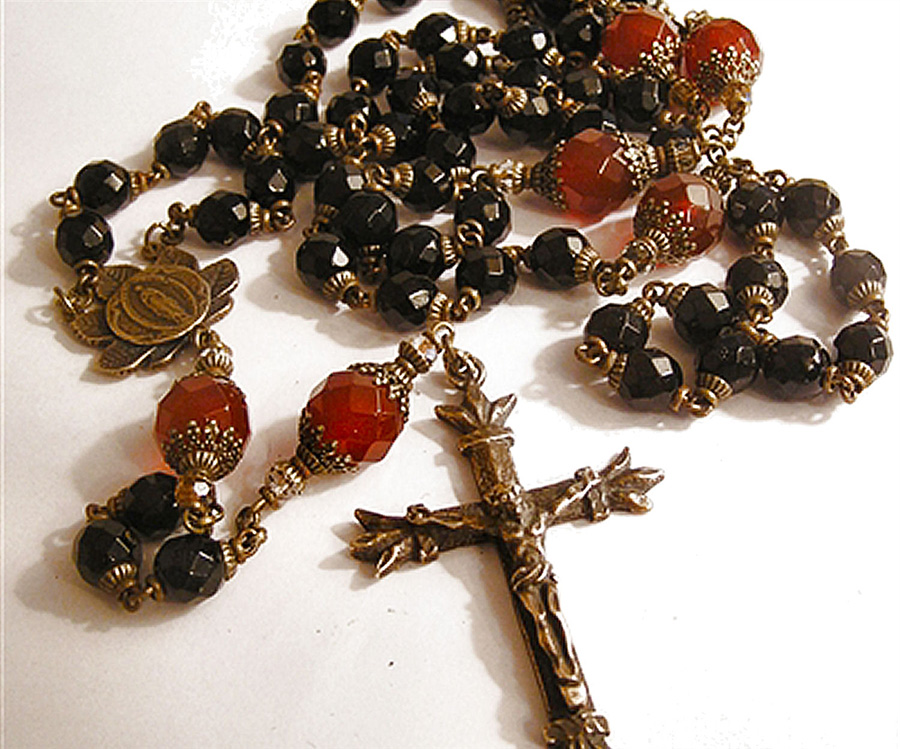
you haven’t done it already, pray a rosary.
If you have, pray another!




/463912201-56a61b075f9b58b7d0dfefb8.jpg)