"Love follows knowledge."
"Beauty above all beauty!"
– St. Catherine of Siena

Friday, April 11, 2014

Faith Filled Friday: The Imitation of Christ

This year for my Lenten read I selected the fifteenth century devotional The Imitationof Christ by Thomas à Kempis.  The work was completed in 1427 and probably written by more than one man, two or three priests at a religious community in Netherlands named Brethren of the Common Life.  Later the work was attributed to a particular priest, who was probably involved in the writing, Thomas à Kempis.   

I knew very little about the work when I picked it.  What lured me was that it was a medieval work—and I wanted to diversify my reading periods—and that The Imitation of Christ comes with the designation of being the “most widely read devotional work next to the Bible.”  How could I not want to read it?   

However, I was warned that it was a dry (shall we say, boring?) work.  I do have to admit it’s not my cup of tea as a devotional, and I think for two reasons.  First the thematic development was extremely drawn out.  For most of the time I was reading, I kept telling myself that this is all repetition and à Kempis never reaches any culmination.  However, I have to say, that is not true.  There is thematic development; it goes from internal consolation to acceptance of Christ, which is about as slow a movement as a glacier, but it is a movement.  But it is drawn out and overly repetitive.  However, this is a devotional, and devotionals are mostly static. 

What really didn’t agree with me was that this was a work for those in monastic life.  It’s a withdrawal from the world.  He states in the Twenty-Fifth Chapter in Book One: “Be watchful and diligent in God’s service and often think of why you left the world and came here.”  There are too many references to being a hermit and restricted to one’s cell.  From the Twentieth Chapter of Book One: “Your cell will become dear to you if you remain in it, but if you do not, it will become wearisome.  If in the beginning of your religious life, you live within your cell and keep to it, it will soon become a special friend and a very great comfort.”   

Was Jesus a hermit?  He had his moments of asceticism.  He spent forty days in the desert, but He came out of the desert and lived with His apostles and was surrounded by thousands and dined with Pharisees and tax collectors and prostitutes and other sinners.  I see Christ as an extrovert and gregarious.  Perhaps I’m projecting in Him parts of my personality, but I don’t think so.  He was a working man, and working men have to deal with the world. 

Though The Imitation of Christ was written in the late medieval period, it really has an outlook of an early medieval period, when monasteries and hermitages were abundant.  But from the twelfth century on, medieval life shifted from predominantly agrarian to urban towns, and so there was a shift from monastic religious orders to evangelizing orders, such as the Franciscans and Dominicans and, a few centuries later, the Jesuits.  They engaged the populace, not retreated from it.  Those are the types of religious orders I identify with, and if I had to pick one that fit my personality I would probably pick the Dominicans.   

Nonetheless, The Imitation of Christ has wonderful passages.  It is a great devotional.  If you opened a page randomly you would find lots of wisdom.  And here I’ll share a few. 

From the Seventeenth Chapter of Book One:
     He who seeks anything but God alone and the salvation of his soul will find only trouble and grief, and he who does not try to become the least, the servant of all, cannot remain at peace for long.
     You have come to serve, not to rule.  You must understand, too, that you have been called to suffer and to work, not to idle and gossip away your time.  Here men are tried as gold in a furnace.  Here no man can remain unless he desires with all his heart to humble himself before God.
             
From the Eighth Chapter of Book Two:

In what can I hope, then, or in whom ought I trust, save only in the great mercy of God and the hope of the heavenly grace?  For though I have with me good men, devout brethren, faithful friends, holy books, beautiful treatises, sweet songs and hymns, all these help and please but little when I am abandoned by grace and left to my poverty.  At such times there is no better remedy than patience and resignation of self to the will of God.
 

In Books Three and Four, à Kempis creates a dialogue between “The Voice of Christ” and “The Disciple.”

From the Eleventh Chapter of Book Three:
The Voice of Christ: My child, it is necessary for you to learn many things which you have not yet learned well.
The Disciple: What are they Lord?
The Voice of Christ: That you conform your desires entirely according to My good pleasure, and be not a lover of self but an earnest doer of My will. Desires very often inflame you and drive you madly on, but consider whether you act for My honor, or for your own advantage. If I am the cause, you will be well content with whatever I ordain. If, on the other hand, any self-seeking lurk in you, it troubles you and weighs you down. Take care, then, that you do not rely too much on preconceived desire that has no reference to Me, lest you repent later on and be displeased with what at first pleased you and which you desired as being for the best. Not every desire which seems good should be followed immediately, nor, on the other hand, should every contrary affection be at once rejected. 

From the Fifty-Second Chapter of Book Three, The Disciple:
What do you especially demand of a guilty and wretched sinner, except that he be contrite and humble himself for his sins? In true sorrow and humility of heart hope of forgiveness is born, the troubled conscience is reconciled, grace is found, man is preserved from the wrath to come, and God and the penitent meet with a holy kiss.
To You, O Lord, humble sorrow for sins is an acceptable sacrifice, a sacrifice far sweeter than the perfume of incense. This is also the pleasing ointment which You would have poured upon Your sacred feet, for a contrite and humble heart You have never despised. Here is a place of refuge from the force of the enemy's anger. Here is amended and washed away whatever defilement has been contracted elsewhere. 

From the Seventh Chapter of Book Four, The Voice of Christ:
Lament and grieve because you are still so worldly, so carnal, so passionate and unmortified, so full of roving lust, so careless in guarding the external senses, so often occupied in many vain fancies, so inclined to exterior things and so heedless of what lies within, so prone to laughter and dissipation and so indisposed to sorrow and tears, so inclined to ease and the pleasures of the flesh and so cool to austerity and zeal, so curious to hear what is new and to see the beautiful and so slow to embrace humiliation and dejection, so covetous of abundance, so niggardly in giving and so tenacious in keeping, so inconsiderate in speech, so reluctant in silence, so undisciplined in character, so disordered in action, so greedy at meals, so deaf to the Word of God, so prompt to rest and so slow to labor, so awake to empty conversation, so sleepy in keeping sacred vigils and so eager to end them, so wandering in your attention, so careless in saying the office, so lukewarm in celebrating, so heartless in receiving, so quickly distracted, so seldom fully recollected, so quickly moved to anger, so apt to take offense at others, so prone to judge, so severe in condemning, so happy in prosperity and so weak in adversity, so often making good resolutions and carrying so few of them into action.

It was certainly worthy of a Lenten read, despite its dryness.

Wednesday, April 9, 2014

Literature in the News: Tolstoy in Crimea

Crimea, that peninsular on the Black Sea where Russia and Ukraine were recently playing tug of war, has been in the news, and was also in the news when Leo Tolstoy served as an officer for Russia in the Crimean War in the 1850s.  I came across this article (titled, “How the Horrors of Crimea Shaped Tolstoy”) in the New Republic  by a Charles King on how serving in the Crimean War shaped Tolstoy’s view of war, which was later infused into his novels.  Mr. King’s bio line says he’s a professor of International Affairs, so I’m not quite sure what his expertise is in Tolstoy, but the article seems credible enough and worthy to share. 

Leo Tolstoy was 26 years old when he first saw the ramparts of Sevastopol. The weather in Crimea in the early winter of 1854—subtropical, cool but not cold—was a paradise compared with the harsh snow and ice farther north. The city itself, though, was in chaos. The heights above the port were ringed with earthworks of woven saplings and packed dirt and stone. Below, the narrow entrance to the harbor was blocked by the hulls of wooden ships deliberately sunk by the Russian navy, placed there to block the invaders. “There are thousands of different objects,” Tolstoy wrote, “thrown in heaps here and there; soldiers of different regiments, some provided with guns and with bags, others with neither guns nor bags, crowd together; they smoke, they quarrel.” 

A junior officer in an artillery brigade, Tolstoy already knew something of the exhilaration and horror of battle. For nearly three years, he had been in the Caucasus, the Russian empire’s mountainous southern frontier, in the middle of a grinding counterinsurgency campaign against upland Muslims. He had seen native villages destroyed and besieged, with the great forests of Chechnya whittled down to nothing—a strategy of the Russian army to deny shelter to Chechen raiding parties. Muslim gunmen would wait in the underbrush and aim their long guns at the Russian sappers sent to hack away a clearing on either side of a road. Not that Tolstoy had placed himself in the line of fire. By his own admission, he spent much of his time there in a Cossack stanitsa, or fortified village, hunting, drinking, “running after Cossack women,” and “writing a little,” as he noted in his diary.
 

Readers of my blog might recall Tolstoy’s Chechnya experience led to his novel, The Cossacks, which I read and examined last year.  You can read about that here.   
 

While Chechnya was more of a raid, incursion, and reconnaissance between small tribal factions, Crimea was Tolstoy’s first experience of major set armies in modern warfare.  From King’s article: 

When he arrived in Crimea, Tolstoy found himself in the middle of a war that did not yet have a name. For years, tensions had been rising between the two great powers in the Near East, the Russian and Ottoman empires. Czar Nicholas I claimed a right to protect the lives and property of Orthodox Christians inside Ottoman lands, including those who controlled access to the holy sites in Jerusalem. The Ottoman sultan, Abdülmecid I, countered that Orthodox Christians—who formed more than a third of all his subjects—were under no particular threat. The czar’s claims, he said, were merely a pretext for interfering in his domestic affairs. 

and  

Britain, France, and Sardinia came to the Ottomans’ aid. By the time Tolstoy arrived in Crimea, most of the great battles of the war were already past. Russian infantry had been put to flight by an Anglo-French force at the River Alma, the Light Brigade had made its doomed cavalry charge at Balaklava, and brutal hand-to-hand combat at Inkerman had broken Russia’s fighting will and ensured that the rest of the conflict would be focused on the desperate defense of Sevastopol. The war became a siege, with the Russians defending the heights against cannonades and bayonet charges. 

Tolstoy was there to witness the results: British and French ships sitting within cannon shot of the Crimean coast; creaking wooden carts being pulled up the steep hills, loaded with corpses; the constant roar of the Russian batteries; and the repeated thrusts of Allied troops, tripping over their greatcoats and slipping downhill in the mud.
 

Tolstoy’s writing career actually was initiated while serving. 

Tolstoy had spent much of the siege writing dispatches from the city, realistic accounts that, in an era of intense press censorship, provided Russia’s reading public with some of its first true-life accounts of battle. They appeared in The Contemporary, an influential St. Petersburg literary journal, and as hard-nosed pieces of reportage—with as much gore as could pass the state censor—they made him almost instantly famous. 

“On the earth, torn up by a recent explosion, were lying, here and there, broken beams, crushed bodies of Russians and French,” he wrote in his final installment from the scene of battle, later collected as Sevastopol Sketches, “heavy cast-iron cannon overturned into the ditch by a terrible force, half buried in the ground and forever dumb, bomb-shells, balls, splinters of beams, ditches, bomb-proofs, and more corpses, in blue or in gray overcoats, which seemed to have been shaken by supreme convulsions . . .” Tolstoy had arrived in Crimea as a casual patriot; he was now a committed skeptic.
 

King then ends his article with this interesting observation from the point of view of another writer who happened to be in Crimea a decade later. 

A decade after the war, in 1867, Mark Twain visited Sevastopol and walked over the old battlefields with a group of American tourists, kicking up bits of shrapnel and shards of bone. U.S. newspapers had carried news of the fighting, and photographers had captured images from the front lines. The telegraph and glass-plate photography had made their debut as tools of war reporting. “Sevastopol is probably the worst battered town in Russia or anywhere else,” Twain wrote in The Innocents Abroad. “But we ought to be pleased with it, nevertheless, for we have been in no country yet where we have been so kindly received.” 

By this stage, Tolstoy was on the other side of his journey of disillusionment, one that had begun in the forests of Chechnya and ended on the Black Sea coast. He was nursing the ideas that would define his work as a mature writer: that battles were a form of deliberate folly, that the only enduring nation was humanity, that ordinary Russians were always better than the rulers whom history seemed to give them. While Twain was looking over the ruins of Sevastopol, Tolstoy was far to the north, back home on the old family estate at Yasnaya Polyana. He was in the final stretch of a manuscript he had decided to call War and Peace.
 

As it turns out, Russia did take Crimea from the Ottoman Empire, and apparently has retaken it from Ukraine.  History does sometimes repeat itself, though this second iteration was without any battle.  War is a terrible thing, and Tolstoy learned firsthand.  Read Charles King’s entire article.

Monday, April 7, 2014

Matthew Monday: Rambling Monologue

Kelly, one of the regular readers of this blog, gave me an idea last week from a comment she made in response to my post on the O.Henry short story, “The Ransom of Red Chief.”  Her comment was in reaction to the monologue that O. Henry writes in the voice of the little kidnapped boy called, Red Chief.  The rambling nature of a little boy’s disconnected thoughts reminded her of her son when he was a child, and it reminds me of my son, Matthew, as well.  So I thought it would be fun to write up a monologue using Matthew’s speech patterns and interests. 

So of course this is fiction, but Matthew either said some of these thoughts somewhere or he could easily have said it.  Picture Matthew sitting at the table eating his favorite meal, raviolis in a butter sauce which since he first learned to talk he calls “yolies.”  He’s sitting back in the chair with a fork in his right hand and every so often leans forward to fork a yolie and place it in his mouth, then leans back again, all the while chatting away while his mother and father try not to answer him.

“I like this.  What am I getting for my birthday?  Do you like the grey Batman or the blue Batman?   I like the black Batman.  You have a cookie on your head.  Do angels have lasers in their eyes?  Isaiah fell off the monkey bars twice.  What would happen if a squirrel stuck his tail in the water spout?  Angelina and Olivia called me names.  I cut up paper with my scissors at school but you have to be careful not to cut your fingers.  Jaden and Luke jumped on me but I pushed them off.  I can’t run faster than a car.  You shouldn't touch electricity.  Does Jesus love everybody?  Even Daddy?  Lightening can kill you.  Yolies are my favorite.  You can have a cat or a dog for a pet but not an alligator.  Do horses lay eggs?  What do you get if you mix purple and orange?  I’m going to be a policeman.  Have you ever gone to jail?  Why do monster trucks have big wheels?  The black Batman can fly but not the blue Batman or the grey Batman.  What’s for dessert?  Can x-ray vision hurt you?  Can I have a rocket for my birthday?”


 Hope you enjoyed it.  So if you feel creative, why not try that in the voice of your child at your blog, and link it back to here.


Saturday, April 5, 2014

2014 Reads, Update #1

Well, the first quarter of the year has passed and the first update on how my reading is going is here.  I have to say it’s going great.  I’m ahead of all my reading goals.  You can read my reading plans for 2014 here.  Of course it helps that I was on vacation for over a week.


To date I’ve read seven short stories (better than the two per month goal), three full books (a memoir, a novel, and an exchange of letters), and two books of the Old Testament.  That’s about on goal, but I’m so well into the currently reading list that a number of those books are near complete.  Unplanned addition was a book (84, Charing Cross Road) of letter exchanges over the post WWII years by a New York City writer Helene Hanff and the friends she made at a London bookstore.  It was recommended by a friend and I thought it would make a great little read while on vacation. 

My Lenten reads are both over three-quarters read: Thomas à Kempis’s The Imitation of Christ and a recent addition that was unmentioned, Happy Catholic by Julie Davis.  Yes, the Thomas à Kempis’ is as dry as forewarned, and so I decided to add a pick-me-up for Lent and went with a book from one of my favorite bloggers, Julie Davis at Happy Catholic.   

Another unplanned addition was a recently published book (Prue Shaw’s Reading Dante) on Dante’s Divine Comedy that got such good reviews I was enticed to pick it up.  I’m two thirds into it.  I’m well into the Hopkin’s poetry and only about 15% into Goldworthy’s Julius Caesar.   But those books will be stretched out to last the year.  I started Les Misérables, and in a flash I’m fifty pages in; it’s good reading!  For this year I’m only planning to read the first volume of Hugo’s epic work, titled Fantine, but if it goes this fast I may add to that.   

Here’s the status and near term plans. 

Completed: 

“The Doom of the Griffiths,” a short story by Elizabeth Gaskell.
The Book of Tobit, a book of the Old Testament.
“Rappaccini’s Daughter,” a short story by Nathaniel Hawthorne.
Life on the Mississippi, a memoir by Mark Twain.
The Book of Judith, a book of the Old Testament.
“The Ransom of Red Chief,” a short story by O. Henry.
Washington Square, a novel by Henry James.
84, Charing Cross Road, a collection of correspondence by Helene Hanff.
“Fifty Grand,” a short story by Ernest Hemingway.
“A Simple Enquiry,” a short story by Ernest Hemingway.
“The Pitcher,” a short story by Andre Debus.
“After Twenty Years,” a short story by O. Henry.
 

Currently Reading: 

Gerard Manly Hopkins: Poems and Prose, Selected and Edited by W. H. Gardner.
Julius Caesar: Life of a Colossus, by Adrian Goldsworthy.
Reading Dante: From Here to Eternity, a non-fiction work of literary criticism by Prue, Shaw.
The Imitation of Christ, a non-fiction devotional by Thomas à Kempis.
Happy Catholic, a non-fiction devotional by Julie Davis.
Fantine, the 1st Volume of Les Misérables, a novel by Victor Hugo.
 

Upcoming Plans: 

 “Paul’s Case,” a short story by Willa Cather.
“Wee Willie Winkie,” a short story by Rudyard Kipling.
"Sredni Vashtar,” a short story by Saki (H.H. Munro).
“The Wood-Sprite,” a short story by Vladimir Nabokov.
“Russian Spoken Here,” a short story by Vladimir Nabokov.
The Book of Esther, a book of the Old Testament.
Some Do Not…, the 1st novel of the Parade’s End Trilogy by Ford Madox Ford.

Thursday, April 3, 2014

Notable Quotes: On Finding Stories by O. Henry

“There are stories in everything. I've got some of my best yarns from park benches, lampposts, and newspaper stands.”

― O. Henry

Tuesday, April 1, 2014

Short Story Analysis: The Ransom of Red Chief by O. Henry

I want to preface the analysis of this wonderful little story by a short meditation on what makes a story.  One can write a narrative about Joe next door going to the grocery store and picking up tomatoes, a rib eye steak, and a can of beans, returning, cooking up dinner, and watching television for the evening, but it wouldn’t be a story.  The touchstone that I use when thinking what makes a story is Franz Kafka’s story “The Metamorphosis.”  Here a timid young man works himself to the bone at a job he doesn’t like to support his lazy parents, is suddenly transformed into an insect, and through the course of trying to hide his new insect body his family accidently kills him.  Now that’s a story. 

So what makes Kafka’s story a story while the events of Joe’s evening not a story?  There is that proverbial journalist’s euphemism that dog bites man is not a story, but man bites dog is.  I think there are three elements that constitute a story.  (1) an interesting character or set of characters, who are (2) in an interesting situation with (3) interesting set of events that reaches some sort of a conclusion.  The incisive word in all three elements is “interesting,” which is vague, I agree.  What constitutes interesting requires a lot more space than this post, and probably more thought on my part.  One common method of “interesting,” at least as it relates to situation and set of events is the use of irony, and more specifically, “situational irony.”  You can read about the different types of irony here.  

Now let’s get to O. Henry’s “The Ransom of RedChief.”  What really makes this story work is that the situation and conclusion are incongruous with what is expected.  Two second rate crooks decide to kidnap a child for ransom to make a quick buck but find the urchin they snatch to be an imp of a child, and instead of getting money for him wind up paying the parents to take him back. 

The story is told in the first person of Sam, one of the kidnappers, a southerner, and the brains of the operation. 

IT LOOKED like a good thing: but wait till I tell you. We were down South, in Alabama -- Bill Driscoll and myself -- when this kidnapping idea struck us. It was, as Bill afterward expressed it, "during a moment of temporary mental apparition"; but we didn't find that out till later. 

Excerpts taken from Literature Network.   The story is quite readable off a computer and could be read in less than an hour. 

When you hear, “but we didn’t find that out until later” your antenna should perk up and recognize that irony will be an important part of the story.  And it is, in many facets. 

There was a town down there, as flat as a flannel-cake, and called Summit, of course. It contained inhabitants of as undeleterious and self-satisfied a class of peasantry as ever clustered around a Maypole. 

Bill and me had a joint capital of about six hundred dollars, and we needed just two thousand dollars more to pull off a fraudulent town-lot scheme in Western Illinois with. We talked it over on the front steps of the hotel. Philoprogenitiveness, says we, is strong in semi-rural communities; therefore and for other reasons, a kidnapping project ought to do better there than in the radius of newspapers that send reporters out in plain clothes to stir up talk about such things. We knew that Summit couldn't get after us with anything stronger than constables and maybe some lackadaisical bloodhounds and a diatribe or two in the Weekly Farmers' Budget. So, it looked good.
 

Notice the verbal irony throughout: a flat town whose name is Summit, a town of “undeleterious” folk, which is to say mild, and having “philoprogenitiveness.” which is to say love of their children.  Sam tends to use pretentious words.  Just as the town is incongruously named after a mountain height, there turns out to be nothing mild about the little boy they kidnap and his family doesn’t exactly love him either.  The rogue’s logic is undermined by reality. 

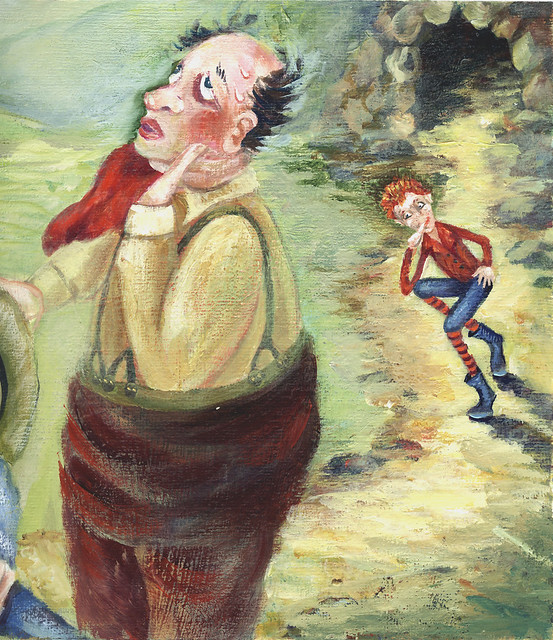
The two find a cave two miles from the town to hide out with the victim.  Finally they make their move.  

One evening after sundown, we drove in a buggy past old Dorset's house. The kid was in the street, throwing rocks at a kitten on the opposite fence. 

"Hey, little boy!" says Bill, "would you like to have a bag of candy and a nice ride?" 

The boy catches Bill neatly in the eye with a piece of brick. 

"That will cost the old man an extra five hundred dollars," says Bill, climbing over the wheel. 

That boy put up a fight like a welter-weight cinnamon bear; but, at last, we got him down in the bottom of the buggy and drove away. We took him up to the cave and I hitched the horse in the cedar brake. After dark I drove the buggy to the little village, three miles away, where we had hired it, and walked back to the mountain. 

Bill was pasting court-plaster over the scratches and bruises on his features. There was a burning behind the big rock at the entrance of the cave, and the boy was watching a pot of boiling coffee, with two buzzard tailfeathers stuck in his red hair. He points a stick at me when I come up, and says: 

"Ha! cursed paleface, do you dare to enter the camp of Red Chief, the terror of the plains? 

"He's all right now," says Bill, rolling up his trousers and examining some bruises on his shins. "We're playing Indian. We're making Buffalo Bill's show look like magic-lantern views of Palestine in the town hall. I'm Old Hank, the Trapper, Red Chief's captive, and I'm to be scalped at daybreak. By Geronimo! that kid can kick hard." 

Yes, sir, that boy seemed to be having the time of his life. The fun of camping out in a cave had made him forget that he was a captive, himself. He immediately christened me Snake-eye, the Spy, and announced that, when his braves returned from the warpath, I was to be broiled at the stake at the rising of the sun.


It’s really a funny story.  Poor Bill is the real victim of the encounter.  The boy is way more than they bargained for.  The boy actually enjoys himself, and takes possession of the situation.  He’s the Red Chief, red for his hair color, and in command.  What was supposed to be a kidnapper’s hideout is the boy’s Indian camp, and instead of the boy being the hostage the kidnappers are going to be scalped and burnt at the stake.  Of course Bill and Sam take that as play talk, but it turns out to be more verbal irony when Sam is startled out of sleep that first night.
 

Just at daybreak, I was awakened by a series of awful screams from Bill. They weren't yells, or howls, or shouts, or whoops, or yalps, such as you'd expect from a manly set of vocal organs -- they were simply indecent, terrifying, humiliating screams, such as women emit when they see ghosts or caterpillars. It's an awful thing to hear a strong, desperate, fat man scream incontinently in a cave at daybreak. 

I jumped up to see what the matter was. Red Chief was sitting on Bill's chest, with one hand twined in Bill's hair. In the other he had the sharp case-knife we used for slicing, bacon; and he was industriously and realistically trying to take Bill's scalp, according to the sentence that had been pronounced upon him the evening before. 

I got the knife away from the kid and made him lie down again. But, from that moment, Bill's spirit was broken. He laid down on his side of the bed, but he never closed an eye again in sleep as long as that boy was with us. I dozed off for a while, but along toward sun-up I remembered that Red Chief had said I was to be burned at the stake at the rising of the sun. I wasn't nervous or afraid; but I sat up and lit my pipe and leaned against a rock. 

"What you getting up so soon for, Sam?" asked Bill. 

"Me?" says I. "Oh, I got a kind of a pain in my shoulder. I thought sitting up would rest it." 

"You're a liar!" says Bill. "You're afraid. You was to be burned at sunrise, and you was afraid he'd do it. And he would, too, if he could find a match. Ain't it awful, Sam? Do you think anybody will pay out money to get a little imp like that back home?"
 

And so the events go on in this manner.  The irony continues when Sam finds that no one in town is in the least upset the boy is missing.  The boy doesn’t want to go back and his parents aren’t in any hurry to get him back.  Finally the kidnappers send the boy’s father a ransom note and threaten that he will never his boy again, and they ironically sign the note “Two Desperate Men.”  The implication may be that they will harm the boy in desperation but the reality is they are now desperate to get rid of the boy. 
 

You can read the rest of the story and how irony is used to end the story.  I just wanted to highlight some of O. Henry’s prose.  William Sidney Porter, his real name, actually did go to jail for embezzlement and he was partnered with another crook for a while.  He spent time in jail, where he started writing of short stories, and after release earned a living from it.  His stories are so likable, and while they do skirt a seedy side of life, they tend to gloss over real evil.  After all, the two kidnappers could have just killed the boy and be done with it, but that drop to heinous behavior is never contemplated.  I love his prose style.  At his best, he writes clean, crisp sentences which have a rhythmic pacing.  He has enough “Americanisms” and local dialect splattered about that make him clearly American.  He has an ear for American locution.  Here are a couple of examples.  Sam here goes up to the cave overlook to see what’s happening in town.
 

I went up on the peak of the little mountain and ran my eye over the contiguous vicinity. Over toward Summit I expected to see the sturdy yeomanry of the village armed with scythes and pitchforks beating the countryside for the dastardly kidnappers. But what I saw was a peaceful landscape dotted with one man ploughing with a dun mule. Nobody was dragging the creek; no couriers dashed hither and yon, bringing tidings of no news to the distracted parents. There was a sylvan attitude of somnolent sleepiness pervading that section of the external outward surface of Alabama that lay exposed to my view. "Perhaps," says I to myself, "it has not yet been discovered that the wolves have home away the tender lambkin from the fold. Heaven help the wolves!" says I, and I went down the mountain to breakfast.
 

The diction is of the American south of a particularly educated man who mixes bookish words with down-to-earth phrases.  Notice the southerner’s use of redundant adjective qualifiers: “contiguous vicinity,” “sturdy yeomanry,” “dastardly kidnappers,” and “somnolent sleepiness.”  You might argue that the redundancy is poor writing, but this is evocative writing of a time and place.  Here is Sam at the town mailing the ransom note.
 

I walked over to Poplar Cove and sat around the post-office and store, talking with the chaw-bacons that came in to trade. One whiskerando says that he hears Summit is all upset on account of Elder Ebenezer Dorset's boy having been lost or stolen. That was all I wanted to know. I bought some smoking tobacco, referred casually to the price of black-eyed peas, posted my letter surreptitiously and came away. The postmaster said the mail-carrier would come by in an hour to take the mail on to Summit.
 

“Chaw-bacons” and “whiskerando” are probably slang that has not lived on, but it just rings with Americanism.  And finally I love the way O. Henry makes characters come to life with just a snippet or passage of speech.  Here he lets the boy ramble on at dinner.
 

Then we had supper; and he [the boy] filled his mouth full of bacon and bread and gravy, and began to talk. He made a during-dinner speech something like this: 

"I like this fine. I never camped out before; but I had a pet 'possum once, and I was nine last birthday. I hate to go to school. Rats ate up sixteen of Jimmy Talbot's aunt's speckled hen's eggs. Are there any real Indians in these woods? I want some more gravy. Does the trees moving make the wind blow? We had five puppies. What makes your nose so red, Hank? My father has lots of money. Are the stars hot? I whipped Ed Walker twice, Saturday. I don't like girls. You dassent catch toads unless with a string. Do oxen make any noise? Why are oranges round? Have you got beds to sleep on in this cave? Amos Murray has got Six toes. A parrot can talk, but a monkey or a fish can't. How many does it take to make twelve?"
 

The discontinuity between the boy’s sentences, his regional slang, his likes and dislikes, his interests and musings define the boy in such a small space.  I just love that passage, and this story.  
 

Thanks to Jan, one of this blog’s regular readers, for suggesting this story.


Monday, March 31, 2014

Lines I Wished I’d Written: From “The Pitcher” By Andre Dubus

Baseball season started today, the greatest sport known to mankind.  To commemorate I read a story by Andre Dubus titled, “The Pitcher.”  For your reading pleasure here is a passage I particularly liked.  The story is about a young pitcher who’s wife leaves him.
 

He spoke to no one.  He went to the far end of the dugout that they left empty for him when he was pitching.  He was too young to ask for that, but he was good enough to get it without asking; they gave it to him early in the year, when they saw he needed it, this young pitcher Billy Wells who talked and joked and yelled at the field and the other dugout for nine innings of the three nights he didn’t pitch, but on his pitching night sat quietly, looking neither relaxed nor tense, and only spoke when politeness required it.  Always he was polite.  Soon they made a space for him on the bench, where he sat now knowing he would be alright.  He did not think about it, for he knew as the insomniac does that to give it words summons it up to dance; he knew that the pain he had brought with him to the park was still there; he even knew it would probably always still be there; but for a good while now it was gone.  It would lie in wait for him and strike him again when he was drained and he had a heart full of room for it.  But that was a long time now, and in the shower or back in the hotel, longer than the two and a half hours or whatever he would use pitching the game; longer than a clock could measure.  Right now it seemed a great deal of his life would pass before the shower.  When he trotted out to the mound they stood and cheered and, before he threw his first warm-up pitch, he tipped his cap.

 -From “The Pitcher” by Andre Dubus.