The
Book of Baruch was written by the scribe of the prophet Jerimiah after the
Israelites were enslaved during the Babylonian captivity.I will only speak of the first five
chapters.The sixth chapter is
apparently an addition which calls itself “A Letter from Jerimiah” and appeals
to the Israelites to not succumb to the idolatry of their Babylonian
masters.As the Introduction to the NAB
edition states at the USCCB website
http://usccb.org/bible/scripture.cfm?bk=Baruch&ch= the Book attempts to
encode the captivity in “Deuteronomic cycle: sin (of Israel), punishment,
repentance, and return (cf. Jgs 2; also Dt 28–33).”The Book uses two voices throughout, that of
the scribe and that of a personified Jerusalem.The Book speaks in prayer, in poetry, in appeal, and in
lamentation.It is quite beautiful in
places.I’m going to quote a section
where the author speaks in the voice of Jerusalem addressing the subjugated and
captive Israelites.
Jerusalem
Addresses Diaspora
17 What can I do to help you? 18 The one who has brought this evil upon you must himself deliver you from your enemies’ hands. 19 Farewell, my children, farewell; I am left desolate. 20 I have taken off the garment of peace, have put on sackcloth for my prayer of supplication; while I live I will cry out to the Eternal One.
21 “Take courage, my children; call upon God; he will deliver you from oppression, from enemy hands. 22 I have put my hope for your deliverance in the Eternal One, and joy has come to me from the Holy One Because
of the mercy that will swiftly reach you from your eternal Savior. 23 With mourning and lament I sent you away, but God will give you back to me with gladness and joy forever. 24 As Zion’s neighbors lately saw you taken captive, so shall they soon see God’s salvation come to you, with great glory and the splendor of the Eternal One.
-Jerusalem
Addresses the Diaspora Baruch 4:19-22, NABRE
In
the language, one gets echoes of the coming Savior.
You
can read more on the Book of Baruch at these websites:
One
last post on the Gospel of John, this on the resurrection scenes.What is marvelous is the physicality of the
resurrected Christ.When He appears to
Mary Magdalene and she finally realizes it is Him, she embraces Him.He has to say, “Stop holding on to me” (John
20:17).In the Vulgate Latin, it’s “Noli
me tangere” or literally “Do not touch me.”I don’t know which is the more accurate translation, I assume the more
modern one, but both emphasize touch.Well, one doesn’t touch a spirit.One touches a body.
And
when Jesus appears to Thomas and He has Thomas put his hands into Christ’s
wounds, we can sense along with Thomas Christ’s physicality.Despite Jesus being able to go through walls,
He is corporeal.He is of a special type
of flesh.
###
Finally
I noticed something in chapter 21 that I never noticed before.After that marvelous scene where Jesus has
Peter commit three times his love, and Jesus forecasts Peter’s death, Peter
asks about the beloved disciple.
Peter turned and saw the
disciple following whom Jesus loved, the one who had also reclined upon his
chest during the supper and had said, “Master, who is the one who will betray
you?”When Peter saw him, he said to
Jesus, “Lord, what about him?”Jesus
said to him, “What if I want him to remain until I come? What concern is it of
yours? You follow me.”So the word
spread among the brothers that that disciple would not die. But Jesus had not
told him that he would not die, just “What if I want him to remain until I
come? [What concern is it of yours?]”(John 21:21-23)
Of
course I’ve read that passage many times, but I never noticed that John, who we
know as the Beloved Disciple, was following Jesus.Where is he going?Does he disappear from the disciples?We know that John is the only apostle who is
not martyred.We know he forms a
community in Asia Minor, and he does disappear from the apostles in Acts.What is strange is that Jesus asks Peter to
metaphorically follow Him but it is John who physically follows Him here.I don’t have an answer for that.But it caught my attention.
With
the closing of chapter 12, we have come to the end of Jesus’ ministry and we
come to what amounts for the last supper in John’s Gospel.John doesn’t narrate the institution of the
Eucharist as the other Gospel’s do at the last supper, but he does narrate two
striking scenes.Let’s look at the
second scene first.I find interesting
that we see Jesus handing bread out in John’s last supper, only the bread is not
His body and He hands it only to Judas Iscariot.When Jesus announces that one of the
disciples will betray Him, and they ask Him who it is, Jesus uses bread signify
the guilty one.
“It is the one to whom I
hand the morsel after I have dipped it.” So he dipped the morsel and [took it
and] handed it to Judas, son of Simon the Iscariot.After he took the morsel, Satan entered him.
So Jesus said to him, “What you are going to do, do quickly.”(John 13:26-27)
What
to make of it?Perhaps if you approach
the Eucharist with an unworthy heart, it actually becomes the inverse of the
body of Christ.
Any
thoughts on why John doesn’t narrate the institution of the Eucharist?Obviously he knew about it.The fact that there’s a last supper, that he
goes to great length in chapter 6 on eating thebody of Christ, and this “inverse” morsel of bread He gives to Judas
shows John’s knowledge of it.My hunch
is John doesn’t narrate it because it’s been done already.He seems to go to great length not to repeat
the other Gospels, and I think he doesn’t feel the need to repeat the
institution narrative.
The
other striking scene is the foot washing scene.
So, during supper, fully
aware that the Father had put everything into his power and that he had come
from God and was returning to God, he rose from supper and took off his outer
garments. He took a towel and tied it around his waist.Then he poured water into a basin and began
to wash the disciples’ feet and dry them with the towel around his waist.He came to Simon Peter, who said to him,
“Master, are you going to wash my feet?”Jesus answered and said to him, “What I am doing, you do not understand
now, but you will understand later.”(John 13:3-7)
Later
Jesus explains the significance.
So when he had washed
their feet [and] put his garments back on and reclined at table again, he said
to them, “Do you realize what I have done for you?You call me ‘teacher’ and ‘master,’ and
rightly so, for indeed I am.If I,
therefore, the master and teacher, have washed your feet, you ought to wash one
another’s feet.I have given you a model
to follow, so that as I have done for you, you should also do.Amen, amen, I say to you, no slave is greater
than his master nor any messenger greater than the one who sent him.If you understand this, blessed are you if
you do it.(John 13:12-18)
He
calls Himself “teacher” and “lord” but that doesn’t quite do it justice.He is King of the universe, God Himself who
will come to judge the living and the dead, and He lowers Himself to do the
lowest menial task, the washing of people’s feet.And He says, this is the model we are to
follow.To follow Jesus then is to be
servant to each other, to find dignity in what appears to be undignified.
This
is another example of Jesus inverting the norm.The poor become exalted, a slave becomes king, love becomes power, the
dead come to life.
Every
parish recreates the foot washing scene every Holy Thursday.Have any of you had the honor of being
selected to be one whose feet get washed?I was selected a few years ago.It was a great moment.
###
All
the narrative scenes and the chapters of the signs in John’s Gospel are
memorable, from chapters one through thirteen, and then the passion narrative
of chapters eighteen and nineteen are extremely engaging as are the
resurrection scenes of twenty and twenty-one.But the chapters in between the signs and passion narrative, fourteen
through seventeen, become a blur.They
are filled with discourse and Jesus’ prayer, and so I think become
indistinguishable.At least for me.As a unit, it is referred to as Jesus’
Farewell Discourse.I put together this
little table to capture the gist and highlights of those four chapters in the
hopes of them being more distinct in the mind.
Chapter
14:
Themes:
(1)
Jesus as the way
(2)
The Holy Spirit as the Advocate and Spirit of Truth
Key
Sayings:
(1)
No one comes to the Father except through me
(2)
Whoever believes in me will do the works that I do
(3)
If you love me, you will keep my commandments
(4)
I am the way and the truth and the life.
Chapter
15:
Themes:
(1)
Discourse on the vine and the fruit
(2)
Discourse on being hated on account of Jesus
Key
Sayings:
(1)
I am the vine, you are the branches.
(2)
Whoever remains in me and I in him will bear much fruit, because without me you
can do nothing.
Chapter
16:
Themes:
(1)
Discourse on the Advocate, the Spirit of Truth
(2)
Discourse on Jesus Going and Returning
Key
Sayings:
(1)
I came from the Father and have come into the world. Now I am leaving the world
and going back to the Father.
(2)
I have told you this so that you might have peace in me. In the world you will
have trouble, but take courage, I have conquered the world.
Chapter
17:
Themes:
(1)
Prayer that His disciples may know the Father
(2)
Prayer that His followers may be one
Key
Sayings:
(1)
Holy Father, keep them in your name that you have given me, so that they may be
one just as we are.
(2)
I pray not only for them, but also for those who will believe in me through
their word, so that they may all be one, as you, Father, are in me and I in you
I
have found that chapter 17 to come up in debates.Jesus prays that His Church be one.All those who have splintered off from the
original Church are really in violation of Jesus’ wish.
I
hope this summary helps as the readings from these chapters come up at Mass.
###
Two
scenes have always caught my interest in John’s passion account.First is the scene when the soldiers come for
Jesus.
So Judas got a band of
soldiers and guards from the chief priests and the Pharisees and went there
with lanterns, torches, and weapons.Jesus,
knowing everything that was going to happen to him, went out and said to them,
“Whom are you looking for?”They answered
him, “Jesus the Nazorean.” He said to
them, “I AM.” Judas his betrayer was also with them.When he said to them, “I AM,” they turned
away and fell to the ground.So he again
asked them, “Whom are you looking for?” They said, “Jesus the Nazorean.”Jesus answered, “I told you that I AM. So if
you are looking for me, let these men go.”(John 18:3-8)
I
always get a kick out of the way the soldiers fall to the ground when Jesus
says the divine name, “I AM.”It’s a
little slapstick moment.It shows that
Jesus has the power to walk away from this if He so wished.He is in control.He commands the situation: “Who are you
looking for?”“That’s me.”“Let these men go.”
This
recalls a moment earlier in John’s Gospel in chapter ten.After the Good Shepherd discourse, Jesus
says, “No one takes [my life] from me, but I lay it down on my own. I have
power to lay it down, and power to take it up again” (John 10:18).He has the power.His life is not taken from Him.He freely allows them to take it.So when they come to arrest Him, the soldiers
falling down to the force of His words, it is a manifestation of His power.
The
other scene that captures my imagination is the interrogation scene before
Pilate.
So Pilate went back into
the praetorium and summoned Jesus and said to him, “Are you the King of the
Jews?”Jesus answered, “Do you say this
on your own or have others told you about me?”Pilate answered, “I am not a Jew, am I? Your own nation and the chief
priests handed you over to me. What have you done?”Jesus answered, “My kingdom does not belong
to this world. If my kingdom did belong to this world, my attendants [would] be
fighting to keep me from being handed over to the Jews. But as it is, my
kingdom is not here.”So Pilate said to
him, “Then you are a king?” Jesus answered, “You say I am a king. For this I
was born and for this I came into the world, to testify to the truth. Everyone
who belongs to the truth listens to my voice.”Pilate said to him, “What is truth?”(John 18:33-38)
Here’s
a bit of a confession.Pontius Pilate is
the person in the New Testament with who I most identified.Pilate here is the model of efficiency.Get to the facts.Understand the situation, and come to a
decision.“What have you done?”“Then you are a King?”What is truth?”He is a Roman officer ready to administrate.Pilate is me in charge of an engineering
project.Figure it out, get the facts,
find the truth, and make it work.
But
Pilate is baffled.This criminal before
him doesn’t behave like a criminal.There is something mystical here.He is trying to understand Jesus.He can’t penetrate the situation.He’s trying to calculate.I’ve
had that so many times in trying to figure what physics are doing in a
design.Why isn’t it working?The design is talking back to me.“There is a truth.”And I say, “What is truth?Truth is what works.”That is the life of an efficient
engineer.But at least there isn’t a
moral problem with what I’m doing.It’s
only an inanimate design, mere metal, electrical, or chemical parts.Pilate has before him a human being.He wants to do what’s moral.But when the situation gets close to a riot,
then the calculation becomes what’s moral is to keep stability.And so Jesus has to die.Efficiency finds an answer.
They
changed the words a bit, but Rod Steiger plays a great Pontius Pilate in Jesus
of Nazareth.Here’s that scene.
Always
good to see that movie.
Kerstin
Replied:
I find it interesting
that you identify with Pilate, Manny. I suppose as a German I fall into this
category too ;-) I like efficiency. Right now I am thinking of re-arranging
some stuff in my kitchen because the way I organized it doesn't quite fit the
work flow...
Looking at your argument
of efficiency, we do get carried away and push God out of the way. Pilate
rightly calculates that a riot is never good, but he misses that by doing so he
pushes God out of the way. How many times - despite the niggling feeling to the
contrary - do we push God out of the way? Probably more often than we care to
admit.
My
Reply:
Haha, Germans have made
some very good engineers over the last few centuries.
If I were in Pilate's
shoes with Pilate's knowledge, I doubt I would have followed a different course
of action. Pilate tries to get Jesus off, but it just got out of control. If I
were to do something different, I guess I could have let Jesus go and lock down
Jerusalem. But in all likelihood, the Romans would not have had enough soldiers
to restrain the mob.
The
introduction to the Gospel of John in the USCCB website states that the
structure of the work is divided between the Book of Signs (through chapter 12)
and the Book of Glory (through chapter 20) with a short prologue at the
beginning and epilogue at the end.
I
might divide it a little differently.I
can’t do better than the Book of signs for the first twelve chapters, but I
think the Book of Glory could be subdivided into chapters thirteen through
seventeen as the Last Supper narrative (though no supper is actually discussed)
and the Passion narrative.
Another
of the repeated phrases is that of being “lifted up.”The first one comes in chapter three.“And just as Moses lifted up the serpent in
the desert, so must the Son of Man be lifted up so that everyone who believes
in him may have eternal life.” (3:14-15). But it continues with
the famous statement of faith: “For God so loved the world that he gave his
only Son, so that everyone who believes in him might not perish but might have
eternal life.For God did not send his
Son into the world to condemn the world, but that the world might be saved
through him” (3:16).I do not think it a
coincidence that it come right before why God sent Jesus into the world.You can almost compress those lines into “God
sent Jesus into the world to be lifted up.”
The
second instance of the lifted up saying comes in chapter 8.It comes during an argument with the Jewish
leaders: “So Jesus said (to them), “When you lift up the Son of Man, then you
will realize that I AM, and that I do nothing on my own, but I say only what
the Father taught me.”Here Jesus
connects the lifting up with the “I AM” statement, what God said His name was
to Moses.You can compress this into
“When I am lifted up, you will realize I am God.”
Side
note.When Jesus refers to “The Jews”
throughout this Gospel, I believe He is referring to the Jewish leaders.Much has been made in this Gospel to justify
anti-Semitism.Referring to them as the
Jews as if they are somebody different doesn’t make sense.Jesus and the disciples are all Jews.This Gospel doesn’t seem to distinguish
between the different types of Jews, such as the Pharisees or the Scribes.He does once or twice but mostly not.That’s why I really believe the anti-Semitism
is improperly interpreted.Since there
is no distinction, and since Jesus is Jewish as well as His followers, “the
Jews” are His specific opposition, the leaders in the Sanhedrin.
The
third instance of the lifted up phrase comes in chapter twelve.Jesus announces His coming glory after riding
into Jerusalem on a colt of a donkey:
Jesus answered and said,
“This voice did not come for my sake but for yours.Now is the time of judgment on this world;
now the ruler of this world will be driven out.And when I am lifted up from the earth, I will draw everyone to myself.”
Commentary
notes say the “ruler of this world that will be driven out” is Satan.This can then be compressed to “When I am
lifted up, I will drive out Satan and draw all to myself.”
So
take all three of these compressed “lifting up” statements and put them side by
side:
(1)
“God sent Jesus into the world to be lifted up.”
(2)
“When I am lifted up, you will realize I am God.”
(3)
When I am lifted up, I will drive out Satan and draw all to myself.”
If
you weren’t aware, this lifting up echoes Moses lifting up a serpent of a brass
serpent in Numbers 21:4-9 as a form of redemption: “When I am lifted up, I will
drive out Satan and draw all to myself.”So this being lifted up connects with driving Satan out with a symbol of
the serpent that was Satan in the Garden of Eden.Christ being lifted up reverses the sequence
in the Garden.Adam and Eve were tempted
by Satan and ate of the forbidden fruit and were cast out.Christ on the cross lifted up becomes a
redeeming fruit on a new tree (the cross) that drives Satan away and restores
wholeness by drawing man back in.Does
that make sense?
###
I
think all the events with the various signs are fascinating in their own
way.In this read, the events with the
raising of Lazarus particularly caught my eye.We know the story.The raising of
Lazarus from the dead is a prefiguring of Christ’s being raised from the
dead.But I think the language John uses
expands the meaning.For instance, when
Jesus first hears of Lazarus’ illness, He says: “This illness is not to end in
death, but is for the glory of God, that the Son of God may be glorified
through it.”Glory is the key word, and
it doesn’t mean the reception of honor.Glory in John’s Gospel is the manifestation of God’s presence, the revelation
of His divinity.It has deep roots in
the Old Testament, going back to Exodus: "The glory of the LORD settled on
Mount Sinai” (Exodus 24:16).
We
see Jesus intentionally takes His time in getting to Bethany, and when He gets
there Lazarus has been dead.But notice
how long he has been dead.
“When Jesus arrived, he
found that Lazarus had already been in the tomb for four days.” (John 11:17)
Most
numbers in the Bible tend to come repetitions.Forty denotes a long period of time, Twelve (as in twelve tribes of
Israel and twelve apostles) denotes a certain completeness, three (Trinity) is
perfection.Four is not common
number.If Lazarus’ death and being
brought back to life is a foreshadow of Christ’s death and resurrection, then
why wouldn’t Jesus have waited for three days rather than four?Jesus seems to be in command of the time in
the story.
Here’s
another interesting detail.When Jesus
gets there, He is met by Martha, Lazarus’s sister, the same Martha from the
Martha and Mary event from Luke’s Gospel.I am particularly struck by what Martha says.
When Martha heard that
Jesus was coming, she went to meet him; but Mary sat at home.Martha said to Jesus, “Lord, if you had been
here, my brother would not have died.[But]
even now I know that whatever you ask of God, God will give you.” Jesus said to
her, “Your brother will rise.”Martha
said to him, “I know he will rise, in the resurrection on the last day.”Jesus told her, “I am the resurrection and
the life; whoever believes in me, even if he dies, will live, and everyone who
lives and believes in me will never die. Do you believe this?”She said to him, “Yes, Lord. I have come to
believe that you are the Messiah, the Son of God, the one who is coming into
the world.”(John 11:20-27)
What
Martha says there at the end is very similar to what Peter says “You are the
Messiah, the Son of the living God.” (Matt 16:16) It is interesting that Martha is raised to
such a high level.The women in John’s
Gospel are so diverse, from the Blessed Mother to the Samaritan woman to the
woman caught in adultery and Martha and Mary Magdalene.I thought Luke’s Gospel particularly spoke to
women, but I think John’s is even more so.
And
then we get Mary who comes out to cry to Jesus.
When Mary came to where
Jesus was and saw him, she fell at his feet and said to him, “Lord, if you had
been here, my brother would not have died.”When Jesus saw her weeping and the Jews who had come with her weeping,
he became perturbed and deeply troubled, and said, “Where have you laid him?”
They said to him, “Sir, come and see.”And Jesus wept.So the Jews said,
“See how he loved him.”But some of them
said, “Could not the one who opened the eyes of the blind man have done
something so that this man would not have died?” (John 11:32-37)
People
are always quick to point out that Jesus wept here.I think the presumption is that He wept for
Lazarus’s death, but I don’t think so.First
He intentionally delayed so to ensure Lazarus died but He also knows He will
raise Lazarus shortly.I think Jesus
wept because of the sadness and weeping around Him.Mary runs out and falls on her knees weeping.The Jews around her are also weeping.He is witnessing the love for Lazarus and the
pain of loss of that love to those who hold him dear.I think Jesus is weeping for the hurt those
living are feeling.And Jesus then takes
the action He intended all along.
So Jesus, perturbed
again, came to the tomb. It was a cave, and a stone lay across it.Jesus said, “Take away the stone.” Martha,
the dead man’s sister, said to him, “Lord, by now there will be a stench; he
has been dead for four days.”Jesus said
to her, “Did I not tell you that if you believe you will see the glory of
God?”So they took away the stone. And
Jesus raised his eyes and said, “Father, I thank you for hearing me.I know that you always hear me; but because
of the crowd here I have said this, that they may believe that you sent
me.”And when he had said this, he cried
out in a loud voice, “Lazarus, come out!”The dead man came out, tied hand and foot with burial bands, and his
face was wrapped in a cloth. So Jesus said to them, “Untie him and let him go.”
(John 11:38-44)
Again
the four days is emphasized.Doesn’t the
four days show a distinction between Christ’s resurrection and Lazarus’s return
to life?Is this a foreshadow of
Christ’s resurrection or something more to teach us about man’s relationship to
Christ?When Jesus calls out
Lazarus—some translations have it as “Lazarus, come forth”—isn’t that exactly
what every person will hear on their death?Notice that bands used for burial (I assume to prevent arms and legs
from twisting under rigor mortis) are highlighted and still on, and Jesus says
to untie him, an act of being freed.I
expect to hear one day, “Manny, come forth.”May I be worthy to be untied.
It's always good to watch clips from Jesus of Nazareth. I noticed though they changed the dialogue a bit.
Let’s
explore some of the first chapter in some detail.The first eighteen verses might be considered
the core of this Gospel.Let me comment
on it in pieces.
1 In the beginning was
the Word, and the Word was with God, and the Word was God. 2 He was with God in
the beginning. 3 Through him all things were made; without him nothing was made
that has been made. 4 In him was life, and that life was the light of all
mankind. 5 The light shines in the darkness, and the darkness has not overcome
it.
Matthew
and Luke start with the infancy narratives.Mark starts with Christ’s precursor, John the Baptist.But John takes it all the way back, back to
beginning of creation.I’m sure most of
you realize it echoes the opening of Genesis, “In the beginning, when God
created the heavens and the earth…”But
actually, as I see it, John is even predating creation in the first two
sentences.“In the beginning was the
Word, and the Word was with God, and the Word was God.”So if God is eternal, the Word being Jesus,
was “with God” but more so, “was God,” and so was always.John makes it clear: “He was with God in the
beginning.”
And
then in the third sentence John takes us to the creation, but with a new
addition to the revelation: “Through him all things were made; without him
nothing was made that has been made.”When I try to visualize this conception of creation, the key word for me
is “through.”I picture God and whatever
power he flares out to create is channeled through Jesus, through perhaps
Jesus’ sacred heart, almost like the beams of light that emanate from Christ’s
heart in the St. Faustina image as pated by Kazimirowski.“In him was life, and that life was the light
of all mankind.”So that creative force
was life, the life that will be mentioned in Genesis.God says in Genesis, “Let there be light,”
and that light John envisions it shines through Jesus.And of course that light is all powerful and
cannot be overcome.
There
is so much to take away from here.Jesus
is the “Word,” sometimes translated as “the logos.”God creates through His spoken word.Words are what formulate the scriptures,
which is the moral law.Christ then is
the embodiment of the law and, indeed, the entire scriptures.Logos is rational being, organization through
logic.Words through logic are an
organizing principle; we orient, organize through, and conceptualize through
words.Jesus Himself then is the
organizing principle of the universe.Nowhere in the other three Gospels do we see this cosmic understanding
of Christ. If we only had the three other Gospels, if the Gospel of John had
not been written, we would lack this conception of Jesus.This is an example of where John’s Gospel
expands beyond just stories but formulates Christian theology.
6 There was a man sent
from God whose name was John. 7 He came as a witness to testify concerning that
light, so that through him all might believe. 8 He himself was not the light;
he came only as a witness to the light.
Once
you get passed the infancy narratives, all four Gospels start the ministry of
Christ with John the Baptist.That
Christ had a precursor prophet must have been strongly engrained in those first
Christians.‘
9 The true light that
gives light to everyone was coming into the world. 10 He was in the world, and
though the world was made through him, the world did not recognize him. 11 He
came to that which was his own, but his own did not receive him. 12 Yet to all
who did receive him, to those who believed in his name, he gave the right to
become children of God— 13 children born not of natural descent, nor of human
decision or a husband’s will, but born of God.
Those
first three sentences have such accelerated narrative movement: He was coming
into the world; He was in the world; and the world did not receive Him.The last two sentences define Christian
theology.Those that do receive Christ
become more than just human beings, we become infused with God.Ultimately, we become part of God.
14 The Word became flesh
and made his dwelling among us. We have seen his glory, the glory of the one
and only Son, who came from the Father, full of grace and truth.
Here
then is the incarnation: “The Word became flesh.”Of course in the infancy narratives we get
the conception which leads to Christ being born, but in John it’s so much more
mystical.He became flesh.If anyone were to think that John thought
that Christ just materialized out of thin air, in the very next chapter we see
His mother, so obviously there was a birth.That second sentence in the 14th verse sums it all up with so
many theological concepts packed together.“We” as a statement of being witnesses to Christ; glory as the
manifestation of God before us; Father and Son to describe the relationship
between God and Jesus; “full of grace” being abundant with God’s gifts; truth
which I think is more theological than the conventional use of the word.That which is held to be true may not be
true.Truth here I think derives back to
what is held in the mind of God, which can only be truth.
15 (John testified
concerning him. He cried out, saying, “This is the one I spoke about when I
said, ‘He who comes after me has surpassed me because he was before me.’”) 16
Out of his fullness we have all received grace in place of grace already given.
17 For the law was given through Moses; grace and truth came through Jesus
Christ. 18 No one has ever seen God, but the one and only Son, who is himself
God and is in closest relationship with the Father, has made him known.
And
then John returns to John the Baptist as eye witness.What is interesting is that lines 16 through
18 are not quotes from the Baptist.We
see this a lot in John’s Gospel.We get
an eye witness statement (here John the Baptist), but then the author (John the
Evangelist) explains the theological implications that the rather more simple
person implied but may not have fully conceptualized.Jesus Christ, as incarnate image of God, came
to give us, God’s creation, grace (God’s benevolent gifts) and truth (the
foundational reality in God’s mind) so that we could be unified with God.
That’s
my attempt to explain what I consider the most powerful and beautiful part of
the Bible.Feel free to correct me if I
stretched or strayed in accuracy in my interpretation.
###
There
are certain repetitions of wording and phrases that come up in the Gospel of
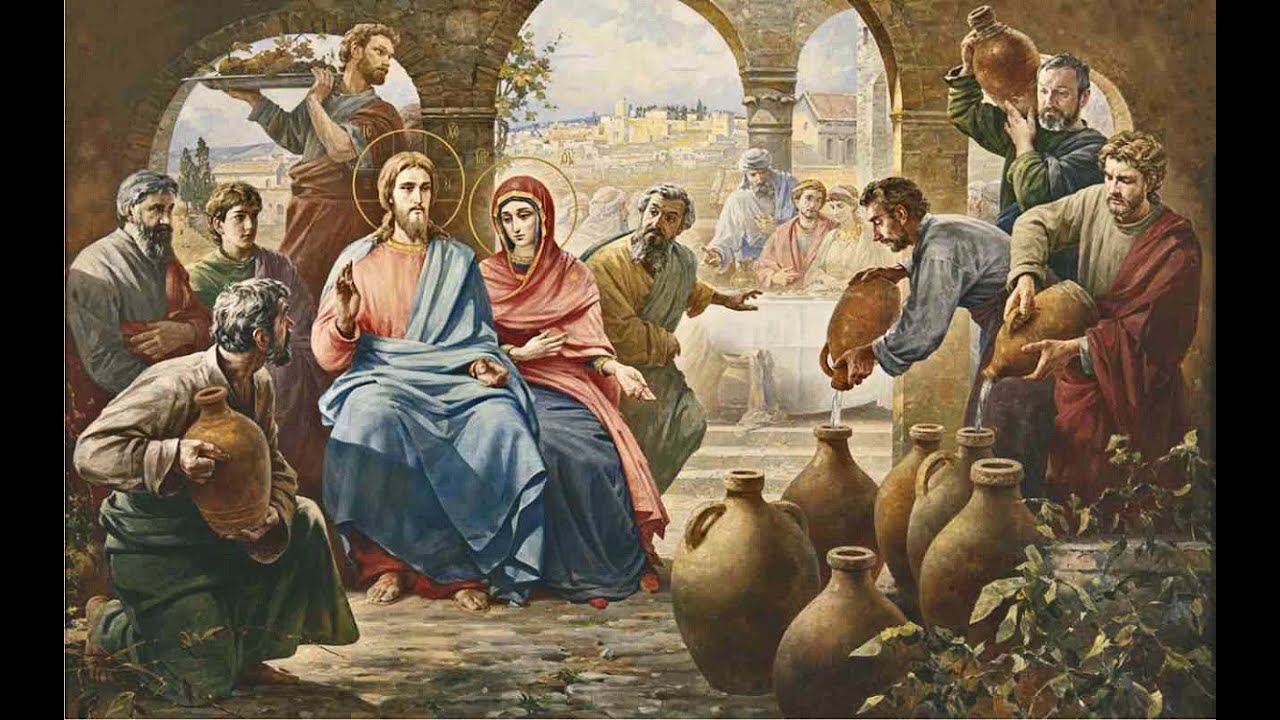
John. We’ll hopefully get to the others but there’s one that first appears in
chapter 2. We know this is the chapter of the wedding feast at Cana. We know
this is the first miracle where He transforms water into wine at the request of
His mother. But He doesn’t initially want to acknowledge the request. He says,
“Woman, how does your concern affect me? My hour has not yet come” (John 2:4).
There are two phrasings that are repeated several times later on: “Woman” and
“my hour.” Let me just focus on “woman” for now.
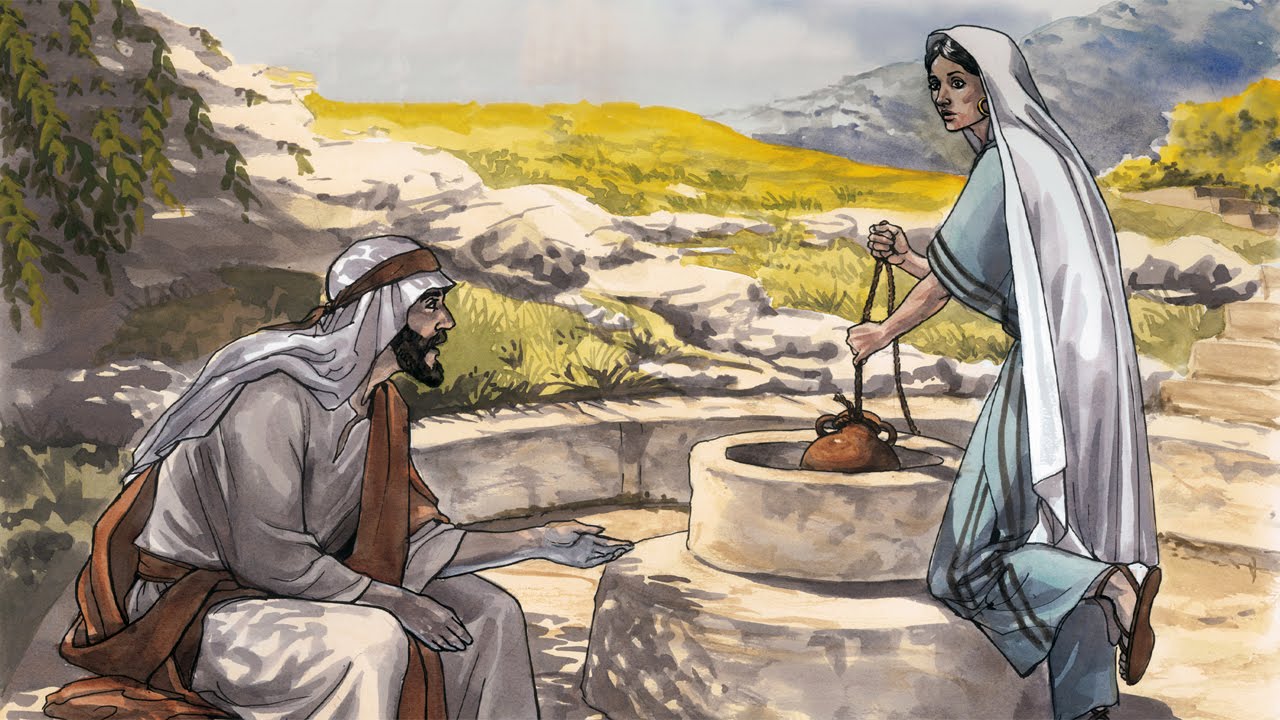
Next
is the encounter at the well with the Samaritan woman in chapter four, one of
my favorite passages in the entire New Testament. First Jesus tells the woman
of her history of being married five times and now even has resorted to living
unmarried with a man. When you think about the number of marriages, she is
obviously a woman who has been repeatedly rejected. What could a woman do in
those days to live but to find another man to support her? Perhaps the divorces
were partly her fault and perhaps it was the husbands’s fault, which is more
likely, but going from husband to husband is a disgrace to her, and finally
she’s even given up on keeping appearances by living outright with a man. She
is alienated and broken. But Jesus offers her life saving water and tells her
He is the messiah: “Believe me, woman, the hour is coming when you will worship
the Father neither on this mountain nor in Jerusalem” (John 4:21). Again there
is “hour” and there is “woman.”
In
chapter eight, a woman caught in adultery is brought to Him and the men who
bring her intend to stone her to death according to Mosaic Law. And Jesus
through His words stifles them and when the men have all left he says: “Woman,
where are they? Has no one condemned you?” (John 8:10). Again there is the
phrasing, “woman.”
In
chapter 19, while Jesus is suffering on the cross (His hour finally come) with
His mother, other women, and the apostle John before Him, He says to His
mother, “Woman, behold, your son.” He then turns to John and says, “Behold,
your mother” (John 19:26-27). Again the word “woman” is used.
Now
how are we supposed to understand the word “woman”? A lot might depend on the
translation, but all translations that I know use “woman.” It seems to me he is
speaking in a general manner referring to all womanhood. These are specific
women He is speaking to, but He is using a word that is generally applied. It’s
a word that goes back to Eve as woman. In all four cases it seems to me that
Jesus is either giving dignity to the women or restoring their wholeness. In
the second example He gives dignity to the woman at the well through His
respect and kindness for her. In the third example He forgives the woman from
her sin of adultery. In the first example, despite reluctance to start the
events that will lead to His crucifixion, He gives dignity to His mother by
obeying her. He also perhaps saves the bride the embarrassment of a undignified
wedding. And in the fourth example He upgrades the status of woman to a
universal mother of all.
There
is nothing like this that I can recall in the Old Testament. Certain women are
revered but nowhere to this level and nothing to a general womanhood level. And
there is nothing like this in the culture that Jesus lived. Women were not
fully respected, seen even as unclean because of their monthly periods, and
were seen as the source of sexual sin (through their womanly attractiveness) as
if men had only a passive role in sexual sin. By the use of the word “woman”
Jesus is restoring the dignity of Eve, perhaps even forgiving Eve, and bringing
her to wholeness from the brokenness of disobedience. I find this remarkable.
Madeleine
Replied:
Manny asked, "Now,
how are we supposed to understand the word "woman"? One thing I do
remember from one of my New Testament exegesis class in college, taught by a
Dominican priest, was a discussion on that word in the wedding at Cana passage.
I do remember we were told that Jesus using that term did not have the
disrespectful connotation it has now, but quite the opposite. That made sense
to me at the time.
My
Reply:
Yes it makes sense to me too
but I've come across a little dispute over that. Do you have Relevant Radio in
your area Madeleine? If you do you may have heard Fr. Simon in the afternoons.
I love his show but I'm usually working. I did catch a show where he agreed
with that. He knows the original languages, so from a linguistic point of view
he said he would have translated "woman" as "my lady" in
the Cana episode. That made sense to me, but I was interacting with the
apologist Steven Ray (he's published a number of books) on his blog one day on
this and brought up Fr. Simon's point. And he disagreed. He was looking at it
from a theological point of view and he made the point I made above in that it
was important to connect "woman" with Eve, and so it had to be
translated as a general sense of womanhood.
Now I don't see how they
both can't be correct. They are not mutually exclusive. It all depends on the
tone Jesus used. Obviously if Jesus used it in a supercilious tone, then that
would be disrespectful to His mother. And that can't be. If He used it in a
sort of appealing and passive tone, then he would not be disrespectful. But I
do think Steven Ray's point is correct, especially when you see that Jesus used
the same word several times. There is more going on than Jesus simply
addressing His mother.