"Love follows knowledge."
"Beauty above all beauty!"
– St. Catherine of Siena

Friday, November 14, 2014

Literature in the News: Teen Creates Book Charity

I thought this was interesting, and this young lady needs a fair amount of accolades.  From the U-T San Diego, which I assume is a San Diego newspaper:  “Teen turns passion for books into charity: Rancho Santa Fe's Sarah Lackey, 16, started the nonprofit Books for Friends, which provides free books to underprivileged children.”

You wouldn’t know it now, but when 16-year-old Sarah Lackey was in grade school, she was so painfully shy that she had no friends. Instead, she found solace and companionship in the world of books.

“When I was kind of alone, books were my escape,” she said. “Whenever I read, I went somewhere else. I didn’t have to think about my problems and books inspired me to do more with my life.”

In elementary school, Sarah would devour at least a book a day and would stay up late every night reading in bed with a flashlight. Over the years, her parents, Joseph and Stacy, were able to keep up with their daughter’s voracious habit by providing her with a steady stream of new books. But the growing stacks of novels around their Rancho Santa Fe gave Sarah an idea.

“Since books had always been an inspiration for me, I wondered about kids who couldn’t afford to buy books,” she said. “I thought that every kid should have the same opportunity to read, regardless of their situation.”

Since that day two years ago, the Cathedral Catholic High sophomore has collected and donated more than 8,000 books for local elementary schools, children in foster care, women and children in homeless shelters and for The Monarch School, which serves at-risk youth. She has also collected more than $5,000 in donations through Books for Friends, her recently incorporated nonprofit that uses 100 percent of donations on books.

Here I am at 52 years old and I wouldn’t have a clue on how to create a non-profit organization.  Her organization is actually a 501(c)(3) corporation.  And look at that, she goes to Catholic school to boot.  Here’s how she got started:

After her family moved to Rancho Santa Fe four years ago, she made a lot of friends at R. Roger Rowe middle school. While serving for two years on the school’s student council, she began organizing book drives. More than 2,500 books were donated to the foster care group Promises2Kids, and hundreds more were used to fill the shelves of the new library at The Monarch School campus, the school confirmed.

Since moving to Cathedral Catholic, Sarah has held another drive that raised 500 books and has two more planned in the spring. She has encouraged friends and family to host similar drives in Northern California and Georgia, and she has expanded donations to four area schools, including Solana Highlands Elementary in Solana Beach.

Now that is enterprising.  This young lady has got a future.  She has a website as well, Books For Friends.  

What do you do with your old books?  I hope you don’t say you throw them out.  Of the books I can depart with—and I have a problem getting rid of things, especially books—I donate mine, either to the local library or a Nursing Home.  I hope you do the same.

I see on her website that Books For Sale takes donations.  I’m going to send Sarah a small check.


Wednesday, November 12, 2014

Cool Video: How Wolves Changed Rivers

This is a new feature for my blog, a means of presenting interesting videos I come across.  They probably won’t be very literary, but such is the nature of videos.

I’ve mentioned a number of times how I love wolves, and I even posted a photo essay a few months ago on my trip to a wolf sanctuary.  This first posted “Cool Video” shows the effects of re-introducing wolves back to Yellowstone Park.  I don’t remember what year my wife and I vacationed at Yellowstone, but it had to be shortly after 1995 when wolves started being re-introduced.  You can read about it here and here.  I remember on the trip trying to locate the one wolf pack there.  We never found it.  Wolves are extremely shy.


I came across this video on the ecological impact of  re-introducing wolves to Yellowstone.  I hope you enjoy it, and you see just how beautiful Yellowstone Park is.  The narrator keeps saying how wolves kept the deer population down, but the video shows elk not deer.  The reality is wolves probably kept both populations down, but there’s a disconnect between the narrator and the film, and it comes across as the narrator being a bit obtuse.  Still it’s an excellent and educational video.


If you’ve never been to Yellowstone national Park, I highly recommend it if you enjoy the outdoors. 

Monday, November 10, 2014

Matthew Monday: First Spit Laugh, Chewing Gum, and Rosie Again

Matthew and I were having breakfast.  I made him those toaster waffles, you know the Ego Waffles, only these were Aunt Jemima’s. 


Matthew doesn’t like them crispy (no idea why, I prefer them that way) so I’ve come up with a process where instead of toasting them in a toaster I microwave them for one minute.  They are usually soft and yet warm, and instead of maple syrup Matthew prefers chocolate whip cream on top.  Matthew at five years old is a slow eater and gets distracted by the newspaper I’m reading on my side of the table, or chattering about any stray thought that comes to his mind.  So at almost every meal I have to focus him on eating or drinking, otherwise he’ll be at the table forever.

On top of that, he’s a fussy eater.  I’m like a wolf when I sit down to eat, gulping down everything in ravenous bites.  He’s like a cat, sampling everything, ordering what he likes to eat best, drinking at intervals to wash down what he doesn’t like.

So Sunday morning I’m urging him to eat up and drink his milk, which is also chocolate.  I know, he’s spoiled.  Suddenly he came upon a piece of waffle (I had cut them up into bite size pieces) that had hardened. 

“I don’t want to eat this one.  It’s too crunchy.”

“There’s nothing wrong with it.  Take a sip of milk.”  He was slow at drinking the milk too and he had hardly touched it.  So he took a “crunchy” piece of waffle and put it into his mouth.  I could see he wasn’t chewing it very eagerly.  “Take a sip,” I repeated.

He took a drink.

“And don’t tell me,” I said, “the milk is too crunchy too.”

It took him a second to get the humor of that and when he did his laugh caused chocolate milk to squirt out and dribble down his chin.  His first spit laugh.


-------------------------------

For the past few weeks Matthew had been bugging me about having a piece of chewing gum.  I didn’t think it wise to let a five year old chew gum, so I’ve said no.  He knows I keep a package of sugarless gum in my study.  One day this week he told me he’s figured out how gum works.  I didn’t quite understand what he meant.

“You chew it,” he explained, “until the flavor runs out and then you spit it out.”

“That’s right.  Where did you learn that?”  I figured it was some kid at school.  At least he won’t swallow it in the future.

“I just thought it and figured it out.”

OK.  He’s a smart kid.  A bit later I go into the upstairs bathroom and there on the floor by the little trash can that he obviously missed, was a little red something.  I picked it up and it was hardened gum.  I shook my head knowing full well that someone just three and a half feet tall chewed a piece gum and tried throwing it away.  I tossed the gum in the can, but then I thought better of it and took it out and put it back on the floor.

Later still, when Matthew and I were both upstairs I had him come into the bathroom. 

“Matthew, what’s that on the floor?”

“Where?”

“By the garbage can.”

“This?”  And he bends down and picks it up and holds it up.  “What is that daddy?”

“Don’t you know?”  Silence.  He says nothing.  So I ask, “Isn’t that gum?”

“Yeah, that’s what it is.”

“Well, how did it get there?”  Silence.  So I volunteered, “Did you take a piece of my gum?”

“Yeah.  But I figured out how it works.  You chew it until the flavor finishes and then you spit it out."

Sigh.

-------------------------------

It’s hard to tell if there’s any improvement between Rosie and Matthew.  He’s not quite as scared of her and most of the time now he fights back when they tangle.  Rosie sees him as a play friend, and play to her is to use her mouth.  And then he makes a run for it, which only triggers a chase instinct in her.  And of course she catches him, and so on.

Here she is giving him a lick.


And playing tug, Matthew trying to be as far from her as possible.


 As you can see in the five weeks we’ve had her, Rosie has really grown.  I’d say she’s more than doubled.

Here’s an interesting tid-bit of information for dog owners I discovered.  I was searching around to see if Rosie was on track with her weight.  There are a lot of dog weight calculators on the internet and when I put Rosie’ information in, they spanned from as low as 48.8 to 82 lbs.  Now that’s quite a range, which shows you they’re not worth much.  The one rule of thumb I found more often was that a pup of a medium to large breed at 14 weeks will be about 2.5 times that at one year old.  If Rosie is 20 lbs today at under 13 weeks, and she’s gaining over two pounds per week, I estimate she’ll be 24 lbs at 14 weeks, which will put her at 60 lbs at a year old.  That’s about right for a Lab.

Saturday, November 8, 2014

Literature in the News: Top Five Catholic Novels

I should probably create a new category of Literature on the Internet, since this wasn’t in the news but a video clip for Taylor Marshall’s blog.  But for now I’ll blur the distinction between news and internet.  Dr. Taylor Marshall is a Catholic convert and theologian.  He was formerly an Episcopal priest but through his theological studies and radical changes that occurred in the Episcopal/Anglican churches brought him to Roman Catholicism.  You can read his bio.  He added this short video clip to one of his recent posts listing his top five Catholic novels not including J.R.R. Tolken’s Lord of the Rings.  I guess Lord of the Rings is among everyone’s favorite Catholic novels, though I bet most people don’t even realize the novel’s Catholic world view. 


Let me just list his five:
1. Brideshead Revisited by Evelyn Waugh.
2. Helena by Evelyn Waugh.
3. Dracula by Bram Stoker.
4. Father Elijah by Michael O’Brien.
5. Father Brown Stories by G. K. Chesterton.

As Marshall states that the novel does not have to be written by a Catholic, but have a Catholic, sacramental world view.  Bram Stoker, who he includes, was not Roman Catholic.  And he also includes short stories, since the Father Brown series is not a novel but a collection of short works.

I too love Waugh's Brideshead Revisited and include it on my list, but I don't think I would include Lord of the Rings, even if I were allowed to.  It's a good novel, but I don't find it overwhelming.  Perhaps because it's in a Fantasy/Sci Fi genre, which there's nothing wrong with it, but it's not my cup of tea.

So let me give you my list, and like Marshall in no particular order.
1. Brideshead Revisited by Evelyn Waugh.
2. The Power and the Glory by Graham Greene.
3. Silence by Shasaku Endo.
4. The Complete Short Stories of Flannery O’Connor.
5. The Sun Also Rises by Earnest Hemingway.

Honorable mentions:
My Antonia by Willa Cather.
The Brothers Karamazov by Fyodor Dostoyevsky.
Light in August by William Faulkner.
Ulysses by James Joyce.
The Leopard by Giuseppe Tomasi di Lampedusa.

First, let me say that there is clearly a bias toward writers in English.  There are lots of great Catholic works by writers who wrote in a continental European language, but unfortunately I have not read many of them.  I tried to diversify my selections by including a Japanese writer (Endo), a Russian (Dostoyevsky), and an Italian (di Lampedusa).  Neither Cather, Dostoyevsky, or Faulkner are Catholic, but I think those works do have a sacramental world view, and I love all three works dearly.  James Joyce was Catholic, but certainly a lapsed one, but all his works come from a Catholic world view, even when he is rejecting his Catholicism.  Lampedusa’s The Leopard is not a novel that makes any list of Catholic novels, but it is deeply Catholic and I’m on a mission to show the world how great a work that is. 

Finally the lists are clearly biased toward the last hundred and fifty years.  One could have gone back to medieval and renaissance works such as Dante’s Divine Comedy, Chaucer’s Canterbury Tales, or Thomas Malory’s Le Morte d’Arthur, but that would too easy.

I should say a word on Hemingway’s The Sun Also Rises.  I bet that a lot of people don’t know that Earnest Hemingway was a Catholic convert.  Albeit, his biography does not appear to be that of a good Catholic, and I doubt he practiced much during his lifetime.  He converted in the 1920s while an expatriate in Europe, and he wrote The Sun Also Rises around the same time.  It’s probably the only one of his novels that has a Catholic, sacramental sensibility.  You hardly ever see it in the literary criticism, but one cannot fully get the novel or appreciate it without seeing the symbolism of Catholic sacraments throughout the work.

You can also see a list of Catholic novels (“100 Best”) at Catholic Online.  I’m amazed at how few of them I’ve actually read.


I would love to hear what your favorite Catholic novels are.

Wednesday, November 5, 2014

Lines I Wished I’d Written: The Demonic Invasion from “The Gentleman from Cracow” by Isaac Bashevis Singer

Last Friday was Halloween but on a Friday I much preferred to post faith filled post, especially since the next day was All Saints Day.  So I went with a saintly post instead of a fiendish one.  But now let me make a Halloween post, an excerpt from a short story by Isaac Bashevis Singer titled, “The Gentleman from Cracow.”  Part IV of the story is a perfect Halloween read, from the eerie, portentous setting to the evil supernatural beings that invade from the sky. 

Let me give you the context.  The town of Frampol, already a humble town, has been further impoverished because of a drought.  Just when the inhabitants are about to abandon the town, suddenly a rich man from Cracow comes to settle, a relatively young widower, and he starts giving away money like it’s sand, and of course the poor people start taking it and going along with his wishes.  Slowly, step by sinful step, the traditional religious ways are compromised and a Sodom and Gomorrah mentality pervades the town.  Finally at a dance the Gentleman (we are never told his name) throws to marry every girl in the town by random lottery, social breakdown ensues and evil spirits take over the town.  In the passage below there are a lot of what appears to be Jewish folkloric references which I don’t recognize, but I don’t think the specific references are significant.  Perhaps they are to those that get them, but one doesn’t need to know them to appreciate this passage.  Also, the girl Hodle in the passage is a girl from the outskirts of town who has been raised loosely and has a reputation for promiscuous and serial sex.  The story is part realism, part folklore, and part cautionary tale, and only a master short story writer as Singer could pull this off in just thirteen pages.  Enjoy, and happy Halloween. 


IV
The setting sun, remarkably large, stared down angrily, like a heavenly eye, upon the Frampol market place. Never before had Frampol seen such a sunset. Like rivers of burning sulphur, fiery clouds streamed across the heavens, assuming the shapes of elephants, lions, snakes, and monsters. They seemed to be waging a battle in the sky, devouring one another, splitting apart, breathing fire. It almost seemed to be the River of Fire they watched, where demons tortured the evildoers amid glowing coals and heaps of ashes. The moon swelled, became vast, blood-red, spotted, scarred, and gave off little light. The evening grew very dark, dissolving even the stars. The young men fetched torches, and a barrel of burning pitch was prepared. Shadows danced back and forth as though attending a ball of their own. Around the market place the houses seemed to vibrate; roofs quivered, chimneys shook. Such gaiety and intoxication had never before been known in Frampol. Everyone, for the first time in months, had eaten and drunk to the full. Even the animals participated in the merrymaking. Horses neighed, cows mooed, and the few roosters that had survived the general slaughter crowed. Flocks of strange birds flew in to pick at the leavings. Fireflies illumined the darkness, and lightning flashed on the horizon. But there was no thunder. A weird circular light glowed in the sky for a few moments and then suddenly plummeted toward the horizon, trailing a crimson tail. Then, as everyone stared in wonder at the sky, the gentleman from Cracow spoke:
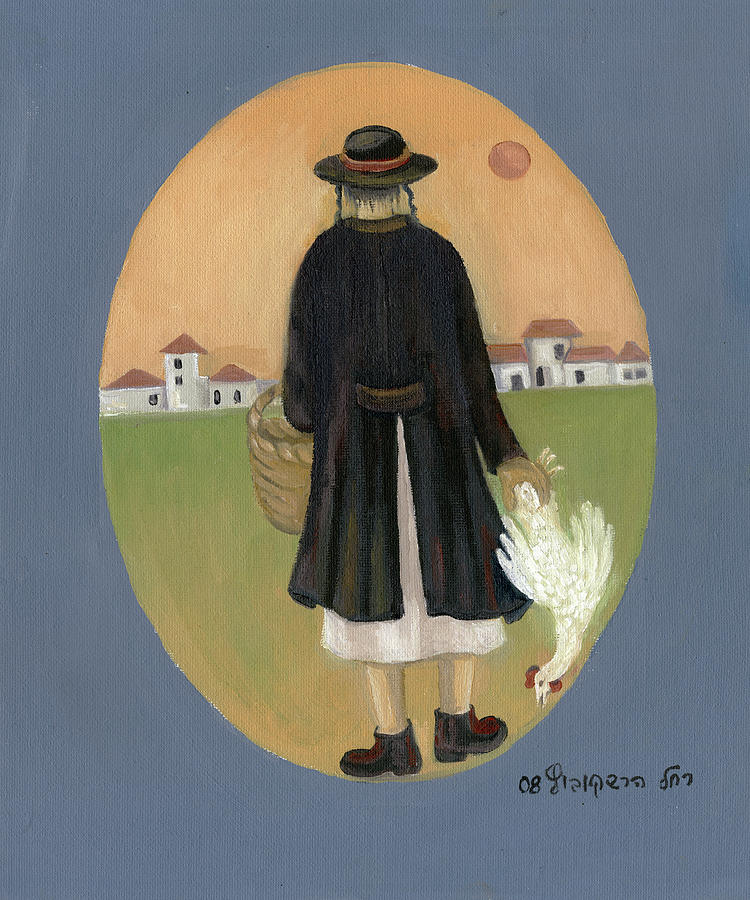
“Listen to me. I have wonderful things to tell you, but let no one be overcome by joy. Men, take hold of your wives. Young men, look to your girls. You see in me the wealthiest man in the entire world. Money is sand to me, and diamonds are pebbles. I come from the Land of Ophir, where King Solomon found the gold for his Temple. I dwell in the palace of the Queen of Sheba. My coach is solid gold, its wheels inlaid with sapphires, with axles of ivory, its lamps studded with rubies and emeralds, opals and amethysts. The Ruler of the Ten Lost Tribes of Israel knows of your miseries, and he has sent me to be your benefactor. But there is one condition. Tonight, every virgin must marry. I will provide a dowry of ten thousand ducats for each maiden, as well as a string of pearls down to her knees. But make haste. Every girl must have a husband before the clocks strike twelve.”
The crowd was hushed. It was as quiet as New Year’s Day before the blowing of the ram’s horn. One could hear a fly buzz.
Then one old man called out, “But that’s impossible. The girls are not even betrothed!”
“Let them become betrothed.”
“To whom?”
“We can draw lots,” the gentleman from Cracow replied. “Whoever is to be married will have his or her name written on a card. Mine also. And then we shall draw to see who is meant for whom.”
“But a girl must wait seven days. She must have the prescribed ablutions.”
“Let the sin be on me. She needn’t wait.”
_____________
Despite the protests of the older men and their wives, a sheet of paper was torn into bits, and on each piece the name of a young man or young woman was written by a scribe. The town’s beadle, now in the service of the gentleman from Cracow, drew from one skullcap the names of the young men, and from the other those of the young women, chanting their names in the same tune as when he called up members of the congregation for the reading of the Torah.
“Nahum, son of Katriel, betrothed to Yenel, daughter of Nathan. Solomon, son of Dov Baer, betrothed to Trina, daughter of Jonah Lieb.” The assortment was a strange one, but in the night all cats are gray, and the matches seemed not too absurd. After each drawing, the newly engaged couple, hand in hand, approached the doctor to collect the dowry and wedding gift. As he had promised, the gentleman from Cracow gave each the stipulated sum of ducats, and on the neck of each bride he hung a strand of pearls. Now the mothers, unable to restrain their joy, began to dance and shout. The fathers stood by, bewildered. When the girls lifted their dresses to catch the gold coins given by the doctor, they showed their legs and underclothing, which sent the men into paroxysms of lust. Fiddles screeched, drums pounded, trumpets blared. The uproar was deafening. Twelve-year-old boys were mated with “spinsters” of nineteen. The sons of substantial citizens received the daughters of paupers as brides; midgets were coupled with giants, beauties with cripples. On the last two slips appeared the name of the gentleman from Cracow and that of Hodle, the daughter of Lipa the ragpicker.
The same old man who had called out previously cried out, “Woe unto us, the girl is a harlot!”
“Come to me, Hodle, come to your bridegroom,” the doctor bade.
Hodle, her hair in two long braids, dressed in a calico skirt, and with sandals on her feet, did not wait to be asked twice. As soon as she had been called she walked to where the gentleman from Cracow sat on his mare, and fell to her knees. She prostrated herself seven times before him.
“Is it true, what that old fool says?” her prospective husband asked her.
“Yes, my lord, it is so.”
“Have you sinned only with Jews or with Gentiles as well?”
“With both.”
“Was it for bread?”
“No. For the sheer pleasure.”
“How old were you when you started?”
“Not quite ten.”
“Are you sorry for what you have done?”
“No.”
“Why not?”
“Why should I be?” she answered shamelessly.
“You don’t fear the tortures of hell?”
“I fear nothing—not even God. There is no God.”
Once more the old man began to scream, “Woe to us, woe to us, Jews! A fire is upon us, burning, Jews, Satan’s fire. Save your souls, Jews. Flee, before it is too late!”
“Gag him,” the gentleman from Cracow commanded.
The guards seized the old man and gagged him. The doctor, leading Hodle by the hand, began to dance. Now, as though the Powers of Darkness had been summoned, the rain and hail began to fall; flashes of lightning were accompanied by mighty thunderclaps. But heedless of the storm, pious men and women embraced without shame, dancing and shouting as though possessed. Even the old were affected. In the furor, dresses were ripped, shoes dropped off, hats, wigs, and skullcaps trampled in the mud. Sashes, slipping to the ground, twisted there like snakes. Suddenly there was a terrific crash. A huge bolt of lightning had with one blast struck the synagogue, the study house, and the ritual bath. The whole town was on fire.
Now at last the deluded people realized that all these seeming occurrences of nature were unnatural in origin. Though the rain kept falling, and even increased, the fire was not extinguished. An eerie light glowed in the market place. Those few prudent individuals who tried to disengage themselves from the demented crowd were crushed to earth and trampled.
And then the gentleman from Cracow revealed his true identity. He was no longer the young man the villagers had welcomed, he was a creature covered with scales, with an eye in his chest, and on his forehead a horn that rotated at great speed. His arms were covered with hair, thorns, and elflocks, and his tail was a mass of live serpents; for he was none other than Ketev Mriri, Chief of the Devils.
Witches, werewolves, imps, demons, and hobgoblins plummeted from the sky, some on brooms, others on hoops, still others on spiders. Osnath, the daughter of Machlath, her fiery hair loosened in the wind, her breasts bare and thighs exposed, leaped from chimney to chimney, and skated along the eaves. Namah, Hurmizah the daughter of Aff, and many other she-devils did all sorts of somersaults. Satan himself gave away the bridegroom, while four evil spirits held the poles of the canopy, which had turned into writhing pythons. Four dogs escorted the groom. Hodle’s dress fell from her and she stood naked. Her breasts hung down to her navel and her feet were webbed. Her hair was a wilderness of worms and caterpillars. The groom held out a triangular ring and, instead of saying,” With this ring be thou consecrated to me according to the laws of Moses and Israel,” he said, “With this ring be thou desecrated to me according to the blasphemy of Korah and Ishmael.” The evil spirits called out, “Bad luck,” and they began to chant,
“The curse of Eve, the mark of Cain,
The cunning of the snake, unite the twain.”
Screaming for the last time, the old man clutched at his head and died. Ketev Mriri began his eulogy,
“Devil’s dung and Satan’s spell
Bring his ghost to roast in hell.”


I didn’t think it possible, but the entire story is on the internet.  Commentary magazine posted the story.  If my excerpt was enticing—and how could it not be—run over and read the entire story.  It’s not very long and Singer is one of the great short story writers.  Let me know what you think.  


Also, for some reason Commentary does not attribute the translation on their posting.  The translation on the internet is the same as the one in The Collected Stories from which I read.  The English translators from the original Yiddish are Martha Glicklich and Elaine Gottlieb.


Sunday, November 2, 2014

Matthew Monday: Halloween 2014

It was a Friday, and I didn’t have anything pressing at work, so I took the day off so I could take Matthew Trick-or-Treating.  In the past we only went to a few houses.  It would be late in the day and dark when I got home from work, so that precluded extensive going house to house.  So this year I got to take him when he got home from school in the early afternoon.  We still didn’t go extensive doorbell ringing.  We walked about for an hour or so.  Boy in that hour he filled up an entire shopping bag.  Whoa, beyond my expectations.  I even asked at the end if we wanted to go some more, and he said, “This bag is too heavy.  Let’s go home.” 

Of course he went as Batman.  Here are some pictures.  Acting tough.


Not sure if you can see it, but he was very proud of the little cape that came with the costume.


My mother was his biggest contributor, giving him at least a half dozen packages.


Even Rosie got to wear a Halloween jester collar.  Here they are fighting as usual.  Some tough guy.  He can't even handle a fifteen pound pup.


I’m glad I took the day off.  It was one of those father/son treasured moments.

Friday, October 31, 2014

Faith Filled Friday: Quotes from the Saints

I know it’s Halloween, but tomorrow is All Saints Day, and that’s way more important.  The October edition of the devotional magazine Magnificant  had in anticipation of the feast day for saints a list of quotes by some of the most memorable saints in the cannon.  It was one quote per saint, and the list lasted eight and a half pages, which I estimate to be about eighty quotes.  I wasn’t sure how to honor All Saints Day with my Faith Filled Friday category, so I decided to emulate and provide ten memorable quotes by ten different saints.


1."Christ be with me, Christ within me, Christ behind me, Christ before me, Christ beside me, Christ to win me, Christ to comfort me and restore me, Christ beneath me, Christ above me, Christ in quiet, Christ in danger, Christ in hearts of all that love me, Christ in mouth of friend and stranger."
            -St. Patrick

2."On the question of relating to our fellowman – our neighbor’s spiritual need transcends every commandment. Everything else we do is a means to an end. But love is an end already, since God is love."
            -St. Teresa Benedicta (Edith Stein)

3. “Whenever anything disagreeable or displeasing happens to you, remember Christ crucified and be silent.”
             -St. John of the Cross

4. “All my pleasure in this land of exile is that of having every kind of suffering found on the cross, deprived of every other consolation except that of the Sacred Heart.”
            -St. Margret Mary Alacoque

5. “Though God hates sin more than any other thing, he loves us poor miserable sinners.  He ardently desires the welfare of our souls as if his own happiness depends on it.”
            -St. John Neumann

6. “A talkative soul lacks both the essential virtues and intimacy with God. A deeper interior life, one of gentle peace and of that silence where the Lord dwells, is quite out of the question. A soul that has never tasted the sweetness of inner silence is a restless spirit which disturbs the silence of others.”
            -St. Faustina

7. “I understood that every flower created by Him is beautiful, that the brilliance of the rose and the whiteness of the lily do not lessen the perfume of the violet or the sweet simplicity of the daisy. I understood that if all the lowly flowers wished to be roses, nature would no longer be enameled with lovely hues. And so it is in the world of souls, Our Lord's living garden.”
            -St. Thérèse de Lisieux

8. “Thou hast made us for thyself, O Lord, and our heart is restless until it finds its rest in thee.”
            -St. Augustine of Hippo

9. “Brother wolf, thou hast done much evil in this land, destroying and killing the creatures of God without his permission; yea, not animals only hast thou destroyed, but thou hast even dared to devour men, made after the image of God; for which thing thou art worthy of being hanged like a robber and a murderer. All men cry out against thee, the dogs pursue thee, and all the inhabitants of this city are thy enemies; but I will make peace between them and thee, O brother wolf, if so be thou no more offend them, and they shall forgive thee all thy past offences, and neither men nor dogs shall pursue thee anymore.”
            -St. Francis of Assisi

10. “"The soul is in God and God in the soul, just as the fish is in the sea and the sea in the fish."
            -St. Catherine of Siena


I hope you like these.  Our communion of saints provides us with so rich a history and legacy.  Is there any particular saint’s quote you’d like to share?