
This is the first of
three posts on the short story “The Night Before
Christmas” by Nicolai Gogol. While
this seems to be listed as a short story, the length and multiple plot lines
would suggest to me to be a novella.
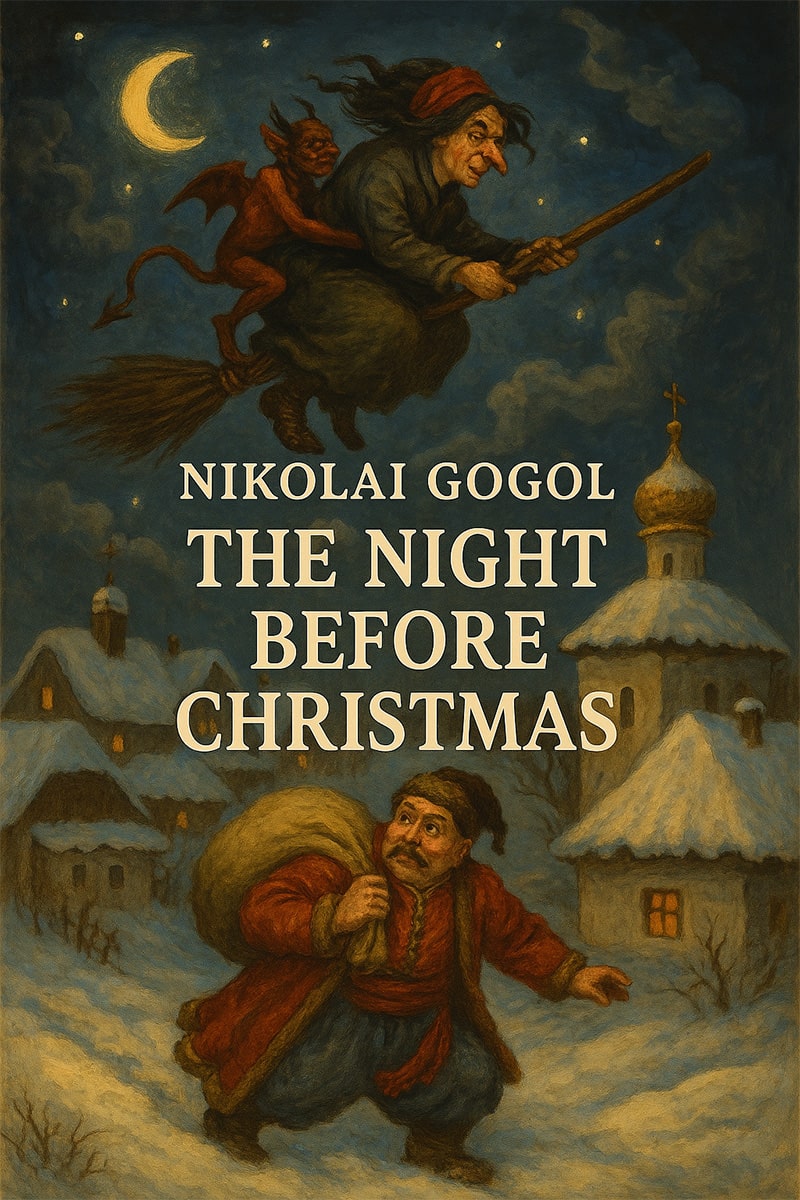
Concerning the translation, I am using The Collected Tales of Nikolai Gogol, which includes this story and is translated by Richard Pevear and Larissa Volokhonsky. By chance I happened to own this book. You don’t need the book. You can find this story in a number of places online such as Gutenberg. Here is an online version with annotations which might be helpful. https://litarchive.online/the-night-before-christmas#google_vignette I think all the online versions use the Constance Garnett translation. Garnett translated all the major 19th century Russian literature in the first half of the 20th century. Her translations I suspect are outside the copy write laws. Pevear and Volokhonsky are contemporary translators, and seem to be on a mission to translate all the Russian writers anew. They have won awards, so I do trust them. But Constance Garnett has a great reputation as a Russian translator as well. As I’ve compared, I don’t think there is that much of a difference.

There is one noticeable difference. The names are spelled differently. I think Garnett altered the spelling for a more phonetic appeal to English speaking readers. I don’t think it matters. If I am going to quote for this discussion I will probably pull from the online source so I can copy and paste. One other translation thing to be aware, some places online translate the title as “Christmas Eve” rather than “The Night Before Christmas.” I don’t think that matters.
Let me provide some preliminaries to aid the reader. This is a 19th century story and a story from a Russian author. Both of these details can provide some difficulties. A 19th century story provides more exposition and/or overture than a contemporary story. A 20th century short story writer will tend to start the story in medias res, or “in the middle of things.” He will tend not to start with exposition and context, but will somehow get it in once the story is started. You have to give a 19th century story a little more time to develop.
A 19th century story will tend to be more verbose, detailed, or exhaustive than a 20th century story. Contemporary stories use elements of poetry and distill their stories with symbols, allusions, loaded imagery, and other literary devices. It comes down to realism versus emotional engagement. The more abundant details of a 19th century story, the more realistic it feels. The more symbolism of a 20th century story though with less details, the greater the emotional connection.
Finally the Russianness of this story does give the non-Russian reader some difficulties. Russians do (or maybe they only once did and no longer) have a particular way of passing names down. This could be a difficulty in some long Russian novels, but I don’t think it’s an issue in this story. There are some cultural distinctions that you will have to do a search on. In this story you will come across the caroling (koliadovat) the townspeople do on Christmas Eve. It’s not just simple caroling as we do here but where the carolers are given treats for their effort. It seems like it combines elements of our Halloween into caroling. Another is some traditional Christmas Eve dish, kutya, which appears to be a required dish. There are also different types of Cossacks mentioned, and they are each associated with a specific region. Other than geography, I don’t know their relationship. There are historical persons who are real people fictionalized. Three that I remember are Queen Catherine the Great, Prince Potemkin, and Denis Fonvizin. Just do a search and they come up pretty easily.
Finally Nicolai Gogol is a Ukrainian, not a Russian, and so there are distinctions I seem to feel but not converse in the subject enough to understand. As we have learned these four years of the Ukraine-Russian War, they are not exactly the same culture. There are some language distinctions and I would bet rsburg. There may be significance in this, but it’s outside my ken. Given the evolving n4186many cultural as well. We know this story occurs in Ukraine, but there is a trip over to St. Petersburg of Ukraine’s borders with Russia, that may also have some significance that alludes me. Catherine the Great was a Russian queen, but I have no idea what her relationship with Ukraine was at this time in history. The story is set in a town called Dikanka, but nearby there is a town called Sorochintsy where some sort of assessor or bureaucrat resides. I found both towns are small when I looked them up but I have no context for a relationship between them. But even though I had to struggle to understand some of this, I don’t think it causes the non-Russian reader to get the wonder and delight of this story.

As to Gogol’s place in Russian literature, he is one of the greats that stand with go along with Pushkin, Tolstoy, Dostevsky, Turgenev, and Chekhov. Pushkin was Gogol’s predecessor and a friend, and ten years older than Gogol. Gogol was a good ten to twenty years younger than the other contemporaneous Russian greats except for Chekhov who was born some eight years after Gogol had died. Gogol’s writing career was over twenty-two years (1830-1852) and included short stories, one novel, drama, and essays. He is known as a great developer of the form of the short story, which perhaps he is best known for, but his one novel, Dead Souls, is also highly respected and acclaimed. Gogol split his career writing in early life in Ukraine and then moving to St. Petersburg.
###
This story, “The Night Before Christmas” or sometimes translated as “Christmas Eve,” is such a superb story. Frankly I think this is elite level of story writing. The 19th century Russians are just so good. I jotted down some notes and I hope it will help readers that might get lost. First a list of characters. This is probably not comprehensive but I think it includes all the major characters. I am using the spelling in my Pevear/Volokhonky translation. It may be different in your translation.
My early comments here are first impressions. By the third post I will have arrived at a more complete understanding of the story. So take my early comments with a grain of salt. I don’t think there is anything erroneous in them but they do speak from a lack of complete understanding. It took several reads
List of Characters
The Witch, Solokha, Vakula’s
mother
The Devil
Cossack Choub
The Deacon, Osip
Nikiforovich
The Headman (Sexton)
Cossack Sverbyguz
Father Kondrat
Choub’s daughter, Oksana
Vakula, the blacksmith
Panas, Choub’s chum
Tymish Korostyavy
Paunchy Patsiuk, the
Zaporozhet, wizard
Shapuvalenko, the weaver
Panas’s wife
The Weaver’s Wife
The Deacon’s Wife
Pereperchikha (Pereperchenko’s wife)
The Zaporozhtsy Cossacks
Prince Potemkin, Grigory
Alexandrovich
Empress Catherine the Great
Most short stories have only one plot line. This one has at least four plot lines that I could count. The plot lines weave in and out of each other. It may be helpful to list them, so you can understand what is going on and how they are interconnected.
Plot Lines
Vakula wins Oksana’s hand
in marriage. (Main plot)
Devil stealing the moon
and causing chaos
Choab’s Christmas Eve
celebration and adventures
Solokha’s dalliances.
I’m trying to arrive at a main theme. Perhaps it could be: love wins despite the devil’s confusion? But it’s more complicated than that. Why is everyone except maybe Vakula the blacksmith so sinful? Whatever the central theme might be there are some recurring motifs that I noticed. Here’s my list.
Motifs:
Pranks
Chaos/confusion
Not being able to see
correctly
Things and people hidden
Infidelity/Promiscuity
Merry making/Laughter
Sin
Use of the “unclean
powers”
Sophistication vs.
simplicity
This story is very complex. I haven’t figured it all out yet, and I am so enchanted with it I am going to read it for a third time. I will soon post on some truly remarkable scenes.

###
Frances’s Comment:
Last year a friend recommended a Russian novel to me, The Master and Margarita. It is a highly creative, imaginative — at times even wild — story told in three parts. The heroine, Margarita, is a beautiful young woman who rides in the air through Moscow — on a broom. At first I thought of the Wizard of Oz, but when I looked it up, I learned that the image of a female character riding a broom is a common trope in Russian literature. Of course, I recognized it again in this story.
My Reply to Frances:
Thanks for that Frances. This story is highly dependent on its Russian/Ukrainian folklore. Unfortunately we can’t totally comprehend the nuances.
###
Kerstin’s Summary of the
Early Section:
THE DAY OF CHRISTMAS EVE ENDED, AND the night began,
cold and clear. The stars and the crescent moon shone brightly upon the
Christian world, helping all the good folks welcome the birth of our Savior.
The cold grew sharper, yet the night was so quiet that one could hear the snow
squeak under a traveler’s boots from half a mile away. Caroling hadn’t yet
begun; village youths weren’t yet crowded outside the windows waiting for
treats; the moon alone peeked through, as though inviting the girls to finish up
their toilette and run out onto the clean, sparkling snow.
So begins our adventure into goings-on of the little
village Dikanka on the night before the Savior is born.
Out of the chimney comes a witch flying on her broom.
Sorochinsky, the property assessor, usually does not
miss anything going on in the village, but this time he is far away.
The witch flies about on her broom and collects stars
into her sleeve.
The exceedingly ugly devil appears on the scene and
after a couple of tries stuffs the moon into his pocket. Now all of Dikanka is
cast in full darkness. His purpose is revenge on the blacksmith Vakula, who is
also a talented artist.
The pinnacle of his art was agreed to be a large panel
inside the church porch which depicted St. Peter expelling the devil from hell
on the day of the Last Judgment. Faced with imminent death, the terrified devil
darts here and there, while the forgiven sinners bash him with whips and
sticks. The devil tried everything to stop Vakula from finishing the hateful
portrait, shoving his hand, blowing soot on the panel—but despite his heartiest
efforts the painting was completed and nailed to the church wall, and since
then the devil swore to take revenge on its creator. For only one more night
could he roam freely and look for a way to pay Vakula back—hence the moon
theft.
As an added bonus, the darkness would also prevent
Cossack Chub, and other prominent citizens from attending the deacon’s holiday
dinner.
The devil having set in motion this mischief starts
flirting with the witch.
Chub and Panas, Oksana’s godfather (kum) step onto the
porch of Chub’s cottage and realize it is pitch black. Chub curses the devil.
He doesn’t want to miss the deacon’s dinner he is already wistfully
anticipating of a bottle of spiced vodka.
Meanwhile, Chub’s daughter Oksana is standing in front
of a mirror completely engrossed in her own reflection. Vakula enters the
cottage unbeknownst to her and is equally taken by her. He wants to marry her,
but she only toys with him, and he knows it.
So what is the devil up to? It is very cold flying
through the air, so the witch descends back down and into her chimney. The
devil follows her, but before he enters the chimney he creates a blizzard so
Chub and kum get disoriented and turn back home in the hopes of catching Vakula
and Oksana alone.
Who is the witch? Her name is Solokha and Valuka’s
mother. As it turns out, she provides extra-marital entertainment for many of
the village’s esteemed male citizens. Her favorite is the well-to-do widower
Chub whom she aspires to claim for herself and his riches. The only wrinkle in
the scheme is her son Vakula and his infatuation with Oksana, so she resorts to
all sorts of witchery to foil them.

No comments:
Post a Comment