
This is the third post of several posts on Redeemer
in the Womb: Jesus Living in Mary by John Saward.
You can find Post #1 here.
Post #2 here.

Kerstin’s Introduction to Chapter 3: A Womb
Wider than Heaven: The Teaching of the Fathers:
From the early Church Fathers on there has been a wonder and amazement
that God would condescend to become a little baby, going through the same nine
months of development in the womb like any human. What makes this even more
unusual is that in pagan antiquity there was a contempt for women and the
bodily reality of birth was considered distasteful. Pagans may believe that
simple statues are deities, but that God would subject Himself to the messiness
of birth was unfathomable. “When thou tookest upon thee to deliver man,” sings
the Church in the Te Deum, “thou didst not abhor the Virgin’s womb.”
Kerstin’s Comments:
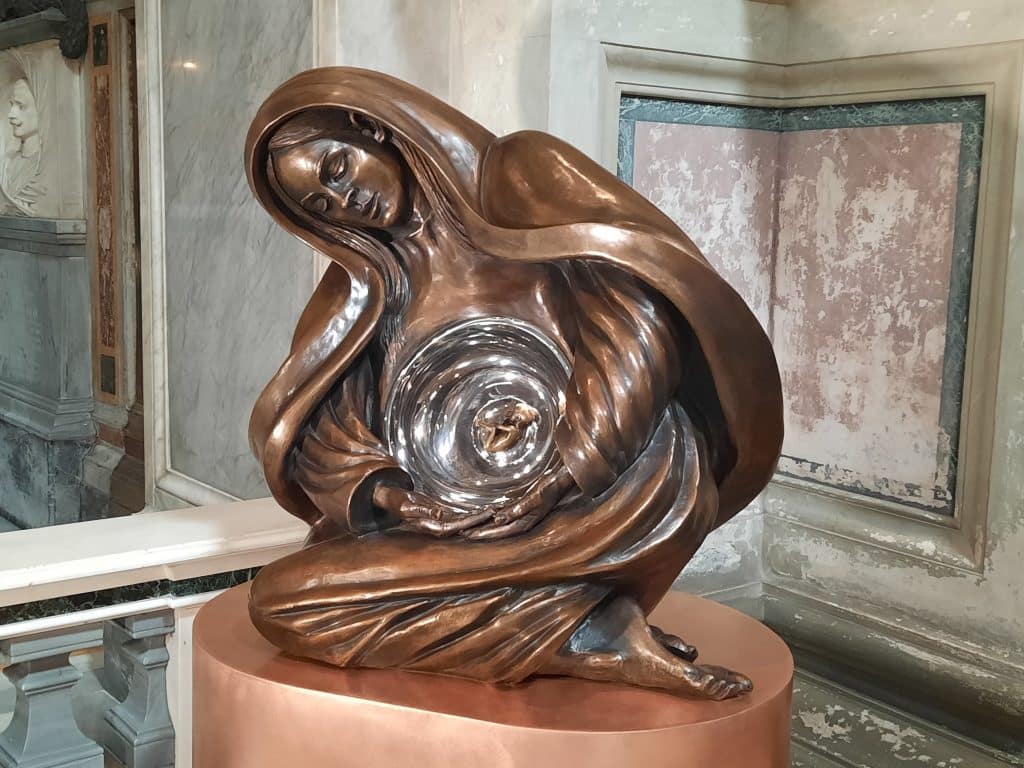
The Theotokos as Sanctuary
Earth and heaven too narrow to serve as embracing
arms, to conceal your divinity.
The womb of the earth is too small for you, and yet
the womb of Mary is large enough for you.
St. Ephrem has a ‘locational’ Christology. He sees the divine Word
taking up a series of residences, each of which, in some sense or other, is a
womb: the bosom of the heavenly Father in which he is eternally begotten in his
divinity, the earthly womb of the Blessed Virgin in which he is conceived and
carried in his humanity, the watery womb of the Jordan in which as man he is
baptized, the deathly womb of Sheol into which in his human soul he descends.
Mother of Manna
The liturgical imagery applied by the Fathers to the expectant Theotokos
sometimes becomes explicitly Eucharistic. “Mary,” says St. Ephrem, “gave us the
living bread instead of the bread of trouble, which Eve gave.” She carries in
her womb him who is the Bread of Life, the heavenly Manna.
Nestorianism and the Unborn Christ
In the 5th century the debate over the divine and human natures of
Christ was intensely explored. Nestorius took the stance of indwelling,, the
man Jesus is the temple in which the divine Word dwells. This means that God is
only attached to a human being, and therefore Mary cannot be the Theotokos, the
Mother of God. It was chiefly St. Cyril who brought more clarity to the issue
and preserved not only the full divinity of Christ but also Mary as the
Theotokos.
St. Cyril and St. Proclus came to see that the temple and dwelling-place
images of Scripture, indeed all the figures of containment and enclosure, apply
with greater precision to the Mother of God than to her Son. The Lord Jesus
Christ is Emmanuel, God-with-us, God-made-man, God the Word personally present
in the flesh. When for nine months the Virgin carries him in her womb, she is
the consummate Ark and Temple of God.
Nestorianism, which removes God from Mary’s womb, was therefore declared
a heresy.
Womb and Bridal Chamber
According to the Patristic understanding, the Virgin’s womb is not only
a church, the shrine of divine presence; it is also a chamber, the scene of
divine nuptials. “The nuptial union is between the Word and the flesh,” says
St. Augustine (354–430), “and the bridal chamber of the union is the Virgin’s
womb.”
…The description of the virginal womb as Christ’s “bridal chamber” is
liable to misunderstanding in another way. It does not sufficiently show that
the Incarnation takes place through the Blessed Virgin’s faith as well as in
her flesh. She is not simply the scene of the Word’s marriage to humanity, the
impersonal place in which the knot of the two natures is tied. She is actively
engaged, personally involved. God does not force his Son upon mankind.
Incarnation is not invasion. He wants humanity to welcome him. He wants the
race of Adam to give the Word its nature freely, with a bridal love. At the
Annunciation, Our Lady gives her consent on behalf of us all. “To show there is
a kind of spiritual marriage between the Son of God and human nature,” says St.
Thomas, “the Virgin’s consent was sought at the Annunciation in place of all
human nature.” Our Lady says “I will” to the marriage as representative of
mankind, indeed of all creation, and as such she is Bride. She is all at once,
as St. Ephrem says, Christ’s Mother, Daughter, Sister, Handmaid, and Bride.
The Ark’s Final Transfer
When the Church begins to celebrate the falling asleep of the Mother of
God, the Fathers make a direct connection between the womb that housed God and
the tomb that could not hold his Mother. The reason for the bodily Assumption
of Our Lady is her divine motherhood. “It is in recognizing this Virgin as
Mother of God that we celebrate her Dormition.” For St. John Damascene (c.
675–749), there is a certain necessity about the glorification of the body that
once contained God. It was necessary (edei) that she who had given hospitality
to the divine Word in her womb should come to dwell in the tabernacles of her
Son.
. . . It was necessary that she who carried her Creator as an unborn
child (hôs brephos) in her womb should live in the divine tabernacles.
…As Ever-Virgin Mother, Mary reveals that with God all things are
possible. The world is not a closed system of corruption. When he is born of a
Virgin and rises from the dead in the flesh, the divine Word breaks the cycle
of Adam’s decay. He comes to make all things new, to halt the decline into
dust.
Ten Long Lunar Months
These texts show quite a departure from the pagan world in how Mary and
her pregnancy are treated. They show reverence of the unborn child, womanhood,
and the human body.
O noble Virgin, do you see,
As weary months of waiting end,
that your unblemished purity
Shines more lovely in motherhood?
O what great joys for the world,
Your chaste womb within it holds,
Whence comes forth the golden age
Whose light renews the face of the earth.

My Comment:
This chapter takes up meditative perspectives of Christ in Mary’s womb
from the Church Fathers.
I don’t know who St. Anastasius of Sinai was but I have heard of his
point that God did not have to incarnate as a baby but could have gone straight
to a man.
St. Anastasius of Sinai (d. c. 700), who succeeded Sophronius and
Maximus in the struggle against Christological heresy, observes that the
omnipotent Word could have bypassed human infancy altogether and created for
himself an adult human nature.
For he who had made Adam and brought him into being from non-being,
without woman, womb, or birth, could have constructed an adult human nature for
himself and dwelt in it and lived in this way in the world.
But he did not. The Son of God emptied himself and accepted the whole
slow development of human life from conception to the last breath. He
condescended to be conceived and carried in the womb, to take flesh from, to be
“made from” (Gal. 4:4), a woman. A Victorian woman poet intuited the truth as
swiftly as the Fathers:
No sudden thing of glory and fear
Was the Lord’s coming; but the dear
Slow Nature’s days followed each other
To form the Saviour from his Mother.
My thought here is that if we only had the Gospel of Mark, we might come
to believe it to be so. To my count
there are only two references to Mary in Mark.
The first is when His mother and kindred show up while He is preaching:
Then his mother and his brothers came; and standing outside, they sent
to him and called him. A crowd was
sitting around him; and they said to him, “Your mother and your brothers are
outside, asking for you“. Jesus replied, “Who are my mother and my
brothers”? And looking at those who sat
around him, he said, “Here are my mother and my brothers! Whoever does the will
of God is my brother and sister and mother”. (Mk 3: 31-35).
And the second is a response from the crowd also in response to His
preaching.
“Is not this the carpenter, the son of Mary and brother of James and
Joses and Judas and Simon? And are not
his sisters here with us”? And they took offense of him” (Mk 6:3)
Mark doesn’t even have the Blessed Mother at the foot of the cross or at the tomb. So what do we make of Mark not having an infancy narrative? Does he not know of those events? He does identify a mother, but a mother is essentially by-passed. Thank God for the other Gospels, So much would have been lost if we only had Mark.
###
Michael’s Reply to My Comment:
In theory, Mark was a child at the time of the crucifixion, some say he
was the child who appears in the Garden of Olives when they arrest Christ, a
child mentioned only in his Gospel. After, Mark was with Peter when Christians
were being persecuted in Rome. So, his gospel is very much about martyrdom as a
Christian vocation; more about the "Church" and the way a Christian
should act, typical themes of the apostles' preaching in Rome. I think I read
something about this in a book by Pope Benedict XVI, but I am not sure. Perhaps
Michelle remembers it better than I do.
My Reply to Michael:
This is true. Mark is regarded as that child, but since he was Peter's
secretary, it has been speculated that Mark got most of his Gospel from Peter.
It is quite possible that Peter never knew the infancy stories, or if he did he
may not have thought them as pertinent. I believe it has been speculated that
Luke actually interviewed the Blessed Mother. How Matthew knew of the infancy
story is more uncertain. But if you look at his version, it is much more
surface historical facts than interior thought of the participants. He probably
pieced that together. The only interior thought Matthew gives us is the angel
who assures Joseph in a dream.
###
My Comment:
I found this lovely.
According to the Fathers, God the Word treats Mary’s womb with infinite
courtesy and gentleness: he leaves it, as he enters it, without breaking its
maidenly seal. It is God’s inviolable sanctuary, and, like the temple in
Jerusalem, says St. Ambrose, its gate remains shut.
What is this “gate of the sanctuary,” this “outer gate towards the East”
that remains closed, and “no one shall pass through it, except the God of
Israel”? Is this gate not Mary, through whom the Redeemer entered into this
world? This is the gate of justice. . . . This gate is
Blessed Mary, of whom it is written that “the Lord will pass through it, and it
shall be shut” after birth, because she conceived and gave birth as a virgin.
As the most perfect sanctuary in revelation, the Immaculate Virgin’s
womb, like her heart, is consecrated forever to God, and to him alone. She
conceives as a virgin, she gives birth as a virgin, and remains forever a
virgin. St. Ambrose speaks for all Christendom when he asks: Would the
Lord Jesus have chosen for his Mother a woman who would defile the heavenly
chamber with the seed of a man, that is to say, someone incapable of preserving
her virginal chastity intact?
How wonderful to call Mary’s womb “the most perfect sanctuary.” Her womb carrying Christ is a sanctuary, a
sanctuary being a consecrated place and a most holy place.
The reference to God treating Mary’s womb “with infinite
courtesy…without breaking its maidenly seal” is a reference to conceiving
without the sexual act and birthing without breaking the hymen. For those that don’t know, the Catholic
Church teaches that Mary did not birth Jesus through the vaginal canal but that
He passed through her body in the way that the resurrected Jesus passes through
walls. Remember in Genesis after the
eating of the fruit, God says to Eve, “I will intensify your toil in childbearing;
in pain* you shall bring forth children” (Gen 3:16). But Mary delivers Jesus, the
“uncorrupted-by-sin” man and woman God originally intended to bear children in
the way it was originally intended before the Fall.
###
Michelle’s Comment:
I found this short
passage but profound:
". . . hail, thou who hast contained in thy holy virginal womb him who
cannot be contained." (St. Cyril)
And a few pages later, the link between our Blessed Mother's womb and her
assumption:
"When the Church begins to celebrate the falling asleep of the Mother
of God, the Fathers make a direct connection between the womb that housed God
and the tomb that could not hold his Mother. The reason for the bodily
Assumption of Our Lady is her divine motherhood."
"Through his Virginal Conception, God the Son becomes “one body”
(syssômos) with his Mother; indeed, for nine months, like every other baby, his
body is literally within hers. It is only right, therefore, that she should be
“one body” with him in glory."
St. John Damascene agrees with the above, writing:
“It was necessary [says Damascene] that she who in giving birth had
preserved her virginity intact should keep her body without corruption, even
after death.”
"He did not spurn the virgin's womb" -From Te Deum.

No comments:
Post a Comment