"Love follows knowledge."
"Beauty above all beauty!"
– St. Catherine of Siena

Friday, February 23, 2024

Quo Vadis: A Narrative of the Time of Nero by Henryk Sienkiewicz, Part 2

This is Post #2 of Henryk Sienkiewicz’s historical novel, Quo Vadis.

You can find Post #1 here.  


Chapters 7 thru 14

Summary

At the palace, Acte, Nero’s former mistress but now a palace attendant, was assigned to prepare Lygia for the feast.   Lygia undesiring to attend fearfully let Acte dress her.  A bond formed between the two of them.  Acte, educated, had read the writings of Paul of Tarsus, and compassionately advised Lygia on how to act in Nero’s company.  They discussed the mystery of why she had been brought to Nero’s palace.  To Acte’s surprise, Lygia, though lovely before, had transformed into the most beautiful of young women. 

They entered the feast and walked among eminent noblemen and senators.  Lygia was frightened and wanted to escape.  She saw Vinicius come in with Petronius.  Acte took her to the dining area and there was Caesar himself.  Vinicius approached her, and she found him handsome.  He pledged to her again.  She asked him why she had been taken to Caesar’s palace, and Vinicius calmed her by saying he would stay by her, and promised to take her to his house.  He sat by her at table.  At one point, drunk, he grabbed her by the arm, but Acte interfered by calling attention to Nero.  It was true.  Lygia had caught Nero’s eye, and Vinicius backed down.

Petronius and Nero have a conversation about Vinicius’s attraction to Lygia.  Other noblemen join in the conversation, a sort of imperious male talk of life and women.  Finally Poppaea, Nero’s wife entered and became the center of attention.  Lygia turned to Vinicius to ask if such a beautiful woman could be Poppaea, who she had heard as a Christian was notoriously evil.  But Vinicius, even more drunk, grabbed at her again.  Her once trust in Vinicius had now turned dread.  What stopped him were the musicians that had come to perform.  Music, reciting of poetry, and dramatic dialogues became the center of attention.    Athletes then came, wrestlers performing for entertainment.  Clowns and dancers followed.  The feast was turning into a bacchanal, and guests were undressing.  Drunken guests were shouting and grabbing at the dancers. 

Finally Vinicius blurts out to Lygia that Nero had taken her from Aulus for him, and that the next evening he will have her brought to his home.  Wildly drunk he rose and put his arms around her neck and pressed his lips on hers.  But Lygia’s giant guard, Ursus, pulled him off her and tossed him aside.  The giant picked up his queen and took her back to her room.  Vinicius called for her and then fell drunk to the floor.  Many of the guests were also lying about drunk.

Ursus had taken Lygia to Acte’s apartments.  Lygia and Ursus want to leave the palace altogether and are ready to return to Aulus’s home, but Acte tells them that it would be an insult to Caesar in which he would take his revenge on Aulus and Pomponia, and Lygia would still be forced to go to Vinicius.  Acte tries to convince Lygia to be resigned to her fate given the power of all the men involved.  Lygia will not accept it.  She and Ursus drop to their knees and pray which moves Acte.  After prayer, Lygia comes up with a new plan.  When Vinicius’ slaves come to take her away, Ursus and scores of other Christians will intercept the entourage and whisk Lygia away and make their way to the far reaches of the empire.

Acte did not like the plan.  She did not think it would work and could not understand why Lygia would refuse to be Vinicius’ concubine or perhaps possibly even wife.  But she marvels at Lygia’s calm as they rest, Lygia falling asleep while Acte awake in dread.  In the afternoon, while waiting for evening for Vinicius’ retinue to arrive and take her away, Lygia and Acte take a walk in the garden.  Poppaea comes upon them and noticing Lygia’s beauty wonders if Nero intends to take her for a mistress.  But Lygia explains that the plan was for Vinicius to taker her that evening and implores Poppaea to persuade Caesar to send her back to Aulus’s home.  Relieved, Poppaea tells her that evening Lygia will be Vinicius’ whore and walks away.  Evening comes and Vinicius’ retinue arrives, and Lygia hugs Acte goodbye.

Meanwhile Vinicius was waiting at his house with Petronius for Lygia to arrive, having prepared to start a feast when she got there.  Petronius admonishes Vinicius about his behavior at Nero’s feast.  It was no way to win over a lady.  As the retinue travels toward Vinicius’s home, it is overwhelmed by Christians who free Lygia.  Ursus kills a man who tried to whisk away Lygia, and Ursus and Lygia abscond into the dark streets of the city.  The slaves who had ushered Lygia in the retinue break the news to Vicinius, and Vinicius in his anger kills an old slave who had taken care of him as a child.

After flogging the rest of the slaves, Vinicius in his anger cannot rest.  He first contemplates a theory that Aulus and Pomponia had sent a party to attack the retinue.  He vows revenge against them.  Then he settles on a theory that Nero himself had attacked the retinue to take Lygia.  Here too he vows revenge but then in the reasoning of Nero’s superior power he resigns to have lost her.  He decides to go to Nero’s palace to discern if she is there.

At the palace Vinicius finds that Nero has been occupied with the illness of his newborn child Augusta, and could not have been the source of Lygia’s escape.  Acte explains to him that the child was with Poppaea when they came across Lygia in the garden, and that now Poppaea suspects that Lygia has cast a spell on Augusta.  If Augusta dies, both Nero and Poppaea will blame Lygia and she will be killed.  She also tells him that Lygia had loved him until his brutish behavior at Nero’s feast.  That she loved him cut to his heart, and he felt immense guilt. 

Vinicius and Petronius make a plan to try to find her.  They send slaves to watch the exits of the city.  They send patrols out to find her and Ursus.  They deduce that only their co-religionists would have gotten together and freed her.  To relieve Vinicius of his stress, Petronius offers him his beautiful female slave, Eunice.  Vicinius has no interest and Eunice resists.  Petronius has Eunice flogged nonetheless for resisting, suspecting that she refused to leave his household because she’s in love with someone there.

The next morning, a man who Eunice knows and who Petronius suspects is the man Eunice loves, presents himself to Petronius and Vinicius.  His name is Chilo Chilonides, a man of many talents and learning, and says he will find Lygia for them.  They promise to reward him with a small fortune if he delivers her.  His first order of business is to figure out what is her religion since only co-religionists would have taken such an initiative.  When he learns that Lygia had drawn a fish symbol, he concludes that she might be a Christian.  Petronius and Vinicius find it impossible to believe she is a Christian.  They hold such prejudiced notions about Christians and their practices. 

A few days later, Augusta dies, and Nero is in a rage.  Petronius tried to console him.  Chilo returns to confirm that the fish symbol stands for Jesus Christ, the god of the Christians.  Chilo then reveals that he through his investigation has “become Christian” himself.  He tells them the story of how he met with a freedman, Pansa, who is a Christian, and Pansa brought him to a house of prayer, and that by doing so he has infiltrated the Christians, becoming friends with an old man named Euricius.  The Christians seem to trust him and has been led into their company.  Through this he hopes to find Lygia.  Vinicius provides him with the necessary money to maintain this cover.


###

Celia Commented:

Manny, your summaries are like gold!! I have read through Chapter 7 so am not reading the summary yet. I AM loving the book and its message. Lygia reminds me of St Cecilia, my patron saint. She converted her pagan husband, as I think Lygia will do. I have seen at least three versions of this book. The one I started with was awful. I could not follow the story. I am now reading the Kindle Unlimited version which is easy to follow and well written. Yet a third version is the hardback that I borrowed to get page numbers. It too is good although I am not reading it.

Kerstin Commented:

Sienkiewiecz does a great job in describing the decadent, crude, and even brutish life of the Roman upper class without himself using crude language. The contrast to the innocent Lygia could not be greater.


I do see some types emerging. We'll see if they hold up.


Petronius: He represents all that is noble in the Pagan world of Rome. He is still a Pagan though, and so does not have a full understanding of virtues, vices, and morals, which is only possible in light of Christ.


Vinicius: He is the passionate young buck who even from a Roman perspective needs gentling and civilizing. He spent years fighting in the provinces, not exactly a place to learn the ways of a gentleman. His attraction to Lygia is not just her outer beauty, but the inner beauty formed by her Christian faith. He doesn't realize it yet, but to win her he must undergo a profound change of heart. This will be quite an uphill climb for him since he messed up so badly.


Lygia: She represents the emerging Christianity in all its splendor and beauty. It is her virtue that beguiles, her meekness and gentleness. At the same time she is a warrior in her own right, her weapons are prayer and full submission to God. She will not compromise her values. The newness of Christianity is also a stumbling block for the surrounding Pagan culture, as it has no reference whatsoever and rumors abound. Pomponia instructed Lygia how to navigate these obstacles. We will see how she will fare on her own. Up to now she had been so sheltered and innocent.

Bruce Commented:

Regarding Nero, the early Church historian Eusebius in his Ecclesiastical history recounts, “When Nero’s power was firmly established, he gave himself up to unholy practices and took up arms against the God of the universe.” “His perverse and extraordinary madness led him to senselessly destroy innumerable lives. In his lust for blood, he did not spare even his nearest and dearest, but in various ways did away with mother, brothers, and wife alike, and countless other members of his family,” as well as his former tutor and Stoic philosopher Seneca, “as if they were personal and public enemies.”


The Roman historian Tacitus, in his Annals, says this about Nero’s persecution of the Christians: “But all human efforts, all the lavish gifts of the emperor, and all the sacrificing to the gods, did not banish the sinister popular belief that the fire was ordered by Nero. To destroy this rumor, Nero fastened the guilt and inflicted the most exquisite tortures on a class hated for their abominations, called Christians by the populace.”


Tacitus continues, “At first, those who confessed were arrested. Then, on their evidence, a huge multitude was convicted, not so much of the crime of fire than for hatred of mankind. These deaths were accompanied by derision: covered in animal skins they were to perish torn by dogs, or affixed to crosses to be burnt as torches when the sun set. Nero offered his gardens for the show and staged games in the Circus, mixing with the crowd in the garb of a driver riding a chariot,” which was behavior not befitting an emperor. “This roused pity. Although guilty and deserving of extreme measures, the Christians’ annihilation seemed to arise not from public utility but for one man’s brutality.”

My Reply to Bruce:

Thank you Bruce. It seems the novel is following the history very closely.

###

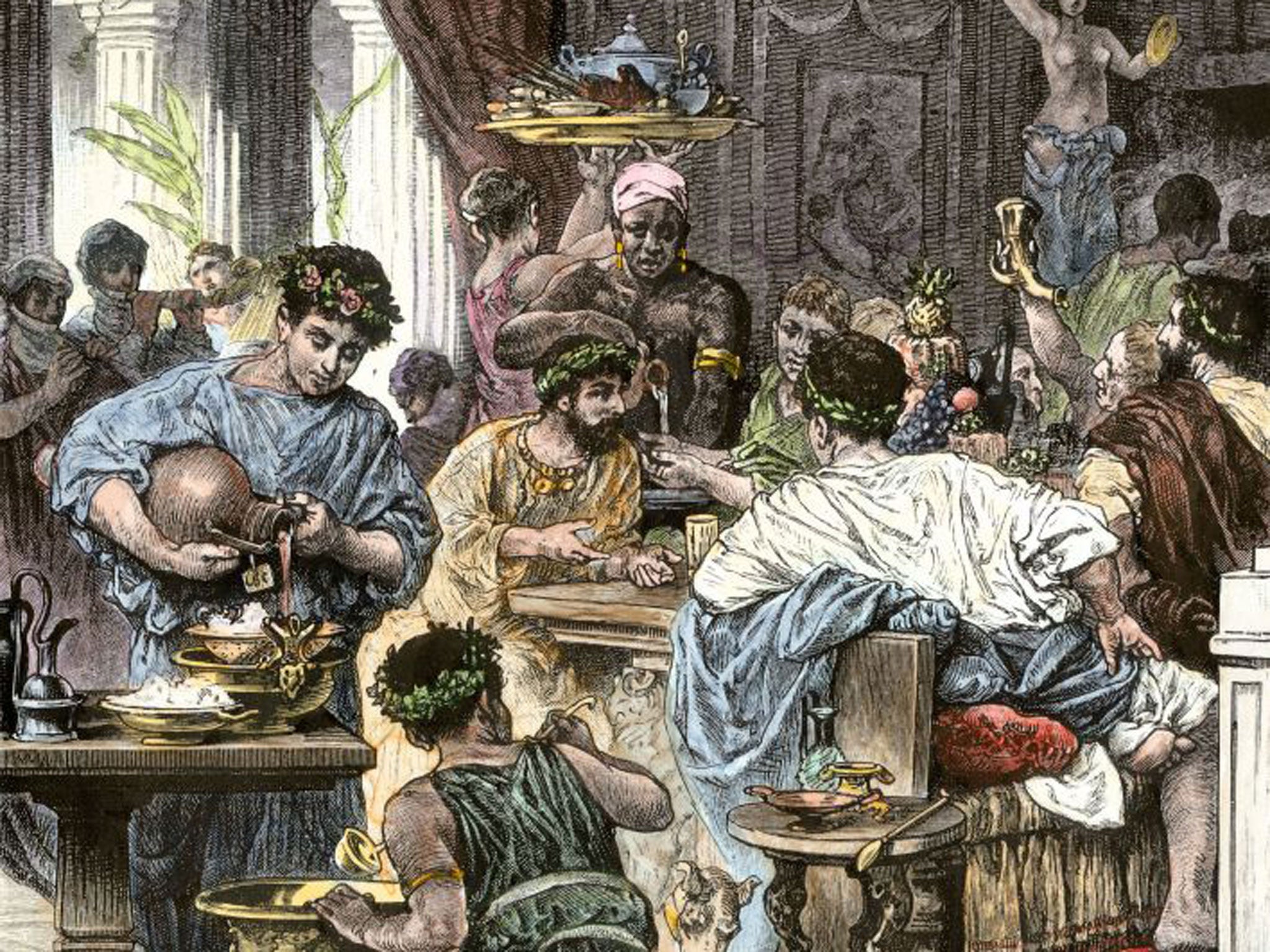
Excerpt from Chapter VII, a scene from Nero’s wild and drunken feast where Lygia was completely out of place.


The pulse beat oppressively in Lygia's hands and temples. A feeling seized her that she was flying into some abyss, and that Vinicius, who before had seemed so near and so trustworthy, instead of saving was drawing her toward it. And she felt sorry for him. She began again to dread the feast and him and herself. Some voice, like that of Pomponia, was calling yet in her soul, "O Lygia, save thyself!" But something told her also that it was too late; that the one whom such a flame had embraced as that which had embraced her, the one who had seen what was done at that feast and whose heart had beaten as hers had on hearing the words of Vinicius, the one through whom such a shiver had passed as had passed through her when he approached, was lost beyond recovery. She grew weak. It seemed at moments to her that she would faint, and then something terrible would happen. She knew that, under penalty of Cæsar's anger, it was not permitted any one to rise till Cæsar rose; but even were that not the case, she had not strength now to rise.


Meanwhile it was far to the end of the feast yet. Slaves brought new courses, and filled the goblets unceasingly with wine; before the table, on a platform open at one side, appeared two athletes to give the guests a spectacle of wrestling.


They began the struggle at once, and the powerful bodies, shining from olive oil, formed one mass; bones cracked in their iron arms, and from their set jaws came an ominous gritting of teeth. At moments was heard the quick, dull thump of their feet on the platform strewn with saffron; again they were motionless, silent, and it seemed to the spectators that they had before them a group chiselled out of stone. Roman eyes followed with delight the movement of tremendously exerted backs, thighs, and arms. But the struggle was not too prolonged; for Croton, a master, and the founder of a school of gladiators, did not pass in vain for the strongest man in the empire. His opponent began to breathe more and more quickly: next a rattle was heard in his throat; then his face grew blue; finally he threw blood from his mouth and fell.


A thunder of applause greeted the end of the struggle, and Croton, resting his foot on the breast of his opponent, crossed his gigantic arms on his breast, and cast the eyes of a victor around the hall.


Next appeared men who mimicked beasts and their voices, ball-players and buffoons. Only a few persons looked at them, however, since wine had darkened the eyes of the audience. The feast passed by degrees into a drunken revel and a dissolute orgy. The Syrian damsels, who appeared at first in the bacchic dance, mingled now with the guests. The music changed into a disordered and wild outburst of citharas, lutes, Armenian cymbals, Egyptian sistra, trumpets, and horns. As some of the guests wished to talk, they shouted at the musicians to disappear. The air, filled with the odor of flowers and the perfume of oils with which beautiful boys had sprinkled the feet of the guests during the feast, permeated with saffron and the exhalations of people, became stifling; lamps burned with a dim flame; the wreaths dropped sidewise on the heads of guests; faces grew pale and were covered with sweat. Vitelius rolled under the table. Nigidia, stripping herself to the waist, dropped her drunken childlike head on the breast of Lucan, who, drunk in like degree, fell to blowing the golden powder from her hair, and raising his eyes with immense delight. Vestinius, with the stubbornness of intoxication, repeated for the tenth time the answer of Mopsus to the sealed letter of the proconsul. Tullius, who reviled the gods, said, with a drawling voice broken by hiccoughs,—"If the spheros of Xenophanes is round, then consider, such a god might be pushed along before one with the foot, like a barrel."


But Domitius Afer, a hardened criminal and informer, was indignant at the discourse, and through indignation spilled Falernian over his whole tunic. He had always believed in the gods. People say that Rome will perish, and there are some even who contend that it is perishing already. And surely! But if that should come, it is because the youth are without faith, and without faith there can be no virtue. People have abandoned also the strict habits of former days, and it never occurs to them that Epicureans will not stand against barbarians. As for him, he—As for him, he was sorry that he had lived to such times, and that he must seek in pleasures a refuge against griefs which, if not met, would soon kill him.


When he had said this, he drew toward him a Syrian dancer, and kissed her neck and shoulders with his toothless mouth. Seeing this, the consul Memmius Regulus laughed, and, raising his bald head with wreath awry, exclaimed,—"Who says that Rome is perishing? What folly! I, a consul, know better. Videant consules! Thirty legions are guarding our pax romana!"


Here he put his fists to his temples and shouted, in a voice heard throughout the triclinium,—"Thirty legions! thirty legions! from Britain to the Parthian boundaries!" But he stopped on a sudden, and, putting a finger to his forehead, said,—"As I live, I think there are thirty-two." He rolled under the table, and began soon to send forth flamingo tongues, roast and chilled mushrooms, locusts in honey, fish, meat, and everything which he had eaten or drunk.


But the number of the legions guarding Roman peace did not pacify Domitius.


No, no! Rome must perish; for faith in the gods was lost, and so were strict habits! Rome must perish; and it was a pity, for still life was pleasant there. Cæsar was gracious, wine was good! Oh, what a pity!


Tuesday, February 20, 2024

Quo Vadis: A Narrative of the Time of Nero by Henryk Sienkiewicz, Part 1

The Catholic Thought book club read the novel Quo Vadis  by the Polish author and Nobel Prize in Literature winner Henryk Sienkiewicz.  It’s novel set in first century Rome—the 60s to be exact—under the Emperor Nero and of course the early Christians.  You may have seen one of several movies based on the novel, and, while I have not seen any of them, the novel must sure exceed them.  This is the first post of which there could be as many as eleven.  In this first post I’ll give an introduction, but in this and the other posts I will provide a chapter by chapter summary, any pertinent discussion from the book club, and one sample excerpt to give a flavor of the writing and story.  I found this to be an extraordinary novel, and well deserved as Sienkiewicz’s acclaim for Nobel Prize. 


Introduction:

As the subtitle implies us, “A Narrative of the Time of Nero,” Quo Vadis is a historical novel set in first century within the Roman Empire.  “Quo Vadis” translates to “Where are you going?” and was published in in Polish in 1896 by Henryk Sienkiewicz.  The story centers around a love interest between Marcus Vinicius, a Roman tribune and patrician, and therefore pagan, and Callina or sometimes called Lygia, a convert Christian and a daughter of a deceased barbarian king.  Like most historical novels there are a number of fictitious characters and characters taken out of the historical time.  Both the central characters are fictitious.  Also like most historical novels, there is a vast sweep of events and many characters.  You can read the major character list on the novel’s Wikipedia entry here: https://en.wikipedia.org/wiki/Quo_Vadis_(novel)  You will recognize the Emperor Nero, deranged and known for his narcissism and persecutor of Christians.  Of Nero we know he was emperor when the great fire of Rome occurred, and indeed some claimed he set or had the fire himself and then turned and blamed the Christians and followed up with a great persecution of Christians.  I expect this will be a scene in the novel.

The character list also includes the apostles Peter and Paul who were in Rome at the time of Nero’s persecution of the Christians.  I expect their martyrdom will also be dramatized.  If Quo Vadis employs other historical novel techniques, I expect there will be an alternating between Roman pagan scenes and Christian scenes culminating in some great climax between the two world views.  But I have not read any summary except of the love interest between the two central characters.

Henryk Sienkiewicz was born in Poland in 1846 to a noble but impoverished family.  The family still had a coat of arms.  He started as a travel writer, including spending time in the United States, and a journalist, and attempted several fiction efforts early on.  The shorter pieces were published but not the novels.  He finally published his first novel in 1880, a historical novel, and from 1883 to 1888 went on to write three novels which are known as The Trilogy, narrating the major events in Polish history. Sienkiewicz was of the persuasion that a work of art, especially a novel “should strengthen and ennoble life, rather than undermining and debasing it.”  One would expect that there is a strong moral element to his works and speak to the “good” in the transcendentals of goodness, truth, and beauty. 

Sienkiewicz published Quo Vadis in 1886 at the age of forty.  He went on to write a number of epic historical novels, but he seems best remembered for his The Trilogy and Quo Vadis.  His work was extremely popular in his day both in his native land and throughout Europe.  He received the Nobel Prize for his “epic works” in 1905 and lived until 1916 to the age of 70.  He has a lasting legacy in Poland and in many European countries.


###

Choosing a Translation:

I was reading up on the translations. There are basically two translations available. The Jerimiah Curtain translation of 1897 and the W. S. Kuniczak translation. Curtain goes so far back that he was a friend of President Theodore Roosevelt. I don't know when Kuniczak translated the work but he died in 2000, so much more recent. Both are supposed to be good translations but Curtain's language is supposed to be dated. Kuniczak I think was Polish himself, was also a novelist, and translated a number of Sienkiewicz's works. Kuniczak is probably the one to get, but I too got the Curtain translation. It was cheap! But despite the language it is supposed to be a faithful translation.  It has survived a long time.

###

Chapters 1 thru 6

Summary

We meet Petronius, an older aristocrat, awakening to the start of the novel, benumbed after having spent the previous night at one of Nero’s feasts.  After getting a message and a bath, his young nephew, Marcus Vinicius arrives, recently returned from Asia Minor and joins him in the bath.  They talk about their mutual travels and assignments, the recent politics, and common acquaintances.  They also talk about life and war and writing.  When Petronius casually mentions Aulus Plautius, Vinicius tells of having stayed at Aulus’s home when he dislocated his arm and was nursed by a most beautiful young slave named Lygia, with whom he had fallen in love.  Vinicius tells the story of how the Emperor Claudius in conquest of the Lygians had taken the girl, who was the Lygean King’s daughter as a political hostage and through several transactions wound up with Pomponia Graecina, the wife of Aulus Plautius, where Vinicius met her.  He expresses his desire to have Lygia and implores Petronius to get Aulus to give her to him.

The two set out to the house of Aulus Plautius.  On the way, Vinicius tells Petronius of his two meetings with Lygia.  They travel through the heart of Rome where the city comes to life with activity.  They stop at a book-shop, and Petronius purchases a book, Satyricon, and gifts it to Vinicius.  Petronius tells him he is the author, but it is a secret and to not tell anyone.  The two arrive at Aulus’s house and are let in.  Aulus was a general under the Emperor Claudius in the conquest of Britain, and the three men have a discussion.  They come to where his little child Aulus and Lygia are playing and then come to Plautius’s wife Pomponia in the garden.  Pomponia is dressed in black mourning.  When Lygia joins them, Vinicius quotes a love verse from Homer, and Lygia to everyone’s surprise knows and speaks the corresponding verse.  She runs off, but Vinicius follows and woos her and asks her to live with him in Sicily.  Meanwhile Petronius and Pomponia are discussing the gods when Pomponia tells him she only believes in one almighty God.

On the way home, Petronius pondered the philosophic implications of Pamponia’s one God.  He speaks of this to Vinicius but Vinicius is focused solely on Lygia.  He says he is completely captivated by her and must marry her.  Petronius tries to calm him, and finally tells him he has a plan that if it works she will wind up in Vinicius’ house.

That evening Petronius goes to have a confidential conversation with Nero.  In a few days a squad of praetorian soldiers headed by a centurion show up in Aulus’ house proclaiming that the emperor commands to take Lygia to his household since she is an offered hostage from the Lygian king.  The household is in tears.  All these years at the Aulus’ household, Lygia had become a daughter to Aulus and Pomponia.  But despite the heartbreak, tears, and anger, Lygia must go.  Lygia is consoled that she can take her retinue that came with her from Lygia, and who share her religion.  Aulus promises he will speak to the emperor to reverse this.

But Nero denies Aulus a visit, and so Aulus goes to Seneca for assistance.  Seneca laughs that he could have any sway over Nero, and that it might actually be counterproductive and Nero deny him in spite.  They come to the conclusion that Petronius had put up Nero to taking Lygia.  Aulus then goes to Vinicius’ home and tells him that Lygia has been taken away.  This enrages Vinicius because he had understood the plan to be that Petronius would have her sent to his house, not the emperor’s. 

Vinicius rushes to Petronius’s home in anger ready to exact violence.  He believes that Petronius has betrayed him to keep Lygia for himself.  Petronius stops him with his own strength but as Vinicius calms down, Petronius explains that this was part of his plan.  It required Lygia to spend some time at the Emperor’s home because Lygia is technically a political hostage, and therefore it required a justification to take her from Aulus.  In time Nero will authorizes her to go to Vinicius’ home.  Vinicius is mollified and asks for forgiveness.


###

Kerstin Commented:

Vinicius is besotted, no question about it. We normally don't get such unfiltered declarations of love. I find it quite amusing. Here is the young buck not knowing where his head stands!


Petronius is a seasoned courtier. He knows how precariously his life hangs in the balance given Nero's volatile temper. He has to outsmart him given Lygia's complicated status. He also has no compunction to let the ends justify the means.


Here is a description and graphics of how a Roman house looked like.

https://roman-empire.net/society/the-roman-house/


Years ago there was a traveling exhibit on Roman life here in Kansas City, and they had rebuilt an atrium with the pool in the middle, etc. It was fascinating

Galicius Comment:

I was rather impressed by how well-grounded Sienkiewicz seemed in the ancient Roman world; dare I say its “culture.” I looked for his sources on the topography and orientation. The Wikipedia information is impressive. I found additional information in Literatura Polska (Literatura Polska, #2) by Julian Krzyżanowski |(Encyclopedic Guide to Polish Literature, Vol. II N-Z) Goodreads which lists some sources Sienkiewicz used: Roman historians Tacitus (C. 56-c.120) and Suetonius (c. 69-c.122). He used 19th Century historians such a E. Renan’s “Antichrist” (1873, A. Giraud, “Flavieau ou de Rome desert” (1835), Ignacy Kraszewski, “Rzym za Nerona” (Rome During Nero” (1866) and Krasinski „Irydion”. The painter Henryk Siemiradzki was his friend. Sienkiewicz admired the painting shown on the Wikipedia page on “Quo Vadis.”


Sienkiewicz had the idea about the Lygians from W. Ketrzynski who thought that they were people living between the Oder and Vistula rivers. This was supported also by studies of K. Murawski.

My Reply to Galicius:

I am impressed too Galicius on how Sienkiewicz captures the Roman mind. I have read that he spent a lot of time learning the culture and psychology. I think he did a superb job!

My Comment:

So what is interesting is that I think Sienkiewicz is playing with Greco-Roman stoicism, and how Vinicius is the very opposite in contrast to Petronius and Aulus who hold to that model much better. Sienkiewicz goes out of his way to highlight Vinicius' over abundant emotion and lack of control. Vinicius is a total failure to hold up this Roman ideal. How this figures in the novel I don't think we've seen yet.

Joseph’s Reply:

There's certainly some play with Stoicism, but I think Sienkiewicz is setting up kind of a three-way thing. You have Vinicius who is ruled by his emotions and desires, Petronius who is so logical as to be coldly ruthless, and the as yet mysterious Christians Pomponia and Lygia. Pitted against these is the overwhelming figure of Nero and his unpredictability so we may see a deep dive into how each character reacts when the winds shift, as it were.

My Reply to Joseph:

I should correct myself. Above I said that Petronius was a stoic like Aulus. I think that is incorrect. He enjoys his life well but he does it with a certain moderation. As pointed out in the summary, Petronius is the actual author of the ancient Roman novel the Satyricon. I'm not sure why Sienkiewicz placed in such a prominent position the author of a Roman decadent satire, but there has to reason. Are the views of the Satyricon endowed to Petronius? I don't know. I have not read the Satyricon. Petronius however strikes me more of an Epicurean, one who enjoys life without the extremes of hedonism but are typically cynical and godless and amoral.

###

Excerpt from Chapter Two.  Petronius and Vinicius are walking through Rome to go to Aulus’s house.  Sienkiewicz marvelously captures the hustle and bustle of the Roman streets.


From the Vicus Apollinis they turned to the Boarium, and then entered the Forum Romanum, where on clear days, before sunset, crowds of idle people assembled to stroll among the columns, to tell and hear news, to see noted people borne past in litters, and finally to look in at the jewellery-shops, the book-shops, the arches where coin was changed, shops for silk, bronze, and all other articles with which the buildings covering that part of the market placed opposite the Capitol were filled.


One-half of the Forum, immediately under the rock of the Capitol, was buried already in shade; but the columns of the temples, placed higher, seemed golden in the sunshine and the blue. Those lying lower cast lengthened shadows on marble slabs. The place was so filled with columns everywhere that the eye was lost in them as in a forest.


Those buildings and columns seemed huddled together. They towered some above others, they stretched toward the right and the left, they climbed toward the height, and they clung to the wall of the Capitol, or some of them clung to others, like greater and smaller, thicker and thinner, white or gold colored tree-trunks, now blooming under architraves, flowers of the acanthus, now surrounded with Ionic corners, now finished with a simple Doric quadrangle. Above that forest gleamed colored triglyphs; from tympans stood forth the sculptured forms of gods; from the summits winged golden quadrigæ seemed ready to fly away through space into the blue dome, fixed serenely above that crowded place of temples. Through the middle of the market and along the edges of it flowed a river of people; crowds passed under the arches of the basilica of Julius Cæsar; crowds were sitting on the steps of Castor and Pollux, or walking around the temple of Vesta, resembling on that great marble background many-colored swarms of butterflies or beetles. Down immense steps, from the side of the temple on the Capitol dedicated to Jupiter Optimus Maximus, came new waves; at the rostra people listened to chance orators; in one place and another rose the shouts of hawkers selling fruit, wine, or water mixed with fig-juice; of tricksters; of venders of marvellous medicines; of soothsayers; of discoverers of hidden treasures; of interpreters of dreams. Here and there, in the tumult of conversations and cries, were mingled sounds of the Egyptian sistra, of the sambuké, or of Grecian flutes. Here and there the sick, the pious, or the afflicted were bearing offerings to the temples. In the midst of the people, on the stone flags, gathered flocks of doves, eager for the grain given them, and like movable many-colored and dark spots, now rising for a moment with a loud sound of wings, now dropping down again to places left vacant by people. From time to time the crowds opened before litters in which were visible the affected faces of women, or the heads of senators and knights, with features, as it were, rigid and exhausted from living. The many-tongued population repeated aloud their names, with the addition of some term of praise or ridicule. Among the unordered groups pushed from time to time, advancing with measured tread, parties of soldiers, or watchers, preserving order on the streets. Around about, the Greek language was heard as often as Latin.


Sunday, February 18, 2024

Sunday Meditation: Into the Desert with the Wild Beasts

We have entered Lent, and today is the First Sunday of Lent.  In all three year cycles, the First Sunday of Lent has Jesus enter the desert to be tempted by Satan.  Matthew’s and Luke’s versions of Jesus’s forty days of temptation similar in that they detail Satan’s forms of temptations.  In Mark’s version we have a general summary of temptations, but he offers two amazing details: Jesus lives among the wild beasts and that angels minister to Him. 


The Spirit drove Jesus out into the desert,

and he remained in the desert for forty days,

tempted by Satan.

He was among wild beasts,

and the angels ministered to him.


After John had been arrested,

Jesus came to Galilee proclaiming the gospel of God:

"This is the time of fulfillment.

The kingdom of God is at hand.

Repent, and believe in the gospel."

~Mk 1:12-15

It’s noteworthy to observe that Matthew’s version does include the detail of the angels ministering to Jesus but no wild beasts, and Luke has neither detail.  This week Fr. Geoffrey Plant has a fine homily that explains Lent, the forty days in the desert, Satan. the temptations in the desert and the association with the temptation of Adam and Eve, and the wild beasts which allude to the beasts in Isaiah.


Then the wolf shall be a guest of the lamb,

and the leopard shall lie down with the young goat;

The calf and the young lion shall browse together,

with a little child to guide them.

The cow and the bear shall graze,

together their young shall lie down;

the lion shall eat hay like the ox.

The baby shall play by the viper’s den,

and the child lay his hand on the adder’s lair.

They shall not harm or destroy on all my holy mountain;

for the earth shall be filled with knowledge of the LORD,

as water covers the sea.  (Isa 11:6-9)


Meditation: "He was among wild beasts, and the angels ministered to him.”

Seek out Bishop Barron’s homily on this week’s reading.  He’s got a different and perhaps more meditative understanding of the wild beasts and the angels.

Wednesday, February 14, 2024

Poetry: Part III of T.S. Eliot’s Ash Wednesday

In the past I have posted Part I and Part II of T.S. Eliot’s magnificent poem Ash Wednesday.  You can read the entire poem here.    

Today is Ash Wednesday, a day of penance, fasting, and meditation on one’s sins and mortality and the four last things: death, judgement, heaven, and hell.  

Eliot’s poem Ash Wednesday really captures this well.  The poem is comprised of six parts, and I’ve already gone through the first two.  Each year I’ll give you another part to meditate on on this solemn day.  Here is Part III.


III


At the first turning of the second stair

I turned and saw below

The same shape twisted on the banister

Under the vapour in the fetid air

Struggling with the devil of the stairs who wears

The deceitful face of hope and of despair.


At the second turning of the second stair

I left them twisting, turning below;

There were no more faces and the stair was dark,

Damp, jaggèd, like an old man's mouth drivelling, beyond repair,

Or the toothed gullet of an agèd shark.


At the first turning of the third stair

Was a slotted window bellied like the figs's fruit

And beyond the hawthorn blossom and a pasture scene

The broadbacked figure drest in blue and green

Enchanted the maytime with an antique flute.

Blown hair is sweet, brown hair over the mouth blown,

Lilac and brown hair;

Distraction, music of the flute, stops and steps of the mind

over the third stair,

Fading, fading; strength beyond hope and despair

Climbing the third stair.


Lord, I am not worthy

Lord, I am not worthy


              but speak the word only.

In Part III the narrator is climbing a spiral staircase and at each of the first three turns he looks down.  Is the climbing of the stairwell an allusion to a journey through life to salvation?  Or is it a journey through Purgatory as a purgative journey to heaven?  Or something else?  I don’t really know.  My intuition leads me to think he is climbing the Purgatorial Mountain akin to Dante’s Purgatorio in the Divine Comedy.  Dante Purgatorial Mountain requires also spiral climb.  But there are no devils in Purgatory, neither in Dante’s Purgatory or in the Catholic doctrine of Purgatory.  Could Eliot have been mistaken or is he suggesting one of the other possibilities?

Nonetheless, go the Church and receive your ashes.  Make time to go before the Blessed Sacrament and meditate on your life and death and your journey hopefully to God.


Sunday, February 11, 2024

Sunday Meditation: Touching the Leper

This Sunday we complete the first chapter of Mark’s Gospel.  Last week Jesus completed His first day of ministry as presented in Mark, and it was a long day of healings.  Then we saw Him seclude Himself on a mountain to pray and, when the apostles found Him, He led them to new towns to preach.  In today’s Gospel reading, in a new town Jesus comes across a leper. 


A leper came to Jesus and kneeling down begged him and said,

“If you wish, you can make me clean.”

Moved with pity, he stretched out his hand,

touched him, and said to him,

“I do will it. Be made clean.”

The leprosy left him immediately, and he was made clean.

Then, warning him sternly, he dismissed him at once.


He said to him, “See that you tell no one anything,

but go, show yourself to the priest

and offer for your cleansing what Moses prescribed;

that will be proof for them.”


The man went away and began to publicize the whole matter.

He spread the report abroad

so that it was impossible for Jesus to enter a town openly.

He remained outside in deserted places,

and people kept coming to him from everywhere.

~Mk 1:40-45

These healings are not just miracles.  They are symbolic for absolving of sin, and if the healing is analogous to the absolution, then the illness is analogous of a sin.  Bishop Barron presents a wonderful homily explaining it.


“If you wish, you can make me clean,” the leper says.  What is he doing?  He is supplicating himself, supplicating himself in faith.  Supplicating faith.  How do you say that in, Latin fiducia supplicans?  Yes, I believe so.  As Bishop Barron asks, “who are the lepers of today’s society?”


Meditation: "Moved with pity, He stretched out his hand, touched him.”