"Love follows knowledge."
"Beauty above all beauty!"
– St. Catherine of Siena

Monday, April 22, 2019

Matthew Monday: Easter Sunday Alleluia

Another Easter come and gone.  Yesterday at Mass as part of the children’s choir, Matthew was asked to do the Alleluia.  The Alleluia has one of the few solos for choir at Mass, so he was excited.  Others might get nervous, but he was eager.  And he was so proud, so for a change he made sure he was spiffily dressed.  My wife got him a tie, a real tie, not a clip on, and he had me tie the knot and I slipped it over his head.  He had a new belt and dress shirt and he had his mother put on hair spray to keep his hair perfect.  First, here’s a picture of him before Mass.


Second, the altar was beautifully decorated for Easter.  Here are a couple of pictures.  First the entire altar.


And a close up of the left side lectern with the statue of the Risen Christ placed near it.  That was specially brought up for Easter.


Finally here’s Matthew with his Celtic Alleluia. 


That man in the video in the green shirt told me after Mass how wonderful Matthew does the Alleluia.  He really does.  

Friday, April 19, 2019

Faith Filled Friday: The Way of the Cross over the Brooklyn Bridge

Today, arguably the holiest day of the year, as my custom now for the last five years, I participated in the annual Way of the Cross over the Brooklyn Bridge. It’s a sort of mini Stations of the Cross procession, we only do five stations, but the distanced walked is about two and three quarter miles.  It starts in Brooklyn at the St. James Cathedral-Basilica, and then the pilgrimage ensues by crossing over the Brooklyn Bridge, stops at Manhattan’s City Hall, stops at the World Trade Center, and concludes at lower Manhattan’s St. Peter’s Church.  It’s organized by local chapter of the Communion and Liberation Movement, which is a Catholic religious organization of religious and lay members.  Fr. Richard Veras seems to be the primary coordinator, though I don’t know if that is his role.  Fr. Veras was the pastor at my parish, St. Rita’s on Staten Island, for a number of years but has moved on.  He has published a number of books and is a monthly contributor to Magnificat magazine.

The form of the events has not changed in the five years.  I detailed them in my 2014 entry, which you can read here.    


I didn’t take a lot of pictures this year.  It was overcast.  But here’s one picture of the procession ahead of me on the Brooklyn Bridge. 


You can see how far long pilgrimage of people ahead of me, and I was toward the front.  The local news lists us in the hundreds, but it seems more to my non-expert eye.

I was able to film one of the pieces sung by the wonderful—and I do mean wonderful with no exaggeration—Communion and Liberation choir.  At the St. James Cathedral, they sing “Go to Dark Gethsemane.”  Let me preface, for some reason my camera just would not focus on the choir.  The video is blurred but I did capture the singing.


We passed a little garden as you come off the Brooklyn Bridge on the Manhattan side and the tulips were in bloom. 


And of course we passed the new Liberty Tower at the World Trade Center.  I don’t know what that weird sculpture is out in front, but who understands modern art?


Finally we made the news.  Here’s a video clip.


I hope you had a blessed Good Friday.  

Tuesday, April 16, 2019

Comments to Dante’s Paradiso, Cantos XV thru XVIII

Throughout what must be hundreds of characters that appear in La Commedia, Dante (the author) never brings in a single family member nor does he mention any, all except for one.  He doesn’t mention his wife nor any of his three children.  We never hear of a father or mother or siblings.  We hear of many father figures, men who in some respect “fathered” Dante.  The work of literature Dante most revered, Virgil’s Aeneid, had at its heart a trip to the underworld by the protagonist, Aeneas, to locate his father Anchises, to ask for some key advice about his future.  Here in this epic of a journey through the underworld, Dante (the author) never has Dante (the character) seek or encounter his father.  The theme of fatherhood being so important in the work, in lieu of encountering and speaking to his father, Dante has Dante encounter his great great-grandfather, Cacciaguida degli Elisei right in center of his third cantica, Paradiso.

Dante (the author) makes it quite clear that Cacciaguida is almost a parallel character to Anchises.  At the moment when Cacciaguida steps up to great his descendant, an allusion is made to the affectionate greeting Anchises gives Aeneas. 

With such affection did Anchises' shade reach out,
if our greatest muse is owed belief,
when in Elysium he knew his son. (XV. 25-27)

And so Cacciaguida greets Dante with much fatherly love.  Indeed, he greets him with pride.  He speaks in Latin, the only Latin tercet in the entire poem.  The Latin connects to Virgil’s work, and to an ancestry that goes back to the Roman Empire.  He says, “O blood of mine, O grace of God, poured down from above, to whom, as to you, have the gates of heaven ever been opened twice?”  He is proud that his blood descendent has been chosen by God to be the only person to ever enter heaven twice.  The pride blossoms just before he finally introduces himself: “O bough of my tree, in who I have rejoiced/even in expectation, I was your root.” (88-89). 

I don’t know what, if any is the significance of Cacciaguida’s name—and for some reason I have never seen any commentary on it—but Cacciaguida literally translates into “hunting guide.”  Perhaps it’s just the real name of his great great-grandfather, and so it doesn’t carry any significance.  But it is just too convenient and smacks of suggestion.  However, I can’t come up with any allusion or significance.  It’s a great name, having a sort of reverence and dignity, a sort of Hemingway-esk patriarch.  A masculine name.

That his character spans from Canto XV through the first half of XVIII, three and a half cantos, certainly suggests significance.  Also he gives his key advice right at the center of Paradiso, Canto XVII having sixteen cantos before it and sixteen cantos after it.  It is in Canto XVII, the exact center, that Cacciaguida tells of Dante’s fate in exile.  He is under the sphere of Mars, the fifth of the ten spheres of heaven.  Virgil has Aeneas meet with Anchises in the sixth of twelve books of the Aeneid, also exactly mid-way.  Having your protagonist meet with a lost father at the center of the structure to seek out wisdom is a powerful story element.  It is akin to a hero climbing a mountain or wandering through a desert to seek wisdom from some venerable sage who will set him on the right path.  When that sage happens to be your father, then all sorts of family dynamics and ancestry are intermingled. 

Cacciaguida says that he has read into The Book of Life and learned of his descendant’s history and knows his fate. 

And he went on: 'That long and welcome craving,
derived from reading in the massive book
where neither black nor white is ever altered,

'you have satisfied, my son, within this light
from which I speak to you by grace of her
who dressed you out in wings for this high flight. (XV.49-54)

By parsing through the various details of Cacciaguida’s monologue, we can piece together that he was born in 1090 in Florence, baptized in the Baptistery od San Giavanni, belonged to one of the oldest of Florentine families which traced its roots to Roman times, was knighted by the Emperor as he joined the Second Crusade, and was killed in action on crusade at the age of 57 in the year of 1147 trying to retake the Holy Land.  Since the Divine Comedy is set in the year 1300, Cacciaguida has been dead for 153 years, some six generations.

A poignant moment in the encounter is when Dante calls Cacciaguida his father.

I began: 'You are my father,
You prompt me to speak with bold assurance.
You raise me up, so I am more than I.

'My mind is flooded by such rivers of delight
that it exults it has not burst
with so much happiness and joy. (XVI.16-21)

Dante goes on to ask about his ancestors.  It is interesting that though Cacciaguida alludes to his noble ancestry, he refuses to answer Dante’s question on who his ancestors were (XVI.43). Why?  I’m not sure.  Perhaps it was just structural.  This would have been tangential and perhaps even a digression, and Dante (the author) didn’t have the space to dwell on it.  The suggestion was enough.

But he directly calls him  “his father” with such affection and joy, a burst of emotion that in human relationship is unparalleled.  My father has been deceased now for over twelve years.  What I would give to meet with him again.

Indeed, Cacciaguida is the culmination of the father theme that has run throughout the Commedia.  He speaks in three tongues, Latin (XV.28-30), a tongue Dante (the character) could not understand (XV.38-39), which could be a proto-Italian, and finally ”not in this our modern tongue” (XVI.33), which would suggest an earlier dialect.  So from Latin to early Italian, Cacciaguida spans over a thousand years of language evolution.  Dante (the author) who is so conscious of writing his poem in the colloquial language, has Cacciaguida encapsulate Italian’s etymology.  In effect his language is the great-grandfather of Italian.

Hollander cites that throughout the Divine Comedy, Dante directly refers to seven beings as “father”:  Virgil, God the Father, Cacciaguida here, St. Benedict, St. Peter, Adam, and St. Bernard.  The last four we encounter further into heaven, and so we get a sense of a journey to one’s father.  In addition to the direct addresses as fathers, Dante refers to five other beings as fathers: Brunetto Latini, Cato, the old Roman stoic, Guido Guinizzelli, St. Francis of Assisi, and the Sun.  Twelve fathers in all, a number which has much significance, one being the number of Jesus’ disciples.  Virgil and Guinizzelli are his poetic fathers, Latini his father in scholarship and learning, Cato his father in being a citizen, St. Francis for being his Franciscan father (Dante being a Lay Franciscan), the other saints for being his spiritual fathers, Adam for being his father in humanity, God for being the ultimate Father, and the Sun as analogous for God.

The search for one’s father is the search for identity, and Dante will find it in Cacciaguida.


###

So why doesn’t Dante (the author) have Dante (the character) meet his father in paradise instead of his great great-grandfather?  Well, the obvious answer would be that his father didn’t die in a crusade, and so wouldn’t fit the sphere of Mars.  But it’s more than that.  We don’t know of any rancor that may have occurred between Dante and his father that might have prevented Dante from including him in his cast.  But Dante is definitive in not including any of his immediate family anywhere in the Commedia.  The character of Cacciaguida, going back over 150 years, provided Dante (the author) with a number of advantages.  First he can create the character as he wishes, since no one knows what he was like.  Second, he’s free of any family dynamics, though I can’t see Dante really being worried of that.  Third, and most important—if not the single most important reason—Cacciaguida’s distance in history allows for a summation of Florence’s degeneration from an ideal past.

It is worthwhile to look at the transitions in the three and a half cantos with Cacciaguida.  (1) We meet Cacciaguida (Canto XV.25-87), (2) Cacciaguida speaks on the virtues of old Florence (XV.88-129), (3) Cacciaguida reveals his history (XV.130-148), (4) Cacciaguida speaks on the evolution of Florence through the great families (Canto XVI), (5) Cacciaguida foretells Dante’s future (Canto XVII), and (6) Cacciaguida catalogues the blessed under the sphere of Mars (XVIII.1-57).  Cacciaguida’s life from six generations back becomes an indictment against the mores of Dante’s day, the civil strife of Dante’s day, against Dante’s enemies who exiled him, and, as we see, against his comrades who were exiled along with him but ultimately abandoned him. 

In Cacciaguida’s character, we see the ideal citizen.  Obviously he is devout, noble, and patriotic.  When the need for the crusade comes up, he accepts at a fairly advanced age the Emperor’s request for recruits and leaves his beloved city and family to fight for the retaking of the Holy Land.  He provides a list of the great and honorable families of his day, and speaks on their virtues.  He shows how over time these virtues eroded, and how the influx of neighboring cities diluted the virtues of old Florence, both through the women who became obsessed with vanity and men who became obsessed with wealth.  He shows how citizens became more loyal to their political parties than to Florence herself, and how factionalism eroded the public good.

Cacciaguida’s discourse is one of the great conservative diatribes in all of literature.  Progressives place some sort of ideal in a utopian future; conservatives place the ideal in the past and rant about the decay in the present.  It doesn’t mean one is more correct than the other; it’s a matter of view.  Cacciaguida expresses a conservative’s appeal to the state of Florence in the day of his great great-grandchild.  And in turn, since Cacciaguida is really the mouthpiece of the author here, Dante is one of the great conservative writers in history.

By bringing in Conrad II, the Holy Roman Emperor, through Cacciaguida’s life, we see what a good and proper role of an Emperor was supposed to be like, and in reflection we see the good and proper role of the city-states, and by suggestion the good and proper role of the Pope.  The Holy Father identifies the religious crises of pilgrims denied a visit to the holy sites; the emperor coordinates the martial means to right the injustice; the citizens of the city-states volunteer with knightly honor to support the call to arms.  This harmonious social constitution counterpoints the social discord of Dante’s day.

Cacciaguida identifies the roots of the social discord in the murder of Buondelmonte in 1216and it has the sense of a mythic story akin to the apple of discord that was supposed to have started the Trojan War.  Buondelmonte dishonors his betrothed lady by running off with another woman.  The family of the insulted lady take revenge and murder Buondelmonte.  A feud develops, which spills over into the political parties, and the die is cast for not just factionalism, which had begun to form anyway, but for factionalism where disputes are settled through violence.

Placing the situation into history, we see how the feud between the Guelphs and the Ghibelline parties is settled through the violent expulsion of the Ghibellines.  The then dominating Guelphs shortly divide into the Black and White parties, and ultimately leads to the violent exile of the Whites of which Dante is a leader.  Dante will be exiled in 1302.  He starts to write the Commedia in 1308 but sets the date of the story back in time to 1300, two years before he is exiled.  He completes the work just short of his death in 1321, so even as he edits the work in his late years he has been in exile from his beloved Florence for nearly twenty years.

We have gotten tidbits of his exile to come throughout the Divine Comedy, but it is here with Cacciaguida that it is confirmed and explained.  Cacciaguida’s foretelling of events brings this thread in the story to a climax and conclusion.  The foretelling of Dante’s future occurs in Canto XVII, the exact center of Paradiso. 

There are some great lines from Cacciaguida’s foretelling of Dante’s future.  Lines 52 through 69 deserve explication.

The populace shall blame the injured party,
as it always does, but vengeance
shall bear witness to the Truth that metes it out.

'You shall leave behind all you most dearly love,
and that shall be the arrow
first loosed from exile's bow.

'You shall learn how salt is the taste
of another man's bread and how hard is the way,
going down and then up another man's stairs. (XVII.52-60)

The general population will blame him, but vengeance will be obtained through the “Truth,” and the capitalization implies a divine justice.  Leaving behind all he most dearly loves (his city, his honor, his property, and his family) will be the first arrow to be shot.  And then the great and memorable tercet, “'You shall learn how salt is the taste/of another man's bread and how hard is the way,/going down and then up another man's stairs.”  He will have to live in poverty in another man’s house and eat another man’s bread.  The synesthesia—providing an analogy through a sensation—of salty bread is magnificent.  Salt can make food so tasty, but if overdone can make it bitter.  Hollander also points out the salt can be a result of tears.  Cacciaguida continues:

'But the heaviest burden your shoulders must bear
shall be the companions, wicked and witless,
among whom you shall fall in your descent.

'They, utterly ungrateful, mad, and faithless,
shall turn against you. But soon enough they, not you,
shall feel their faces blushing past their brows.

'Of their brutish state the results
shall offer proof. And it shall bring you honor
to have made a single party of yourself alone. (XVII.61-69)

His “wicked and witless” companions will be ungrateful and turn against Dante.  But ultimately the honor will be his alone because Dante in the end will be a party of one.  That phrase, “party of one” has been used often since it was written. 


Finally Cacciaguida will devote some time to predicting the good fortune and future heroics of Cangrande della Scala, a nobleman from Verona, who would become Dante’s patron while in exile.  In 1300, Cangrande would only have been nine years old, so this is purely a foretelling.  Cangrande apparently was a brave warrior and conquered a number of northern city-states.  I don’t know if Cangrande’s conquests had a religious element to it, but it is fitting that they he is featured in the sphere of Mars.  Dante (the author) in gratitude for the patronage immortalizes Cangrande (which by the way translates into “big dog”) with this passage.


Sunday, April 14, 2019

Dante's Paradiso Cantos XV - XVIII, Summary

Canto XV

At the sphere of Mars, Dante tells us that God has silenced heaven’s music.  He sees what seems to be a shooting star fly off the cross and fall toward Dante.  The shooting star settles in front of Dante, now appearing like a gem, speaks in Latin: “O blood of mine, O grace of God, poured down from above, to whom, as to you, have the gates of heaven ever been opened twice?”  In total joy, the spirit with ardent love blesses God for showing such favor to his descendent.  The spirit has read in the Book of Life of Dante’s salvation and has been with anticipation waiting for him.  He encourages Dante to speak and ask who he is.  Finally Dante does so, referring to him as a “living topaz.”  The spirit identifies himself as the father of Dante’s great-grandfather.  He tells Dante that he lived in a time when Florence was a simpler place, a humbler place, a more virtuous place.  The light rants against the mores and luxuries of Dante’s day, and identifies exemplar citizens of his day.  Citizens were not exiled then as now, and parents were dutiful to their children, instructing them of their origins.  When he was alive, Florence was peaceful, fair, sweet, and its citizens were patriotic and devout.  Finally he gives his name as Cacciaguida.  His wife came from the Po valley and was the source of Dante’s last name.  He was knighted by the Emperor Conrad and went on a crusade to retake the Holy Land, and it was there that he was martyred. 

Canto XVI

Dante (the author) opens with a short digression on the insignificance of noble blood.  He respectfully and joyfully  addresses Cacciaguida, calling him his father.  Dante asks him four questions: who were his ancestors, what was it like in Florence in his day, how many people lived there, and who were the noteworthy people of his day?  Being given these questions, Cacciaguida glows with delight.  Indirectly he says he was born in 1091 when Florence was about a third the size and with a fifth of the population.  But all those that lived there were fit to bear arms and yet still humble artisans.  He refuses to name his ancestry out of modesty and says the town was better with its smaller borders.  It would have kept the grifters out from the nearby towns.  The intermingling between the towns has resulted in an increased population, and that ever since has been the source of the city’s ills.  Cacciaguida goes on to catalogue the great Florentine families and their declines.  He tells Dante that from Dante’s perspective he cannot see the degeneration because one’s life is so brief.  Cacciaguida goes on to directly or indirectly identify some forty families, giving some little tidbit about each.  He ends his discourse with the death of Buondelmonte who abandoned one betrothed for another only to be murdered by the kinsman of the jilted lady at the foot of the statue of Mars.  This is in Cacciaguida’s view, the start of the feuding families and the political strife that has sunk Florence into infighting.  And Cacciaguida concludes that he was there when Florence was a glorious and tranquil place, never fighting between themselves.

Canto XVII

Still at Mars, Dante (the character) with Beatrice’s encouragement wishes to know more about the prophesies he’s heard while traveling through hell and purgatory.  These prophesies, Dante says, were grave, and he would like to prepare himself to face these afflictions.  With plain and clear speech, Cacciaguida with paternal love tells Dante his future.  Looking through God’s sight, Cacciaguida has seen a vision of things in store for Dante.  He has seen that Dante will be forced to flee from Florence in unjust exile and indicates that behind the treachery will be the corrupt Pope.  The city will turn on Dante but ultimately he will get vengeance.  Cacciaguida tells him that everything he holds dear will be left behind, and that he will taste the bitterness of eating another man’s bread.  And the most bitter burden of all will be the abandonment of his supposed friends, so Dante will be left as a party of one.  But a noble Lombard will give him much assistance and support.  This noble Lombard, Cacciaguida foretells, will earn such honor that even his enemies will have to acknowledge his greatness.  Trust him, Cacciaguida finally advises.  He concludes once again that Dante will be vindicated.  Dante responds that he will need to prepare for such a blow and asks his forefather if he thinks it’s wise to tell his tale with absolute truth.  Cacciaguida says to tell the bitter truth no matter who it hurts, and if there are some that don’t like it, then they can go scratch.  Ultimately it will do them good and Dante will gain the highest honors.

Canto XVIII


Still at Mars, while Cacciaguida and Dante ponder what has been said, Beatrice breaks the dour spell with a command to change their thoughts.  She reminds them that God lifts all burdens and that they are in heaven.  When Dante gazes into her beauty, he feels a release and the pull of eternal beauty.  Dante then realizes that his forefather wants to add something else.  He wants to name some of the souls that are on the cross.  He will go one to name eight, each a fitting soldier for the realm of Mars.  With each name a shooting star flies off the cross and propels toward Dante.  But in an instant, Dante finds that he and Beatrice have been transported to Jupiter.  Lights that appear to be birds fly about, singing and morphing into shapes of letters.  The first three letters are in the shape of “D,” “I,” and “L.”  Thirty-five letters fly around, spelling out in Latin the opening sentence from the Book of Wisdom: “Love justice you who love the earth.”  The birds settle all on the last letter, “M,”  and then scatter with a thousand other lights and when all the lights finally settle, they form a pattern of a head and neck of an eagle.  Dante (the author) goes into several digressions: the beauty of the pattern, the source of heavenly justice, and the corruption of papal justice. 


Monday, April 8, 2019

Matthew Monday: I Found My Four Leaf Clover


For St. Patrick’s Day, Matthew’s class had to write a short story for a fourth grade writing assignment.  I thought it was cute and worth sharing.  It’s titled “I Found My Four Leaf Clover,” and this would be the first short story Matthew will have ever written.


Hi, my name is Matthew.  I live in New York.  I have to tell you a story.  It’s about me finding a four leaf clover.  It was just an ordinary day when I was playing at the park with my dad.  The ball went on the grass and I saw the four leaf clover.  Then I showed him and then luck started to happen.

After I got back from the park, I was tired, so I went on my mom’s computer, and I had so much luck in the game.  It was amazing, and my dad bought lottery tickets.  We won the lottery.  Then I screamed “we’re rich.”  All the money was 80 billion dollars.  I was so happy.  I also got ten kittens.  I played with them so much.  They were so cute.  Then it was almost three o’clock during the day and I had so much luck.  I also got some cool baseball cards.  I got a super rare card.

Then the day was almost over and we ordered pizza, and it was so yummy.  I had four pieces of pizza.  It was delicious.  Then around nine o’clock I was about to go to bed.  My mom said I can stay up to ten o’clock.  That was fun.  I hope you have a happy St. Patrick’s Day.  I also hope you liked my story.

I think if we won $80 billion we would have more than pizza for dinner.  And I tell you what, Matthew my boy, if we won that much I’d let you stay up to eleven o’clock. 

Saturday, April 6, 2019

Comments to Dante’s Paradiso, Cantos X thru XIV

The sphere of the sun is so rich; there is so much I could discuss.  First of all it's a dividing line in the organization of paradise.  Dante makes it clear with a sort of new preamble.  Those inward from the sphere of sun (that is the moon, Mercury, Venus) contain souls who had some sort of limitation from full completeness.  At the sun and then beyond, all souls are complete, and so there is actually no hierarchy, just diversity.  Is there a hierarchy for those inward from the sun?  It's not spelled out but the further one gets away from the earth, the less distinct the souls features become.  Dante (the character) can almost make out Piccarda's features at the moon.  Less so for those at Mercury and even less at Venus.  Once he reaches the sun, the souls are just pure light.  That would suggest some sort of hierarchy.

But if you think of it this way, the light emanating from the sun is so intense that it obliterates all detail of feature, and the further away from the sun the more detail is possible.  The moon is the furthest away, so Dante (the character) can almost make out Piccarda's features.  So perhaps there isn't a hierarchy, distance from the sun.  That would make a two part hierarchy, those before the sun and those from the sun and after.  I'm not sure which of these two possibilities Dante is suggesting.

Also, the sunlight causes shadows, and, though we don't have any mention of shadows, there is a metaphoric shadow, the limitations on the souls in from the sun.  But this only works in one direction, toward the earth.  We can see the souls at the moon, Mercury, and Venus as casting a shadow, their limitation.  Behind the sun is the same intense light as at the sun.  Shadows are obliterated.

So at the sun, we have a major division, and it's noteworthy that it's in the tenth canto.  In Inferno, Dante entered the City of Dis at the tenth canto.  In Purgatorio, Dante entered purgatory proper at that tenth canto.  All three cantica have a divisional transition at the tenth canto.  I have said how integrated is the Divine Comedy.  Here is another example.

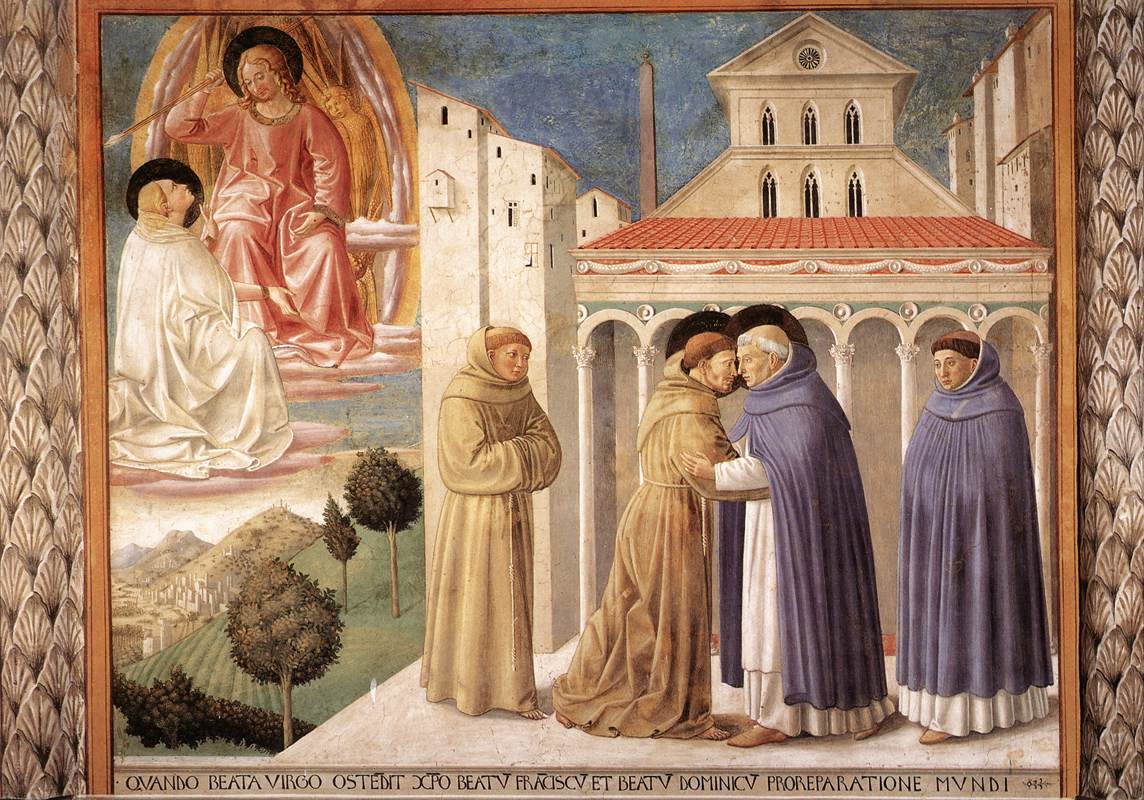
At the sphere of the sun, there are five prominent characters not including Dante and Beatrice.  There is St. Thomas Aquinas, St. Bonaventure, Solomon, and though they are only described, St. Francis of Assisi and St. Dominic de Guzman, both founders of respective orders and perhaps the preeminent saints of the middle ages.  The sphere of the sun are for the souls who were paragons of wisdom, either through learning-as seen with the souls in the first garland-or through mysticism-as seen with those in the second garland. 

St. Thomas is the principal representative of the sphere of the sun, and we know of his great effort at absorbing all knowledge into his Summa Theologica.  Hollander points out a fascinating parallel, the very first word that Thomas speaks is "Quando," and it's placed as the last word of a line.  Back in Inferno, the character whose very first word was also "Quando" and also oddly placed as the last word of a line was Ulysses (see Inf.XXVI.90).  Did I mention how incredibly integrated is La Commedia?  Indeed, both characters were people who strove for total knowledge, knowledge of all things in the universe.  They are two characters of same coin. 

But while Ulysses strove only for his own prideful self, Thomas accumulated knowledge to preach the divine Word.  He strove for no personal honors, and so notice his humility when he speaks.  He calls himself a "lamb" when we know he was nicknamed an ox.  When he goes through his catalogue of saints in the first garland, he puts himself second.  He gives deference to his "brother and teacher" Albert the Great and to the founder of his order, St. Dominic.  He doesn't say that he is the greatest of the lights at the sun, but another, Solomon. 

Thomas the Dominican goes on to delineate the virtues of St. Francis of Assisi.  Thomas's central point of St. Francis is that he was the lover of Lady Poverty, and the personification is significant.  Indeed, at one point it sounds like almost a sexual union, "he joined himself to her" (XI.62).  When Francis marries Lady Poverty, she is a widow, her first husband being Jesus Christ.  In embracing Lady Poverty like a bride, Francis has restored virtue to a church that had become too worldly.

As a complement to Thomas, St. Bonaventure, the Franciscan, goes on to laud the virtues of St. Dominic.  St. Dominic is portrayed as taking Lady Faith as his love and bride, and, as a knight fighting for his lady fair, combats the heresies that taint the virtue of Lady Faith.  He too seems joined in sexual union ("amorous lover of the Christian faith") with his lady.  By embracing Lady Faith, Dominic has restored has restored truth to the church, traveling "through the vineyard/which quickly withers if the keeper is corrupt" (l. 86-87).  The other controlling metaphor in describing Dominic is that of a paladin. 

'Then, both with learning and with zeal,
secure in apostolic office, he went forth,
like a torrent gushing from its lofty source,

'and fell upon the tangled weeds of heresy,
attacking with his overwhelming force
wherever the resistance was most stubborn. (XII.97-102)

Hollander points out, and I agree, that Dante (the author) goes overboard with this imagery of militarism.  He says that St. Dominic was "gentle to his own and savage to his foes" (l.57).  Unfortunately the average person knows a lot less about St. Dominic than St. Francis.  St. Dominic was a gentle soul, hardly savage.  One of the first stories about St. Dominic is how he converted an innkeeper.  The innkeeper followed the Albigensian heresy, and when St. Dominic found out stayed up all night conversing with the man, and by the break of morning, the Innkeeper had converted to doctrinal faith.  It has been said Dominic "befriended" an order, meaning his order grew by his ability to embrace people in friendship.  There was no sense of fighting in anything he did that I know of.  Either Dante was under a wrong impression or he takes his metaphor too far.

This crisscrossing of Dominican praising a Franciscan and a Franciscan praising a Dominican is a wonderful touch.  It was said that at this time the two orders were rivals and some bad blood had developed between the two.  I don't know if that is true, but it sounds correct.  Dante (the author) ends each of the two discourses on the two founding saints in a similar way.  The Dominican, who has been praising Francis, points out how untrue the Dominicans of today (Dante's day) have become.  And the Franciscan, who has been praising Dominic, speaks of how the Franciscans of the day have lapsed from the rule.  Dante (the author) as his custom throughout the Commedia highlights a degeneration from an ideal height to his day.  If the two orders were quarreling, neither could claim the moral high ground.

It should be pointed out that Dante (the author) was a Lay Franciscan but one who was a great admirer of St. Thomas Aquinas.  Indeed, the whole Divine Comedy owes so much to Thomistic thought.  Obviously he had read much of St. Thomas' work.  He places St. Thomas as the central character under the sphere of the sun, and though St. Thomas says that Solomon is the brightest light, we can see that Thomas is the pinnacle of the sphere.

The two garlands of saints is such a wonderful image.  It suggests a laurel wreath placed on a hero's head.  The twelve blessed in each ring suggest the twelve apostles.  The two wreaths heighten a couplet imagery than runs in this section: Thomas and Bonaventure, Francis and Dominic, learning and mysticism, spirit and flesh.  The couplets could all fit the metaphor of two wheels of a single chariot (XII.106), the chariot being the Church.  At the end, shattering the duality that has prevailed, Dante (the author) brings in a third set of lights. 

And just as, at the approach of evening,
new lights begin to show throughout the sky,
so faint they seem both real and yet unreal,

it seemed to me that I began to see
new subsistences there that formed a ring
beyond the other two circumferences.

Ah, true incandescence of the Holy Breath!
How suddenly its glowing shone before me,
so bright my eyes could not endure it! (XIV.70-78)

The third ring is analogized as being formed like the Holy Spirit is formed, that is as a function of the love between the Father and the Son.  The wreaths are now a Trinity!  But who would reside in the third wreath?  Hollander provides a couple of theories but there is nothing conclusive.  I personally like the thought that Christ's twelve apostles reside in that third ring.

###

Some random thoughts on these cantos.

A motif that’s been running through the entire Paradiso is that of the souls dancing.  I think it’s been noted at every sphere so far.  We see here at the opening of Canto XII when the second wreath approaches the first and “matches it motion for motion and song for song” (l.6)  But what is the nature of this dance?  I think we get more detail further down:

When the dance and all the other celebration --
the singing and the brilliant blaze of flames,
light with light blent in ardent joy –

came to a stop together and of one accord,
as eyes, when beauty moves them,
must open wide or close as one,

from the core of one of these new lights,
as the north star makes a compass needle veer,
rose a voice that made me turn to where it came from. (XII.22-30)

The dancers “match motion for motion,” and come “to a stop together of one accord” like a pair of eyes must open and shut together.  What a brilliant simile.  Eyes move in unison.  All the motion of the dance is in unison.  Medieval dancing was not like disco dancing where everyone moves to their personal rhythm, or even couples dancing where each couple differently than another.  Here we have twenty-four spirits dancing in unison.  I picture it more like the Olympic sport, synchronized swimming, where everyone performs the same motion in harmony. 

The Holy Spirit is a strong presence in these cantos.  Dante starts with the Holy Spirit in the opening lines of Canto X, “Gazing on His Son with the Love/the One and the Other eternally breathe forth” (l.1-2) and ends with the Holy Spirit as the third garland suddenly comes forth from the splendor of the other two.  Well, that would make sense since the Holy Spirit is associated with wisdom.

A motif that runs through this section is that of begetting and fertility.  From Canto X:

So brilliant the fourth family of the highest Father,
who forever gives it satisfaction, shone,
revealing how He breathes and how begets. (l.49-51)

The “fourth family” refers to the fourth sphere, the sun, who the Father pleases by showing how the Holy Spirit (breathes) and how he creates.  I also think there is a pun here on the Father’s direct and indirect creation.  He breathes life in Adam (direct creation) but has created the means for populating the world, indirectly creating life through begetting.  And when St. Thomas first speaks later in the canto, he refers to love as being “increased” and “multiplied in you” (l.84-85).  “Multiplied” echoes Genesis command to go out and multiply. 

We see the fertility imagery with the saints Francis and Dominic, each married to their Lady, and begetting virtue and faith in the Church.  We see fertility of the garden—both Francis and Dominic are referred to as gardeners, growing fruit and crops for the sheep to fatten on.

Ingesting food to fatten is another motif that runs here.  Francis, for instance, finds the Muslims (those under the Sultan) “unripe for conversion” while he returns “to reap the harvest of Italian fields” (XI.106).  Dante even has Solomon speak in these cantos, echoing his Song of Solomon (XIV.37-60), which describes a physical love.  All these motifs seem to coordinate together.  Physical love leads to begetting, which is an indirect creation, which require proper ingesting of the harvest, both physical and spiritual, which require Francis and Dominic to lead them to heaven where eventually they will reunite with their flesh.  And while on earth in their earthly flesh, they will need a wise ruler—Solomon being the wisest—to rule them so they don’t need to scatter like lost sheep.  This is Dante (the author) painting a picture of Edenic ideal.

I loved the way the souls jump for joy at the thought of the return of the flesh. 

As, impelled and drawn by heightened joy,
dancers in a round may raise their voices,
their pleasure showing in their movements,

so, at that eager and devout appeal,
the holy circles showed new joy in wheeling
as well as in their wondrous song. (XIV.19-24)

And then they go one to sing a song of praise to the Trinity.  I think we today have become much more gnostic in that we emphasize the spirit over the flesh.  Perhaps this is a reaction to the today’s secular emphasis on pleasure, but Christianity properly understood is a union of the flesh and spirit.  This is why in these passages Dante alludes to the Annunciation, the moment Christ became man.  And this is why Solomon is so important.  He was the wisest ruler who guided fleshly beings, a ruler who properly combined the spiritual with the material.

That image of what souls will be like when their flesh returns is spectacular:

But like a coal that shoots out flame
and in its glowing center still outshines it
so that it does not lose its own appearance,

'just so this splendor that enfolds us now
will be surpassed in brightness by the flesh
that earth as yet still covers. (XIV.49-54)

The flesh will be like a piece of coal that is burning hot, the glow permeating the material.  Wow!

At the end of Canto XIII, Thomas Aquinas in chastising rash judgement, recalls a ship. 

and once I saw a ship, which had sailed straight
and swift upon the sea through all its voyage,
sinking at the end as it made its way to port. (136-138)

That’s an allusion to Ulysses who back in Inferno, recounts his final, disastrous journey where he sinks his ship and crew.  Not only is Thomas contrasted against Ulysses but so is Solomon, who is prudent, not rash, and who governed well so that his people did not perish. 

The closing image in Canto X of the heavens as a “glorious wheel in motion” fits the harmony of the universe and the creator, and fits the aesthetics of the entire Commedia.  Dante compares it to a clock with cogs pulling wheels and driving others, “chiming its ting-ting with notes so sweet” (139-148).  Hollander points out that this may be the first reference to a clock in all of literature.

I should point out the Cristo rhymes.  In all of Inferno, the name of Christ is never spoken.  I think he was referred to indirectly.  The name of Christ comes up in Purgatorio, but never at the end of a line.  If it comes up at the end of a line, it needs to be rhymed.  Hollander points out that in a previous work Dante rhymed Cristo with tristo (distraught) and malo acquisto (ill-gotten gains) and in retrospect it left a bad taste in his mouth.  But what then to rhyme Cristo with?  Dante solves it here by rhyming Cristo only with itself.

'He was called Dominic, and I shall speak of him
as that laborer chosen by Christ
to help Him dress and keep His garden.

'He seemed indeed a messenger and intimate of Christ,
since the first affection manifest in him
was for the initial precept taught by Christ. (XII.71-75)

You can check the corresponding Italian.  Dante does this four times in Paradiso: XIV.104-108, XIX.104-108, and XXXII.83-87.

Finally I should note that St. Thomas Aquinas’ complement is St. Bonaventure.  St. Bonaventure is probably the Franciscan Order’s greatest intellectual saint and was a fellow teacher with Thomas at the University in Paris.  He wrote a work called The Journey of the Mind into God.  It’s supposed to be one of the great works of mysticism, and perhaps was the inspiration for the entire Commedia.  As we see throughout the Divine Comedy, Dante (the character) is on a journey into God.  It’s only 60-ish pages.  We should read this in the book club one day.

I’m going to have to end it here.  This is getting long.  I didn’t even discuss the saints included in the two catalogues of saints.  I said this was a rich section.