"Love follows knowledge."
"Beauty above all beauty!"
– St. Catherine of Siena

Saturday, March 2, 2019

Comments to Dante’s Paradiso, Cantos I thru V

The most important theological concept in these first few cantos I think is this inequality of graces that are distributed and attained.  And what I think makes it difficult to grasp, at least for me, is the multifaceted nature of it.  Let’s look at the several suggestions in the text.  First is right in the opening lines:

The glory of Him who moves all things
pervades the universe and shines
in one part more and in another less.

I was in that heaven which receives
more of His light. He who comes down from there
can neither know nor tell what he has seen,

for, drawing near to its desire,
so deeply is our intellect immersed
that memory cannot follow after it.  (Par. I.1-9)

So right at the beginning we see that God’s light permeates “in one part more and in another less.”  This appears to suggest that there is an uneven distribution of blessings.  Later in the canto Dante states “The lamp of the world rises on us mortals/at different points” (ll. 37-38) which on the surface is a simple statement of astronomical fact, but as you read further down it makes you wonder if Dante implies more.  The bright heavenly light shines into Beatrice, and Beatrice turns toward her left (l. 46) to fully face the sun, and the rays bounce off her and return to the heavens,  Dante peering into her eyes is a recipient of the light and through her can see the glory of the sun.  And then:

Much that our powers here cannot sustain is there
allowed by virtue of the nature of the place
created as the dwelling fit for man.

I could not bear it long, yet not so brief a time
as not to see it sparking everywhere,
like liquid iron flowing from the fire. (ll. 55-60)

Light is clearly more than just the external energy we experience but in the poem a symbol of God’s grace.  So he was allowed to receive this grace because he is up in heaven and not on earth, so location does seem to make a difference, but even here he could only sustain it for a “brief time.”  Again by itself, I don’t think it reaches a complete theological point, but it is accumulating force. 

Let’s continue.  And then in Canto II we get the discourse on varying spots of the moon.  Dante believes it has to do with density and rarity but Beatrice first refutes him and goes on with her experiment of three mirrors:

‘Take three mirrors, placing two at equal distance
from you, letting the third, from farther off,
also meet your eyes, between the other two.

‘Still turned to them, have someone set,
well back of you, a light that, shining out,
returns as bright reflection from all three.

‘Although the light seen farthest off
seems smaller in its size, still you will observe
that it must shine with equal brightness.

‘Now, as the substantial form of snow,
if struck by warming rays, is then deprived
both of its former color and its cold,

‘I shall now reshape your intellect,
thus deprived, with a light so vibrant
that your mind will quiver at the sight. (II. 97-111)

The location of the mirror is critical to the size of the source, and the further from the source, the less the intensity.  Also important here is how the recipient reacts to the light.  Just as snow melts from sunlight, so does one’s mind and intellect get reshaped by the light.  She goes on to explain that the source of light is behind it all and His light moves the varying spheres, which direct their distinctive influence across the universe for His purpose.  Ultimately this reaches the individual:

‘And the heaven made fair by all these lights
takes its stamp from the intellect that makes it turn,
making of itself the very seal of that imprinting.

‘And as the soul within your dust
is distributed through the different members,
conforming to their various faculties,

‘so angelic intelligence unfolds its bounty,
multiplied down through the stars,
while revolving in its separate oneness.  (II. 130-138)

It is from this “imprinting” of heavenly light that we receive grace and influence from above.  But that is still not the complete picture because a “stamping” would eliminate the free will.  “The soul within [the] dust”—that is the fundamental element of ones being—varies in faculty, and so reacts individually to that light.  Just so the moon spots.  They are reacting differently to the light.

So to sum up here, Dante is trying to capture the immense complexity of God working His will while we individuals maintain our free will.  Light, allegorically standing for grace, does not permeate evenly through the universe, and we the receptacle of that grace do not process it equally. 

We can then see it worked out in Canto III with the character of Piccarda.  She is under the influence of the moon because she has been inconstant in her vow to be a nun.  Unfortunately her brother, Corso, forced her out of the convent to marry for his political advantage.  She did not want to break her vow, but was forced to.  Same goes for her neighbor in this sphere, Constanza, ironically named because she was inconstant.  Constanza too was forced out of her convent against her will to marry the Holy Roman Emperor. 

Later, Dante (the character) in Canto IV asks Beatrice—actually more precisely intends to ask but Beatrice can read his mind and articulates it before he does—about the justice of these two spirits limited from the highest spheres of heaven because they were forced to break their vows against their will.  Beatrice clarifies:

No, all adorn the highest circle –
\but they enjoy sweet life in differing measure
as they feel less or more of God’s eternal breath.

‘Those souls put themselves on view here
not because they are allotted to this sphere
but as sign of less exalted rank in Heaven.  (IV. 34-39)

There is no injustice.  All saved souls reside in the highest circle, but they experience God’s breath (another metaphor for grace) “in different measure.”  They are here at the moon because they are “of a less exalted rank.”  This explains why the two spirits are in this sphere but it still doesn’t quite answer why a forced broken vow is inconstant.  Beatrice explains this further down in a beautiful simile:

‘For the will, except by its own willing, is not spent,
but does as by its nature fire does in flame,
though violence may force it down one thousand times.

‘Thus, if it stays bent, whether much or little,
it then accepts that force, as indeed did these,
since they could have retreated to their holy place.  (IV. 76-81)

The human will is like a flame striving upward.  If force attempts to curb it, it will either be indomitable or it will acquiesce.  There is here a subtle difference between those that resist the force and those that accept the force.  Beatrice goes on to contrast Piccarda and Constanza against St. Lawrence and Gaius Mucius Scaevola.  Someone constant will finds a way to keep their vow or dies trying. 

Each person, then, has a different capacity to receive God’s grace, which shines unequally on people.  So is the notion of unequal capacity for grace theologically sound?  St. Paul in his first letter to the Corinthians outlines the differences in abilities between humans:

There are different kinds of spiritual gifts but the same Spirit; there are different forms of service but the same Lord; there are different workings but the same God who produces all of them in everyone.  To each individual the manifestation of the Spirit is given for some benefit.  To one is given through the Spirit the expression of wisdom; to another the expression of knowledge according to the same Spirit; to another faith by the same Spirit; to another gifts of healing by the one Spirit; to another mighty deeds; to another prophecy; to another discernment of spirits; to another varieties of tongues; to another interpretation of tongues.  But one and the same Spirit produces all of these, distributing them individually to each person as he wishes.  (1 Cor 12: 4-11)


Dante aesthetically reformulates St. Paul’s differences of gifts into his influences of the spheres.  And so we will see that each sphere has a gift associated with it.  Jupiter for just rulers, Mercury for ambition, the sun for wisdom, and so on.  What about the notion that everyone receives varying degrees of light, and therefore grace?  Yes, that is Church doctrine.  God provides sufficient grace to all to attain salvation, but it is not equally distributed.  And what about the notion that each individual can only hold so much grace?  Well, look at Luke 1:28 where the angel Gabriel addresses the Blessed Virgin, “Hail, full of grace, the Lord is with thee.”  If Our Lady is “full of grace,” then others are not “full.”  In Dante’s anthropology, then, humans are like cups—receptacles—holding quantities of God’s grace, some bigger, some smaller, some full, some not so full.  Picture the Blessed Mother as being one supersized cup filled to the top.  Perhaps then someone like St. Francis of Assisi is a large cup, maybe three-quarters full.  Someone like Piccarda is a regular sized cup maybe just half full.  Now perhaps sinner me is probably only a small whiskey shot glass perhaps only a quarter full.  ;)

If you’ve understood this concept, I think you’ve understood one of the most difficult concepts in the Paradiso.


###

Some random observations.

In the middle of the first canto, in answering Dante’s question on why he is able to move through matter, Beatrice makes what I think is a statement that captures the aesthetics of the entire Divine Comedy:

‘All things created have an order
in themselves, and this begets the form
that lets the universe resemble God.  (Par. I. 103-105)

All things have a reason for their form, which in turn is an image of God.  So too does the Commedia, an order built on the form of logical patterns—spiraling circles downward for hell based on justice, rising ringlets upward in heaven built on levels of grace.  The form of the book is the form of the universe, which resembles God.

In that passage, Beatrice in explaining why Dante is moving upward, she describes the bent of natural inclination, either upward or downward.

‘In that order, all natures have their bent
according to their different destinies,
whether nearer to their source or farther from it.

‘They move, therefore, toward different harbors
upon the vastness of the sea of being,
each imbued with instinct that impels it on its course.

‘This instinct carries fire toward the moon,
this is the moving force in mortal hearts,
this binds the earth to earth and makes it one. (I. 109-117)

Each created thing will move toward its destiny, and the created thing of man is like the flame is designed to move upward toward God like flame moves toward the moon.  She goes on to explain why not all move souls move upward.

It is true that as a work will often fail
correspond to its intended form, its matter
deaf and unresponsive to the craftsman’s plan,

‘so sometimes a creature, having the capacity
to swerve, will, thus impelled, head off another way,
in deviation from the better course

‘and, just as sometimes we see fire
falling from a cloud, just so the primal impulse,
diverted by false pleasure, turns it toward earth. (I. 127-135)

So given free will (“having the capacity/to swerve) man does not always choose to respond “to the craftsman’s plan.”  The “primal impulse” to go upward is perverted.  Sin therefore pulls us down.  The natural state of man is really to go up. 

See how this works in the conceptualizations of hell, purgatory, and heaven?  When one is fixed in sin, one spirals downward to ones fixed level of justice in hell.  The climb up the mountain of purgatory is the struggle to dispose of this sin and find one’s true natural state.  Once one reconfigures to the state one was intended, one rises to its heavenly position.

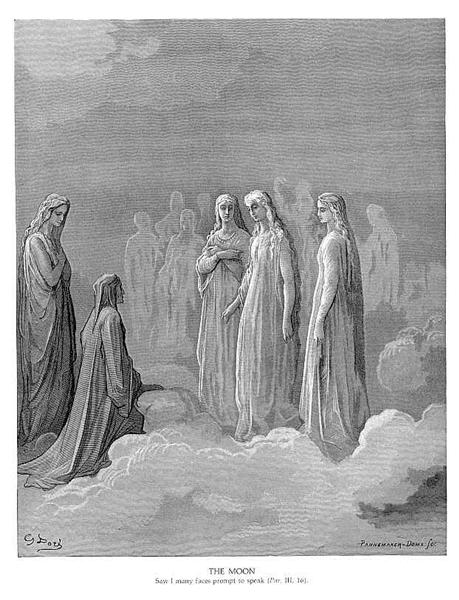
The workings of heaven are such that the spirits have very little definition.  When Dante first sees Piccarda and the other spirits in the moon, it seems to him that they are vague reflections.  He describes them as such.

As through clear, transparent glass
or through still and limpid water,
            not so deep that its bed is lost from view,

the outlines of our faces are returned
so faint a pearl on a pallid forehead
comes no less clearly to our eyes,

I saw many such faces eager to speak,
at which I fell into the error opposite to that
which inflamed a man to love a fountain.  (Par. III. 10-18)

The outlines of their faces are so faint that their heads I think look like pearls.  That is interesting.  What we’ll find is that each character’s features get less distinguishable the further into heaven Dante travels.  In a few spheres further in, the characters will be no more than just lights.  Dante later points out to Piccarda how her face shines forth.

Then I said to her: ‘From your transfigured faces
shines forth a divinity I do not know,
and it transforms the images I can recall.  (III. 58-60)

So those in heaven have achieved a “transfiguration” and the shine is of the measure of grace.  No wonder as Dante goes further into paradise the character’s faces, actually their entire bodies, have a more intense glow.

I guess the outline of Piccarda’s face is clear enough to see her smile when Dante asks her if she is content with the lowest level of paradise.  She smiles when she answers him.  The facial smile is certainly a leitmotif in these early cantos.  In addition to Piccarda here, Beatrice smiles twice in these cantos (lines I.95, III.25).  Recall how at the end of Purgatorio after Dante receives absolution he can now look into Beatrice’s face and sees her second beauty, her smile.  This was associated with love.  And there is much more smiling in heaven.  Hollander in his notes points out that Paradiso refers to twice as many smiles as in Purgatorio, and I don’t believe there were any in Inferno.

Piccarda’s answer to Dante about being content is a well-known passage, and warrants quoting the entire speech.

Brother, the power of love subdues our will
so that we long for only what we have
and thirst for nothing else.

‘If we desired to be more exalted,
our desires would be discordant
with His will, which assigns us to this place.

‘That, as you will see, would not befit these circles
if to be ruled by love is here required
and if you consider well the nature of that love.

‘No, it is the very essence of this lessed state
that we remain within the will of God,
so that our wills combine in unity.

‘Therefore our rank, from height to height,
throughout this kingdom pleases all the kingdom,
as it delights the King who wills us to His will.

‘And in His will is our peace.
It is to that sea all things move,
both what His will creates and that which nature makes.’ (III.70-87)


The power of love subdues our will so that our blessed state depends on God’s will, and “in His will is our peace.”  St. Thomas Aquinas defines love as wanting the best for the other person.  We see it here in action.  Wanting others to have the highest grace is more important than we achieving the highest.  There is no envy, even though Piccarda was denied a higher place because of her brother’s despicable action and not through of her fault.


Tuesday, February 26, 2019

Short Story: A Sin Confessed by Giovanni Guareschi

Don Camillo is the central character, a Catholic priest, in a series of short stories by Giovanni Guareschi, an Italian writer who published in the years after WWII.  The short stoies are set in a small, northern Italian town and deal with the life and complications of Don Camillio as he upholds the Roman Catholic positions as Italy steers toward communism.  His arch nemesis is the Communist Mayor, Giuseppe Bottazzi, nicknamed, Peppone.  Now based on that you would think that these stories are pretty cerebral, but perhaps just the opposite.  It’s not that they lack depth or intellectual vigor, but that they are mostly comic, though it should be said not all.  The depth is in the humor.

Don Camillo is a big, brash man, passionate about the church and perhaps at times falls into a sin or two to make his point.  He speaks to Christ, and in turn Christ speaks back the moral position, which is sometimes not what Don Camillo wants to do.  Peppone may not be as brash, but perhaps equally hot tempered, and he is devious.  So you get a hot tempered priest, a hot tempered communist, both hot tempered Italians, and you have the ingredients of a lot of fun. 

Guareschi was in some ways like Don Camillo, a big brash man, but he certainly appears to have more of a sense of humor than his character.  Satire seemed to fit Guareschi’s writing well, and what could he satirize more than Church he was familiar with and the communists he detested.  Middle class in upbringing, he was clearly on the side of the anticommunists and actually a monarchist in his younger days.  He wrote for newspapers but his success at story telling led him to fiction.  There are some six or seven collections of Don Camillo stories translated into English.  Each story is typically not very long.  I had a collection when I was growing up.  A friend at Goodreads reviewed a collection, and it brought back some memories.  So I went out and got The Complete Little World of Don Camillo, translated by Adam Elgar, which contains over thirty stories.  Each story appears to be less than ten pages each.  

I read “A Sin Confessed,” which may be the very first Don Camillo story.  Guareschi introduces us to the character in the first paragraph as if he had never written of him before.

Don Camillo was one of those straight-talkers who are incapable of knowing when to hold back. On one occasion during Mass, after some unseemly goings-on in the village involving young girls and landowners far too old for them, he threw caution to the wind. Having started an agreeable homily on matters in general, he happened to catch sight of one of the guilty parties sitting right there in the front row. Breaking off from what he’d been saying, he draped a cloth over the Crucifix above the high altar, and planting his fists on his hips he finished his sermon in his own unique style. So blunt was the language of this great brute of a man and so thunderous the delivery that the very roof of the little church had appeared to shake.

OK, now you can see what I mean by a brash priest.  In the next paragraph we get the kernel of the story:

Naturally, at election time, Don Camillo expressed his opinions about leftwing activists in a similarly explicit manner, with the consequence that, just about sunset, as he was coming back to the presbytery, a great hulk of a man wrapped in a cloak darted out from a hedge behind him and, making use of the fact that the priest was encumbered by his bicycle and a bundle of seventy eggs hanging from the handlebars, gave him a whack with a stick before vanishing as if the earth had swallowed him up.

Don Camillo said nothing about this to anyone, but once he was back in the presbytery and the eggs were in a safe place, he went into the church to ask Jesus for advice, as he always did in moments of doubt.

‘What should I do?’ asked Don Camillo.

‘Rub a bit of oil and water on your back and say nothing,’ answered Jesus from above the altar. ‘You must forgive those who offend you. That is the rule.’

Don Camillo and Jesus go back and forth, the priest wanting to take revenge, but Jesus presenting the voice of conscience.  Here’s the conclusion of their exchange, Don Camillo speaking:

‘It’s pointless arguing with you, you’re always right. Thy will be done. We’ll forgive. But remember, if my silence makes that lot think they can get away with anything, and then they smash my head in, it’ll be your responsibility. I could quote you passages from the Old Testament …’

‘Don Camillo, you come here telling me about the Old Testament! I take full responsibility for whatever happens. But, just between ourselves, it serves you right. That little misfortune will teach you to play politics in my house.’

So Don Camillo forgave. But one thing stuck in his craw like a fishbone: the burning desire to know who had given him that tap on the back.

Now can you imagine, after some time has passed, Peppone comes in for a confession after 28 years of being lapsed and confesses that he was the one who hit the priest with a stick.  Enraged, Don Camillo absolves him, gives him ten Our Fathers and ten Hail Marys for a penance and rushes off to the crucifix to speak to Christ.

‘Jesus,’ he said, ‘forgive me, but I am going to beat him into a pulp.’

‘Do not even dream of it,’ answered Jesus.  ‘I have forgiven him, and so must you.  Deep down he is a good man.’

‘Don’t trust the Reds, Jesus.  They lure you in just so they can take advantage of you.  Take a good look at him.  Can’t you see what a villainous mug he’s got?’

Well, I won’t spoil how Don Camillo gets his revenge, with Jesus’ consent no less, and Peppone even takes it good naturedly.  A happy ending for all.

These are a fun bunch of stories.

I came across this movie of Don Camillo, narrated by Orson Wells, of all people.  It seems like a patching together of various Don Camillo stories.  The opening part of the movie might be based on “A Sin Confessed.”  But I’ve only watched about ten minutes.


Saturday, February 23, 2019

Dante's Paradiso Cantos I - V, Summary

Canto I

After Dante (the author, not the character) gives glory to God, he points out that one who returns from up high can neither fully explain nor fully grasp his experience, but he will do what he can.  In emulation of the classics, he invokes Apollo, the god of the sun, to help him in this effort.  It is now noon and Dante (the character) turns to loom at Beatrice, who is staring at the sun.  The light reflecting off her eyes pours into Dante’s soul so strongly that he can only sustain it for a short time.  But as he continues to gaze on her, he feels changed within.  Through her, he can see the heavens spinning like wheels, bright as the sun and on fire.  He feels his body lifting and asks, how could this be?  Beatrice explains that it is natural to be lifted toward the heavens, and that it is unnatural—because sin is the unnatural state in man—to be held down to earth.

Canto II

In a naval metaphor, Dante (the author) warns the reader that not all are fit to follow him on this journey.  Because of their innate thirst for God, the two pilgrims (Dante the character and Beatrice his guide) rise with the speed of an arrow shot to the first heavenly sphere, the moon.  Dante asks Beatrice, what do the dark spots on the moon signify?  She turns the question on him and asks him what he thinks they are.  After Dante answers incorrectly, Beatrice goes on to explain first why he is wrong (it has nothing to do with rare or dense matter) and second proposes an experiment of mirrors to arrive at the truth.  If the mirrors are staggered, then a light shining into them appears different size but the original light is the same for each mirror.  The differences in light and dark coloration on the moon is due to the different distribution of graces God has used to create the universe, though it’s the same light that shines on all.  It is the matter which has varying capacity to absorb it.


Canto III

As Dante was about to confess his error on the moon spots, he sees the outline of faces as if in the bottom of a pool of water.  The faces are all eager to speak to him.  Beatrice explains to him these beings are assigned under the sphere of the moon—the moon associated with inconstancy—because they in life failed in maintaining their vows.  She urges him to speak to them, and he finds the one who speaks back to be his cousin-in-law, Piccarda, mentioned in Purgatorio (cantos XXIII & XXIV) when Dante met her brother and his friend, Donato Farese.  In life she had vowed to be a nun but was forced out of the convent by her other brother to marry for political reasons.  Dante asks her if she is content to be in the lowest sphere of heavenly blessedness.  She responds that she has no desire for more, that she would not be blessed in the first place if her will was discordant with God’s.  She replies with the famous line, “In His will is our peace.”  She speaks of the spirit beside her, Constanza, the Empress and wife of Henry VI, who was also pulled out of a convent to marry.  So both have failed in keeping their religious vows, though both forced.  Piccarda then fades into the mist, singing Ave Maria.

Canto IV

Still at the sphere of the moon, Dante (the character) is perturbed by two equally perplexing implications of his encounter with Piccarda.  Beatrice reads his mind and formulates for him the two questions at the root of Dante’s confusion.  She answers the second question first by explaining that these souls do not reside in these heavenly spheres but appear to him at the sphere as a sign to reflect the distinct heavenly graces that people receive.  These spirits at the moon reside in Empyrean with all the other spirits in heaven but here reflect the lower rank they received.  This, she continues, is in complete contradiction to what is generally understood on earth.  He then answers the first question, pertaining to the justice of people forced from their vows being of lower rank.  It is true, they were forced, but nonetheless their wills to maintain their vows was incomplete.  Their will could have found an escape or even death to uphold their vows.  Satisfied, Dante asks a third question, can a person make up in some other way for a vow left unfulfilled?  Beatrice looked at Dante with eyes so radiant that it almost overpowered him.


Canto V


Beatrice first addresses Dante's inability to directly look at her, telling him that she has flamed out more brightly because having moved closer toward God, she has more perfect vision.  Then she reformulates his question on whether a vow left unfulfilled can be made up.  Beatrice explains that one's free will given to God in a sacred pledge, one sacrifices further freedom.  The only allowable substitution for an unfulfilled vow must be of a significantly greater vow granted through God's representative, the Church.  She cautions about making foolish vows.  As fast as an arrow shot the two rise up out of the moon and reach the sphere of Mercury.  He sees a number of spirits there as if they are fish in a pond, and one approaches to speak to him.  He tells Dante that he and the spirits around him are on fire from the light from heaven, and then asks Dante whether he would like to receive some of this light.  Dante responds that he doesn't know who the spirit is and why he is under the influence of this sphere.  With apparent joy, the spirit glows even brighter.


Wednesday, February 20, 2019

Dante's Paradiso, Introduction

At the Catholic Thought Book Club, we’re returning to the Divine Comedy, and reading the last cantica, Paradiso.  You’ll be seeing a number of posts on it in the next couple of months.  Here’s the introduction I provided to this last section.

As an introduction to Paradiso, let me say up front that this is the least familiar to me of the three canticles.  While I had read Inferno and Purgatorio several times each (perhaps as many as four times) I have only read Paradiso one and a half times.  Many years ago I read it through, and then a couple of years ago I got to just about half way.  I was going to finish it, but then our book club selected it as our long term read, and so I started over with Inferno again and realized I would read Paradisio through when we got to it. 

When we had last left Dante (the character, not the author) at the end of Purgatorio, he and Beatrice were in earthly paradise and had set their sights for the stars.  Dante had undergone contrition, confession, and absolution and was ready for the holiness of heaven.  This last cantica is the final part of Dante the pilgrim’s journey through the world of the dead, now through the world of those in heaven.  So what can we expect here?  In Inferno, the goal of the journey was to reach through a winding funnel the heart of hell and to Satan.  In Purgatorio the goal was to climb along the edge of a spiraling mountain and reach Beatrice.  In Paradisio the goal is to rise through the heavenly spheres to reach Empyrean, the heart of heaven, and to God.

Just as Inferno and Purgatorio are each constructed to have ten major sections, so too Paradisio contains ten sections.  Ten is for Dante the number of perfection, and likewise the entire Divine Comedy is constructed to have one hundred (ten times ten) cantos.  Each of the canticas—a cantica or in English canticle, is a major division, Inferno, Purgatorio, and Paradiso—contains thirty-three cantos, which are subdivisions to the cantica.  That accounts for ninety-nine, and the hundredth is the introductory canto just before Dante the character enters Inferno.  Perhaps this is rudimentary for those who have read along, but perhaps there is someone starting with us in Paradisio.  If so, I urge you to read the introductions I provided to Inferno and Purgatorio.  It’s not difficult to start here if you allow yourself time to understand what has gone on.

The ten sections of Paradiso consist of seven heavenly bodies (moon, Mercury, Venus, sun, Mars, Jupiter, and Saturn), a section of consisting of an assemblage of stars, a section called the crystalline sphere from which God directly moves the universe, and finally Empyrean.  If Inferno was a downward slide allegorically suggesting the ease of sin, and Purgatorio was an upward climb allegorically suggesting the struggle of penance, then Paradiso is a rising allegorically suggesting the glory of salvation.  There is no effort in the rising.  Think of Dante and Beatrice, his guide for a good deal of Paradisio, as helium filled balloons being drawn toward God. 

In formulating the structure and nature of Paradiso, Dante was without doubt influenced by St. Paul when he talks of his mystical journey in Second Corinthians:

I must go on boasting. Although there is nothing to be gained, I will go on to visions and revelations from the Lord. I know a man in Christ who fourteen years ago was caught up to the third heaven. Whether it was in the body or out of the body I do not know—God knows. And I know that this man—whether in the body or apart from the body I do not know, but God knows—was caught up to paradise and heard inexpressible things, things that no one is permitted to tell. I will boast about a man like that, but I will not boast about myself, except about my weaknesses.  (2 Cor 12:1-5)

Without getting into the exegesis of this passage, we see there are multiple heavens and that his body or soul (he does not know which) is lifted up to paradise.  And it is unclear to Dante too whether his journey through the heavens is bodily or not. 

The pilgrims (Dante and Beatrice) do make stops at each of the spheres where they do meet other souls, but I should make it clear, since many make this assumption, that the souls do not reside in these spheres.  In a way this is a break as an analogs to Inferno, where those souls reside forever in those circles, and to Purgatorio where the penitents make their way through the ledges of the mountain. In Paradisio the souls all reside in Empyrean with God but travel to the spheres to show Dante the variation of graces bestowed by God to people.  Those souls have some characteristic of their sphere of influence but are not integrated to it.  If they were, they would be separated from God.  Indeed, there integration in Empyrean suggests a beautiful integration into the Body of Christ.

Critics of Paradiso say that it is the least polished of the three canticas.  I have not noticed that.  If I have my timeline correct, Dante (the author) started writing the Commedia in 1308 and completed first drafts of Inferno and Purgatorio by 1313, writing them nearly in parallel.  He spent the next four or five years revising the first two canticas and planning Paradiso.  He started Paradisio in 1317 and finished shortly before his death in 1321.  It’s conceivable he would have polished up Paradisio if he had lived longer just as he did the first two.  But having perfected the style and technique in the first two canticas, which spanned nearly a decade, he would need less time and effort in putting down the final third.  If it’s not as polished, it’s pretty darn good.

Some readers consider Paradiso the least interesting of the three.  Perhaps it’s because it deals with theological issues more directly.  There are less characters, and the pace is slower and more contemplative.  Perhaps it’s also because there is less narrative tension in Paradisio.  Inferno builds narrative tension through the personal dangers facing the pilgrims.  Purgatorio builds narrative tension through the struggle of cleansing sin.  Paradisio seemingly doesn’t have a narrative means to build tension.  Its sole tension is built on the anticipation of seeing God. 

If Paradisio lacks tension, however, the sheer beauty of its imagery and content makes it the most exquisite.  I think of the three canticas in this way.  Inferno is the most imaginative.  Purgatorio is the most human.  Paradiso is the most sublime.  It is here in Paradiso that all the themes are knitted together and reach closure.  What has been left incomplete is completed; development reaches denouement; intonations arrive to closed cadences.  It is good to recall the three overarching themes of the Divine Comedy: Man must be civilly responsible, man must seek the fulfillment of his Christian faith, and that the poet should create in an effort to capture God’s divine beauty. It is Paradiso we find the highest achievement of civil governance, we find most attainment of holiness, and we find the Empyrean, the mystical rose that represents perfection of God’s creation and on which the entire Divine Comedy is meant to represent.

With that, let’s get to Paradiso.


As to a reading plan, I don’t want to push myself at five or six cantos per week as I did while reading Inferno and Purgatorio.  I was more familiar with those and I still fell behind.  I looked at the division of the cantos and found some reasonable breaks.  So I propose the following reading plan of eight weeks. 

27 Jan – 2 Feb, Cantos 1 – 5
3 Feb – 9 Feb, Cantos 6 – 9
10 Feb – 16 Feb, Cantos 10 – 14
17 Feb – 23 Feb, Cantos 15 – 18
24 Feb – 2 Mar, Cantos 19 – 22
3 Mar – 9 Mar, Cantos 23 – 27
10 Mar – 16 Mar, Cantos 28 – 30
17 Mar – 23 Mar, Cantos 31 – 33

These are the discussion weeks, so the read prior is the time allotted to read them.  So you should start reading now.  Some weeks we have five cantos to read, some four, the last two weeks three cantos each.  This should give us a leisurely pace to digest the poetry.  I encourage you to read and post your comments.  If there is a particular passage that is giving you trouble, please ask and I will do my best to explain it.  As you can tell from my discussions of Inferno and Purgatorio, I love the Divine Comedy.  It’s the greatest work of literature ever written.

[We're already a week behind that schedule I put together.  This is a work I don't want to rush.]


Monday, February 18, 2019

Matthew Monday: Basketball Shooting Tournament

There hasn’t been much on the Matthew front to report lately but there was something back in November that I’ve been meaning to post.

As I mentioned back in October, Matthew decided to play soccer this year instead of basketball.  Well, as expected, the St. Rita soccer team is horrible.  Two years ago they didn’t win a game.  Last year Matthew played basketball, and the soccer team again didn’t win a game.  So far in the first halve of this year’s season—it gets divided by winter with a first half autumn and second half spring—they didn’t win a game.  In the meantime, Matthew had improved in basketball and wished he had joined the team.

But back in November, separate from the Catholic Youth Organization (CYO), there was a nationwide basketball shooting contest.  It was essentially foul shots, though the younger grades were a step closer than the foul line.  Each school would pick the best two or three for each grade, send them to a local competition (Staten Island, in this case), the winners would go to a regional competition, and those winners would go for the national.

It was one day in early November that Matthew came home from school and said he had won the basketball shooting contest at his school for his grade.  I really didn’t understand the national tournament yet so I was confused.  But I have to admit I didn’t believe he had won any kind of basketball shooting contest.  He could barely reach the basket two years before and he hadn’t practice since.  Well, he did win his school competition, even over the ones on the basketball team.  And so he made it as the school representative for fourth grade at the regional.

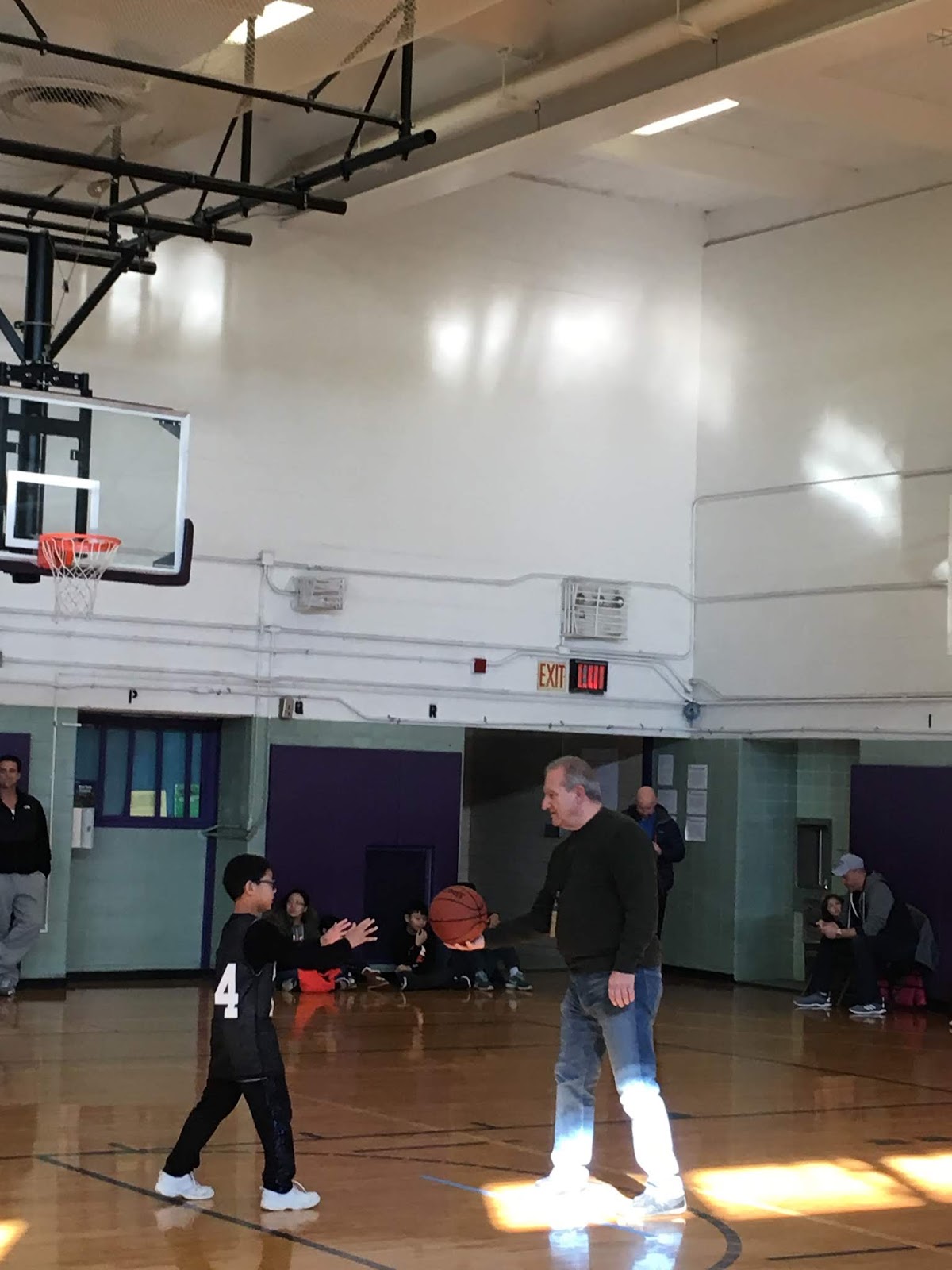
At the regional he was excellent.  He was something like 15 of 20 in the first round, and a little less than that in the second.  Unfortunately there’s not going to be much to show you because—mea culpa—I muffed the pictures and film.  I think I screwed up initially and then my phone battery died.  But here’s what I did take.  First a still picture of Matthew of Matthew getting the ball at the foul line.


And here’s a four second video of Matthew taking a shot.  The camera stops before the ball reaches the basket but I do think it went in.


Finally Matthew wound up in third place for the fourth graders.  Now that is third place for all of Staten Island, and we at Staten Island have a population for nearly 500,000.  That’s the size of a small city.  Here’s a picture of Matthew with his third place medal.


As you can bet, he wants to play basketball next year.

EDIT:  I forgot to mention.  Third place does not move on in the competition.  Only the first place winners.  

Sunday, February 10, 2019

In Memoriam: Frank Robinson

Frank Robinson was one of my dearest baseball players and the backbone of the great Orioles teams from 1966 to 1971.  Six years he played in Baltimore.  He led them to the World Series four of those six years, winning twice.  I became an Orioles fan in 1970 at about nine years old.  Here I am nearly fifty years later and still an Orioles fan.  I don’t remember the 1970 season.  My earliest baseball memory was the sixth game of the 1971 World Series, the Orioles against the Pirates.  The Pirates had a three games to two lead in the series and if they won the sixth they would be world champions.  The game went into extra innings, bottom of the tenth.  Frank Robinson got on base and somehow got to third.  The next hitter—I learned later it was Brooks Robinson—hit a bloop fly ball to shallow center.  Frank Robinson tags and beats the throw home, sliding over the plate to win the game.  That Frank Robinson slide into home to win the game is my earliest baseball memory.

Here, I found it.  This is my earliest baseball memory.


Frank Robinson passed away on February 7th this past Thursday.  He was 83.  He was a gentleman but he played with an intensity that was downright ferocious.  Here’s how the Baltimore Sun started his obituary:  

Orioles outfielder Frank Robinson had those skinny legs and a gingerly gait that made it seem as if his feet always hurt. But the ferocity with which he played baseball belied his appearance. He crowded the plate with abandon and hurtled into fielders to break up double plays. Once, at Yankee Stadium, he decked a fan who tried to rob him of a fly ball.

"I always had the willingness to push myself. I tried to be better than what I was," said Mr. Robinson, a 13-time All-Star and first-ballot Hall of Famer in 1982. "Sure, it’s just a game. But it’s my life."

He would be a hall of famer, hitting just short of 3000 hits and hitting 586 career home runs.  He would also be baseball’s first black manager and a first ballot hall of famer.  His number 20 is retired by three teams—the Cincinnati Reds, the team who drafted and played for ten years, the Baltimore Orioles, the team who he led to four World Series appearances, and the Cleveland Indians, the team with who he finished his career and who hired him as the first black manager. 

He was traded to Baltimore after the 1965 season when the Reds thought he was washed up at 30 years old.  From the Sun’s Obit:

Cast off by Cincinnati owner Bill DeWitt, who called him "an old 30," Mr. Robinson seethed.

"I was hurt and angry," he said at the time. "I feel I have something to prove and the quicker I can, the better off I’ll be."

And boy did he ever.  1966, his first with the Orioles, would be his greatest year.  Again from the Sun:

On Opening Day, 1966, in his third at-bat as an Oriole, Mr. Robinson homered in a 5-4 victory. One month later, he hit a pitch completely out of Memorial Stadium — the only player ever to do so.

"The [one-minute] ovation the fans gave me after I trotted back on the field following the homer was the thing I remember most about my years in Baltimore," Mr. Robinson said later. "I knew then that I had been accepted."

He hit a club-record 49 home runs, drove in 122 runs and batted .316. He led the Orioles to their first American League pennant and a four-game sweep of the Los Angeles Dodgers in the World Series. He won the Triple Crown, leading the league in batting average, home runs and RBIs, and both the AL and World Series Most Valuable Player awards. Moreover, he brought a brassy edge to the Orioles that remained long after his departure in 1971.

And then he was traded after the 1971 season.  I was heartbroken.  How could they trade Frank?  But at the point he was 36 and on the decline.  He would finish a few more years with several teams and become the Cleveland Indians player manager.  He finally retired as a player after the 1976 season. 

But I was too young to fully appreciate Frank Robinson as a player.  I got to really appreciate Frank when he became the Orioles manager during the 1988.  That year the team would lose its first 21 games and fire its manager Cal Ripkin, Sr. and put in Frank.  They had one of the all-time worst season records that year.  But the next year, 1989, not only did the team have a winning record but they actually competed for a division title, though they fell short in the end.  They went from a record of 54-107 and in last place 34 1/2 games out of first in ’88 to 87-75 in second place just two games out of first in ’89.  I remember that season so well.  We were actually in first for part of the season.  Just like 1966 was Frank Robinson’s great ball player year, 1989 was Frank’s great managerial year.  He was voted manager of the year.

Here is a wonderful tribute put together using Frank Robinson’s own voice.  I think it shows what a gentleman he was and what a tenacious ballplayer.


That is a wonderful tribute.  Eternal rest grant to him, O Lord; and let light perpetual shine upon him. May his soul rest in peace. He brought us joy.