"Love follows knowledge."
"Beauty above all beauty!"
– St. Catherine of Siena

Wednesday, February 17, 2016

Short Story Analysis: “A Cup of Cold Water” by Edith Wharton

“A Cup of Cold Water” is a lovely short story by Edith Wharton centered on a man named Woburn.  The story divides into two halves, which frankly I’m not convinced is aesthetically whole.  By that I mean that there is a first half which is a story in itself and a second half that seems like a separate story, though the central character of Woburn is in both halves.  You can read the entire story at the Literature Network, here, from which I will use as a source for the quotes.    

The story is set in New York City in the late 19th century.  Woburn is a poor young man who has this infatuation with a rich young lady, Miss Talcott.  Here is a one sentence paragraph of why Woburn is charmed with Miss Talcott.

Her supreme charm was the simplicity that comes of taking it for granted that people are born with carriages and country-places: it never occurred to her that such congenital attributes could be matter for self-consciousness, and she had none of the nouveau riche prudery which classes poverty with the nude in art and is not sure how to behave in the presence of either.

In other words, she didn’t realize other people weren’t born with her financial advantages, which meant she did not look down on the lower classes, or it didn’t dawn on her to look down on them.  She’s natural and not snobby.

So Woburn—which I think is so named because it nearly sounds like “woe born”—realizes he has to be rich to marry Miss Talcott, and so starts investing in stocks with borrowed money, and then starts using money from the bank at which he worked.  Here are two wonderful paragraphs on his subsequent crash.

He had invested the few thousand dollars which had been his portion of his father's shrunken estate: when his debts began to pile up, he took a flyer in stocks and after a few months of varying luck his little patrimony disappeared. Meanwhile his courtship was proceeding at an inverse ratio to his financial ventures. Miss Talcott was growing tender and he began to feel that the game was in his hands. The nearness of the goal exasperated him. She was not the girl to wait and he knew that it must be now or never. A friend lent him five thousand dollars on his personal note and he bought railway stocks on margin.  They went up and he held them for a higher rise: they fluctuated, dragged, dropped below the level at which he had bought, and slowly continued their uninterrupted descent. His broker called for more margin; he could not respond and was sold out.

What followed came about quite naturally. For several years he had been cashier in a well-known banking-house. When the note he had given his friend became due it was obviously necessary to pay it and he used the firm's money for the purpose. To repay the money thus taken, he increased his debt to his employers and bought more stocks; and on these operations he made a profit of ten thousand dollars. Miss Talcott rode in the Park, and he bought a smart hack for seven hundred, paid off his tradesmen, and went on speculating with the remainder of his profits. He made a little more, but failed to take advantage of the market and lost all that he had staked, including the amount taken from the firm. He increased his over-draft by another ten thousand and lost that; he over-drew a farther sum and lost again. Suddenly he woke to the fact that he owed his employers fifty thousand dollars and that the partners were to make their semi-annual inspection in two days. He realized then that within forty-eight hours what he had called borrowing would become theft.

And so he realizes he has lost everything including Miss Talcott and needs to leave town before he will be arrested.  On the night before he will skip town there is a ball where Miss Talcott was to attend and had invited him.  He decides to go and have one last moment with her before he will never see her again.  Here is that last moment.

Presently Woburn was aware that she had forgotten young Boylston and was glancing absently about the room.  She was looking for someone, and meant the someone to know it: he knew that Lost-Chord look in her eyes.

A new figure was being formed. The partners circled about the room and Miss Talcott's flying tulle drifted close to him as she passed. Then the favors were distributed; white skirts wavered across the floor like thistle-down on summer air; men rose from their seats and fresh couples filled the shining parquet.

Miss Talcott, after taking from the basket a Legion of Honor in red enamel, surveyed the room for a moment; then she made her way through the dancers and held out the favor to Woburn. He fastened it in his coat, and emerging from the crowd of men about the doorway, slipped his arm about her. Their eyes met; hers were serious and a little sad. How fine and slender she was! He noticed the little tendrils of hair about the pink convolution of her ear. Her waist was firm and yet elastic; she breathed calmly and regularly, as though dancing were her natural motion. She did not look at him again and neither of them spoke.

When the music ceased they paused near her chair. Her partner was waiting for her and Woburn left her with a bow.  He made his way down-stairs and out of the house. He was glad that he had not spoken to Miss Talcott. There had been a healing power in their silence. All bitterness had gone from him and he thought of her now quite simply, as the girl he loved.

What a lovely but melancholy moment.  And that was the ending of the first half of the story.  The second half begins with Woburn spending the night at a hotel since he still had a number of hours before the steamer on which he will escape the city departs.  In the adjoining room he hears a woman crying.

There was no mistaking the nature of the noise; it was that of a woman's sobs. The sobs were not loud, but the sound reached him distinctly through the frail door between the two rooms; it expressed an utter abandonment to grief; not the cloud-burst of some passing emotion, but the slow down-pour of a whole heaven of sorrow.

Woburn sat listening. There was nothing else to be done; and at least his listening was a mute tribute to the trouble he was powerless to relieve.  It roused, too, the drugged pulses of his own grief: he was touched by the chance propinquity of two alien sorrows in a great city throbbing with multifarious passions. It would have been more in keeping with the irony of life had he found himself next to a mother singing her child to sleep: there seemed a mute commiseration in the hand that had led him to such neighborhood.

In that second paragraph is the theme of the story: “the drugged pulses” of grief and “alien sorrows in a great city throbbing with multifarious passions.”  What a great sentence.  This is a story of a big city, of people saddened by unrequited passions.  Through the keyhole Woburn spies that the woman has a gun and intends to kill herself.  He breaks through the door and comforts the woman, who feels she has no other recourse but suicide.  Woburn tells her he will figure out a solution to whatever problem she has that has brought her to this point.

Ruby Glenn, the sobbing woman, tells him the story of how she was bored living in a small town named Hinksville, “a poky little place,” which sounds a lot like Hicksville, an emblematic name of a town in the middle of nowhere.  There she lived a mundane life with an unexciting husband, Joe, who is away a lot for his work and his mother, an austere woman whose only guest was a Baptist minister.  When her husband was away for an extended time, a colorful journalist “bewitches” her and they run off together.  After five months traveling about he abandons her, and wants to get back to her husband but has no money.  She’s confident he will take her back but believes his mother has stymied her letters.  Ruby, in contrast to Miss Talcott, is quite class conscious, and understands the limitations of want, and, through her bad decision to run off, desired to live a fantasy life outside of her means.

What we have is a story within a story where Woburn resolves Ruby’s problems by using his remaining pocket money to pay for her back bills and her train fare back to Hinksville.  You can now see how aesthetically the overall story is bifurcated.  By this point the reader has lost sight of Miss Talcott and the events that led him to the hotel.

So what holds the story together?  Certainly the sorrows of those in a big city throbbing with passions.  What I think holds the story together is the suffering that Woburn experiences in the first half leads him to help the poor woman out in the second half.  In paying the woman’s bills, Woburn has sacrificed his means of escaping debtors.  At the end of the story he has to go back to the bank where he worked to face his misconduct.

But before he puts the Ruby on the train, there is a final scene where Ruby thanks him.

Ruby Glenn had obediently prepared herself for departure and was standing before the mirror, patting her curls into place. Her eyes were still red, but she had the happy look of a child that has outslept its grief. On the floor he noticed the tattered fragments of the letter which, a few hours earlier, he had seen her place before the mirror.

"Shall we go down now?" he asked.

"Very well," she assented; then, with a quick movement, she stepped close to him, and putting her hands on his shoulders lifted her face to his.

"I believe you're the best man I ever knew," she said, "the very best-- except Joe."

She drew back blushing deeply, and unlocked the door which led into the passage-way. Woburn picked up her bag, which she had forgotten, and followed her out of the room. They passed a frowzy chambermaid, who stared at them with a yawn. Before the doors the row of boots still waited; there was a faint new aroma of coffee mingling with the smell of vanished dinners, and a fresh blast of heat had begun to tingle through the radiators.

“I believe you’re the best man I ever knew.”  This was Woburn’s heroic moment.  Her sincere statement of his character is his reward.  He may never have Miss Talcott as a wife, he may be poor for the rest of his life, he may even face prosecution and jail for embezzlement, but he saved a poor woman from killing herself and got her back to her husband to save her marriage.

Finally there is the odd title of the story.  There is no cup of water in the entire story.  As it turns out, the title comes from Matthew 10:42.  It’s one of those sayings of Jesus: “And whoever gives only a cup of cold water to one of these little ones to drink because he is a disciple—amen, I say to you, he will surely not lose his reward.”  His sacrifice has been his reward, which has made him a hero.  Though awkwardly structured, it is a wonderful story.


Sunday, February 14, 2016

Notable Quote: Have the Courage to Suffer by Antonin Scalia

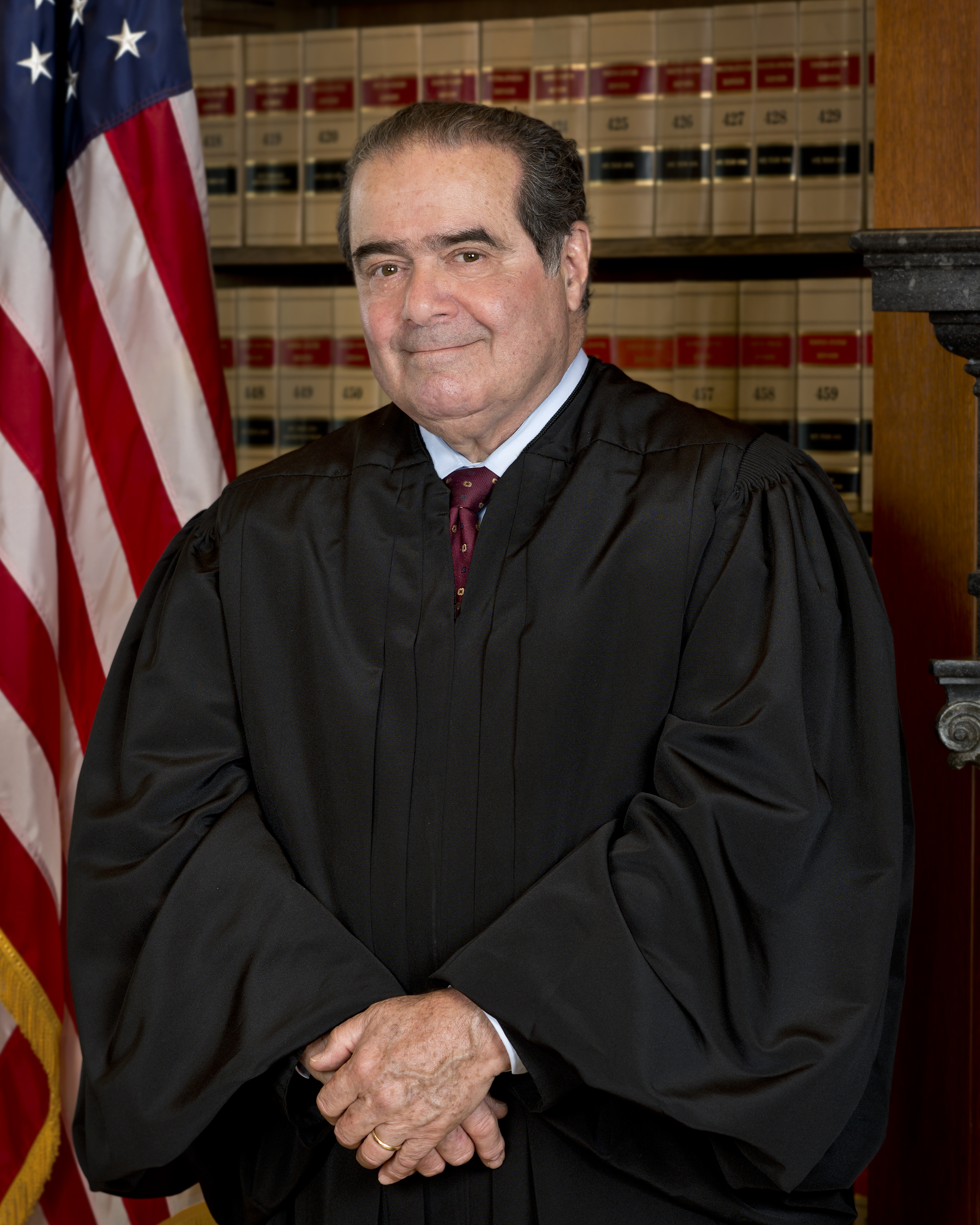
I guess by now most of the American readers of my blog have heard that Supreme Court Justice Antonin Scalia passed away Saturday.  

I have to say I am a bit heartbroken over it.  Antonin Scalia was a personal hero of mine.  As an Italian-American and a conservative and a Catholic I was so proud of him.  It is my perception that until Scalia hit the national scene, Italian-Americans and Catholics were predominantly center-left on the political scale, which is to say moderate Democrats as far as political party affiliation goes.  And I would assess that over 90% of my family would consider themselves Democrats, even today. 

Now it is without question that it was the Democratic Party which left traditional values behind, which made a new generation look toward the political right for a fit.  As I matured and found my philosophic match, there was no question that I was a conservative.  I think it’s in my genetic makeup.  Antonin Scalia, with his pugnacious personality, his wit and charm, his intellectual brilliance, his devout Catholicism, his loud and larger than life energy—the very essence of Italian male extroversion—his dedication to family and tradition made him an icon for many, but specifically for those of us of Italian ethnicity.  Some of us have crazy uncles and some of us have brilliant uncles: Antonin Scalia was our brilliant uncle, and we could point to him to justify our political leanings.

There are many great Scalia quotes.  I love the one where he’s being interviewed by a writer for New York magazine, which is a publication somewhere left of Pravda, where the interviewer is shocked that Scalia actually believes in heaven and hell.  Scalia leans in to him and adds, “I even believe in the Devil.”  

But the quote of his I most embrace is this one on the courage to be a Christian:

“God assumed from the beginning that the wise of the world would view Christians as fools ... and he has not been disappointed…If I have brought any message today, it is this: Have the courage to have your wisdom regarded as stupidity…Be fools for Christ. And have the courage to suffer the contempt of the sophisticated world.”
            - Speech at Living the Catholic Faith conference, 2012


Antonin Scalia was an intellectual giant compared these petty, conventional “sophisticates.”  There are only a handful of people that I would love to hang out with in heaven, if I should be graced with getting there.  Antonin Scalia is one of them.  May eternal light shine upon him as he rests in peace.


Friday, February 12, 2016

Faith Filled Friday: Papal Mass Rosary

Back when I posted on the Papal Mass I was blessed to be able to attend at Madison Square Garden when Pope Francis came to New York last September, I mentioned I had bought as a memento the official rosary to go with the visit and I had promised to post pictures.  I think the pictures make for a good Lenten Faith Filled Friday post.

Here they are inside the little box they come in.


If you look carefully on the box you can see it says “Limited Edition Commemorative Rosary” and in the back of the box it says they were “Handmade in Italy.”  Here’s the entire rosary.


They are black beads which I assume are glass, but what I really like is that the connectors are really strong.  Here’s a close up of the crucifix and centerpiece.


Both the crucifix and the Blessed Mother in the centerpiece have a simplicity that reflects the Holy Father’s personality.  Here are the backsides.


The centerpiece has a dove with a sort of heart and cross above it, which was the logo for the visit.  The back of the crucifix is inscribed:

“FRANCIS OUR POPE
A JOURNEY OF FAITH
THROUGH THE HEART OF NEW YORK 2015”

A very nice memento indeed.

Wednesday, February 10, 2016

Poetry: Ash Wednesday by Anya Krugovoy Silver

I’ve never heard of Anya Silver, but I did come across this poem in Sarah Arthur’s Between Midnight and Dawn: A Literary Guide to Prayer for Lent, Holy Week, and Eastertide, which is a  Lenten collection of literature.  

As I searched around for information on Ms. Silver, I found she’s a professor of English at Mercer University in Georgia, a published poet of two anthologies, and she won Georgia’s author of the year award for the poetry category in 2015. She’s apparently a rising contemporary poet, and I hope she doesn't mind me posting her poem.

The poem is to commemorate today’s initiation of Lent, Ash Wednesday.  

Ash Wednesday
By Anya Krugovoy Silver

How comforting, the smudge on each forehead:
I’m not to be singled out after all.
From dust you came. To dust you will return.
My mastectomy, a memento mori,
prosthesis smooth as a polished skull.
I like the solidity of this prayer,
the ointment thumbed into my forehead,
my knees pressing hard on the velvet rail.
If God won’t give me His body to clutch,
I’ll grind this soot in my skin instead.
If it can’t hold the flame that burned by breast,
I’ll char my brow; I’ll blacken my pores; I’ll flaunt
with ash this flaw in His creation.

From that little bio on her article, we do learn she is a cancer survivor.  The poem has a ring of personal experience.  A momento mori is a symbol of one’s mortality, such as a skull, which Silver nicely sneaks into the fifth line.  A momento mori is also a reflection on one’s mortality, such as the famous “Alas poor Yorick!” passage in Shakespeare’s Hamlet.  And so this whole poem is a momento mori, as is the ash cross that is placed on one’s forehead today. 
 

I really love the last five lines of the poem with those conditional “if” statements:

If God won’t give me His body to clutch,
I’ll grind this soot in my skin instead.
If it can’t hold the flame that burned by breast,
I’ll char my brow; I’ll blacken my pores; I’ll flaunt

with ash this flaw in His creation. 

How wonderful.  I hope you do get your ashes today.


Monday, February 8, 2016

Literature in the News: A Bishop Who Learned Through the Great Books

When I came across this article on Aleteia on Bishop James D. Conley of Lincoln, Nebraska’s being inspired as a young man when he came across the classics in college, I could immediately identify.  From the article:

I grew up in the Presbyterian Church and went to public schools my whole life. I didn’t have a very good education at all. It was during the early 1970s, and there was a lot of experimentation in education, a lot of educational models that were being tried …

But providence stepped in, and I went off to the University of Kansas, and I learned about a program that was being offered there called the Integrated Humanities program. … There was no religious motivation at all for me to get involved in the program; it just sounded interesting.

That’s exactly what happened to me.  My high school education wasn’t spectacular, or inspiring when it came to the humanities.  I was a good science and math student, and went on to college for a physics degree, which I ultimately switched over to engineering.  But my first college (Brooklyn College of the City University of NY) also had started an integrated humanities program, and since I needed a certain amount of elective humanities credits, and since I was intrigued with the program, I entered it, while also doing my math and science.  The integrated humanities program simultaneously presented courses that were interlinked by era, so that you would take literature, history, arts, and philosophy of a particular time all together.  It was here as a Freshman that my love of literature and the arts was formed.

It seems to have made a great impact on Bishop Conley as well:

The program was started by two English professors and one classics professor. They were seasoned, tenured professors, and they were very good teachers. They had discovered that students really had not been exposed to the great things of Western culture — literature, poetry, music — things that were part of the staple of education a generation or two before. They were frustrated as university professors that you couldn’t presume that students had [studied] the fundamentals.

So they chose as the model “Let Them Be Born in Wonder,” the Latin phrase, nascantur in admiratione — the idea being that these students had never been exposed to wonder, so as teachers, let’s introduce them to these beautiful things that had always perennially been taught through the ages. It was a freshmen/sophomore program.

We read the great Greek classics, beginning with The Odyssey, all the way through to the Romans, in the second semester. We read The Aeneid, among others. And in the third semester we read early Christian authors, passages from the Bible, The Confessions of St. Augustine, The Consolation of Philosophy by Boethius. The last semester we began with The Canterbury Tales and continued with the early Moderns and ended with the modern day.

What happened was, students, as in my own case, fell in love with this beautiful literature, the characters, everything else surrounding it, because not only was this a literary program, we had a lot of extracurricular things: we’d go stargazing, learn about the constellations and how they worked into the literature we were reading, especially the pagan authors. And we would have, every year, a spring waltz, where the students would come together and organize a beautiful experience of waltzing. We’d hire the university orchestra, reserve the university ballroom and have waltz lessons, since nobody knew how to waltz. It taught us manners. It taught us how to treat women as ladies, and men became gentlemen in the process. It was a poetic exposure to beautiful music, beautiful dancing.

This is what I’m trying to do with my blog.  I’m trying to share my understanding of the Great Books to whoever may be interested.

Bishop Conley has started what he calls the Newman Institute at the University of Nebraska:

It’s an institute for Catholic thought and culture. It’s something that has come from my own experience at a big public land grant university. The University of Nebraska is similar. … There are others that are doing this, and quite successfully. Catholic studies institutes are springing up at different universities across the country. And all of them have the same goal — that is to expose students to the great ideas, great books, great treasures of our Western culture and Catholic tradition, on a secular campus …


That sounds great.  If you’re going to college for a Humanities degree, make sure you go to an institution that is focused on the great books of western culture.  It will shape the rest of your life.

Thursday, February 4, 2016

Literature in the News: “They,” The Word of the Year

Who comes up with these awards?  There really is a word of the year, awarded by the American Dialect Society (ADS).  
And the winner for 2016 is…

they: gender-neutral singular pronoun for a known person, particularly as a nonbinary identifier.

The award ceremony (actually a vote was held) was held at the Marriott Marquis, Washington D.C. on January 8th. 

In its 26th annual words of the year vote, the American Dialect Society voted for they used as a gender-neutral singular pronoun as the Word of the Year for 2015. They was recognized by the society for its emerging use as a pronoun to refer to a known person, often as a conscious choice by a person rejecting the traditional gender binary of he and she.

Presiding at the Jan. 8 voting session were ADS Executive Secretary Allan Metcalf of MacMurray College and Ben Zimmer, chair of the New Words Committee of the American Dialect Society. Zimmer is also executive editor of Vocabulary.com and language columnist for the Wall Street Journal.

The use of singular they builds on centuries of usage, appearing in the work of writers such as Chaucer, Shakespeare, and Jane Austen. In 2015, singular they was embraced by the Washington Post style guide. Bill Walsh, copy editor for the Post, described it as “the only sensible solution to English’s lack of a gender-neutral third-person singular personal pronoun.”

There you go.  The impetus for the selection is tied to this mad, insane rush to destroy gender from our language and our lives.  So if you’re confused, let me give you an example.  Normally “they” is a plural noun for multiple subjects. 

Five horses crossed the road.  They neighed.

But to use it as a singular pronoun for a known person is distort common usage.  This is how we would normally use a singular pronoun:

John wants a sex change.  He has discussed it with his doctor and wife.


Here’s how the new usage would work:

John wants a sex change.  They has discussed it with his doctor and wife.

Makes sense?  Of course not.

John Hovatt II had a very passionate disapproval in the American Thinker with his article, “'They' is Destroying the English Language.”  

This new usage is politically-correct jargon that is being forced on the public. Singular they now refers to those sexually-confused individuals who do not wish to be called he or she. It has been determined that “they” can now refer to a “known person as a non-binary identifier.” Predictably newspapers like the Washington Post have already included this usage in their style books. In so doing, they (plural) have declared grammatical war upon the language.

It is war, but a dirty war. One cannot help but be struck by the utter mediocrity and cowardice of the august assembly of linguistic warriors. Had these linguists had a bit of courage they might have adopted any of the numerous “gender-neutral” ridiculous-sounding pronouns such as “jee,” “ney” and “thon” that have already been created by activists to promote their cause. They (plural) could even have gone farther by making up their own new pronouns and challenging the world to use a novel new creation to accommodate the sexually unsure.

Instead these jargonists prefer to take a perfectly good pronoun and strip it down to singularity. In so doing, they have mutilated, emasculated, and disfigured this faithful pronoun and emptied it of meaning. These pedantic paladins of political correctness hide behind the excuse that “they” already has some singular common usages as when used with words like “everyone.” This can be seen in a sentence: “Everyone likes their dogs.” However, this is purely a smokescreen in this dirty war to hide an agenda that uses languages as one of its most effective weapons.

Of course this only applies to a singular person who claims to not want to be identified by his gender.  From the ADS post:

While editors have increasingly moved to accepting singular they when used in a generic fashion, voters in the Word of the Year proceedings singled out its newer usage as an identifier for someone who may identify as “non-binary” in gender terms.

“In the past year, new expressions of gender identity have generated a deal of discussion, and singular they has become a particularly significant element of that conversation,” Zimmer said. “While many novel gender-neutral pronouns have been proposed, they has the advantage of already being part of the language.”
Which infuriates John Hovatt II further:

This development is truly tragic because such artificial impositions go against the very purpose of language. Language should give clarity to thought. Its beauty consists in its ability to define concisely and clearly. The richness of vocabulary comes from how well words express nuance and subtlety.

But singular they? All is muddled and confused. If you have one they and add another they do they become two theys or are theys simply they? No one really knows, nor do the linguists really care. They (plural) want to make a political statement and force upon the users the task of determining the context of the usage. It assumes the public is savy to the esoteric world of politically-correct jargon.

There is another reason why this usage of singular they is wrong. The principal purpose of language is to express the truth. Words are essential vehicles for uniting ideas to things -- a simple definition of truth. A man, for example, has an idea of what a cat is. When he sees the cat, he exclaims: Cat! The word communicates a truth to all those around him. It instantly unites the idea and the thing.


Now how is a person supposed to know when writing about most people that this particular person wants to be identified as a “non-binary, gender-neutral” person?  You can’t, so the default will ultimately be that all people will be referred to in a gender-neutral way.  Just when you thought modernity can’t get more insane, it does.

Tuesday, February 2, 2016

Music Tuesday: Take It Easy by the Eagles


Another old time rock-and-roller passed away last week, Glenn Fry, lead singer of the Eagles.  

From TMZ: 

Glenn Frey, co-founder and guitarist for the Eagles, has died ... TMZ has learned.

We're told the cause of death was a combination of complications from rheumatoid arthritis, acute ulcerative colitis, and pneumonia.

Frey had been battling intestinal issues for months and had surgery in November. We're told in the last few days his condition took a turn for the worse. He died in New York City.

Glenn co-wrote and sang on most of the Eagles hits, including “Take It Easy,” “Tequila Sunrise,” “Lyin’ Eyes,” and “Heartache Tonight,” to name a few. He also co-wrote “Hotel California” and “Desperado” with Don Henley and took home 6 Grammys with the band.

 Here’s some other great reading on Frey.  Here Linda Ronstadt tells how Glen Frey and Don Henley formed the Eagles while working on her band in the early 1970s. 

And here’s Don Henley’s full statement upon hearing of Glenn’s death: 

"He was like a brother to me; we were family, and like most families, there was some dysfunction. But, the bond we forged 45 years ago was never broken, even during the 14 years that the Eagles were dissolved. We were two young men who made the pilgrimage to Los Angeles with the same dream: to make our mark in the music industry -- and with perseverance, a deep love of music, our alliance with other great musicians and our manager, Irving Azoff, we built something that has lasted longer than anyone could have dreamed. But, Glenn was the one who started it all. He was the spark plug, the man with the plan. He had an encyclopedic knowledge of popular music and a work ethic that wouldn't quit. He was funny, bullheaded, mercurial, generous, deeply talented and driven. He loved is wife and kids more than anything. We are all in a state of shock, disbelief and profound sorrow. We brought our two-year 'History of the Eagles Tour' to a triumphant close at the end of July and now he is gone. I'm not sure I believe in fate, but I know that crossing paths with Glenn Lewis Frey in 1970 changed my life forever, and it eventually had an impact on the lives of millions of other people all over the planet. It will be very strange going forward in a world without him in it. But, I will be grateful, every day, that he was in my life. Rest in peace, my brother. You did what you set out to do, and then some."

The song I will remember Glenn Frey will be “Take it Easy.”  Here Glenn singing live.


May he rest in peace.